Rainwater Collection Calculator: Gallons and Tank Size
A rainwater collection calculator is commonly used by multiplying roof area by rainfall in inches by 0.623, then applying a runoff factor of about 0.8 to 0.95; with a 1,000-square-foot roof, that comes to roughly 500 to 590 gallons from 1 inch of rain. If you ignore losses and storage limits, you may buy a tank that is too small, too expensive, or useless for dry spells. This guide shows how to estimate usable water, choose barrel, tote, or cistern size, and account for overflow.
How is this calculated?
Press Calculate to see the math with your numbers.
What the calculator tells you


The calculator is a sizing tool. It turns roof catchment area, rainfall depth, and efficiency into an annual or storm-based gallon estimate, then helps you turn that number into storage and watering capacity. The key figure is how much water you can keep and use.
Roof catchment area means the horizontal footprint of the roof, not the sloped surface area. Rainfall depth is measured in inches or millimeters, and you can use annual totals, monthly totals, or a single storm if you want to size for a specific event. Local climate normals matter because the same roof can collect very different totals in dry and wet regions.
Gallons harvested versus gallons you can use
Harvested gallons and usable gallons are not the same. The calculator can estimate the volume that reaches the system, but first-flush diversion, splash, evaporation, overflow, and storage limits can cut what ends up available for container watering or seasonal irrigation.
For non-potable garden use, usable water is usually the amount that survives those losses and fits the tank you installed. For whole-house or potable use, the calculation alone is not enough; treatment, filtration, and local rules matter.
How the gallon formula works
The annual yield formula is gallons = roof area × rainfall × 0.623 × efficiency. The calculator estimates rainwater harvesting potential within a calendar year, and that 0.623 factor converts square feet and inches of rain into gallons. It is the link between roof size and storage volume.
Why roof footprint matters more than slope
Use the horizontal roof footprint. A steep roof may have more surface area, but rainfall is captured from the area projected onto the ground, which is the number that drives runoff volume. If you use the sloped surface instead, you will overstate the harvest.
That distinction matters most on tall roofs and complex rooflines. A simple rectangle is easy to estimate. Multiple roof planes should be added by footprint, not by angled surface measurement.
What 0.623 means in the formula
0.623 is the conversion factor used in the rainfall equation. It reflects how many gallons fall on one square foot from one inch of rain. That makes the formula easy to scale from a small garden shed roof to a large house roof.
A common rule of thumb is to remember the pattern, not the unit math: larger roof, deeper rain, more gallons. The calculator does the conversion, but the logic stays the same.
Runoff coefficient versus collection efficiency
Runoff coefficient values on the calculator range from 0.10 to 1.00. That number describes how much rainfall becomes runoff from a catchment surface. Collection efficiency is the practical capture rate after real-world losses, and some sources treat the two terms almost interchangeably.
In practice, they are not identical. A well-installed system can still lose water to first flush diversion, splash, overflow, and evaporation. Tallyard notes well-installed systems achieve 80-90% efficiency, which is a useful planning range for many home systems.
Which tank size fits your target?
Tank size should match both the volume you can harvest and the amount you want to spend or maintain. A 55-gallon barrel works for small, repeat watering. A 275-gallon tote is better for heavier vegetable-bed demand. Dedicated cisterns above 1,000 gallons suit seasonal storage and larger roofs.
55-gallon barrels for small garden use
The same source says a 55-gallon rain barrel is standard DIY storage. That size fits small yards, patio beds, and short dry spells. It is also easy to place under a downspout, but it fills quickly, so overflow handling becomes important.
275-gallon totes for larger watering loads
The same source says 275-gallon IBC totes are the next step up. They make more sense when you want to run a hose to multiple beds or capture a larger share of a storm. They still need a stable base, a screened inlet, and a plan for overflow.
1,000-gallon-plus cisterns for seasonal storage
The same source recommends dedicated cisterns above 1,000 gallons. That scale is better when the roof is large enough to refill it often or when you want to carry water between wet months and dry months. Bigger storage is useful only if your roof and rainfall can keep it supplied.
Rainwater sizing table
The table below turns roof area and annual rainfall into estimated annual gallons at 80%, 85%, and 90% efficiency. It also maps the result to a likely storage class and use case. Use it as a sizing guide, then check your actual roof footprint, local rainfall normals, and the space you have for tanks.
| Roof area | Annual rainfall | 80% efficiency | 85% efficiency | 90% efficiency | Suggested storage class | Likely use case |
|---|---|---|---|---|---|---|
| 500 sq ft | 20 in | 4,984 gal | 5,295 gal | 5,607 gal | 275-gallon tote or cistern | Vegetable beds, repeated hand watering |
| 500 sq ft | 40 in | 9,968 gal | 10,590 gal | 11,214 gal | 1,000+ gallon cistern | Seasonal irrigation, larger garden zones |
| 1,000 sq ft | 20 in | 9,968 gal | 10,590 gal | 11,214 gal | 1,000+ gallon cistern | Seasonal irrigation, multiple beds |
| 1,000 sq ft | 40 in | 19,936 gal | 21,179 gal | 22,428 gal | 1,000+ gallon cistern | Higher-demand garden use, larger property |
| 2,000 sq ft | 20 in | 19,936 gal | 21,179 gal | 22,428 gal | 1,000+ gallon cistern | Whole-garden supply, seasonal storage |
| 2,000 sq ft | 40 in | 39,872 gal | 42,358 gal | 44,856 gal | Multiple cisterns | Large garden area, managed overflow |
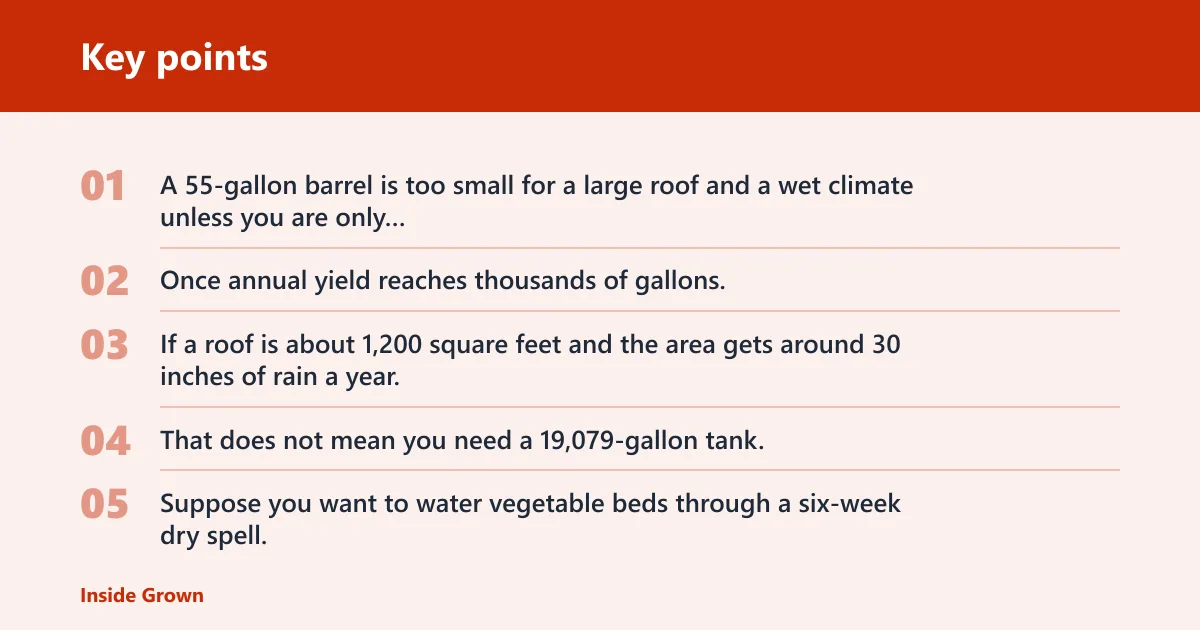
The table shows why storage class matters. A 55-gallon barrel is too small for a large roof and a wet climate unless you are only catching the first part of a storm. Once annual yield reaches thousands of gallons, the system needs tote-scale or cistern-scale storage to avoid constant overflow.
If a roof is about 1,200 square feet and the area gets around 30 inches of rain a year, then at about 85% efficiency the formula gives roughly 19,079 gallons a year. That does not mean you need a 19,079-gallon tank; it means you need storage sized for your target reuse window, plus overflow handling.
Suppose you want to water vegetable beds through a six-week dry spell. A smaller tank may still work if rain comes often enough to refill it. If storms are less frequent, a larger cistern may be the better fit even though your daily draw is modest.
How much water can one inch of rain collect?
One inch of rain on one square foot of roof area yields 0.623 gallons before losses. Multiply that by the roof footprint, then apply your collection efficiency. That makes 1 inch easy to scale from a small shed to a large house.
A 1,000-square-foot roof can collect roughly 623 gallons per inch before losses, and at about 80% to 90% efficiency that works out to around 498 to 561 gallons. Rainfall pattern matters, though: many small storms behave differently from one hard downpour because overflow and first-flush losses rise when water arrives fast.
What parts does a rainwater system need?
A basic system needs gutters, downspouts, a first-flush diverter, a storage tank, and an overflow path. The roof sends water into the gutters and downspouts, which carry runoff to storage. If the delivery path is undersized or dirty, the system will spill water before it reaches the tank.
Gutters and downspouts
Gutters and downspouts are the delivery path from roof to storage. They need enough capacity for hard downpours, and they need cleaning so leaves and grit do not block flow. Clogged gutters reduce yield and can push water over the edge where it is lost.
First-flush diverter
A first-flush diverter sends the first dirty rinse of rainfall away from storage. That improves water quality, but it also reduces captured volume. If the setting is too aggressive, you can throw away more water than you meant to, especially in small storms.
Storage tank and overflow path
The storage tank should match both storm capture and seasonal demand. It also needs an overflow route so heavy rain does not back up into gutters or flood the base of the tank. Overflow should move water away from foundations and paths.
Local codes and water-use rules can affect installation, storage, and overflow handling. That is especially true where mosquito control, setbacks, freeze protection, or cross-connection rules apply. Check before you build, not after the tank is full.
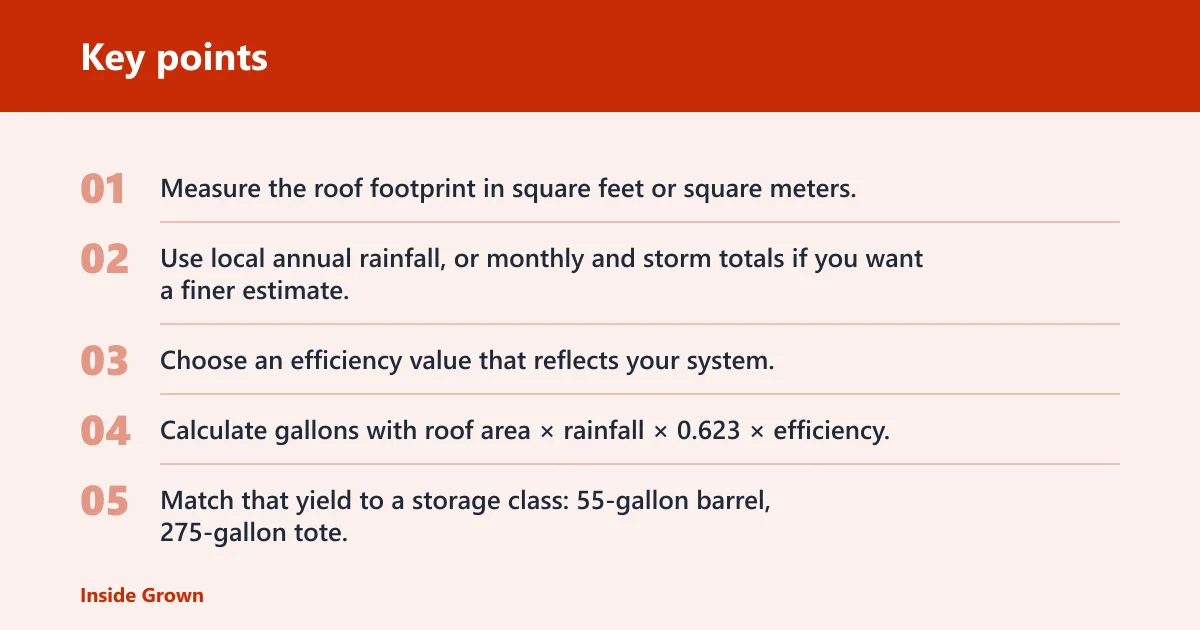
- Measure the roof footprint in square feet or square meters.
- Use local annual rainfall, or monthly and storm totals if you want a finer estimate.
- Choose an efficiency value that reflects your system, usually in the 80% to 90% range for a well-installed setup.
- Calculate gallons with roof area × rainfall × 0.623 × efficiency.
- Match that yield to a storage class: 55-gallon barrel, 275-gallon tote, or 1,000-gallon-plus cistern.
- Plan overflow, freeze protection, and cleaning access before installation.
A common first-timer mistake is sizing storage only from annual gallons. That can lead to a tank that looks large on paper but overflows in wet months and runs dry during a hot stretch. The better approach is to size for the roof, the storm pattern, and the watering schedule together.
Frequently asked questions
How much rainwater can I collect from my roof?
It depends on roof footprint, rainfall depth, and efficiency. Annual totals depend on local rainfall and how much storage you have.
How to calculate rainwater harvesting
Use the annual yield formula: gallons = roof area × rainfall × 0.623 × efficiency. Start with the horizontal roof footprint, not the sloped surface, then use rainfall in inches or convert millimeters to the same unit set. The efficiency term accounts for losses in the real system.
What runoff coefficient should I use?
Use a value that reflects your catchment material and system design, keeping in mind that calculator values range from 0.10 to 1.00. Smooth, well-draining roofs generally perform better than rough or leaky surfaces. If you are sizing a home system, stay conservative and account for first flush and overflow losses.
Is roof area or floor area used in the calculation?
Use the roof’s horizontal footprint, which is the catchment area above the ground. Floor area is only a rough stand-in if the roof shape is simple and the overhangs are modest. For accurate sizing, measure the roof projection, not the sloped roofing surface.
How do rainwater collection systems work?
Rain falls on the roof, runs into gutters and downspouts, passes through a first-flush diverter, and flows into a tank or cistern. The system may overflow during heavy storms, and the stored water can then be used for garden irrigation or other non-potable tasks if local rules allow it.
How much water is one inch of rain?
One inch of rain on one square foot of roof area equals 0.623 gallons before losses. Multiply that by the roof footprint to get gross capture potential. A larger roof produces more water, but your usable amount still depends on efficiency, storage space, and how quickly storms arrive.