Fertilizer Dilution Calculator: Mix It Right
To use a fertilizer dilution calculator, start with the label rate, keep every unit the same, and measure the concentrate before you add water. A bad conversion can burn plants, waste product, or leave you feeding far less than the label intends. This guide shows how to read the label, convert teaspoons, tablespoons, ounces, or milliliters, and check the final mix for a watering can or sprayer.
How is this calculated?
Press Calculate to see the math with your numbers.
How to use the calculator
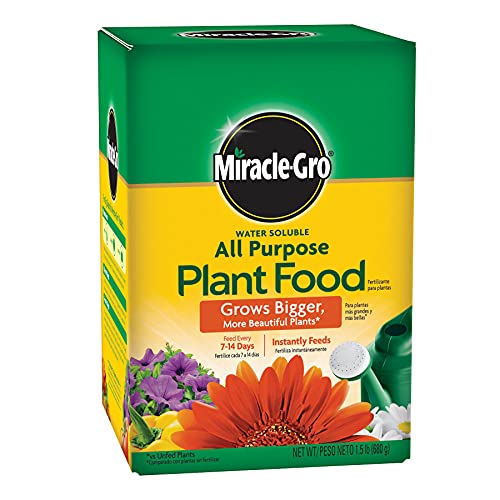

Enter a batch volume and label rate, then see the dose in milliliters, teaspoons, and fluid ounces for common container sizes. Use the calculator as a conversion tool; always confirm the bottle label first.
Formula: dose = label rate × batch volume, after converting everything to the same unit.
Read the label first
Start with the bottle directions, then match them to the container you are filling. Most liquid fertilizers list a rate such as mL/L, oz/gal, tsp/qt, or a dilution ratio such as 1:100. The label may also change by plant type, growth stage, or if you are feeding seedlings, established plants, or a hydroponic crop. For background on nutrient concentration and crop feeding, see hydroponic nutrient solutions and reading NPK labels.
Do not begin with the NPK number. A 20-20-20 formula and a 4-4-4 formula can each be used at very different dilution rates, because NPK describes analysis, not the dose. The label rate comes first. Guidance on fertilizer concentration and label interpretation is consistent with university extension fertigation resources and manufacturer directions, which is why the bottle rate should stay primary over general analysis numbers.
Find the dose format on the bottle
Look for a line that tells you how much concentrate to add per unit of water. Common formats include milliliters per liter, ounces per gallon, teaspoons per quart, or a ratio like 1:200. If the label gives a dose per watering can or tank, use that exact volume instead of converting it into a generic chart. EPA label databases and extension guides both emphasize following the product-specific rate rather than substituting a generic dose.
Separate per-volume directions from total tank directions
A per-volume rate scales with the final batch size. A total-tank instruction is fixed for that container. If the label says 5 mL per liter, then a 10 L tank needs 50 mL. If it says add 2 oz to a 4-gallon sprayer, that is the whole tank dose.
Check whether the label changes by plant type or growth stage
Many products ask for weaker mixes on seedlings, orchids, or salt-sensitive plants, and stronger mixes on heavy feeders. That difference matters. A seedling tray and a tomato crop should not receive the same strength just because the fertilizer bottle is the same. Extension fertilizer guides commonly recommend lower starting concentrations for sensitive crops and staged increases for heavier feeders.
What dilution ratio means
A dilution ratio describes the proportion of concentrate to water. In a 1:100 mix, one part concentrate goes with 100 parts water. Percentage directions mean the same idea in another form, such as 1% solution. Use the ratio as written, then convert it to the batch size you actually mix.
Translate 1:100 into plain volume terms
For every 1 mL of concentrate, add 100 mL of water if the ratio is strict volume to volume. That gives about 101 mL of final solution, which is why some labels and calculators express the same recipe as roughly 1%. The exact final volume depends on the system the label uses, so read the wording closely.
Read percentage-based dilution rates
A 1% solution means 1 part product in 100 parts final mix. A 0.5% solution means half that strength. Some labels use percentages for sprays, foliar feeding, or disinfectant-style products, so confirm if the percentage is based on final volume or on the water portion alone.
Note the difference between volume/volume and weight/volume
Volume/volume uses liquid measure, like mL per L. Weight/volume uses mass of product per volume of water, such as grams per liter. They are not interchangeable unless the label tells you the density conversion or gives both forms. That distinction matters when a product is thick or highly concentrated.
How do you calculate fertilizer per gallon?
Use the label rate, then multiply or divide until it fits the gallon size of your watering can or sprayer. Keep the same unit system from start to finish. If the label says teaspoons per quart, convert quarts to gallons first, or convert the teaspoon rate into gallons with a clean conversion.
Use the label rate and final volume
One gallon equals 3.785 liters. If the label rate is 10 mL per liter, then 1 gallon needs about 37.85 mL of concentrate. If the label says 2 teaspoons per gallon, use 2 teaspoons in the full gallon, not in each quart unless the label says so.
Convert teaspoons, milliliters, ounces, and quarts
Common kitchen and garden conversions help when labels mix units. One teaspoon is about 5 mL. One tablespoon is 3 teaspoons or about 15 mL. One fluid ounce is about 29.6 mL. One quart is a quarter of a gallon, or about 0.946 L.
Scale the same recipe for larger or smaller batches
Suppose a label calls for 2 mL per liter and you need 5 gallons. Convert 5 gallons to 18.93 liters, then multiply 2 by 18.93. The answer is 37.86 mL of concentrate in the full tank. For a half-gallon batch, divide that gallon dose by 2.
How do you calculate fertilizer per liter?
For liters, the math is simpler because many labels already use metric units. Read the rate, multiply by the number of liters, and check the result against the smallest measuring tool you can handle accurately. Tiny amounts are where mistakes happen most often.
Convert common per-liter label rates
If the label says 5 mL/L and you are making 3 L, use 15 mL. If the label says 1 tsp per 2 L, that is 0.5 tsp per liter. Since 1 tsp is about 5 mL, the per-liter rate is about 2.5 mL/L.
Work from milliliters to teaspoons when needed
Some growers measure only with spoons. That can work for larger amounts, but it is less precise for low doses. A 1 mL error is a 20% error if the target is 5 mL. For small batches, a syringe or graduated cylinder is the safer tool.
Check the math with a quick unit swap
Picture a 2 L watering can and a label rate of 1 teaspoon per liter. The mix needs 2 teaspoons total. Since 1 teaspoon is about 5 mL, the can needs about 10 mL of product. The unit swap confirms the same answer two ways.
Dilution cheat sheet
This sheet gives worked examples for 1 L, 1 gallon, and 5 gallons. Each example keeps the label rate first, then converts it into mL, teaspoons, tablespoons, or ounces as needed. Use it as a check, not as a substitute for the bottle directions.
| Label rate | 1 L mix | 1 gal mix | 5 gal mix | Sanity check |
|---|---|---|---|---|
| 1 mL/L | 1 mL | 3.8 mL | 18.9 mL | Very light feed; often used for sensitive plants. |
| 2 mL/L | 2 mL | 7.6 mL | 37.9 mL | Still a light mix; check that the crop is not a heavy feeder. |
| 5 mL/L | 5 mL = 1 tsp | 18.9 mL = 1.27 tbsp | 94.6 mL = 6.3 tbsp | A common midrange liquid-feed rate. |
| 10 mL/L | 10 mL = 2 tsp | 37.9 mL = 1.28 fl oz | 189.3 mL = 12.8 tbsp | Strong enough that measuring accuracy matters. |
| 15 mL/L | 15 mL = 1 tbsp | 56.8 mL = 1.92 fl oz | 283.9 mL = 9.6 fl oz | Often too strong for seedlings or orchids. |
| 20 mL/L | 20 mL = 4 tsp = 1.33 tbsp | 75.7 mL = 2.56 fl oz | 378.5 mL = 12.8 fl oz | Check the label carefully; this is a heavy rate. |
| 1 tsp/L | 1 tsp = 5 mL | 3.8 tsp = 19 mL | 18.9 tsp = 94.5 mL | Easy to scale, but use real measuring tools. |
| 1 tsp/qt | About 1.06 tsp/L | 4 tsp = 20 mL | 20 tsp = 100 mL | Quart-based labels need a quart-to-gallon conversion. |
| 2 tsp/qt | About 2.11 tsp/L | 8 tsp = 40 mL | 40 tsp = 200 mL | Double the quart dose, then scale it cleanly. |
| 1 oz/gal | 0.264 fl oz/L = 7.4 mL/L | 1 fl oz = 29.6 mL | 5 fl oz = 148 mL | Common on gallon-based labels; do not confuse with dry ounces. |
| 2 oz/gal | 0.528 fl oz/L = 14.8 mL/L | 2 fl oz = 59.1 mL | 10 fl oz = 296 mL | A stronger feed; watch sensitive plants closely. |
| 1:100 | 10 mL per 1 L final mix, approximately | 37.9 mL per gallon, approximately | 189.3 mL for 5 gallons, approximately | Best checked against the label wording, since final volume rules can differ. |
One-line sanity checks for each mix
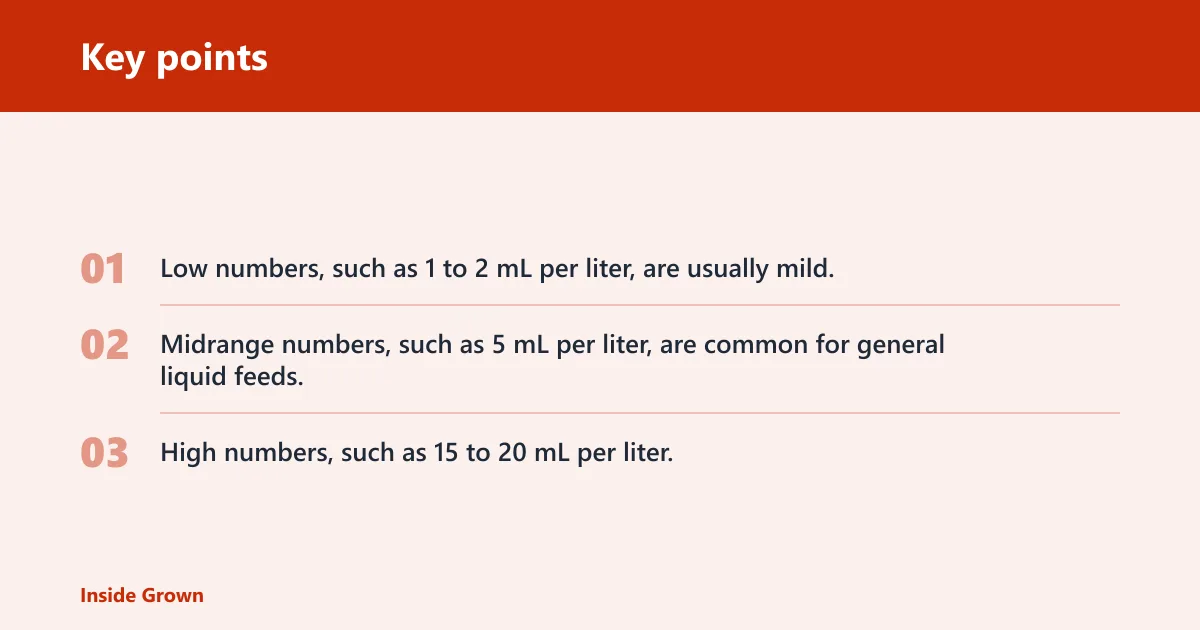
Low numbers, such as 1 to 2 mL per liter, are usually mild. Midrange numbers, such as 5 mL per liter, are common for general liquid feeds. High numbers, such as 15 to 20 mL per liter, deserve extra care and are often too strong for seedlings, orchids, and other salt-sensitive plants.
How do you measure fertilizer accurately?
Use a tool that matches the dose size. A graduated cylinder works well for milliliters, a dosing syringe helps with very small amounts, and a measuring cup is better for larger volumes. A dosing pump can improve repeatability, but only if it is set correctly and checked against the label rate.
Choose the right tool for small doses
When the dose is under 10 mL, kitchen spoons are often too rough for careful work. A 5 mL syringe or a marked cylinder gives a cleaner result. For 1 to 2 L batches, that difference can decide whether the mix is on target or off by a large margin.
Avoid guesswork with teaspoons and kitchen cups
Spoons vary. Cups vary. Leveling method matters. If the label rate is exact, a dedicated garden measuring tool is better than a food utensil that also measures baking ingredients. Keep those tools separate so residue does not move between kitchen use and fertilizer use.
Keep garden tools separate from food tools
Use a dedicated measuring cup, syringe, or cylinder for fertilizer only. That reduces contamination and keeps the dose repeatable. Rinse after use, but do not return it to kitchen duty.
Can ppm or EC replace the label rate?
No. ppm and EC are checks, not a starting point for most hand-mixed garden fertilizers. In hydroponics and fertigation, growers often use a ppm target or an EC range to verify solution strength, but the dose still needs to be converted from the fertilizer label and its analysis. EC and TDS are indirect readings, so conversion matters. If you are comparing meters or nutrient targets, see choosing a TDS meter.
Use ppm targets for hydroponics and fertigation
Hydroponic recipes often aim for a ppm target because nutrient concentration has to stay within a narrow range. That target comes after the label step, not before it. Different fertilizers have different NPK and micronutrient contents, so the same mL dose can produce different ppm values. University extension fertigation guides typically recommend using the label dose first, then using EC or ppm as a verification step.
Read EC or TDS as a check, not a label substitute
EC meters report electrical conductivity in mS/cm or similar units. TDS meters estimate ppm from conductivity, but the conversion factor varies by meter. A reading can tell you the mix is stronger or weaker than intended, yet it cannot tell you the correct fertilizer dose on its own.
Convert fertilizer dose to target strength only after the label step
For a hydroponic tank, first calculate the label dose for the full volume. Then measure EC or TDS and compare it with the crop target. If the reading is high, dilute the batch. If it is low, add more concentrate in small steps and retest.
What happens if the mix is too strong?
Too much fertilizer can burn roots and leaves, raise salt levels in the root zone, and push a plant past what it can use. The first signs are often leaf tip burn, margin scorch, wilting despite wet soil, or a crust on the medium. Sensitive plants react sooner than heavy feeders.
Spot overfertilization symptoms early
If a plant shows sudden tip burn after feeding, stop and check the mix. Review the unit conversion, the batch size, and the measuring tool. Hard water can also affect the final mix because it already contains dissolved minerals that add to overall strength.
Lower the rate for seedlings, orchids, and salt-sensitive plants
Seedlings usually need weaker feeds than mature plants. Orchids and many salt-sensitive ornamentals also prefer a lighter hand. A common first-timer mistake is using the same rate on every plant in the room, then wondering why the smallest pot shows burn first. A practical decision matrix is below.
Retest or remix when the first batch is off
Suppose a 1-gallon batch was mixed at 2 oz when the label called for 1 oz. Do not try to guess how much water to add by eye. Measure the actual extra water, dilute the batch again, and retest the strength if you are using EC or TDS.
How do I calculate fertilizer dilution from a concentrate?
Read the label, convert the final batch size into the same unit, then multiply the dose rate by that volume. If the product says 4 mL per liter and you need 6 liters, the answer is 24 mL. If the label uses gallons, convert gallons to liters first or stay in gallons throughout.
What is a 1:100 fertilizer dilution ratio?
A 1:100 ratio means 1 part concentrate to 100 parts water, usually by volume unless the label says otherwise. In a 1 liter final mix, that is roughly 10 mL of concentrate. In a 1 gallon batch, it is about 37.9 mL. Always check whether the label uses final volume or water volume.
How many mL of fertilizer go in 1 gallon of water?
There is no single answer. It depends on the label rate. A 5 mL/L fertilizer needs about 18.9 mL per gallon. A 10 mL/L fertilizer needs about 37.9 mL per gallon. If the bottle says 1 oz/gal, that equals about 29.6 mL per gallon.
How do I convert ppm to fertilizer dilution?
Start with the label dose, then measure the resulting solution with an EC or TDS meter if ppm is the target system. Ppm does not convert to a universal fertilizer dose without knowing the product analysis and the meter’s conversion factor. The label rate comes first; the meter confirms whether the mix lands near target.
How do I dilute liquid fertilizer for houseplants?
Use the product label, then choose the weaker end of the range if the plant is a light feeder, a seedling, or an orchid. Mix the concentrate in clean water, stir well, and avoid kitchen spoons for exact doses. If the label offers a range, begin at the lower rate and watch the plant’s response.
How do I measure fertilizer without a dosing pump?
Use a syringe, graduated cylinder, or marked measuring cup. For small batches, a syringe is often the cleanest option because it handles low milliliter doses more accurately than a spoon. Rinse the tool after use and keep it dedicated to garden work so the reading stays repeatable.
Frequently asked questions
| Question | Quick answer | Best-fit guidance |
|---|---|---|
| How do I calculate fertilizer dilution from a concentrate? | Multiply the label rate by the final batch size after matching units. | Use the bottle direction first, then convert teaspoons, mL, ounces, or gallons consistently. |
| What is a 1:100 fertilizer dilution ratio? | One part concentrate to 100 parts water, usually by volume. | Confirm whether the label means final volume or water volume before mixing. |
| How many mL of fertilizer go in 1 gallon of water? | It depends on the label rate; there is no universal gallon dose. | Examples include about 18.9 mL for 5 mL/L and 29.6 mL for 1 oz/gal. |
| How do I convert ppm to fertilizer dilution? | Use ppm as a check, not a replacement for the label rate. | Set the dose from the label, then verify with EC or TDS if the crop is in a ppm-managed system. |
| How do I dilute liquid fertilizer for houseplants? | Follow the label and bias weaker for light feeders and sensitive plants. | Seedlings, orchids, and stressed plants usually need the lower end of the labeled range. |
| What happens if I mix fertilizer too strong? | Too-strong mixes can cause burn, salt buildup, and root stress. | Check the math, the measuring tool, and the label; then dilute and retest if needed. |
Plant-type dilution guide: seedlings usually do best at the lightest labeled rate; orchids and other salt-sensitive plants generally need a low-to-moderate mix; leafy houseplants often fit the middle of the labeled range; heavy feeders such as tomatoes and other high-demand crops may use stronger rates when the label allows it; hydroponic crops should be adjusted to the target EC or ppm after the label dose is calculated.