The Difference Between Primary and Secondary Growth in Plants
Primary growth extends stems and roots from apical meristems at the tips; secondary growth widens them from lateral meristems, especially vascular cambium and cork cambium. Mixing them up makes plant anatomy diagrams harder to read and can lead to wrong ID of young versus woody tissue. This guide shows the stem-and-root timeline and the exact cross-section clues for each growth type. (UMN) (Wikipedia)
Primary vs secondary growth at a glance
Primary growth adds length to stems and roots. Secondary growth adds width. In stems and roots, the two often happen in sequence, so a woody organ usually starts by elongating and later begins to thicken as lateral meristems turn on.
| Feature | Primary growth | Secondary growth |
|---|---|---|
| Main effect | Increases length | Increases thickness |
| Where it happens | Shoot and root apices | Lateral meristems |
| Meristem involved | Apical meristem | Vascular cambium and cork cambium |
| Typical products | Epidermis, ground tissue, primary xylem, primary phloem | Secondary xylem, secondary phloem, periderm |
| Common plant examples | Herbaceous plants, growing tips of all vascular plants | Woody plants such as trees and shrubs |
| Cross-section clue | Young, simple tissue pattern near the tip | More layered tissue, wood, bark, and thicker support tissue |
Stem and root timeline
Primary growth starts first at the tips of stems and roots. That is where apical meristems sit, and that activity drives elongation. In woody stems, secondary growth begins later, after the axis already has a primary body. The cambium then adds width around that earlier framework.
That sequence matters in real tissue. A young stem may still be mostly primary growth. A mature woody stem usually contains both, with old primary tissues near the center or outer edge and secondary tissues layered around them.
How does primary growth work?
Primary growth happens at the apices, or tips, of stems and roots. Apical meristem cells divide there and push the organ longer. That extension lets shoots reach light and roots reach water and minerals.
Where apical meristems are located
Apical meristems sit at the ends of stems and roots. In a shoot, they drive vertical extension and add new leaves and stem tissue. In a root, they push the organ deeper into soil while forming new root tissues behind the tip.
What primary growth produces
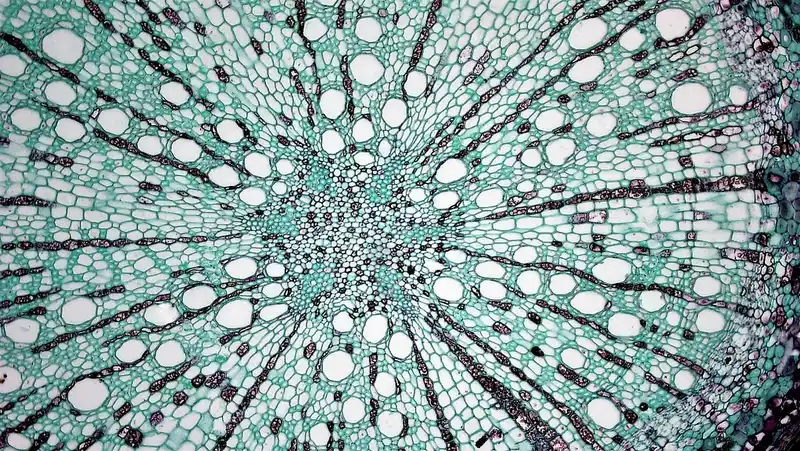
Primary growth forms the epidermis, ground tissue, primary xylem, and primary phloem. Those tissues make the first body plan of the organ. They give the stem or root its initial shape before any thickening begins.
For a stem, that usually means a young axis with an outer epidermis, inner transport tissues, and a central region made of ground tissue. For a root, the same growth mode builds the early transport and support pattern near the tip.
How does secondary growth work?
Secondary growth happens in lateral meristems. It increases girth rather than length. In woody stems and roots, vascular cambium and cork cambium drive that radial growth.
Where lateral meristems are located
Lateral meristems run along the sides of stems and roots, not at the tip. The vascular cambium sits between primary xylem and primary phloem. The cork cambium forms in outer tissues and builds the protective outer covering of mature organs.
What vascular cambium and cork cambium produce
Vascular cambium typically produces secondary xylem to the inside and secondary phloem to the outside. Secondary xylem is wood. It adds thickness, supports water transport, and strengthens the stem or root. Secondary phloem lies outside the vascular cambium and conducts sugars.
Cork cambium makes cork cells and contributes to bark, more precisely the periderm. Periderm replaces the epidermis in mature plants and includes cork cambium, cork, and phelloderm. That outer system reduces water loss and protects older tissues.
Why woody stems change over time
In woody plants, secondary growth usually starts after primary growth has already built the initial stem or root. The plant first lengthens, then thickens. That is why young woody stems can look deceptively similar to herbaceous stems until cambium activity becomes obvious.
Secondary growth also gives rise to annual growth rings in many woody plants. Those rings come from repeated cambial activity across seasons. As the stem ages, older inner secondary xylem can function as heartwood, while younger outer xylem remains sapwood and still moves water.
Which tissues does each growth type produce?
Primary growth and secondary growth produce different tissue sets, and that difference is one of the clearest ways to identify them in section. If you can name the tissue, you can usually name the growth process that formed it.
| Growth type | Tissues produced | What to look for in section |
|---|---|---|
| Primary growth | Epidermis, ground tissue, primary xylem, primary phloem | Simple young organization near the tip or in a non-woody organ |
| Secondary growth | Secondary xylem, secondary phloem, periderm | Wood, cambium-associated layers, and outer protective tissue |
Here is the key difference in a cross-section: primary tissues form the first body plan, while secondary tissues add layered thickening around that body. Secondary xylem sits inside the cambium. Secondary phloem sits outside it.
Stem growth checklist
Use this checklist when you are staring at a stem cross-section and trying to decide what you are seeing. The fastest route is to ask where growth happens, what changed, and which tissues are present. Tip clues point toward primary growth. Side clues point toward secondary growth.
- Tip vs side: If the tissue comes from a stem or root tip, primary growth is the better fit. If the change comes from layers around the axis, think secondary growth.
- Length vs width: Lengthening points to primary growth. Thickening points to secondary growth.
- Apical vs lateral meristem: Apical meristem means primary growth. Lateral meristem means secondary growth.
- Primary vs secondary tissues: Epidermis, ground tissue, primary xylem, and primary phloem point to primary growth. Secondary xylem, secondary phloem, and periderm point to secondary growth.
- Stem cross-section: If you can identify wood, bark, or a cambial zone, secondary growth is present. If the section is mostly a simple young pattern without those layers, primary growth is dominant.
- Start with location: tip or side?
- Check the organ: stem or root?
- Look for cambium: vascular cambium or cork cambium?
- Identify the tissues: primary tissues or secondary tissues?
- Confirm the growth type from the pattern, not from a single feature.
A common first-timer mistake is to label any thick stem as “secondary growth.” Thickness alone is not enough. A young sunflower stem can be wide but still show mostly primary tissues, while a thin twig from a woody shrub may already contain secondary xylem and phloem.
How do you tell them apart in stems and roots?
Stems and roots both use the same growth logic, but their anatomy is easier to confuse when you compare them side by side. In both organs, primary growth comes from tips and secondary growth comes from lateral meristems. The tissue pattern, however, differs enough that you should check the organ before naming the growth type.
Young woody stems
Young woody stems can look like primary growth at first. Early on, the stem may still be extending, and the cambium may only be beginning to lay down secondary xylem and secondary phloem. If wood is not obvious yet, look for a cambial ring and the first layers of thicker support tissue.
Suppose you cut a 1-year-old shrub stem and see a thin outer layer, a ring of cambial tissue, and a small amount of wood. That stem has both growth types. The elongation stage happened first, and the thickening stage has already started.
Roots versus stems
Roots also show primary and secondary growth, but the cross-section clues differ from stems because roots are built for uptake and anchorage. Primary root growth starts at the root tip. Secondary growth in older roots can add thickness, especially in woody plants, by adding secondary xylem inward and secondary phloem outward.
Picture an older tree root cut in cross-section. If you see a thick woody center and outer protective periderm, that root is in secondary growth. If you see a simpler young root structure near the tip, primary growth is the main process.
Common lookalikes and edge cases
Do not assume every thick plant organ has strong secondary growth. Some non-woody plants show limited secondary thickening, and monocot edge cases can confuse a quick look. Also, some stems are only partly thickened, so the presence of a few layered cells does not automatically mean a fully woody stem.
Woody plants such as trees and shrubs usually show both primary and secondary growth. Herbaceous plants usually show primary growth only. That pattern is common, but the safest ID still comes from the tissues in the section, not from the plant’s general category alone.
Choose primary growth if… / Choose secondary growth if…
Use primary growth when you are dealing with elongation at tips, young non-woody tissue, or a cross-section that still shows the first body plan. Use secondary growth when the organ is thickening, cambium is active, or the section contains wood and periderm. The organ can show both at once.
Choose primary growth if…
- You are examining a shoot or root tip.
- The main change is length, not width.
- Apical meristem activity is the best match.
- The section shows epidermis, ground tissue, primary xylem, and primary phloem without obvious wood or bark.
Choose secondary growth if…
- You are examining a stem or root that is thickening.
- Vascular cambium or cork cambium is present.
- The section shows secondary xylem, secondary phloem, or periderm.
- You are looking at a woody plant such as a tree or shrub, especially an older stem or root.
Frequently asked questions
What is primary and secondary growth in plants?
Primary growth lengthens stems and roots by activity at the apical meristem. Secondary growth thickens those organs through lateral meristems, especially vascular cambium and cork cambium. In practical terms, primary growth builds the first length of the plant, while secondary growth adds girth around that earlier body.
What is secondary growth in plants?
Secondary growth is the increase in thickness that comes from lateral meristems. Vascular cambium adds secondary xylem inward and secondary phloem outward, while cork cambium forms cork cells and contributes to periderm. This is the growth process that produces wood and much of the outer protective tissue in mature plants.
How do primary growth and secondary growth differ in plants?
Primary growth increases length and happens at stem and root tips. Secondary growth increases thickness and happens in lateral meristems. Primary growth produces epidermis, ground tissue, primary xylem, and primary phloem. Secondary growth produces secondary xylem, secondary phloem, and periderm. The location and the tissues are the fastest ways to tell them apart.
Do all plants have secondary growth?
No. Secondary growth is common in gymnosperms and dicotyledonous angiosperms, but many herbaceous plants do not show it in a major way. Some non-woody plants have limited secondary thickening, and monocot edge cases can complicate simple rules. Always check the tissue pattern rather than assuming from plant type alone.
Which meristems cause primary and secondary growth?
Primary growth comes from apical meristems at the tips of stems and roots. Secondary growth comes from lateral meristems, mainly vascular cambium and cork cambium. Apical meristems support elongation and vertical growth. Lateral meristems support radial growth and add thickness.
How can you tell primary growth from secondary growth in a stem?
Look at the tissue pattern in cross-section. If you see a young stem with epidermis, ground tissue, primary xylem, and primary phloem, primary growth is dominant. If you see cambium, secondary xylem, secondary phloem, wood, bark, or periderm, secondary growth is present. The safest answer comes from the tissues, not the stem’s size alone.