Compost Calculator: How Much Compost You Need for Beds
Use a compost calculator by multiplying area by depth. At 1 inch over 100 square feet, you need about 0.31 cubic feet, and most beds need 1 to 2 inches. Too much compost can overfeed plants, bury crowns, and waste money. This guide shows how to size compost for lawns, beds, raised beds, and no-dig projects, then convert the result to bags or bulk volume.
How is this calculated?
Press Calculate to see the math with your numbers.
What this calculator gives you

This guide helps you choose a project type, measure the space, pick a depth, and turn that result into cubic feet, cubic yards, liters, cubic meters, or bag counts. It also separates surface top-dressing from mixing compost into soil, which are different jobs with different depths.
Start with the project, not the package. An established lawn needs a very thin top-dress, while a new bed or no-dig area can take a deeper layer.
Which project type to pick?
Choose the preset that matches the job you are doing: new lawn, established lawn, garden bed, raised bed, or trees and shrubs. If you want compost on top of the soil, use a top-dress or amendment depth. If you are filling a bed from scratch, use fill volume instead of amendment depth.
What measurements you need before you start
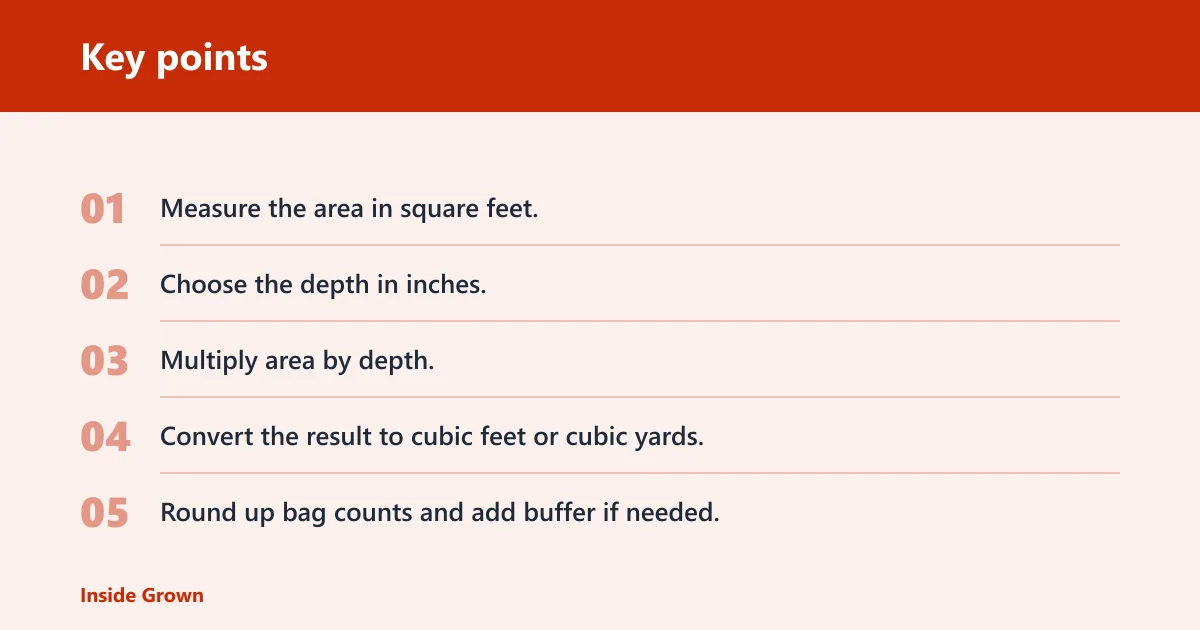
- Measure the area in square feet.
- Choose the depth in inches.
- Multiply area by depth.
- Convert the result to cubic feet or cubic yards.
- Round up bag counts and add buffer if needed.
When to use the safety buffer
Add a buffer when the bed edges are irregular, the compost is loose and fluffy, or the surface is uneven. A 10% buffer is a practical default. Use 5% for very precise rectangular areas and up to 20% if you expect settling, hand-spreading losses, or a rough fill shape.
How much compost do you need?
For any project, the core calculation is area multiplied by depth. Keep the depth in inches, then convert to volume. A shallow lawn top-dress needs far less material than a bed amendment or a raised-bed fill. If the compost sits on top, use a thin layer. If it goes into the soil, the target depth is deeper.
The area × depth formula
Use this simple method: square feet times inches, then convert to cubic feet or cubic yards. For a rectangular space, length × width gives area. For a 10 by 5 foot garden, the area is 50 square feet. At 2 inches deep, that bed needs roughly 8.3 cubic feet, or about 0.31 cubic yards.
How to choose a depth by project type
A new lawn typically uses 1-2 inches of compost. An established lawn can use 1/4 to 1/2 inch, and Penn State Extension recommends 0.25 to 0.5 inch for established lawns. A new garden with heavy compost dosage requires 2 inches. If you are mixing compost into soil, 6 to 8 inches is the mixing zone, not a surface dress.
When to stop at a surface layer
Stop at a surface layer when you are top-dressing an existing lawn or lightly amending a bed. Do not bury grass blades, crowns, or stems. Thick compost on turf can smother growth, and too much compost in a planting hole can hold water where roots need air.
Compost calculator table
The table below maps common projects to depth, coverage, bag count, and a buffer note. Bag counts assume 2 cubic foot bags unless noted. Round up to whole bags.
| Project | Recommended depth | Cubic yards per 100 sq ft | 2 cu ft bags per 100 sq ft | When to add 10% extra |
|---|---|---|---|---|
| Established lawn top-dress | 0.25 to 0.5 inch | 0.008 to 0.015 | 0.4 to 0.8 | Add 10% if the lawn is uneven or you are top-dressing by hand |
| Bed amendment | 1 to 2 inches | 0.031 to 0.062 | 1.6 to 3.1 | Add 10% if the bed edges are irregular or the soil is compacted |
| New bed or heavy amendment | 3 inches | 0.093 | 4.7 | Add 10% if settling is likely after watering or rain |
| Raised bed fill | Use full bed height, not amendment depth | Varies by height | Varies by height | Add 10% for settling, especially with coarse or fresh material |
| No-dig bed | 6 to 8 inches | 0.185 to 0.247 | 9.3 to 12.4 | Add 10% if the surface is uneven or you want a reserve for touch-ups |
The table is a sizing guide, not a rule to force every bed into the same depth. A lawn and a raised bed should not be treated the same way.
How do you measure your space?
Measure the area first, then choose depth. Rectangles are easiest, but circles, triangles, and odd shapes work too. If the space is irregular, break it into smaller shapes, calculate each part, and add them together. That keeps the compost estimate tied to the real footprint, not a guess.
Length × width for rectangles
Multiply length by width in feet. A 10 by 5 foot bed equals 50 square feet. That is the example garden area used throughout this guide.
Circle, triangle, and custom areas
For a circle, use the radius squared times pi. For a triangle, use half of base times height. For a custom shape, split the area into rectangles and triangles, then total the sections. This is usually faster than trying to trace a strange shape into a single estimate.
Converting square feet to square meters
If you buy compost in metric units, square feet can be converted to square meters before you size the order. This is useful for UK, South African, and other metric buying scenarios where bag labels and bulk listings are often shown in liters or cubic meters.
How many bags or bulk yards should you buy?
Bag counts come from volume, not from area alone. A 1 cubic foot bag covers less than a 2 cubic foot bag, so always check the size on the label. Bulk usually makes more sense once the order grows large enough that bag count, hauling time, and waste become the main cost drivers.
1 cu ft, 2 cu ft, and 40 L bag conversions
Round up to whole bags. A 1 cubic foot bag is about 28.3 liters. A 40 L bag is roughly 1.4 cubic feet. A 2 cubic foot bag is about 56.6 liters. If your math says 3.2 bags, buy 4 bags.
Cubic feet to cubic yards
Divide cubic feet by 27 to get cubic yards. One cubic yard top-dresses about 1,300 square feet, depending on the depth. For a 1,000 square foot lawn at 1/4 inch, the need is 0.77 cubic yards, about 21 cubic feet, or about 10 bags of 2 cubic feet.
When bulk usually makes more sense
Bulk often becomes the better option when the bag count rises into the dozens, when the project is a whole lawn, or when you need a deep fill. Bagged compost is easier for small repairs and tight access. Bulk is better when delivery and unload space are available.
Suppose you are top-dressing a 1,000 square foot lawn at 1/4 inch. The estimate is about 0.77 cubic yards, which is about 21 cubic feet. That works out to about 10 bags of 2 cubic feet, before adding a buffer for uneven areas.
How deep should compost go?
Depth depends on the job. Established lawns need a very thin layer. Garden beds can take a thicker surface amendment. Raised beds need fill volume based on the bed height. No-dig beds use a deeper layer because the compost is part of the planting zone, not a finish layer on top.
Established lawns
Use 0.25 to 0.5 inch for established lawn top-dressing. That is thin enough to work into the canopy without smothering grass. A common first-timer mistake is laying compost so thick that the blades disappear. If the lawn is thin or bumpy, stay near the low end and repeat later if needed.
Garden beds and new beds
A bed amendment usually falls in the 1 to 2 inch range. A new garden with heavy compost dosage requires 2 inches, and a 100 square foot bed at 2 inches needs about 0.62 cubic yards. For a 10 by 5 foot bed, the 2 inch example equals about 8.3 cubic feet.
Raised beds, no-dig beds, trees, and shrubs
Raised beds are a fill-volume problem first. Measure length, width, and height, then subtract what is already in the bed if you are topping up. No-dig beds often use 6 to 8 inches of compost above the surface. Trees and shrubs usually need compost placed on the surface or worked lightly into the top layer, not packed against trunks or stems.
How much does compost weigh?
Weight changes with moisture, texture, and how fine the material is. A cubic foot is lighter when compost is dry and much heavier after rain or soaking. Use weight estimates only for hauling and delivery planning, not for a precise planting rule.
Weight per cubic foot and cubic yard
Most compost is sold by volume, not by weight, because moisture shifts the number. A cubic yard equals 27 cubic feet, so the load weight can swing a lot between dry and wet product. If you are lifting bags by hand, the bag label matters more than any single weight estimate.
Why moisture changes the number
Wet compost can weigh far more than dry compost because water adds mass without changing the stated volume. That matters when you are moving bags, loading a truck, or arranging a bulk delivery. If you expect rain before spread day, plan for the higher end of the weight range.
Planning for hauling and delivery
Check access, unloading space, and whether you can wheel the material to the bed. Bulk deliveries are efficient, but they need room. Bagged compost is easier to stage in small loads. If the order is near the point where hauling becomes tiring, bulk may be the simpler answer.
Picture a 4 by 8 foot raised bed that is 12 inches deep and empty. That is 32 cubic feet of fill, not a 2 inch amendment job. Mixing that up would leave you short by a large margin and force a second order.
Frequently asked questions
How much compost do I need for my garden?
For most garden beds, start with 1 to 2 inches. If the soil is poor, compacted, or very low in organic matter, use the higher end. Convert the area to square feet, multiply by the depth, then round up to whole bags or the next bulk fraction.
How much compost do I need for a lawn?
For an established lawn, use 0.25 to 0.5 inch. A new lawn typically uses 1-2 inches. If you are covering 1,000 square feet, 1/4 inch needs 0.77 cubic yards, about 21 cubic feet, or about 10 bags of 2 cubic feet.
How many bags of compost do I need?
Divide the needed cubic feet by the bag size, then round up. A 40 L bag is about 1.4 cubic feet, a 1 cubic foot bag is exactly 1 cubic foot, and a 2 cubic foot bag is about 56.6 liters. Whole-bag rounding avoids shortages.
How do I work out how much compost I need?
Measure the area, choose the depth, and calculate volume. For rectangles, use length × width. For circles or triangles, use the matching area formula. Then convert inches of depth into cubic feet or cubic yards. Add a 10% buffer if the shape is irregular or the surface is uneven.
What is the best compost ratio for soil?
There is no single best ratio for every soil. For top-dressing, the goal is a thin surface layer. For new beds and poor soil, 1 to 2 inches is common. For mixing into soil, 6 to 8 inches is the working depth, not the compost-only depth.
How deep should compost be applied?
Depth depends on the use. Established lawns: 0.25 to 0.5 inch. Garden or bed amendment: 1 to 2 inches. Heavy amendment or new-bed use: 3 inches. When mixing compost into soil, use 6 to 8 inches of mixing depth.
How much compost does a cubic yard cover?
Coverage depends on depth. One cubic yard top-dresses about 1,300 square feet at a thin lawn application. At deeper bed-amendment depths, coverage drops fast. Use the depth you need first, then back-calculate the area the yard will cover.
How long does it take for compost to be made?
Finished compost time varies with feedstock, moisture, aeration, and turning schedule. Because that process is inconsistent, it is better to size the application by volume and use compost that is already mature. Unfinished compost can rob nitrogen or heat the root zone.