How to Mix Compost into Existing Landscape Soil Beds
For established garden beds, top-dress about 1 to 2 inches of compost for most plantings; only mix in a deeper layer when roots are sparse, the soil is badly compacted, and the bed can tolerate disturbance. Done poorly, compost can bury roots, dry out, or settle unevenly. This guide shows how to choose the right method and apply it correctly.
This guide is part of our Soil and landscape basics for gardeners series.
What you’ll need before you start


Start with well-decomposed compost. It should be fully broken down, should not smell strongly, and should not have many identifiable pieces. That matters because finished compost is fit for top dressing or mixing into soil, while unfinished material can tie up nitrogen and heat up after application. (wikihow.com)
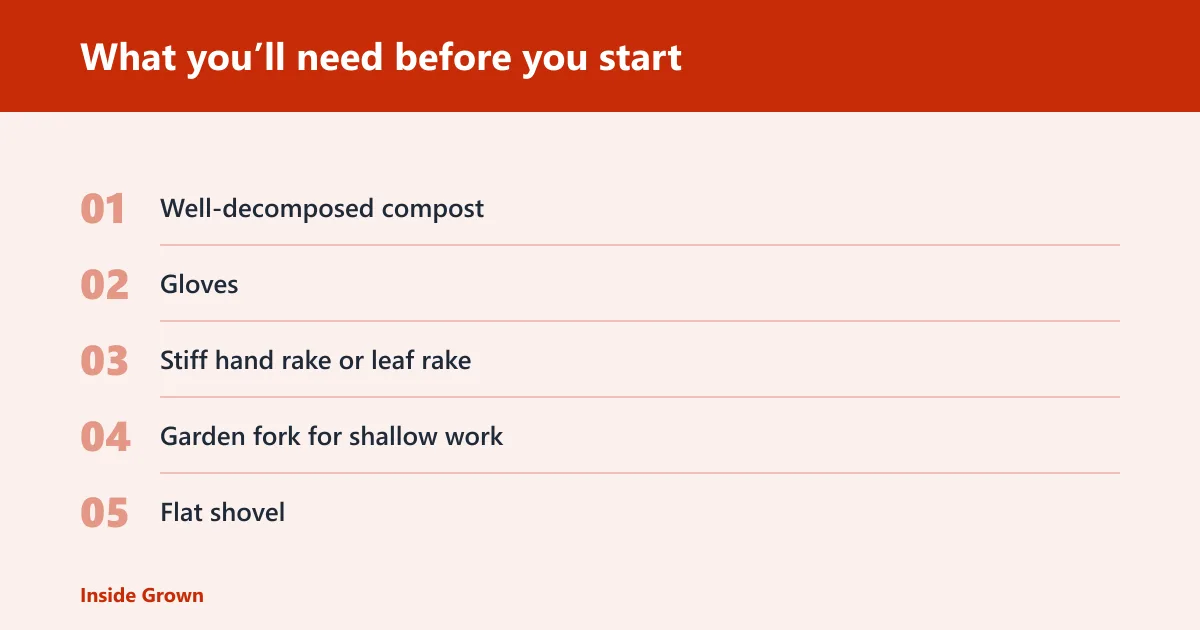
- Well-decomposed compost
- Gloves
- Stiff hand rake or leaf rake
- Garden fork for shallow work
- Flat shovel
- Tape measure or ruler
- Bucket or wheelbarrow
- Watering can or hose
How to check compost quality
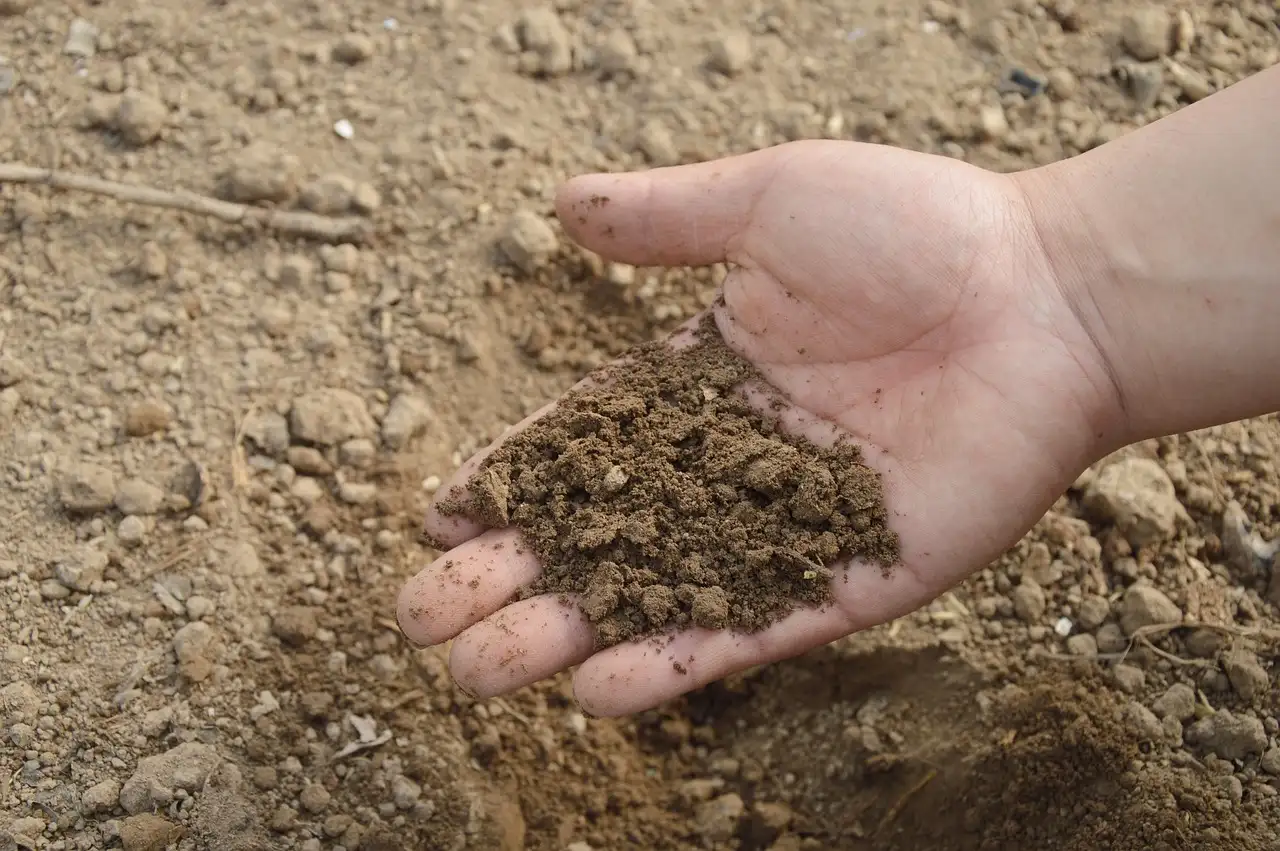
Scoop up a handful and look closely. Finished compost should feel crumbly, not hot, and not have a strong sour or ammonia smell. If it still has recognizable food scraps, sticks, or other large pieces, keep it out of established beds. That matters most around shrub and tree roots.
Safety and bed-prep basics
Water the bed lightly the day before, if the soil is dry. Slightly moist soil is easier to work and less likely to compact. Keep compost away from stem bases, crown flares, and trunk flare areas, because piling material there can trap moisture and invite rot.
📊 Garden Design says the optimal composting ratio is around 2 to 3 parts brown matter to 1 part green. Source: Gardendesign.
How do you mix compost into existing garden soil?
Mix compost into existing garden soil only shallowly, and only where roots are not dense near the surface. For most established beds, top dressing is safer than full mixing because it improves surface tilth without tearing through feeder roots. In beds that are being reset, a limited fork-in blend can work.
Why established beds need a different approach
Old beds already contain roots, crowns, and buried stems close to the surface. Deep tilling can sever roots and shift grades around trees and shrubs. Compost still helps. It improves aeration in tight soils, supports water retention in sandy soil, and can build better structure over time without a full overhaul.
- Inspect root flare, crown height, and drainage before moving any soil.
- Choose top dressing if plants are established and roots are widespread near the surface.
- Choose shallow fork-in blending only in open pockets or recently planted areas.
- Reserve full renovation for beds that are being rebuilt and can tolerate disturbance.
- Spread compost evenly, then water lightly so it settles without washing into stems.
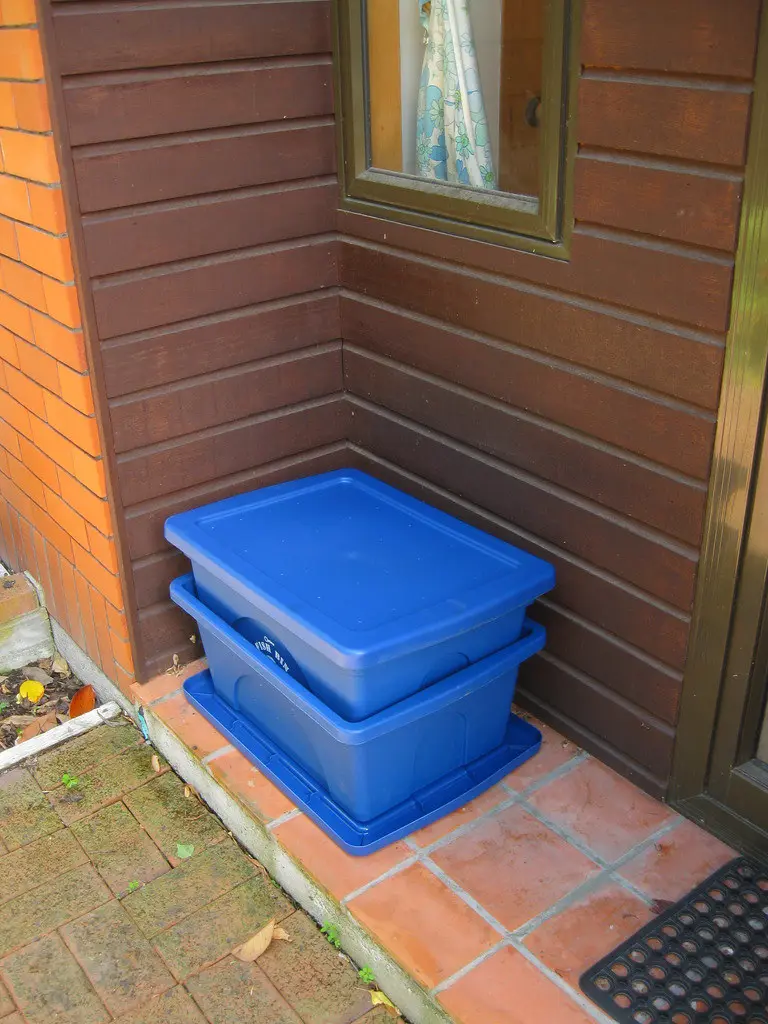
Should compost be mixed in or left on top?
Leave compost on top when the bed is established and roots are close to the surface. Mix it in only when the soil can be disturbed safely and the planting is young enough to handle it. Top dressing is the lower-risk choice for shrubs, perennials, and foundation beds with dense root systems.
Choose top dressing for established roots
Top dressing means spreading compost on the soil surface. It works well in old beds because it avoids full tilling and still supports soil biology at the surface. A 1-inch layer is a good starting point for maintenance, and around 2 inches is often about the upper end for many established plantings.
Choose shallow fork-in mixing for open soil
If a bed has open spaces between young plants, use a garden fork to blend compost into the upper few inches of soil, rather than working it deeply. Keep the work patchy and shallow. This helps clay loosen and allows oxygen to reach roots without creating a hard layer beneath the amended zone.
Choose full renovation only when the bed is being reset
Full renovation makes sense when you are regrading, replanting, or replacing failed soil. It is the most disruptive option, so it should be used sparingly. In long-lived beds with mature shrubs or trees, it can do more harm than good.
Step 1: Inspect the bed and soil first
Check the bed before adding anything. Soil type, root depth, and plant age should determine the method. Clay, sandy, rocky, and compacted beds all respond differently, and the wrong approach can leave the surface uneven or the root zone poorly drained.
How to read the soil quickly
Clay soil holds shape when squeezed and often drains slowly. Sandy soil falls apart and dries quickly. Rocky soil resists a fork and can leave compost stranded near the surface if the bed is worked too deeply. Compacted soil feels hard, tight, and difficult to push a tool into.
- Scrape back leaf litter and mulch to expose the soil surface.
- Look for crown flare on shrubs and perennials, and trunk flare on trees.
- Test drainage by watering a small patch and noting how long the water sits.
- Probe gently with a fork to find root depth and resistance.
- Decide whether the bed can take top dressing, shallow mixing, or no disturbance.
Step 2: Spread compost at the right rate
Use enough compost to change the upper soil, not so much that you smother roots or bury stems. For top dressing, 1 to 2 inches is the practical range for most established beds. For shallow fork-in work, keep compost limited to the top 4 to 6 inches of soil and avoid deep blending.
How much to use for common bed types
| Bed condition | Best method | Compost rate | Main risk to watch |
|---|---|---|---|
| Established shrub bed | Top dressing | 1 to 2 inches on the surface | Burying crown flare |
| Young perennial bed | Shallow fork-in | 2 to 4 inches blended into top 4 to 6 inches | Cutting feeder roots |
| Clay soil with compaction | Top dressing or shallow fork-in | 1 to 2 inches on top; limited incorporation only where open | Smearing and poor aeration |
| Sandy, low-fertility soil | Top dressing | 1 to 2 inches yearly | Drying too fast if left bare |
| Bed being rebuilt | Full renovation | Use compost as part of the new root-zone mix | Settling after regrading |
Keep compost away from stems and trunks
Do not pile compost against woody stems, canes, or tree trunks. Leave the crown and flare visible. If the bed needs a finished look, stop the compost several inches short of the stem base and finish the edge with mulch only after the soil is settled.
How deep should you work compost into clay, sandy, or compacted soil?
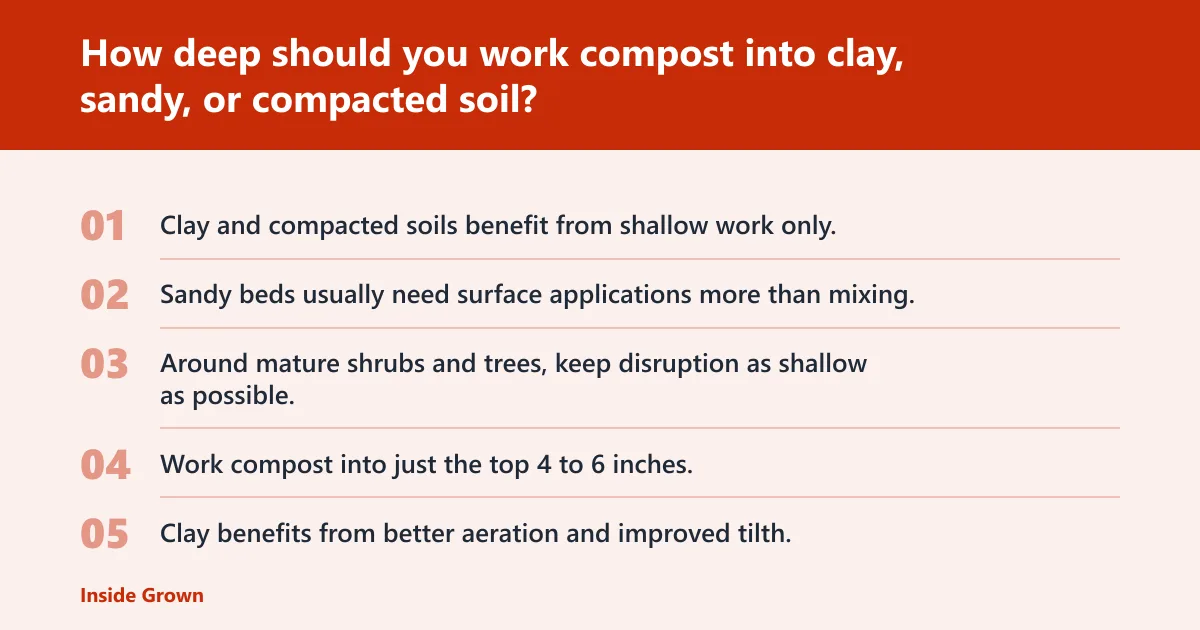
Depth depends on soil type and root density. Clay and compacted soils benefit from shallow work only, because deeper disturbance can smear the soil or damage roots. Sandy beds usually need surface applications more than mixing. Around mature shrubs and trees, keep disruption as shallow as possible.
Clay soil
Work compost into just the top 4 to 6 inches, and only where the bed is open enough to do so safely. Clay benefits from better aeration and improved tilth, but deep mixing can make a dense zone below the amended layer. Top dressing is often safer for older clay beds.
Sandy soil
Spread compost on top and let watering move fine particles downward over time. Sandy soil gains from better water retention, which helps it act more like a sponge and slows rapid drying. Heavy digging is usually unnecessary unless the bed is being rebuilt.
Compacted or rocky soil
Use shallow fork work to open channels, then add compost. On rocky ground, a surface layer can improve the upper root zone without fighting every stone. On compacted ground, avoid repeated deep turning; that can create uneven settling and poor drainage around roots.
Beds around shrubs, perennials, and trees
Shrubs and trees usually tolerate surface compost better than root-zone disturbance. Perennials can accept a light fork-in blend if the clump is not crowded. Foundation beds are often the most sensitive, because roots and irrigation lines may be close to the surface.
Say your 8-by-4-foot foundation bed has mature boxwoods and thin, pale soil. A 1-inch top dressing gives the roots a gentler path than a 4-inch dig-in would, and it avoids exposing irrigation lines or burying the shrub crowns.
Suppose a new perennial border on sandy soil dries out every afternoon. A 2-inch surface layer can slow moisture loss, reduce crusting, and support steadier root-zone moisture without disrupting young transplants.
Decision checklist and amendment-rate table
Use the bed, not the calendar, to choose the method. If roots are shallow, the planting is old, or the soil is already crowded, top dress. If the bed is open and compacted but still young, shallow fork-in blending can work. If the area is being rebuilt, start over.
Decision checklist
- Use top dressing if plants are established and root flare is already close to the surface.
- Use shallow fork-in blending if the bed is young, open, and only mildly compacted.
- Use full renovation only if you are regrading or replanting the bed.
- Avoid mixing deeply around mature shrubs, trees, or any plant with exposed surface roots.
- Stop if the soil stays waterlogged after watering; more compost will not fix a drainage flaw by itself.
Likely risks by soil type
| Soil type | Best compost use | Likely risk | What to avoid |
|---|---|---|---|
| Clay | Top dress or shallow fork-in | Poor aeration if worked too deeply | Deep tilling in wet soil |
| Sandy | Top dress | Fast drying if left bare | Leaving compost in thick ridges |
| Rocky | Top dress | Uneven settling | Forcing a deep blend through stones |
| Compacted | Shallow fork-in or staged renovation | Restricted root growth | Repeated deep digging around roots |
Common mistakes to avoid
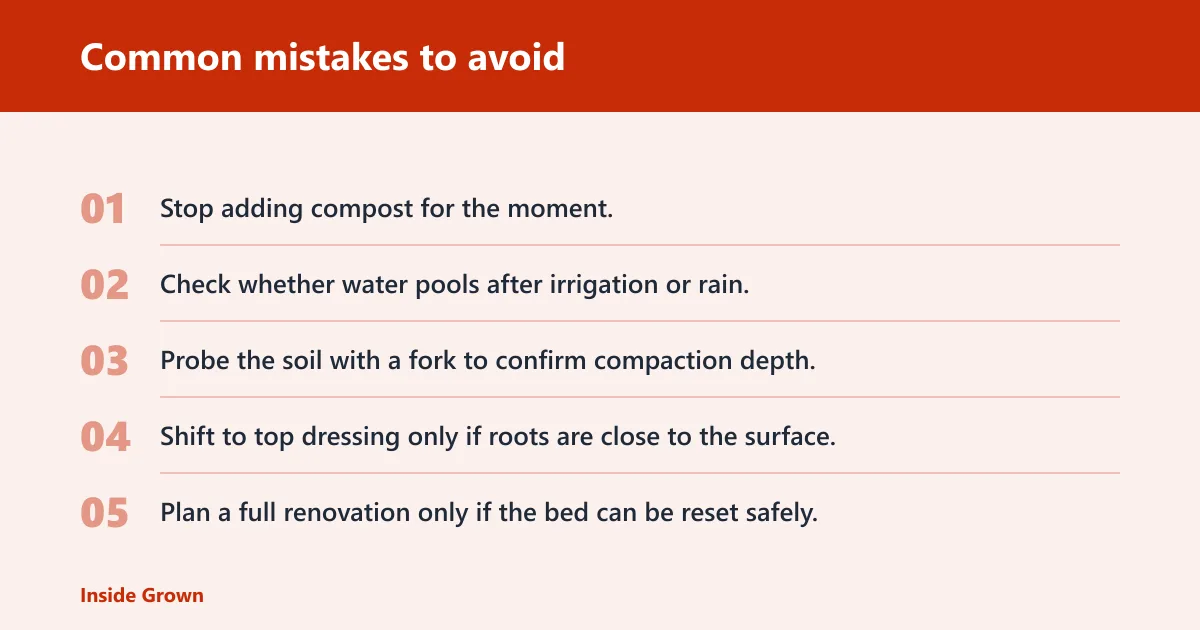
The most common failures are simple: too much compost, too much digging, and the wrong compost quality. Established beds usually suffer from overcorrection, not from too little effort. Keep the layer thin enough to settle without burying plant crowns or changing drainage patterns.
Burying crowns or flared trunks
If compost covers the crown of a perennial or the flare of a tree trunk, pull it back at once. Covered crowns stay wet longer and can rot. Around woody plants, the base should remain visible after the compost is spread.
Overamending with too much compost
Excess compost can leave soil overly loose at the surface and too fine below, which creates settling and drainage problems. It can also tilt the nutrient balance too far for some beds. Start with a modest layer, then reassess later instead of loading on more.
Using unfinished compost
Do not use compost that smells strong, still heats up, or has many recognizable pieces. Unfinished material is not stable enough for established roots. It can continue breaking down in place and compete with plants for nitrogen.
Creating a drainage layer that traps water
Do not make a sharp boundary between amended and unamended soil. That can hold water at the layer break instead of letting it move through. Blend only shallowly, or top dress and let time and biology do the mixing for you.
A common first-timer mistake is spreading a thick mound of compost around a rose bed and leaving the canes half buried. The safer fix is to pull the material back from the stems, level the layer, and keep the crown exposed.
If that didn’t work, try this next
If a bed still drains poorly after a light compost application, stop adding more organic matter and check the grade, irrigation, and soil compaction first. A drainage flaw usually needs water management or bed reconstruction, not just another layer of compost.
- Stop adding compost for the moment.
- Check whether water pools after irrigation or rain.
- Probe the soil with a fork to confirm compaction depth.
- Shift to top dressing only if roots are close to the surface.
- Plan a full renovation only if the bed can be reset safely.
Frequently asked questions
How do you mix compost into existing garden soil?
Use a fork or narrow spade to work compost only into the top 4 to 6 inches of open soil. Around established plants, top dressing is safer because it improves surface structure without cutting through a dense root zone. Keep compost off crowns and trunk bases.
How much compost should I mix into garden soil?
For established beds, use 1 to 2 inches on the surface for top dressing. If the bed is young and open, 2 to 4 inches can be lightly blended into the top 4 to 6 inches of soil. More than that raises the risk of settling and burial.
Should compost be mixed in or left on top of the soil?
Leave it on top for old beds with established roots, shrubs, or trees. Mix it in only where the planting is young or the soil is being rebuilt. Top dressing is the safer default because it avoids root damage and still improves soil tilth over time.
Can you add compost to an established garden bed?
Yes. Established beds often benefit from surface compost because it improves water retention, aeration, and surface structure without heavy disturbance. The main rule is to keep the layer thin, keep it away from stems, and avoid burying crowns or flares.
When is the best time to add compost to garden soil?
Compost can be added in spring, summer, fall, or winter. The better timing depends on soil moisture and plant stress. Apply it when the bed is workable and not saturated, then water lightly so the compost settles without washing into stems or drainage paths.
What kind of compost is best for existing soil?
Use well-decomposed compost that is fully broken down, does not smell strongly, and has few identifiable pieces. That finished material is stable enough for existing soil and safe for top dressing or shallow mixing. Avoid fresh, hot, or fibrous material in established beds.
Can you grow plants in straight compost?
Well-decomposed compost can support growth, but straight compost is usually better as a component than as the only root medium. For raised beds, mixing compost with loam is recommended. In established beds, compost works best as an amendment or surface layer, not a full replacement for soil.
How often should compost be added to garden beds?
Most established beds do well with a light annual top dressing, especially where soil is sandy, compacted, or low in organic matter. If the bed already holds moisture well and has good tilth, less frequent additions may be enough. Recheck crown height and drainage each time.