How to Prevent Clogged Drip Emitters in Hard Water
Flush lines monthly, clean filters every 2 to 4 weeks, and treat scale, sediment, and slime differently: vinegar or mild acid for mineral buildup, screen or disc filters for grit, and chlorination for biofilm. Skip that work and emitters clog, flow falls, and plants dry unevenly. This guide shows a simple homeowner routine for hard water and well water systems.
This guide is part of our Irrigation systems for home gardens series.
What you’ll need before you start

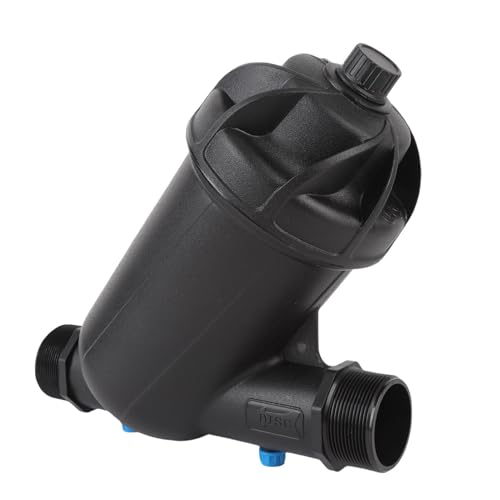


- Screen, disc, or mesh filter sized for the mainline
- Bucket and a clean water source for flushing
- Pressure gauge if one is already installed
- White vinegar or an approved acid cleaner
- Gloves and eye protection
- Spare emitters
- Flush caps or end plugs
- Extra tubing connectors
How do I keep drip emitters from clogging with hard water?
Use filtration, regular flushing, and periodic scale removal in that order. Hard water carries calcium and magnesium, and those minerals can leave calcium carbonate scale inside drip emitters. If the line also carries grit, the clog starts as sediment, then scale hardens around it.
Keep the routine simple. Clean the filter first, flush the lines next, then use acid cleaning only when mineral deposits are the problem.
Start with the water source
- Check whether the supply is well water or municipal hard water.
- Inspect a few emitters at the far end of the line for reduced discharge.
- Look for white crust, gritty residue, or slime at the outlet.
Match the fix to the clog
- Use filtration for sand, silt, and rust.
- Use flushing for loose particles in the tubing.
- Use acid cleaning only for mineral scale.
What kind of clog are you dealing with?
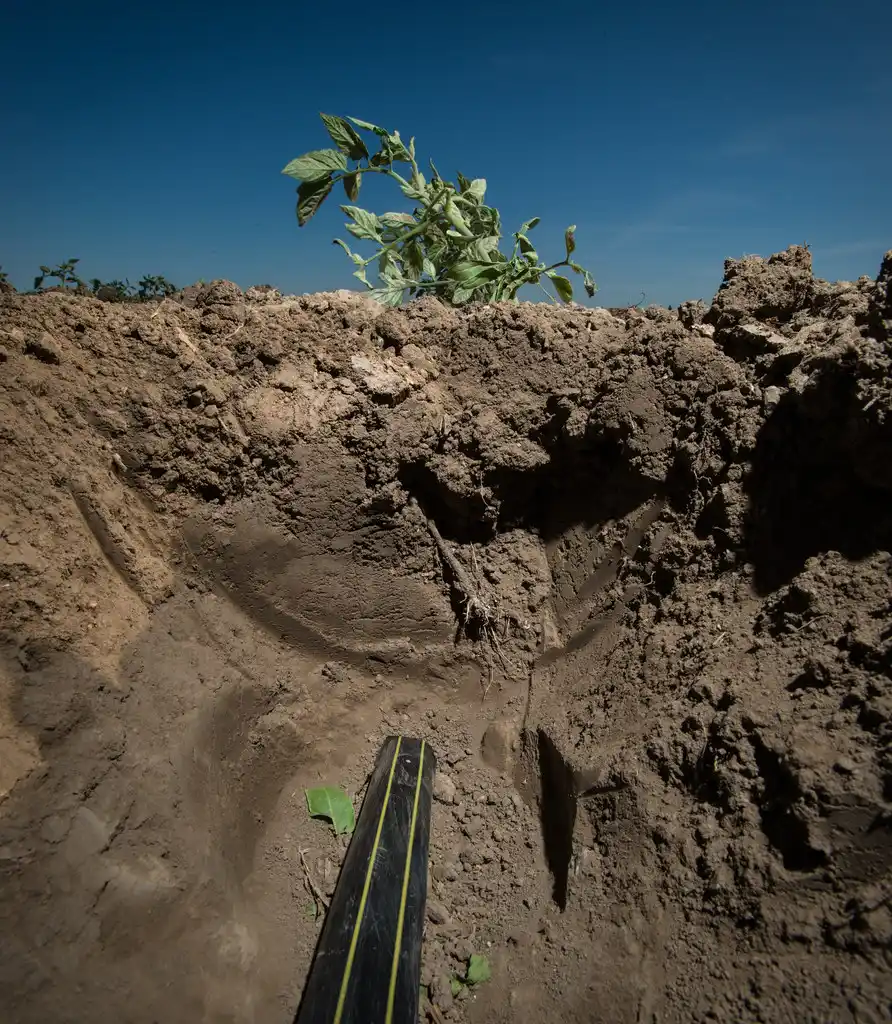
Sort out the problem before you clean anything. Clogging can come from physical, chemical, and biological factors. Physical clogging can be caused by sand, silt, or rust. Chemical clogging is calcium carbonate scale. Biological clogging can be caused by algae or bacterial slime.
That distinction matters because the wrong fix wastes time. A filter will not dissolve scale, and acid will not remove a wad of sand.
Quick clues you can see without tools
- White crust: mineral scale from hard water
- Gritty residue: sediment from well water or disturbed pipes
- Slippery film or dark slime: biological growth
- Uneven plant growth: inconsistent water delivery from clogged emitters
Step 1: Check the water source first
Well water often needs tighter filtration because it can carry silt, sand, rust, and minerals. Municipal hard water may look clear, but it can still leave deposits inside emitters over time. Reduced discharge at certain emitters is an early sign of clogging.
- Run the system and inspect the first, middle, and last emitters.
- Mark any emitter with weaker flow or an uneven spray pattern.
- Test two or three emitters before changing the whole system.
Use the pattern to narrow the cause
If only the end of the line weakens, pressure loss may be part of the problem. If random emitters weaken, debris or scale is more likely. Sloped gardens often magnify the difference, which is why pressure-compensating emitters are recommended for sloped lawns.
Step 2: Install the right filter and flush schedule
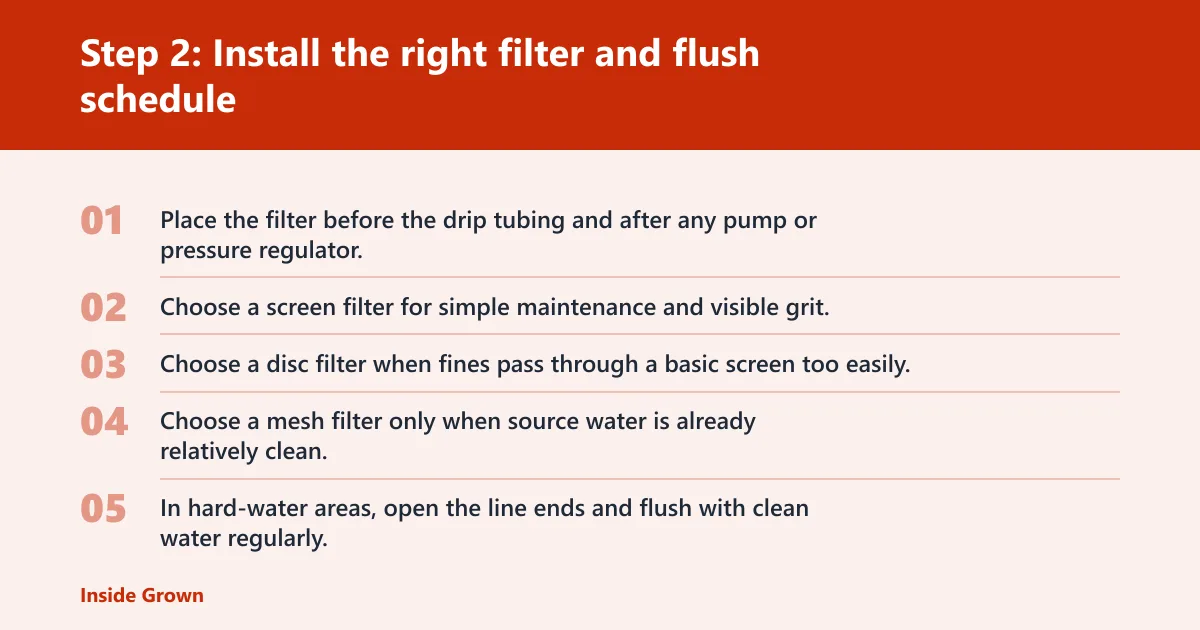
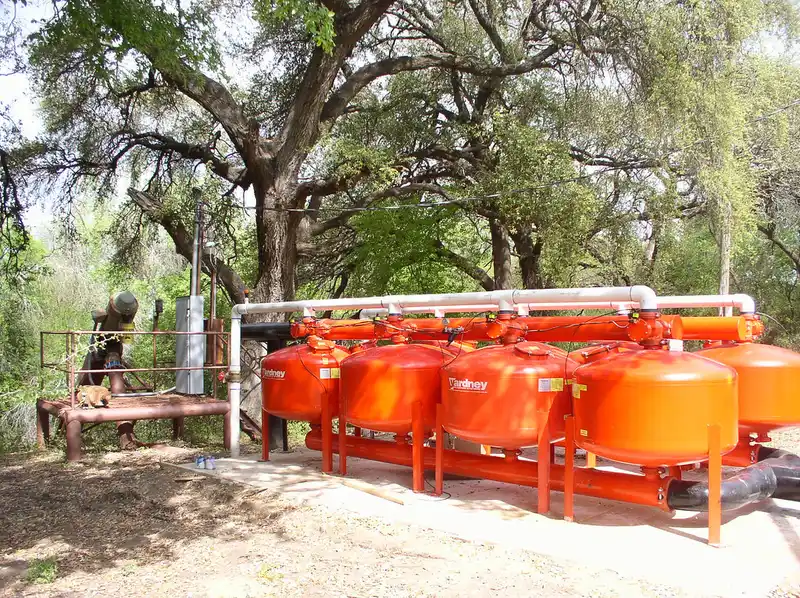
Proper filtration sits upstream of the emitters. For small gardens, a screen filter works well for light sediment, a disc filter handles finer debris better, and a mesh filter is useful when the water is already fairly clean and the goal is fine particle capture.
Flushing helps remove loose particles, but it does not remove mineral scale. That is why the filter and the flush are separate jobs.
- Place the filter before the drip tubing and after any pump or pressure regulator.
- Choose a screen filter for simple maintenance and visible grit.
- Choose a disc filter when fines pass through a basic screen too easily.
- Choose a mesh filter only when source water is already relatively clean.
- In hard-water areas, open the line ends and flush with clean water regularly, often about monthly.
- If the water is dirty or comes from a well, clean the filter regularly, often every few weeks.
When the schedule should be tighter
Increase cleaning frequency after rain, trenching, pump repairs, or any time sediment may have entered the line. Clay soils allow water to move farther than sandy soils, so emitter spacing can differ, but the filter and flush routine still needs to match the water source, not the soil.
Step 3: Clean mineral buildup before it hardens
Acid flushing is a chemical cleaning method that can dissolve mineral deposits inside pipes and emitters. It makes sense when flow drops, the filter is clean, and white scale is present. It is not a one-time cure, and it should be used periodically, not after every clog.
- Shut off the supply and isolate the drip zone.
- Mix the cleaner exactly as directed by the product label.
- Wear gloves and eye protection before handling the solution.
- Circulate or soak the line long enough to loosen scale.
- Rinse with clean water until the line runs clear.
If that didn’t work, try this next
- Remove the worst emitter and inspect the outlet for hardened scale.
- Soak the emitter in a mild acid solution if the part is removable and intact.
- Replace the emitter if flow does not recover after cleaning.
How do I tell whether the emitter is clogged or just under pressure?
A clogged emitter usually shows reduced discharge at one point or one short stretch of tubing, while low pressure tends to affect a larger section of the line. Pressure-compensating emitters help by holding more even discharge across pressure swings, especially on slopes. A quick flow check often separates the two.
Quick flow test
- Run the zone for a few minutes.
- Fill identical cups under three emitters: near, middle, and far.
- Compare the water level in each cup.
- If one cup is much lower, that emitter may be partially clogged.
- If all cups are low, pressure loss is more likely.
When pressure-compensating emitters are worth it
Use them in sloped gardens and in long runs where pressure changes across the line. They do not stop scale or sediment, but they reduce uneven watering from pressure variation and make flow checks easier to interpret.
One-page troubleshooting table and maintenance plan
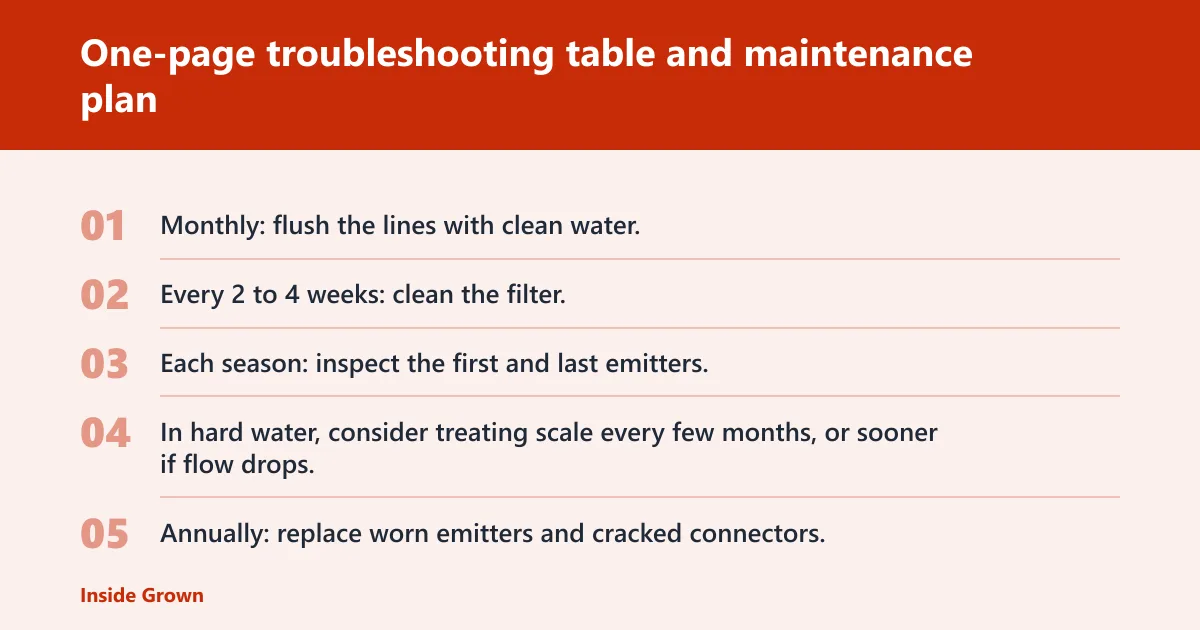
This table separates symptom, likely clog type, quick test, best fix, and maintenance interval for small gardens. Use it as a monthly checklist, then tighten the schedule if the source water is dirty or hard.
| Symptom | Likely clog type | Quick test | Best fix | Maintenance interval |
|---|---|---|---|---|
| White crust at emitter outlet | Mineral scale | Wipe with a damp cloth; residue stays white and chalky | Acid flush, then rinse | Every 2 to 3 months in hard water |
| Grit in end caps or flush water | Sediment | Catch flush water in a cup | Clean or upgrade the filter, then flush | Every 2 to 4 weeks for well water |
| Slippery film or dark slime | Biofilm | Rub residue between fingers | Clean lines, then disinfect per product label | As needed; check monthly in warm weather |
| One emitter weak, neighbors normal | Partial clog | Compare cups during a 5-minute run | Remove and clean, or replace if damaged | Inspect monthly |
| Whole row weak | Pressure loss | Check the start and end of the line | Check regulator, length, slope, and fittings | Each season |
Simple routine for small gardens
- Monthly: flush the lines with clean water.
- Every 2 to 4 weeks: clean the filter.
- Each season: inspect the first and last emitters.
- In hard water, consider treating scale every few months, or sooner if flow drops.
- Annually: replace worn emitters and cracked connectors.
Common mistakes
The biggest error is treating every clog as the same problem. A screen or disc filter will not remove calcium carbonate scale, and acid will not fix sand. Another common mistake is flushing too rarely, which lets loose particles settle and harden inside the line.
What goes wrong and how to avoid it
- No prefilter on well water: install one upstream before debris reaches the emitters.
- Flushing only after visible failure: flush monthly instead.
- Acid on every clog: use it only for mineral buildup.
- Ignoring slope: use pressure-compensating emitters in sloped areas.
- Keeping damaged emitters too long: replace severe clogs rather than soaking forever.
When should I replace a clogged drip emitter instead of cleaning it?
Replace the emitter when cleaning does not restore flow, the housing is cracked, or scale has narrowed the passage so much that discharge stays uneven. Severe clogs may require replacing drippers, especially after repeated acid cleaning or when the part looks distorted.
Replace it if any of these are true
- The emitter still runs weak after flushing and soaking.
- The plastic body is cracked, brittle, or warped.
- The outlet stays blocked with hard white scale.
- The cost of repeated cleaning exceeds a spare part.
Frequently asked questions
Does hard water cause mineral buildup in drip emitters?
Yes. Hard water contains calcium and magnesium, and those minerals can build up inside drippers as calcium carbonate scale. The safest response is regular flushing, routine filter cleaning, and occasional acid flushing when white scale is the main problem.
What filter should I use for drip irrigation on hard water?
Start with a screen or disc filter installed upstream of the emitters. Use a screen filter for lighter debris, a disc filter for finer particles, and a mesh filter when the source water is already fairly clean. If the water is well water, clean the filter more often.
How often should I flush drip lines to prevent clogs?
Flush monthly in hard-water areas and more often if the water source is dirty. Open the line ends, run clean water until the discharge looks clear, and then close the system again. Flushing removes loose particles, not mineral scale.
Can acid flushing clean mineral deposits in drip irrigation?
Yes, acid flushing can dissolve mineral deposits when scale is the issue. Use it only after confirming that the line is not packed with sand or slime, and rinse thoroughly afterward. It should be periodic maintenance, not the only cleaning method.
How do I tell whether a drip emitter is clogged or just low pressure?
Run a short flow test with identical cups under several emitters. If one emitter is weak while the others look normal, clogging is likely. If the whole line is weak, pressure loss, line length, or slope is the more likely cause.
Should I use pressure-compensating emitters in a sloped garden?
Yes, they are a good fit for sloped gardens because they keep discharge more even as pressure changes along the line. They do not stop sediment or scale, but they reduce uneven watering and make troubleshooting easier when the terrain changes pressure.