How to Prevent Backflow in a Home Irrigation Setup
Install an approved backflow preventer between your house water supply and the irrigation line, then select the device your local code allows for sprinkler or drip systems. Skip it, and irrigation water can siphon into drinking water, causing repairs, failed inspections, and possible fines. This guide shows which device to use, where it goes, and how to winterize it for a safe home irrigation setup.
Backflow basics for irrigation
Backflow is water moving the wrong way across the cross-connection between potable water and irrigation piping. That matters because irrigation lines can carry soil, fertilizer, pesticides, and bacteria. Irrigation systems are one of the highest-risk cross-connection categories, so device choice and installation details matter.
What causes irrigation backflow in the first place?
Two pressure failures drive most irrigation backflow. Backsiphonage happens when negative pressure in the supply main creates suction, such as during a water main break or firefighting demand. Backpressure happens when downstream pressure exceeds supply pressure, often because of pumping systems or fertigation.
Picture a lawn zone tied to a house line with no protection. If the street main loses pressure, irrigation water can be pulled toward the potable side. If a pump or injector raises downstream pressure, the flow can reverse for the same reason. The hazard is the reversal itself.
Why soil, fertilizer, and bacteria matter
The contamination risk is real. Soil and standing water can sit in laterals, sprinklers, and drip tubing. Add fertilizer or pesticides, and a cross-connection becomes a path for chemicals and microbes to reach the drinking-water supply. That is why local code treats irrigation as a serious hazard category.
Which backflow device fits your setup?
For a simple outdoor branch, an atmospheric vacuum breaker can fit if the device stays above the downstream outlet and never sees continuous pressure. For a typical residential in-ground sprinkler line, a pressure vacuum breaker is the common choice. For low-hazard underground-constrained systems, a double check valve assembly may be accepted. For higher-hazard or injection systems, an RPZ is the stronger option where local code allows it.
Atmospheric vacuum breaker for simple above-ground branches
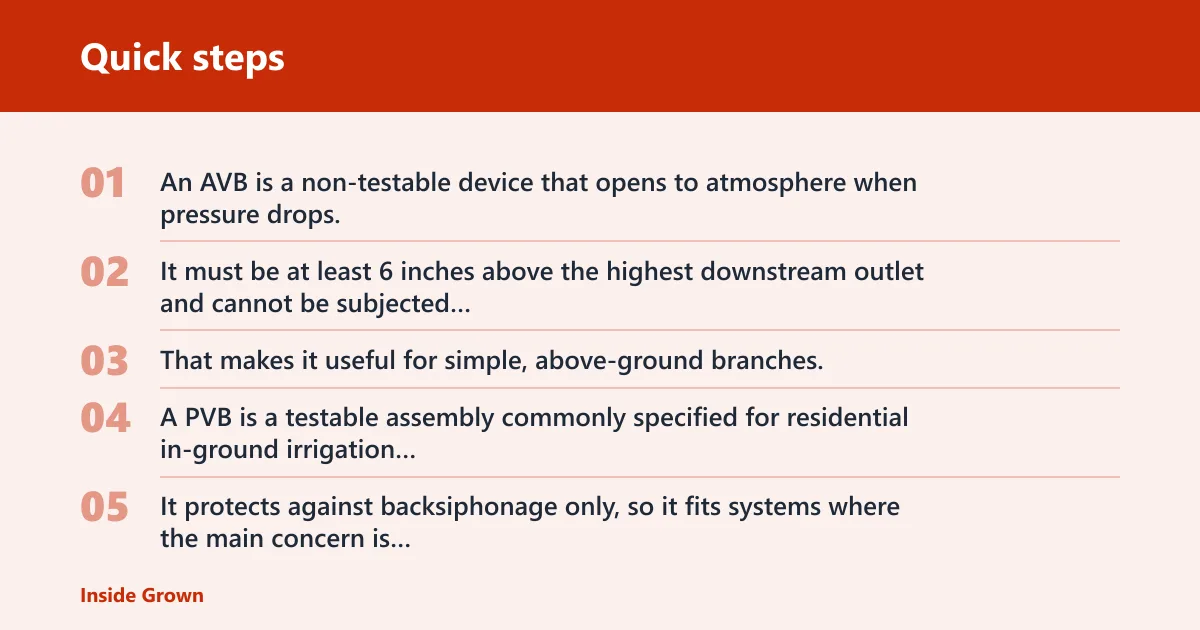
An AVB is a non-testable device that opens to atmosphere when pressure drops. It must be at least 6 inches above the highest downstream outlet and cannot be subjected to continuous pressure. That makes it useful for simple, above-ground branches, not for buried or constantly pressurized layouts.
Pressure vacuum breaker for common residential sprinkler lines
A PVB is a testable assembly commonly specified for residential in-ground irrigation systems. It protects against backsiphonage only, so it fits systems where the main concern is suction from supply pressure loss. It must be installed at least 12 inches above the highest downstream sprinkler head.
Double check valve assembly for low-hazard, underground-constrained setups
A DCVA uses two spring-loaded check valves in series. It is generally used for low-hazard applications and is often the practical choice where underground installation is needed. It is not the right answer for higher-hazard irrigation or chemical injection, because its protection level is lower than an RPZ.
Reduced pressure zone assembly for higher-hazard or injection systems
An RPZ uses two independently operating check valves and a differential pressure relief valve. It protects against both backsiphonage and backpressure, which makes it the higher-protection choice for higher-hazard irrigation, especially where chemical injection is present. Local code still controls final acceptance, so check the jurisdiction before you buy or install.
Irrigation backflow decision checklist
Use this table to narrow the safest likely path before you choose a device. The right answer depends on system type, contamination risk, whether chemicals are injected, and whether the assembly can sit above grade. Annual certified testing is more common for testable assemblies and is often required by local water authorities.
| System type | Contamination risk | Chemical injection | Above-ground or underground constraint | Safest likely device path | Annual certified testing needed? |
|---|---|---|---|---|---|
| Hose bib branch with short outdoor run | Low to moderate | No | Above-ground allowed | AVB if the outlet stays below the device and no continuous pressure is present | No for the device itself if non-testable; local code may still set inspection rules |
| Residential in-ground sprinkler system | High | No | Above-ground installation preferred for the assembly | PVB, if local code accepts it and the height rule can be met | Yes, for testable assemblies in many jurisdictions |
| Low-hazard buried branch where above-ground placement is not practical | Low | No | Underground constraint | DCVA, if local code accepts underground installation for that use | Yes, for testable assemblies in many jurisdictions |
| Fertilized drip or injection-fed irrigation | Higher hazard | Yes | Usually above-ground testable assembly needed | RPZ, subject to local code and sizing requirements | Yes, typically required for testable assemblies |
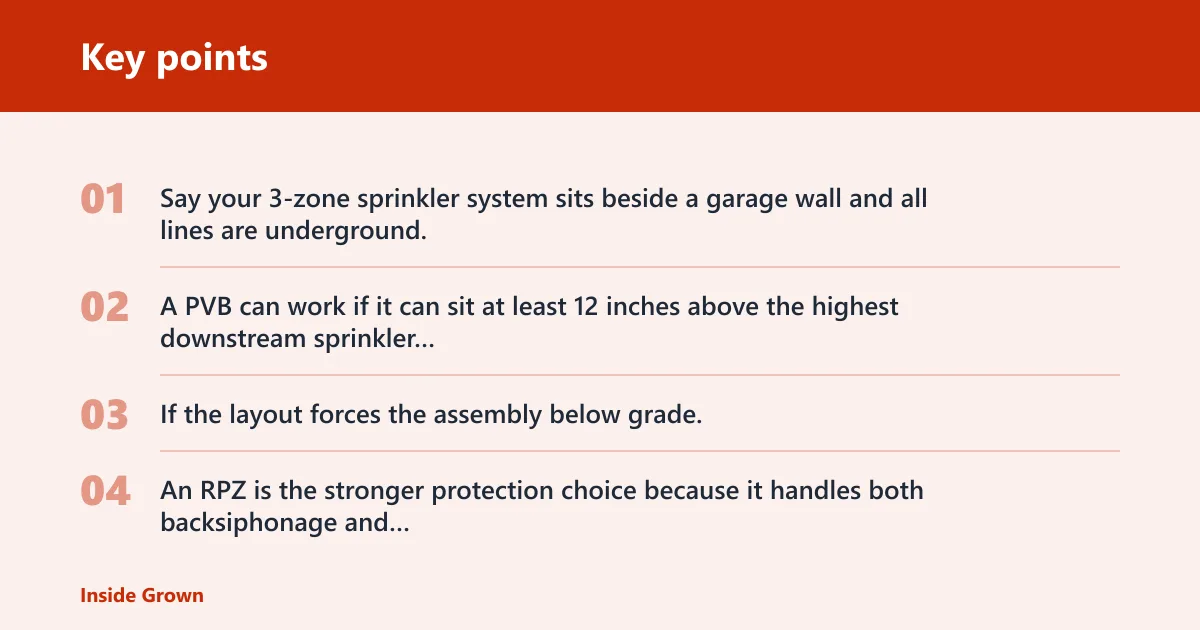
Say your 3-zone sprinkler system sits beside a garage wall and all lines are underground. A PVB can work if it can sit at least 12 inches above the highest downstream sprinkler head. If the layout forces the assembly below grade, a DCVA may be the code-accepted fallback for a low-hazard setup.
Suppose your drip system injects fertilizer. That changes the risk category. An RPZ is the stronger protection choice because it handles both backsiphonage and backpressure, but the final answer still depends on local code and whether the jurisdiction accepts that installation location.
Must-have
 Also greatVitaFlow Tool · 3/4 in. · Bronze Body · Dual Shutoff
- Heavy-duty corrosion-resistant brass body for durability
- Dual quarter-turn shutoff valves for easy operation
- Integrated test cocks enable quick servicing
Drawback: Limited to 3/4 inch FNPT connections.$69.99Price as of 12 Nov 2026View on Amazon →As an Amazon Associate we earn from qualifying purchases. Prices and availability are accurate as of the date shown and are subject to change

- Heavy-duty corrosion-resistant brass body for durability
- Dual quarter-turn shutoff valves for easy operation
- Integrated test cocks enable quick servicing
VitaFlow Tool 3/4″ Pressure Vacuum Breaker Assembly is the strongest fit for a common residential sprinkler line when you can meet the elevation rule. It is a testable assembly with dual shutoff valves and integrated test cocks, which matters for annual inspection and service. Its main drawback is that a PVB only protects against backsiphonage, not backpressure, and it still needs above-grade placement.
Our pickOrbit · 1 in. FPT · Automatic · Anti-siphon valve- Prevents water backflow to protect your system
- Includes flow control for precise irrigation adjustment
- Compatible with major 24 VAC irrigation controllers
Drawback: Requires above-ground installation on risers.$17.04Price as of 12 Nov 2026View on Amazon →As an Amazon Associate we earn from qualifying purchases. Prices and availability are accurate as of the date shown and are subject to change

- Prevents water backflow to protect your system
- Includes flow control for precise irrigation adjustment
- Compatible with major 24 VAC irrigation controllers
Orbit 1 in. FPT 100 Series Anti-Siphon Valve fits simple above-ground branches where an automatic anti-siphon valve is allowed. The flow control helps tune sprinkler output, and the valve works with major 24 VAC controllers. Its drawback is that anti-siphon valves are not the right answer for every buried layout, and they do not replace the need to follow local code for the cross-connection.
Nice-to-have
Upgrade pickPinrui · 1 in. · Double Check · Modular Design- Features two check valves in series for high-efficiency operation
- Durable stainless steel and reinforced nylon construction
- Compact and modular removable pressure vessel design
Drawback: Higher price point compared to standard anti-siphon valves.$219.00Price as of 12 Nov 2026View on Amazon →As an Amazon Associate we earn from qualifying purchases. Prices and availability are accurate as of the date shown and are subject to change

- Features two check valves in series for high-efficiency operation
- Durable stainless steel and reinforced nylon construction
- Compact and modular removable pressure vessel design
Pinrui 1″ Double Check Backflow Preventer is the fallback to study when you need a low-hazard, code-accepted option and underground installation is part of the job. Its compact modular design can help in tighter spaces. The drawback is simple: a DCVA is generally not the right choice for high-hazard irrigation or chemical injection, so it should not be treated as a universal substitute for an RPZ.
Consumables and spares
For irrigation backflow work, consumables are usually not replacement cartridges on the shelf. They are the parts and habits that keep the assembly serviceable: caps, drain access, clear labeling, and a plan for annual testing after repair or replacement. If a device is sticking, leaking, or cracked, replacement is often the better move than another seasonal patch.
- Shut off the water supply to the irrigation branch before draining.
- Open drain points or test cocks only as the manufacturer allows.
- Leave the assembly in a position that drains without trapping water.
- Mark the shutoff location so spring start-up is simple.
- Schedule a certified backflow tester after repair, replacement, or annual service when your local code requires it.
Budget setups
Use the table below as a quick path from system type to the most likely device tier. Prices are listed only where supplied. Always confirm size, approval, and local acceptance before you buy.
| Setup | Likely device | Why it fits | Price |
|---|---|---|---|
| Starter | Orbit 1 in. FPT 100 Series Anti-Siphon Valve | Best for a simple above-ground branch where anti-siphon protection is allowed | $17.04 |
| Mid | VitaFlow Tool 3/4″ Pressure Vacuum Breaker Assembly | Better fit for a common residential sprinkler line that needs a testable assembly | $69.99 |
| Serious | Pinrui 1″ Double Check Backflow Preventer | Useful where low-hazard underground installation is needed and local code accepts a DCVA | $219.00 |
How high should it be installed?
A PVB must be installed at least 12 inches above the highest downstream sprinkler head. An AVB must be installed at least 6 inches above the highest downstream outlet. Those clearances are not optional details; they are part of how the device breaks siphon conditions and keeps water from flowing backward.
Why orientation and access matter
Height is only part of the job. The assembly needs the correct flow direction, the right orientation, and enough access to inspect, drain, and test it. If a device is buried, jammed against a wall, or hard to reach, service becomes difficult and winter damage is more likely.
What to confirm before you buy
Check the manufacturer’s listing for the exact size, accepted installation orientation, and whether the device needs annual testing. For an RPZ, confirm that the jurisdiction accepts that model and assembly type for your hazard level. For a PVB, confirm that the 12-inch height rule can actually be met.
Winterizing and leak checks
Drain the assembly before hard freezes, shut off the supply, and open approved drain points or test cocks only as the manufacturer allows. A cracked body, a stuck vent, or a relief port that keeps discharging can point to freeze damage or internal wear. If the device cannot drain fully, it is at risk.
How to drain a backflow preventer for winter
Close the upstream supply, relieve pressure, and drain the assembly through the approved ports or drains. Leave the device in the position the manufacturer specifies for winter storage. Do not force a valve open or remove parts that are not meant to come off in the field. If the unit does not drain cleanly, have it checked before the next freeze.
How do I know if my irrigation backflow preventer is leaking?
Visible water from a relief port, a vent that drips after shutdown, or a valve that will not hold pressure are common warning signs. Repeated nuisance discharge is not normal. A small drip after service can be a sign of a failing check valve, damaged seat, or freeze-related cracking that needs repair or replacement.
When repair is not enough
If the body is cracked, the vent is stuck, the valve fails testing, or the same leak returns after service, replacement is usually the better decision. A certified backflow tester can verify whether the assembly still holds pressure after installation or repair. If it does not, the unit should not stay in service.
Irrigation backflow diagram essentials
A simple irrigation backflow preventer diagram should show the potable inlet, the backflow assembly, the direction of flow, the test cocks, the shutoffs, and the downstream irrigation lines. That lets you identify where the potable side ends and where the irrigated side begins.
What the parts tell you
The inlet points to the house supply. The arrows show the intended flow direction. Test cocks mark where a certified backflow tester connects gauges. Shutoffs show where you can isolate the assembly. Downstream lines show which zones are protected by that one device.
Why diagrams help during replacement
If the assembly has to be replaced, the diagram helps you match the new device to the old orientation and flow path. It also helps you spot a cross-connection that was built backward or tucked too low for the device type. That is a common reason a replacement job fails inspection.
Frequently asked questions
How do I prevent backflow in a home irrigation system?
Install the correct backflow preventer at the cross-connection between your potable water line and the irrigation piping, then place it at the height and orientation your code requires. Choose the device based on the system type and hazard level, and arrange annual certified testing whenever the assembly type or local rules call for it.
What type of backflow preventer do I need for a sprinkler system?
For many residential in-ground sprinkler systems, a PVB is the common choice because it is testable and widely specified. It must sit at least 12 inches above the highest downstream sprinkler head. If the system has injection or a higher hazard, an RPZ may be the more protective option, subject to code.
Can a backflow preventer be installed underground?
Not every device can. AVBs and PVBs depend on above-grade placement, and a PVB needs the 12-inch clearance above the highest downstream sprinkler head. A DCVA is the more common candidate where underground installation is needed, but local code still decides whether that setup is acceptable for your system.
Do I need a backflow preventer if I use fertilizers in my irrigation system?
Yes, that is the kind of setup that raises the risk. Fertilizer or other chemical injection creates a higher-hazard condition, and RPZ protection is often the safer path where local code allows it. The final device choice still depends on your jurisdiction, but fertilizer use should never be treated as a low-risk exception.
What does an irrigation backflow preventer diagram show?
A diagram usually shows the potable water inlet, the backflow assembly, the direction of flow, the shutoff valves, the test cocks, and the downstream irrigation piping. That layout helps you verify which zones are protected and whether the assembly is positioned high enough, accessible enough, and oriented correctly for service.