Best Landscape Lighting for Curb Appeal (2026): we compared
Best curb-appeal lighting often works in three layers: path lights spaced roughly 8–10 feet apart, a few uplights on the facade or trees, and a pair of lanterns at the entry; stop when the walk and door read clearly from the street. Skip that balance and the yard reads dim, patchy, or overlit, which can make even a good house look smaller and cheaper. This guide covers fixture mix, spacing, aiming, and wattage choices I use to get a calm front elevation without buying extra lights.
This guide is part of our Landscape lighting guide series.
Quick comparison

| Product | Badge | Best for | Price | ||
|---|---|---|---|---|---|
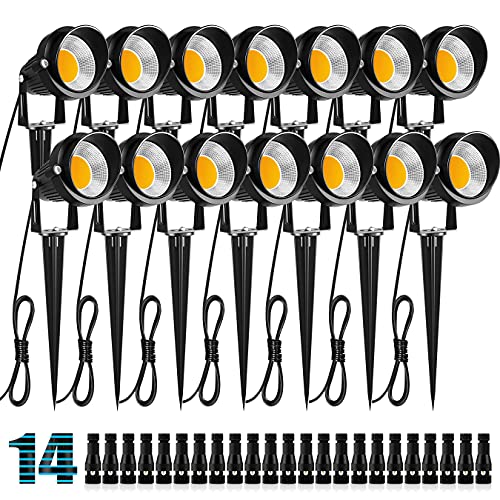 | ZUCKEO 10W Low Voltage Landscape Lights LED LandscapeZUCKEO | Our pick | 14 pack · 10W · 12V · 1000LM | $89.99 Price as of 28 Sep 2026 | View |
 | voona Solar LED Outdoor Lights 8-Pack Stainless Steelvoona | Budget pick | 8 pack · solar · stainless steel | $40.99 Price as of 28 Sep 2026 | View |
 | SUNVIE LED Low Voltage Landscape Lighting 12V LandscapeSUNVIE | Also great | 12 pack · 8 path + 4 spot · 12V | $149.99 Price as of 28 Sep 2026 | View |
 | CREPOW Spot Lights Outdoor, Smart RGBW LED Color ChangingCREPOW | Pair with it | 2 pack · RGBW · app & remote | $29.69 Price as of 28 Sep 2026 | View |
 | Gardencoin Complete Low Voltage Landscape Lighting Kit,Gardencoin | Upgrade pick | 12 pack · 5W · 200W transformer | $359.99 Price as of 28 Sep 2026 | View |
This comparison is about visual impact, not just lumens or price. The right mix depends on the house shape, the front walk, and whether the goal is soft welcome lighting or a stronger architectural read after dark.
According to How Much Does Landscape Lighting Cost in 2024? — The national average landscape lighting cost is $3,500.
How we chose
The shortlist favors curb appeal first. That means the fixtures had to do a visible job on a front elevation, not only light a path.
Glare control came next. A good front yard should feel calm from the street, with sources mostly hidden and beams aimed cleanly.
Durability mattered too, especially for wired LED and low-voltage systems that have to hold color and output through seasons.
Finally, installation practicality mattered: transformer needs, fixture count, and whether the layout makes sense for a small budget or a fuller, more formal front yard.

ZUCKEO 10W Low Voltage Front-Yard Lights: best for strong path and accent lighting
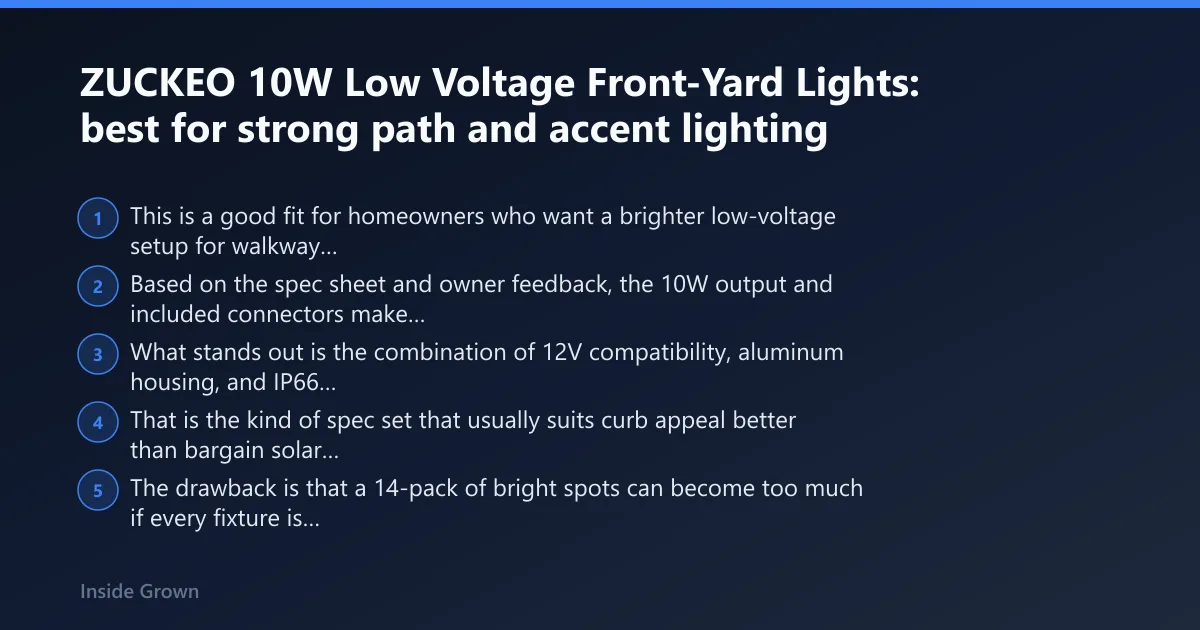
- Bright 10W LEDs with included wire connectors
- Aluminum housing with IP66 waterproof rating
- Low voltage compatible with most transformers
This is a good fit for homeowners who want a brighter low-voltage setup for walkway edges, planting beds, and small facade accents. Based on the spec sheet and owner feedback, the 10W output and included connectors make it easier to build a clear front-yard lighting layer without piecing together a lot of separate parts.
What stands out is the combination of 12V compatibility, aluminum housing, and IP66 waterproofing. That is the kind of spec set that usually suits curb appeal better than bargain solar stakes, because the light output stays more consistent and the fixtures tend to read as deliberate rather than temporary.
The drawback is that a 14-pack of bright spots can become too much if every fixture is used at full strength on a small home. The layout has to be restrained, or the front elevation can turn flat and harsh.
voona Solar LED Outdoor Lights: best for the cheapest entry-level path lighting
- Stainless steel construction with star pattern lens
- Solar powered with up to 8 hours runtime
- Wireless installation by simply pushing into ground
This suits a small budget where the main goal is to outline a walkway or driveway edge with minimal install effort. It is the easiest option here to place, because each light pushes into the ground and runs without wiring.
Its solar format is also the reason it lands low on the curb-appeal ladder. Simple solar-powered lights can cost as little as $50 each, but solar output is usually less consistent than wired low-voltage lighting, especially where shade or winter sun limits charging.
The drawback is performance consistency. For a front yard where the entry needs to read polished at night, solar often works as an add-on, not the core of the plan.
SUNVIE LED Low Voltage Front-Yard Lighting Kit: best for a balanced front yard
- Complete kit with 8 path lights and 4 spotlights
- Die-cast aluminum housing with IP65 rating
- Soft white 3000K light for consistent color
This is the most balanced layout option in the group for curb appeal-first lighting. The 8 path lights and 4 spotlights split the front yard into two jobs: guiding people to the door and giving the facade enough shape to look finished after dark.
The 3000K output is a strong point. Warm white keeps stone, siding, and porch finishes from looking icy, and that helps a house read more expensive without turning the yard into a spotlight display.
The drawback is simple: a kit can still be overused. If every fixture is aimed at the front wall, the look gets busy fast, so the spacing and aiming need discipline.
CREPOW Spot Lights Outdoor: best for colorful accents, not classic curb appeal
- Full color changing with app and remote control
- Music mode and DIY scene customization
- IP65 waterproof aluminum alloy housing
This is for homeowners who want color-changing features on special occasions or seasonal displays. The app control, remote, and RGBW output make it flexible for mood lighting, but that is a different goal from the quiet, upscale look most front yards need.
Based on the spec sheet, the IP65 housing is adequate for outdoor use, and the aluminum alloy body is a plus. Still, the biggest drawback is visual restraint. Color effects can pull attention away from the architecture and make the front of the house feel more playful than polished.
For curb appeal, this is best treated as accent lighting in limited doses, not the main plan.
Gardencoin Complete Low Voltage Front-Yard Lighting Kit: best for a larger or more formal house
- Complete kit with transformer and 150FT wire
- Auto dusk-to-dawn sensor with programmable timer
- Dimmable 5W spotlights replacing 50W halogen
This is the strongest all-in-one wired option for a larger front yard or a home with more facade to light. The included 200W transformer and 150FT wire make it easier to plan a complete low-voltage system without sourcing the backbone separately.
It also fits the layered approach well. The 5W spotlights are a better match for controlled accenting than oversized flood-style lighting, and the dusk-to-dawn sensor with programmable timer helps keep the system consistent from night to night.
The drawback is scale. A kit this complete can be more than a small front yard needs, and the cost makes more sense only when the property has enough frontage to use the extra fixtures well.
Quick picks
- Best overall: SUNVIE LED Low Voltage Front-Yard Lighting Kit for a clean path-plus-accent layout.
- Best for a small budget: voona Solar LED Outdoor Lights for the simplest path edging.
- Best for a larger or more formal house: Gardencoin Complete Low Voltage Front-Yard Lighting Kit for a fuller wired plan.
- Best for stronger accent brightness: ZUCKEO 10W Low Voltage Front-Yard Lights.
- Best for decorative color effects: CREPOW Spot Lights Outdoor, if the goal is seasonal mood lighting rather than classic curb appeal.
What is the best curb-appeal lighting?

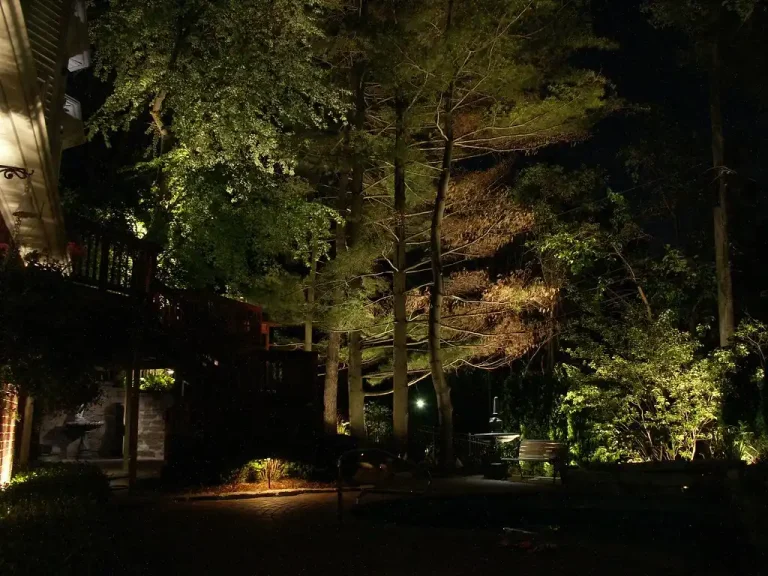
The best curb-appeal lighting is a layered low-voltage LED plan: path lights for the walk, uplights for key architecture or trees, and one pair of entry lights so the door reads clearly from the street. That mix looks more intentional than flooding the yard with extra fixtures.
Low-voltage lighting is typically 12V, uses a transformer, and usually gives more consistent output than solar for residential curb appeal. LED fixtures are the better long-term upgrade because they use less energy, last longer, and come in warm and cool color temperatures.
Path lights are usually the first layer because they define edges and keep the front approach readable. Uplights and wall lights do the visual work that makes a house look finished at night.
Where this works best
This setup fits most suburban front yards, especially where the house has a visible entry, a walkway, and at least one feature worth accenting. It also works well when the goal is to make the home feel more expensive without lighting every shrub.
Where it falls short
If the yard is very wide and open, a few fixtures can feel sparse. If the house has heavy shadows, a layout with only path lights will help safety but still leave the front elevation flat.
Which lighting makes a house look best at night?
The fixtures that make a house look best at night are the ones that define shape without exposing every source. For most homes, that means warm path lights, controlled uplights on trees or columns, and outdoor wall lights at the entry or garage to anchor the front elevation.
Downlights can be excellent when the goal is a softer, moonlight-like effect. They reduce glare when aimed correctly and make a front yard feel calmer than a row of bright spots pointed upward.
In-ground lights are the best choice when fixtures need to stay discreet. They work well along drives, edges, and clean hardscape lines where visible posts would clutter the view.
Premium-looking choices versus basic safety lighting
Basic safety lighting is about seeing the walk. Premium-looking lighting is about framing the house. Path lights can do both, but the more expensive look usually comes from fewer visible sources, warmer color temperature, and careful aim.
Floodlights can make a yard brighter, but they usually do not make it look better. A calmer, layered plan almost always reads more upscale.
Should I use low-voltage or solar lighting for curb appeal?
For curb appeal, low-voltage is usually the better choice. It runs on 12V through a transformer, gives steadier output, and handles a front elevation more evenly than solar lights, which depend on sun exposure and battery condition.
Solar lights make sense when wiring is impractical or the budget is very tight. Simple solar-powered lights can cost as little as $50 each, which helps for quick path marking, but they are usually not the first choice for a front yard meant to look polished at night.
If the goal is a more permanent, higher-end look, wired low-voltage LED lighting is the safer bet.
When solar is still useful
Solar works best for short runs, low-importance edges, or temporary seasonal use. It can also help homeowners test placement before committing to a wired install.
When wired low-voltage is worth it
Wired low-voltage is worth it when the front walk, entry, and facade all need to read together. That is the point where consistency matters more than convenience.
How many lights do I need for a front yard?
Most front yards need fewer fixtures than people expect. A simple design with 10 to 20 fixtures may cost $1,000 to $2,000, and that count is often enough for a modest facade, a walk, and one or two accents without overlighting the property.
For a larger front yard, 20 to 40 fixtures may be appropriate, but only if there is enough frontage, planting, and architectural detail to justify them. The goal is balance, not volume.
Start with the entry, the main path, and one focal point. Add more only when a feature still disappears at night.
Simple spacing strategy
- Light the walkway edges first, using path lights about 8–10 feet apart.
- Add one pair of entry lights or wall lights at the door or garage.
- Use 2–4 uplights on the facade, columns, or a feature tree.
- Stop when the route to the door reads cleanly and the house face has shape.
Signs you have too many fixtures
If the front wall looks flat, the lawn looks washed out, or the driveway edge competes with the entry, the system is too dense. Too many fixtures also make the home look smaller because the eye stops on the light sources instead of the architecture.
What type of lighting is cheapest to install?
The cheapest type to install is usually solar path lighting, because it does not require trenching, wiring, or a transformer. The lowest upfront cost can make sense for a fast refresh, especially on short walkways or side edges.
That said, cheapest to install is not the same as best for curb appeal. Wired low-voltage systems cost more to put in, but they usually look more consistent and more deliberate on the front of a home.
Outdoor wall lights can also be relatively affordable at the fixture level, with typical cost ranges from $50 to $250, but the installation still depends on where power already exists.
Where low install cost works
Use the cheapest option when the lighting job is small and the main goal is visibility. Short paths, rental properties, and temporary seasonal use are the best fits.
Where cheap lighting fails
If the front entry, facade, and walk all need to look coordinated, low-cost fixtures often fall short. Uneven brightness and mixed color temperatures are common failure points.
How much does lighting cost installed?
The national average lighting cost is $3,500. The typical lighting cost range is $2,100 to $4,900, and installed lighting can cost $100 to $250 per fixture depending on fixture type, layout, and wiring complexity.
A simple design with 10 to 20 fixtures may cost $1,000 to $2,000. A larger project with 20 to 40 fixtures may cost $2,000 to $5,000. Projects with 40+ fixtures may cost $5,000 to $7,000+.
That spread comes from the parts people do not always see: transformer sizing, wire runs, and how much time it takes to place fixtures cleanly without glare.
What drives the total
Fixture count matters, but fixture type matters too. Uplights and higher-end LED fixtures cost more than basic path lights, and a transformer adds to the system total.
Why the cheapest bid can look worse
A low bid often means fewer fixtures, weaker materials, or poor spacing. The result can be a front yard that is technically lit but still looks unfinished.
Which fixtures should I use for paths, trees, and entryways?
Use path lights for walkway edges, uplights for trees and facade features, and outdoor wall lights for porches and garages. That is the cleanest division of labor for curb appeal because each fixture has a clear visual job and does not fight the others.
For paths, path lights are often the first layer for safety and frontage. For trees and columns, uplights add depth and make the home feel more architectural. For porches and garages, wall lights help the front of the house read clearly at night.
If the fixtures need to stay discreet, in-ground lights are the better choice along drives or hardscape edges.
Fixture-by-feature decision table
| Front-yard feature | Best fixture type | Typical wattage tier | Glare risk |
|---|---|---|---|
| Walkway | Path lights | Low | Low if spaced 8–10 feet apart and aimed downward |
| Facade | Uplights or wall lights | Low to medium | Medium if fixtures are too close or aimed too high |
| Trees | Uplights | Low to medium | Medium if the beam hits eyes from the street |
| Porch | Outdoor wall light | Low | Low when fixtures are shielded and placed at entry height |
| Driveway edge | In-ground lights | Low | Low to medium if the beam is too tight or too bright |
How do I make lighting look high-end instead of glaring?
High-end lighting looks controlled. That means warmer color temperature, fewer visible fixtures, careful aim, and enough spacing to define the yard without turning it into a runway or floodlit lot.
Glare usually comes from three mistakes: fixtures placed too high in the sight line, too many lights on one feature, or mixed color temperatures that make the front of the house feel chaotic. A low-voltage system with LED fixtures helps, but the layout still matters more than the hardware.
Downlights are a smart choice where a softer, moonlight-like effect is wanted. They reduce glare when aimed well and can make the front elevation feel calmer than upward beams alone.
Practical rules that keep the look refined
- Use path lights only where people actually walk.
- Pick one color temperature and stick to it across the front yard.
- Keep uplights off the windows unless there is a clear design reason.
- Use wall lights at the entry to anchor the front door and garage.
- Add fewer fixtures first, then adjust aim before buying more.
Which one should you buy
For the smallest budget, the voona Solar LED Outdoor Lights are the easiest starting point, but they should be treated as a basic path solution rather than the full curb-appeal plan. For most homes, the SUNVIE kit is the best balance of path lights and accent spots.
If the front yard is larger or the house is more formal, the Gardencoin kit gives the most complete wired setup. If stronger accent brightness is the goal, the ZUCKEO option is the better dedicated spot light choice.
The CREPOW set only makes sense when color and seasonal effects matter more than a classic upscale look. For a front yard that needs to feel calm, complete, and polished, the answer is usually wired low-voltage LED with restrained fixture count.
Frequently asked questions
What is the best curb-appeal lighting?
The best setup is a layered low-voltage LED plan with path lights, a few uplights, and entry wall lights. That mix gives the front yard shape, keeps the walk readable, and avoids the flat look that comes from using only one fixture type or too many bright lights.
Which lighting makes a house look best at night?
Uplights, outdoor wall lights, and well-spaced path lights usually make a house look best at night. Uplights add depth to trees and architecture, wall lights frame the entry, and path lights keep the approach clean without washing out the front yard.
Should I use low-voltage or solar lighting for curb appeal?
Low-voltage is usually better for curb appeal because it runs on 12V through a transformer and gives more consistent output than solar. Solar can work for a small budget or a quick path refresh, but it is less dependable when the front yard needs to look polished every night.
How many lights do I need for a front yard?
Start with enough to light the walk, the door, and one or two key features. For many homes, 10 to 20 fixtures is enough for a simple design, while larger front yards may need 20 to 40. Add lights only when a specific area still disappears at night.
What type of lighting is cheapest to install?
Solar path lighting is usually the cheapest to install because it avoids wiring and transformer costs. It is a practical short-term choice, but it rarely gives the same finished look as a wired low-voltage system when the goal is strong curb appeal.
How much does lighting cost installed?
The national average lighting cost is $3,500, with a typical range of $2,100 to $4,900. Installed lighting can run $100 to $250 per fixture, while larger projects with more fixtures move quickly into the multi-thousand-dollar range depending on layout and complexity.