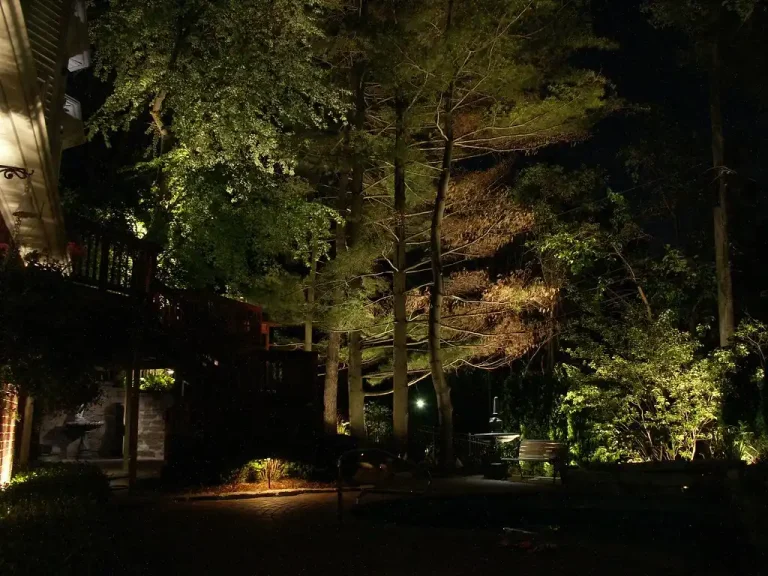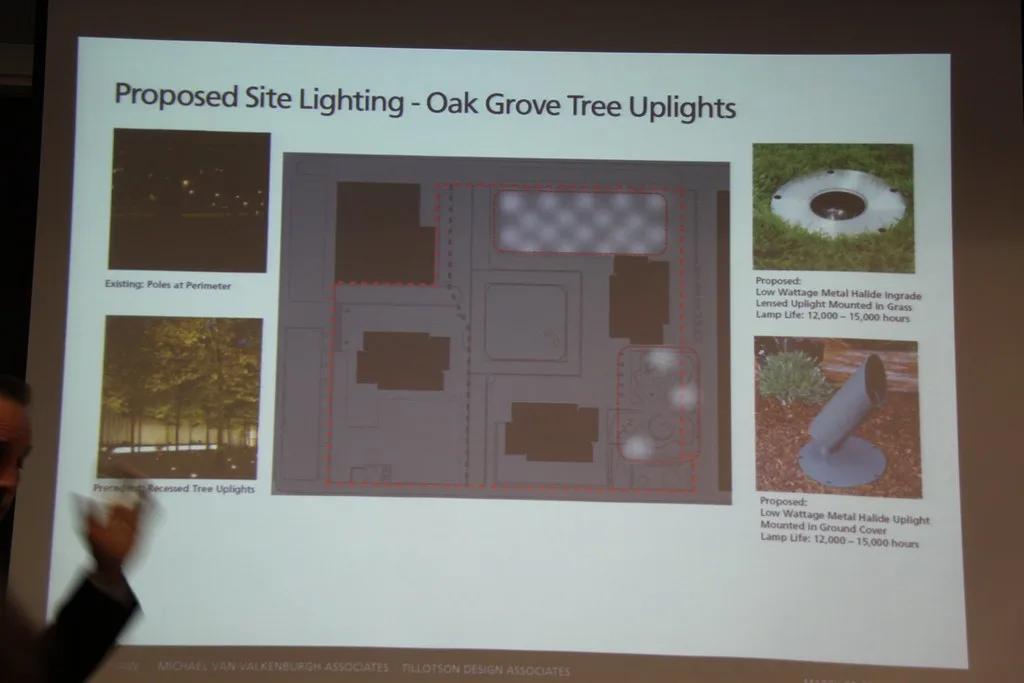
How to Light Trees with Landscape Fixtures Correctly
Set a narrow-beam low-voltage spotlight about 1/3 to 1/2 the tree’s canopy width from the trunk, then tilt it up so the beam covers the crown without throwing glare into the lens. Poor placement leaves trunks blown out, canopies patchy, and fixtures visible from the yard. This guide shows how to match fixture type, beam angle, and setback to the tree’s shape for clean uplighting.
This guide is part of our Landscape lighting guide series.
What you’ll need


- Bullet lights for narrow, controlled beams
- Well lights for flush, in-ground uplighting in active areas
- Flood fixtures for broad canopies
- LED lamps in the 3–10 watt range for most tree uplighting
- Low-voltage lighting transformer, 12-volt system
- Direct burial cable, 12-gauge or 10-gauge for runs longer than 100 feet
- Wire connectors rated for outdoor use
- Stake or mounting hardware for the chosen fixture type
- GFCI-protected power source
- Basic hand tools, tape measure, and shovel
📊 Low-voltage landscape lighting systems operate on 12 volts. Source: Tree Uplighting Guide: Highlight Trees with Outdoor.
What tree lighting should do at night
Pick the effect before you pick the fixture. A good tree setup makes the trunk legible, gives the canopy shape, and keeps the fixture itself out of view. If the beam lands only on bark, the tree can read flat; if it fills only the outer leaves, the trunk disappears and the tree can look like a floating mass.
Read the tree structure first
Look for four things: trunk, canopy, first major branching point, and whether the tree is multi-trunk. Those traits decide where light should land. A columnar tree needs a tighter beam and a lower spread. An open-canopy shade tree needs light that reaches into the crown and catches interior branching.
What you’ll need to decide before layout
- Pick the tree part you want to read first: trunk, canopy, or both.
- Measure the widest canopy spread and note the first major branching point.
- Choose a fixture type that matches the form, not just the size.
- Mark the likely setback so the lens stays out of the hot spot zone.
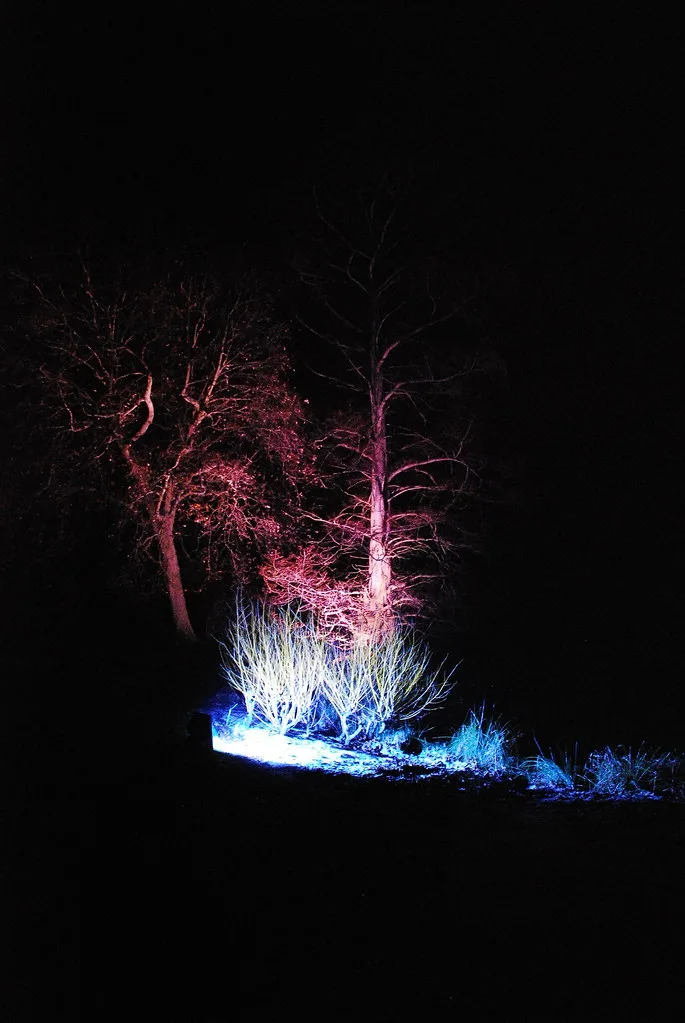
How do you plan the layout before you dig?

Map the tree form, not just the trunk location. Measure canopy width, note whether the crown is columnar or broad, and decide if you want trunk-first, canopy-first, or mixed lighting. For most trees, set the fixture 1–3 feet from the trunk, then adjust the beam so it lands on the target zone without washing out the bark.
Step 1: Choose the fixture type for the tree form
Bullet lights suit narrow beams on trunks and architectural details, especially when you want a focused accent. Well lights are flush-mount uplights that stay nearly invisible by day and work well in high-traffic areas. Flood fixtures spread light across wider canopies, including oak- or maple-like trees with broad crowns.
Step 2: Set beam angle, wattage, and setback
Use narrower beams for tall, columnar trees, and wider beams for broad canopies. A narrow beam is useful when you want a tight, facade-style effect on a trunk or specimen stem. Keep most LED lights in the 3–10 watt range, and go lower in small yards to cut spill and glare.
Step 3: Place the lights to shape the effect
Aim at the trunk when you want texture and vertical emphasis. Aim into the canopy when you want fullness and depth. Use two fixtures when one beam cannot cover the crown cleanly. That second beam is often what prevents a lopsided canopy and keeps the tree from reading flat against the house or fence.
Step 4: Size the transformer and route the cable
Use a 12-volt low-voltage landscape lighting transformer with at least 20% headroom over total connected wattage. Mount it near a GFCI outlet and at a modest height above grade. Run direct burial cable at least 6 inches deep, and use 12-gauge or 10-gauge for runs longer than 100 feet.
How many lights do I need to light a tree?
The right count depends on tree form, height, and canopy density. Small trees may need one or two fixtures, while larger trees often need three or more to avoid a bright trunk and dark outer edges. The goal is even reading, not maximum brightness. Too much output makes small trees look harsh and flat.
| Tree form | Fixture type | Beam angle | Setback from trunk | Number of fixtures | Most likely mistake |
|---|---|---|---|---|---|
| Columnar tree | Bullet light | 10°–15° | 1–2 feet | 1–2 | Using a wide beam that spills past the crown |
| Open-canopy shade tree | Flood fixture | 45° or wider | 2–3 feet | 2–4 | Lighting only the trunk and leaving the canopy spotty |
| Multi-trunk tree | Bullet light or well light | 15°–45° | 1–3 feet | 2–3 | Aiming one beam at the center and losing side stems |
| Evergreen | Bullet light | 10°–15° | 1–3 feet | 1–3 | Starting too high and missing the lower structure |
| Specimen tree | Bullet light plus flood fixture | 12° plus 45°–60° | 1–3 feet | 2–5 | Creating a floating-tree effect by ignoring the trunk |
This Old House says trees under 20 feet may need two 20-watt uplights, while larger trees may require three to five uplights. It also recommends 35 to 50 watts each for larger trees and lighting both trunk and canopy to prevent a floating effect. Use that as a planning check, not a default for every yard.
How do you avoid glare when lighting trees?
Keep the lens out of direct sight lines, use lower wattage when the yard is small, and avoid aiming the beam into windows, patios, or seating areas. Glare usually comes from a fixture that is too bright, too close, or aimed too flat. Dirty lenses and a shifted stake can turn a good layout into a bright nuisance.
If that didn’t work, try this next
- Move the fixture farther from the trunk in small increments until the hot spot softens.
- Reduce lamp wattage before widening the beam, because extra beam spread can worsen spill.
- Angle the head slightly away from viewing areas if the fixture is visible from the yard edge.
- Switch exposed fixtures to well lights in paths or other high-traffic zones.
Two common scenarios
Say your 14-foot maple throws a bright oval on the bark but the outer leaves disappear. Move one flood fixture a foot farther out and add a second beam aimed into the canopy. That usually fixes the flat look and reduces trunk washout.
Suppose your 9-foot ornamental tree sits beside a patio and the lens is visible at eye level. A well light or a lower-output bullet light with a narrower beam will usually control glare better than a wide flood fixture.
Can I use well lights for tree uplighting?
Yes. Well lights are a strong option when you want the fixture nearly invisible by day or need a safer choice in high-traffic areas. They work best when soil drainage is reasonable and when the tree does not need a sharply controlled beam. They are less ideal if you need a very tight trunk accent.
When well lights make sense
Choose them near walkways, lawns, and play areas where an exposed fixture could be kicked, snagged, or mowed around. They also help when you want the light source hidden but still want upward illumination on the trunk and low branches. Use them carefully around debris or mulch that can block the lens.
How do I size a transformer for tree lights?
Start with total lamp wattage, then add at least 20% headroom. A 12-volt transformer should be mounted near a GFCI outlet and ideally about 12 inches above grade. That margin helps the system stay stable as you add a fixture later or swap to a slightly higher-output lamp.
Quick sizing check
- Add the wattage of every lamp on the run.
- Multiply that total by 1.2 for headroom.
- Choose a transformer rated above that number.
- Keep the unit near the GFCI-protected source.
If the run is long, pair the transformer with proper cable size. For runs longer than 100 feet, 12-gauge or 10-gauge cable is recommended. That helps limit voltage drop, which is a common reason distant fixtures look dimmer than the ones near the transformer.
What wattage should I use for tree lights?
Most tree uplighting examples work well with LED landscape lights in the 3–10 watt range. Lower output is often better in small yards, because it limits glare, spill, and overlighting. LEDs also run cooler than halogen and can last 25,000–50,000 hours, which makes them a practical choice for repeated seasonal use.
How wattage changes the look
Use lower wattage when the tree is close to a porch, patio, or window. Use more output only when the tree is large enough to absorb it. Brightness cannot fix a poor beam angle or wrong setback. If the light misses the canopy shape, extra watts usually just make the mistake easier to see.
Common mistakes to avoid
The most common errors are easy to spot once you know the pattern: a beam that is too narrow for the crown, a fixture pushed against the trunk, or too much power on a small tree. Seasonal growth, dirt on the lens, and a shifted fixture can also change the effect after the first week.
- Placing fixtures against the trunk: Keep 1–3 feet of setback to reduce hot spots and trunk washout.
- Using the wrong beam: Narrow beams suit columnar forms; wide beams suit broad crowns.
- Overlighting small trees: Drop wattage before you widen the beam.
- Ignoring seasonal growth: Re-aim after canopy expansion or pruning.
- Skipping cleanup: Dirty lenses cut output and skew the beam.
Prevention
Mark each fixture position after the night test and check the aim again after the first major leaf flush of the season. A slight shift in stake position or a few inches of new growth can change the beam pattern enough to bring back glare or shadow gaps.
What type of fixture is best for trees?
The best fixture depends on the tree form and the visual goal. Bullet lights are best for narrow, controlled beams on trunks or architectural details. Well lights are best when you need a low-profile fixture in a busy area. Flood fixtures are best when the tree has a broad canopy that needs even spread across the crown.
How far should lights be from a tree trunk?
Set fixtures 1–3 feet from the trunk in most cases. That distance is close enough to read bark texture and lower branching, but far enough to avoid a bright hot spot at the base. If the crown is wide, you may move the fixture outward slightly so the beam reaches the canopy cleanly.
What beam angle is best for uplighting trees?
Use 10°–15° for tall, columnar trees and 45°–60° for broad canopies. A 12° beam is useful when you want a tight, precise trunk accent. Beam angle should follow the tree form, because a beam that is too narrow will miss foliage and a beam that is too wide will spill into the yard.
Should tree lights point at the trunk or canopy?
Point at both when you can. Trunk light gives texture and vertical emphasis, while canopy light adds fullness and depth. If you aim only at the trunk, large trees can look flat. If you aim only at the canopy, the tree can appear to float. A mixed approach usually gives the cleanest read.
Frequently asked questions
How far should landscape lights be from a tree trunk?
Start 1–3 feet from the base of the trunk. That placement avoids a harsh hot spot and gives the beam room to rise into the tree. For broader crowns, nudge the fixture outward until the canopy reads evenly and the lens is no longer visible from common viewing angles.
What beam angle is best for uplighting trees?
Use 10°–15° for columnar forms and 45°–60° for broad canopies. If you need a very tight accent on a trunk or stem, a 12° beam is a practical choice. Match the beam to the tree shape first, then fine-tune the aim after dark.
How many lights do I need to light a tree?
Small trees often need one or two fixtures, while larger trees may need three to five. Trees under 20 feet may use two 20-watt uplights, and larger trees may take three to five fixtures. Add lights only when one beam cannot cover the trunk and crown without leaving dark gaps.
Should tree lights point at the trunk or canopy?
Point at the trunk when you want bark texture and a stronger vertical line. Point into the canopy when you want volume and depth. Many trees look best with one fixture aimed lower and another aimed higher, because that pairing prevents the floating-tree effect.
What type of landscape fixture is best for trees?
Use bullet lights for narrow, controlled accents, well lights for flush, low-visibility installs, and flood fixtures for wide crowns. Broad shade trees usually need the spread of a flood fixture, while columnar trees benefit from the tighter control of a bullet light.
How do I avoid glare when lighting trees?
Use lower wattage, keep fixtures out of direct sight lines, and avoid putting the lens too close to seating areas or windows. If glare persists, move the fixture farther from the trunk or switch to a well light. Dirt on the lens can also turn a soft beam into a harsh one.
Can I use well lights for tree uplighting?
Yes. Well lights are a good choice where exposed fixtures would get in the way or where you want the hardware to disappear during the day. They are especially useful in active areas, but they still need clear drainage and a clean lens so the beam stays usable.
How do I size a transformer for tree lights?
Add the wattage of all lamps, then choose a transformer with at least 20% more capacity. For example, a 60-watt load needs at least 72 watts of rated capacity. Mount the unit near a GFCI outlet, and keep it about 12 inches above grade when possible.
What wattage should I use for landscape tree lights?
Most tree uplighting works well with 3–10 watt LEDs. Use the lower end for small trees, tight yards, and any spot where glare is a concern. Larger trees can take more output, but wattage should follow the beam angle and setback, not replace them.