
How to Calculate Wattage for Landscape Lighting
Add the wattage of every fixture on each low-voltage run, then size the transformer at roughly 125% of that load. Undersize it and the lights dim, the transformer runs hot, and later fixture additions can push the system past its limit. This guide shows how to total wattage by circuit type, apply a safety margin, and choose the right transformer size.
Landscape wattage planning table

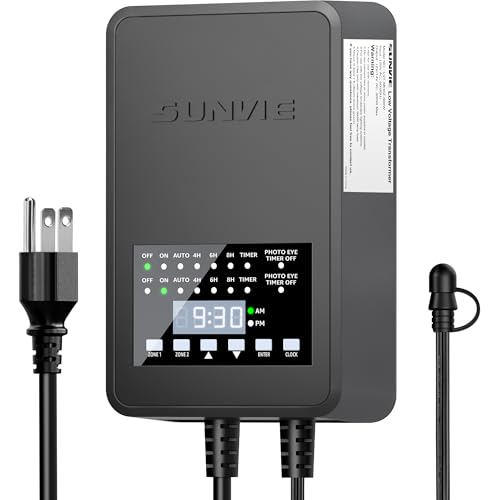
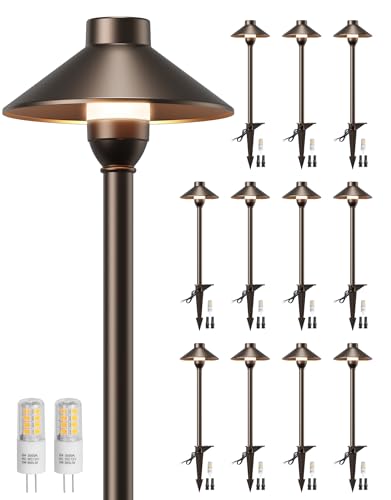

This table turns common fixture types into a planning load. Use it to estimate circuit wattage before you choose a transformer. The headroom column shows how much extra capacity you should leave, with at least a 20% buffer when the run is long or you expect more fixtures later.
| Fixture type | Typical watts per fixture | Example fixture count | Recommended transformer headroom |
|---|---|---|---|
| Path light | 1 to 7W LED | 5 lights | At least 20% above the run load |
| Spot or uplight | 3 to 15W LED | 4 lights | 20% to 30% above the run load |
| Deck or step light | 0.5 to 4W LED | 6 lights | 20% above the run load, more if the run is long |
| Flood or security light | LED units vary; many are described by lumen output, often 700+ lumens | 2 lights | Plan a separate run if the wattage pushes the circuit near capacity |
How do you calculate wattage for landscape lighting?
Multiply the number of fixtures on one low-voltage run by the wattage of each fixture, then add the results for each separate zone. For a 12V landscape lighting system, that total is the load the transformer must support. Keep path lights, tree lights, and step lights separate when their wire lengths or brightness needs differ.

Use one run at a time
Start with a single circuit, not the whole yard. If a path has five lights at 10W each, that run draws 50W. If a tree group has four lights at about 8W each, that is about 32W on a separate run or zone. Do not average those numbers together unless they truly share one circuit.
A common first-timer mistake is to count every fixture in the yard as one total and stop there. That ignores how the wire is actually laid out. A 12V system can handle mixed fixture types, but each run still needs its own wattage total and voltage-drop check.
Worked front-walk example
Say your front walk is 40 feet long and you place pathway lights about every 8 feet. That gives 5 fixtures, which matches one common sample calculation. At 10W each, the run totals 50W. A 60W transformer may be too tight once margin is added, while 100W gives more room.
How much transformer capacity do you need?
Choose a transformer rated above the actual load, not equal to it. A 20% buffer is a common minimum, and 20% to 30% is a better planning range when the run is long or the lighting may expand. That extra capacity keeps the transformer cooler and leaves room for later fixtures.
Match the load to common sizes
Think in capacity bands such as 60W, 100W, 150W, 200W, and 300W. A 60W transformer can fit a modest run, but one calculator lists its 80% band at 48W. The same calculator lists the 100W transformer 80% band at 80W. Those bands are useful because they keep you below the top end of the unit.
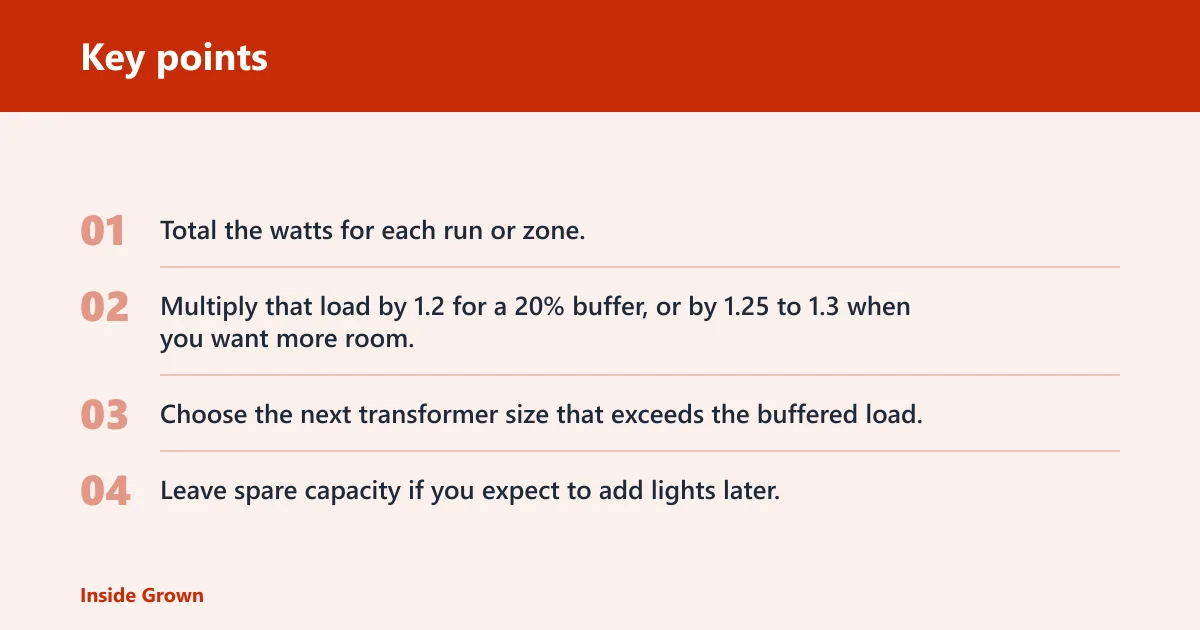
- Total the watts for each run or zone.
- Multiply that load by 1.2 for a 20% buffer, or by 1.25 to 1.3 when you want more room.
- Choose the next transformer size that exceeds the buffered load.
- Leave spare capacity if you expect to add lights later.
Worked mixed tree-and-path example
Suppose a path run has 6 lights at 5W each for 30W, and a tree run has 3 uplights at 12W each for 36W. The combined system is 66W, but it should not be treated as one blind total if the cable lengths differ. A 100W transformer fits the combined load with buffer, and two runs make voltage control easier.
That split matters. Path lights often sit 6 to 10 feet apart, while spotlights are often 10 to 15 feet apart. The spacing is design context, not a fixed rule, but it shows why a path circuit and a tree circuit usually behave differently.
Worked stair and step example
Picture a side stair with 6 step lights at 2W each. The run totals 12W, which is light by itself, but the run may still need attention if it travels a long distance from the transformer. In that case, the issue is less total wattage and more voltage drop along the wire.
How do you avoid voltage drop?
Voltage drop happens when current travels too far along cable, and the lights at the end see less voltage. The result is dimmer output, uneven brightness, or color shift on some LED fixtures. You reduce it with thicker wire, shorter runs, or by splitting one long circuit into two shorter ones.
When a run is too long
Longer wire runs create more resistance, and higher loads make that loss worse. If a path light string looks bright near the transformer but dim at the far end, the circuit is likely too long for the wire gauge or load. Separate runs often work better than one long daisy chain.
Suppose a 70-foot line of mixed lights sits on one thin cable and the far fixtures look weak. Moving half the fixtures to a second run changes only one variable: the circuit length. That often restores brightness more effectively than swapping every lamp for a higher-wattage model.
Use wire and zones together
Thicker wire helps, but it is not a cure-all. The best fix combines wire sizing with zone planning. A path circuit, an accent-tree circuit, and a step-light circuit can all share one transformer, but each should be sized as its own load so one long branch does not drag down the rest.
How many watts do you need for landscape lighting?
Most small residential systems land in the tens of watts per run, not hundreds, unless you are using several uplights or security fixtures. Path lights often use 1 to 7W each, spot and uplights often use 3 to 15W each, and deck or step lights often use 0.5 to 4W each. Choose by task, not by a single house-wide watt target.
Spacing and wattage by zone
Pathway lighting is usually for safety and wayfinding. One calculator places path lights 6 to 8 feet apart, while another source says 6 to 10 feet apart. It also lists pathway lights at 100 to 200 lumens each. That is a good residential range for soft guidance without glare.
Spotlights are usually spaced 10 to 15 feet apart, and floodlights are often spaced 15 to 25 feet apart. Those wider gaps reflect their beam spread and purpose. Flood and security fixtures are usually planned for coverage and detection, not for the gentle rhythm of a path.
Color temperature matters too
For homes, warm white LED light at 2700K to 3000K is the usual choice. It suits porch edges, walks, and planting beds without looking harsh. Warm light also makes it easier to keep the scene low glare while still giving clear wayfinding.
How far apart should landscape lights be placed?
Spacing depends on fixture type and the job the light is doing. Path lights often land around 6 to 10 feet apart, spotlights often 10 to 15 feet apart, and floodlights often 15 to 25 feet apart. Use those ranges as planning guides, then adjust for beam angle, plant height, and shadow overlap.
Path lights need rhythm, not crowding
Pathway lights should mark direction without turning the walk into a runway. A common residential target is 100 to 200 lumens per light, which is usually enough for guidance when fixtures are spaced evenly. Too many lights close together create glare and waste wattage.
Can you mix different fixture wattages on one transformer?
Yes, but mix them by zone with care. A transformer can feed path lights, uplights, and step lights at the same time if the total wattage stays within capacity and the runs stay balanced. The mistake is assuming every fixture can share the same wire length and still look even.
Keep the transformer sized for the total load across all connected runs, then judge each run for voltage drop on its own. That is the difference between a system that looks planned and one that just happens to power on.
How many watts does each landscape light use?
There is no single answer, because fixture use drives wattage. Path lights often sit in the 1 to 7W LED range, spot and uplights often in the 3 to 15W range, and deck or step lights often in the 0.5 to 4W range. Security fixtures are usually judged by lumen output, often 700+ lumens, rather than wattage alone.
Convert watts to kilowatts for operating cost
To estimate energy use, divide watts by 1000 to get kilowatts. A 50W run equals 0.05 kilowatts. Multiply that by hours of use per night and by the number of nights in a year to estimate annual use. That step helps you plan both energy cost and transformer capacity.
If a system runs 6 hours a night, a 50W circuit uses 0.3 kilowatt-hours per night before losses. That is not the whole design question, but it ties the wattage plan to real operating cost. Higher wattage means more load, more heat, and more annual energy use.
Frequently asked questions
How do I calculate watts for landscape lighting?
Count the fixtures on each run, multiply by each fixture’s wattage, then total the runs that truly share one transformer output. A 5-light path circuit at 10W each equals 50W. If you add a tree run or step run, calculate those separately before choosing transformer size.
How do I size a transformer for landscape lights?
Add the wattage of every fixture on the transformer, then choose a unit that exceeds that load by about 20% to 30%. Common sizes include 60W, 100W, 150W, 200W, and 300W. If the load is close to a size limit, move up or split the system.
How do I avoid voltage drop in a low-voltage lighting run?
Keep runs shorter, use thicker wire when needed, and divide long strings into two circuits instead of forcing one line to do everything. Voltage drop gets worse as distance and load rise. If the far fixtures look dimmer, the run likely needs a layout change, not just a stronger bulb.