Landscape Lighting for Small Yards and Patios Guide
For small yards and patios, a common approach is to use about 3 to 5 fixtures total: one ambient layer, one path or task layer, and one accent layer, with tighter spacing and shielded light to help limit glare. Too many bare bulbs make compact spaces feel smaller, brighter, and harder to use. This guide covers fixture types, spacing, beam control, and simple layouts for courtyards, patios, and narrow side yards.
How small yards need a different lighting plan


Small outdoor spaces need restraint. In a tight patio or yard, every fixture changes how large the area feels, so the plan should favor fewer lights, narrower beam spread, and carefully aimed output. A compact layout also leaves less room for bulky housings, bright hot spots, and overlapping pools of light.
That is why a small-yard plan usually works better when it follows the space’s architecture. You light the edges, the vertical surfaces, and the places people actually use. Open lawn-style lighting makes more sense on larger properties than on a fenced patio, apartment courtyard, or side yard.
Why fewer fixtures usually work better
More fixtures do not automatically mean better light. In a small space, extra heads can create glare, flatten the shadows that give depth, and make walls and paving feel washed out. A tighter, well-aimed layout often gives clearer circulation and better comfort with less visual clutter.
What changes when space is tight
Mounting height matters more. So does beam spread. When fixtures sit close to seating, fences, or steps, even a slightly wide beam can spill into eye level. Compact layouts also need lower wattage planning, because a small area can become overlit fast.
What kind of outdoor lights work best in a small yard?
The best small-yard lights are compact, controllable, and matched to a clear job. Path lights handle movement, hardscape lights fit walls and seating ledges, deck and step lights improve safety, and a restrained accent light can add depth without crowding the plan.
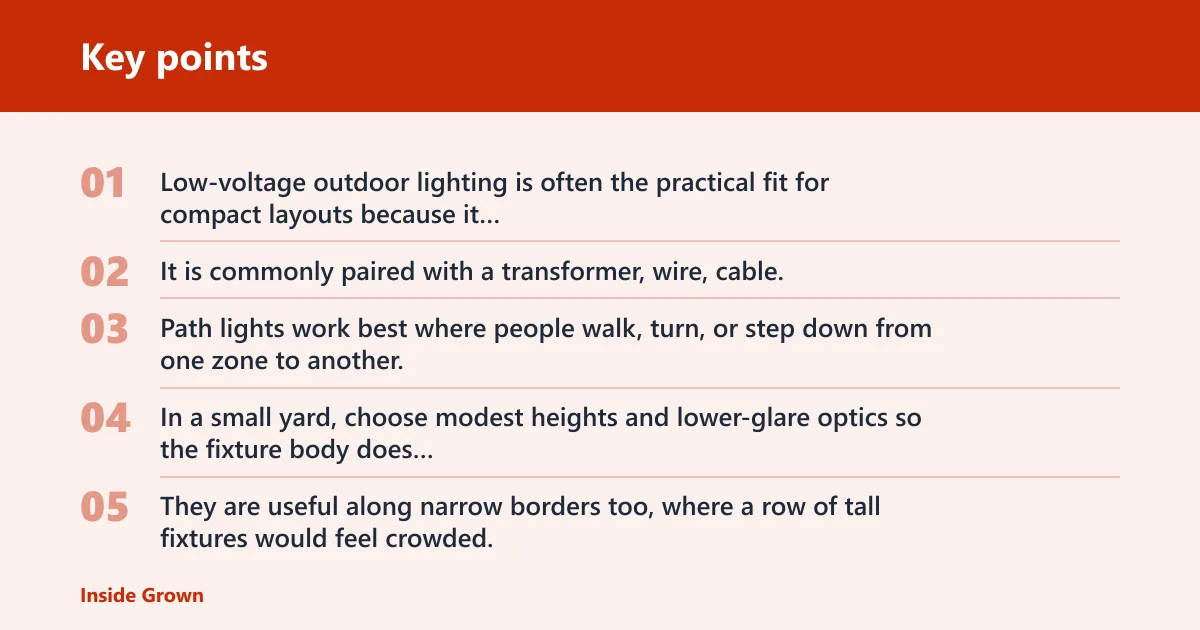
Low-voltage outdoor lighting is often the practical fit for compact layouts because it supports smaller fixture counts, simpler wiring, and lower wattage planning. It is commonly paired with a transformer, wire, cable, and timers or control devices so the system stays easy to manage.
Path lights for circulation and borders
Path lights work best where people walk, turn, or step down from one zone to another. In a small yard, choose modest heights and lower-glare optics so the fixture body does not dominate the view. They are useful along narrow borders too, where a row of tall fixtures would feel crowded.
Hardscape lights for walls and seating areas
Hardscape lights mount into walls, steps, seating walls, and retaining walls. That makes them a strong fit when ground space is limited. They can wash light across a patio edge or seating surface without adding another stake or post to the floor of the space.
Deck and step lights for edges and stairs
Deck and step lights are compact and practical for stairs, deck landings, and patio transitions. They are best where you need safe footing but do not want visible bulk. A small number placed at the risers or side returns usually does more good than lighting every step from multiple directions.
Uplights, wall wash lights, and in-ground well lights for accents
Uplights can add depth when aimed at a tree, container, or architectural feature, but they need restraint in a small space. Flood and wall wash lights spread light across fences or masonry with fewer fixtures, while in-ground well lights stay flush and reduce clutter if they are placed with care.
Lighting Warehouse lists uplights, path and walkway lights, hardscape lights, deck and step lights, flood and wall wash lights, in-ground well lights, transformers, wire and cable, timers and control devices, and solar lights and portables as outdoor lighting categories. That mix matches the way a small system is usually built: by function, not by fixture count alone.
How do you light a small patio without crowding it?
Use layers instead of stacking more fixtures. Keep the lighting low-profile near seating and walking paths, then move the brighter work to walls, steps, or nearby vertical surfaces. The goal is usable light across the patio surface, not a row of visible points at eye level.
In a tight patio, the most comfortable plan often starts with one ambient source, one task source, and one accent source. That can be a wall wash on a fence, a pair of step lights at a threshold, and one restrained accent light aimed away from faces. One clean layer works better than several competing ones.
Keep fixtures out of the sightline
Place lights where they illuminate the area without staring back at the viewer. Low mounted hardscape lights, tucked step lights, and shielded path lights all help. If a fixture is easy to notice from every chair, it is probably too visible for a small patio.
Use light on surfaces, not into faces
A patio feels calmer when light lands on paving, walls, railings, and planting surfaces. Direct glare from exposed bulbs makes a compact yard feel harsher and smaller. Aim beams downward or across a surface, and keep uplights narrow enough that the beam stops at the target.
How far apart should lights be in a compact layout?
In a compact layout, spacing should follow the area you need to see, not a fixed count. Path lights usually need to be farther apart than homeowners expect in small yards, while wall and hardscape fixtures can cover more area if their beam spread is controlled. Leave some areas dark on purpose.
That blank space gives the eye a place to rest. It also keeps a small yard from looking overlit. On a tight site, dark corners can help define the patio as a usable room rather than a flat field of light.
Spacing ideas for path lights
For short walks and borders, a common approach is to set path lights far enough apart that their pools of light barely overlap. In a narrow yard, that may mean only a few fixtures along the route. Keep them staggered rather than lined up like runway lights.
Spacing ideas for wall and hardscape fixtures
Wall and hardscape fixtures can often cover a larger portion of a small space than a row of path lights can. Place them to wash the surface evenly, then avoid adding extra heads in the same zone. Too much overlap creates bright bands and wastes output.
When to leave areas unlit on purpose
Dark zones help define the scene. A planting bed, a corner near the fence, or a small patch of lawn does not always need its own fixture. If the important areas are lit well, the rest can stay quiet.
Sample small-yard lighting plans by layout size
These sample layouts show how to scale a system down without losing function. The counts are starting points, not fixed rules, because beam spread, wall height, and seating layout change what each fixture can cover. The point is to use the fewest lights that still solve the job.
| Layout size | Recommended fixture types | Approximate fixture count | Coverage areas | Layout notes |
|---|---|---|---|---|
| Tiny patio | 1 hardscape light, 1 step light, 1 accent uplight or wall wash | 3 | Patio surface, one threshold, one fence or planting feature | Keep all fixtures shielded and aim away from seating |
| Standard small yard | 2 path lights, 2 hardscape lights, 1 uplight or flood and wall wash light | 5 | Walkway, seating wall, edge of patio, one tree or wall | Use staggered placement and leave one corner dark |
| Narrow side yard | 2 path lights, 1 wall wash light, 1 in-ground well light | 4 | Walk path, fence plane, one accent planting or entry point | Choose low profiles to keep the corridor open |
Say your patio is about 10 by 12 feet with one short wall and a pair of chairs. A single wall wash on the fence, one step light at the threshold, and one small accent light near a planter can give the room structure without filling the floor with hardware.
Suppose a narrow side yard is only a passage between the driveway and the back gate. A pair of modest path lights and one wall wash often does more than a line of bright stakes, because the wall gives the light a place to land.
How do you avoid glare in a tiny backyard lighting plan?
Choose lower-glare optics and modest mounting heights. Control beam spread on walls and fences, and aim uplights with restraint. In a tiny yard, the main glare risk is not brightness alone; it is exposed source visibility from normal seated or standing positions.
Glare control also depends on where the light stops. If a beam overshoots a fence or lands in a neighbor’s sightline, the small yard can feel sharper and less private. Tight aiming solves more problems than adding more wattage.
Choose lower mounting heights
Lower mounting heights reduce how far the source sits above eye level. That matters for path lights near chairs, fixtures on short walls, and lights mounted on steps or railings. The lower the source, the easier it is to keep the lamp hidden while lighting the surface.
Control beam spread on walls and fences
Flood and wall wash lights should cover the surface without spraying light past it. In compact spaces, a narrower spread is often easier to control, especially on short fences or masonry walls. A wide beam can flatten detail and spill into windows or seating areas.
Aim uplights with restraint
Uplights need careful placement in close quarters. One well-aimed accent can add depth, while several bright uplights can make a small yard feel busy and washed out. Keep them away from direct sightlines and target only the feature you want to call attention to.
What low-voltage parts make a small system easier to manage?
Low-voltage systems are easier to scale down because the transformer, wire, and control devices can be matched to a small load. That helps you avoid oversizing the system, wasting energy, or filling a compact yard with too many fixtures. Timers make the plan easier to live with, too.
Transformer sizing and placement
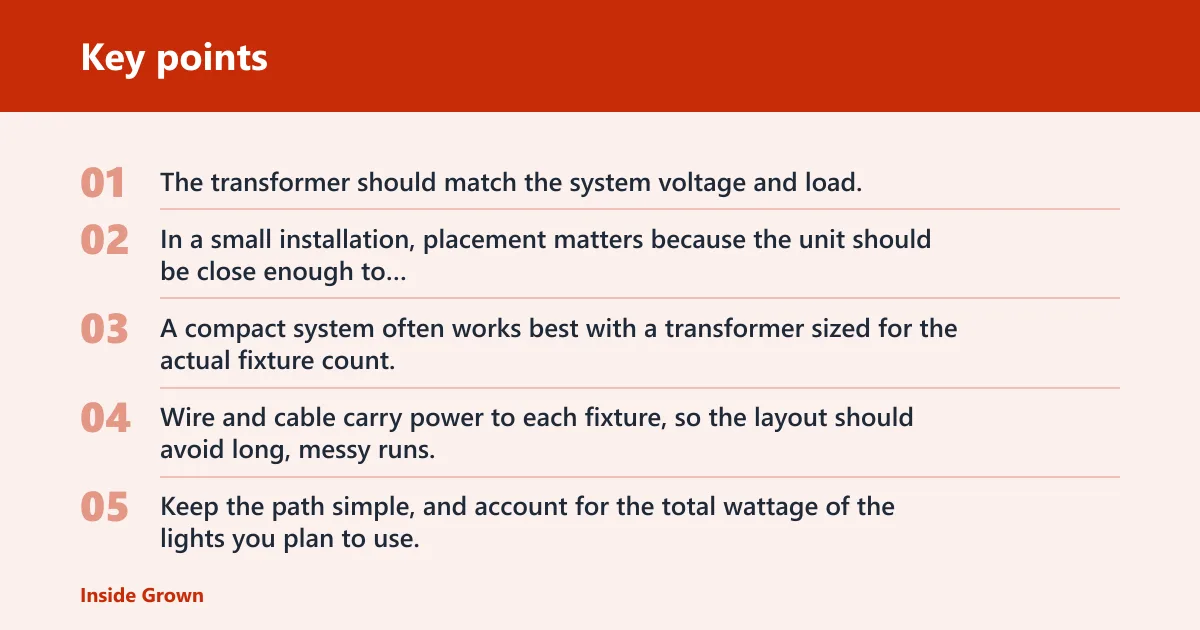
The transformer should match the system voltage and load. In a small installation, placement matters because the unit should be close enough to limit unnecessary wire runs, but still accessible for service. A compact system often works best with a transformer sized for the actual fixture count, not for future expansion that may never happen.
Wire, cable, and load planning
Wire and cable carry power to each fixture, so the layout should avoid long, messy runs. Keep the path simple, and account for the total wattage of the lights you plan to use. Small systems are easier to troubleshoot when the wire path is short and organized.
Timers and control devices
Timers and control devices help prevent over-lighting and make a small system easier to use every night. They also limit wasted run time, which matters when the whole plan may use only a few fixtures. Automation is especially useful in courtyards and apartment patios where convenience matters.
Where solar lights fit, and where they do not
Solar lights can work in small yards when the goal is simple path marking or a little accent lighting in a sunny spot. They fall short when you need consistent output, careful beam control, or reliable coverage on a shaded patio. In tight spaces, inconsistency shows up quickly.
A common first-timer mistake is choosing solar path lights for a shaded side yard and expecting them to carry the whole plan. If the panel does not get enough sun, the lights may be dim or uneven, which is more noticeable in a compact layout than in a larger garden.
Frequently asked questions
How do I light a small patio without making it feel crowded?
Use only a few fixtures and keep them low-profile. A good small-patio plan usually relies on one surface wash, one path or step light, and one restrained accent. Aim light across walls and paving instead of into eye level, and leave at least one area visually quiet.
What kind of outdoor lights work best in a small yard?
Low-voltage path lights, hardscape lights, deck and step lights, and a small number of uplights or wall wash lights are usually the best fit. They cover specific jobs without taking much floor space. In-ground well lights can also work when you want a flush look with less clutter.
How far apart should lights be in a compact outdoor layout?
Spacing should follow the area each fixture covers, not a fixed yard-wide pattern. In a compact layout, path lights can sit far enough apart that their light pools barely meet, while wall and hardscape fixtures can cover more area with fewer heads if the beam spread is controlled.
How do I avoid glare in a tiny backyard lighting plan?
Keep fixtures low, shield the source, and aim light onto surfaces rather than into faces. Use lower-glare optics for path lights and avoid placing uplights where they can be seen directly from seating. In a small yard, even one exposed bulb can feel harsh.
Should I use uplights, path lights, or hardscape lights in a small yard?
Start with the job you need solved. Path lights work for circulation, hardscape lights are strong for walls and seating areas, and uplights should be used sparingly for one tree, planter, or architectural feature. Small yards usually need more task and surface light than accent light.
How do I light steps, walls, and seating areas around a patio?
Use deck and step lights for edges and stairs, then add hardscape lights for seating walls or retaining walls. If a fence or masonry surface needs more coverage, a flood or wall wash light can spread light across it. Keep the beam controlled so the patio stays comfortable.
Can solar lights work for a small patio and yard?
Yes, but mainly for simple, sunny locations with modest expectations. Solar lights are best for light path marking or small accents where output can vary a bit. They are less dependable for shaded patios, tight spaces that need precise beam control, or layouts that need consistent evening performance.
What low-voltage fixtures are easiest to add later in a small yard?
Path lights and some hardscape lights are often the easiest to expand later because they can be added to a compact low-voltage run without changing the whole layout. A transformer with a little capacity left can make future additions simpler, but the first plan should still stay small and clean.