What Is Soil Buffering and Why Is It Useful?
Soil buffering is a soil’s resistance to pH change. The stronger the buffering, the more lime or sulfur you need to move pH, and the slower the shift. Buffering also helps reduce sudden pH swings, which can stabilize nutrient availability for roots. Skip that detail and you can waste money on the wrong amendment, or keep correcting a pH that barely moves. This guide explains what buffering means, why some soils resist change, and how to read a soil test before you add lime or sulfur.
What soil buffering means



Soil buffering is why pH does not jump quickly after a small amendment. A buffered soil pushes back against change, so acid or alkaline additions are partly absorbed by the soil itself before the pH reading moves much.
That resistance is not random. Clay, organic matter, and cation exchange capacity, or CEC, are key factors in it. CEC is the soil’s ability to hold positively charged nutrients and other ions. Soils with more clay and more organic matter usually buffer more strongly.
Why resistance matters for gardeners
For gardeners, buffering changes the size and pace of the response. A low-buffer sandy bed may move after a modest lime application, while a clay-heavy bed may barely change until a much larger amount is applied, and even then the shift can take time.
That is why the same dose can look effective in one bed and disappointing in another. The amendment did not fail; the soil simply had more resistance.
What is the difference between soil pH and buffer pH?
Soil pH and buffer pH are different numbers with different jobs. Soil pH tells you how acidic or alkaline the soil is right now. Buffer pH is a lab value used mainly in acidic soils to estimate how much lime the soil may take before its pH changes.
Both can appear on the same soil test report, but they answer separate questions. Soil pH tells you the starting point. Buffer pH helps predict the lime dose needed to move that starting point, when the lab uses that system.
What each number tells you on a soil test
If the soil pH is 5.4, the soil is currently acidic. If the buffer pH is also low, the soil may have stronger resistance and may need more lime to shift than another soil with the same current pH but a higher buffer pH reading.
That distinction matters because pH alone does not tell you whether the soil will change quickly or barely at all. Buffer pH is the clue to that response in the lab method being used.
Why buffer pH is used to estimate lime needs
Lime raises pH, but the amount needed depends on how much the soil resists change. Buffer pH gives the lab a way to estimate that resistance, so lime recommendations are based on more than the current pH value.
That is why guessing from pH alone can lead to under-application or overapplication. In many recommendation systems, a lower buffer pH means a larger lime need, but the exact interpretation depends on the lab method and the recommendation system. Some labs do not use buffer pH this way for already alkaline soils.
Why some soils change pH slowly
Soils change pH slowly when they have a larger pool of charged surfaces and exchange sites that soak up acidity or alkalinity. Clay and organic matter are the two biggest practical reasons, and they usually raise both buffering and CEC.
Sandy soils usually react faster because they have fewer exchange sites. They hold less of the amendment in reserve, so the pH can move more quickly after treatment.
Clay and surface area
Clay has very fine particles and a large surface area. That gives it many places to hold nutrients and ions, which raises nutrient retention and increases resistance to pH change.
In a clay-heavy bed, lime or sulfur may need more time to show up in a soil test. The material has to react across a larger set of soil surfaces before the pH reading moves much.
Organic matter and cation exchange capacity
Organic matter also adds exchange sites and raises CEC. Compost, decomposing residues, and humus help the soil hold nutrients and moderate abrupt pH swings, which is useful for plant roots but slower for short-term pH correction.
That does not mean more compost instantly fixes pH. It changes buffering gradually as organic matter builds, breaks down, and interacts with the rest of the soil.
Why sandy soils react faster
Sandy soils have larger particles, fewer exchange sites, and lower CEC. That usually means lower buffering, so pH can change faster after lime or sulfur is added.
Fast change is not always safer change. Sandy soils can overshoot more easily if you add too much at once, so small adjustments and retesting matter.
How buffering affects lime and sulfur
Buffering changes how quickly lime or sulfur works and whether the result stays near target. Lime raises pH more slowly in strongly buffered soils, while sulfur lowers pH more slowly when buffering is high and soil biology is not active enough to convert it efficiently.
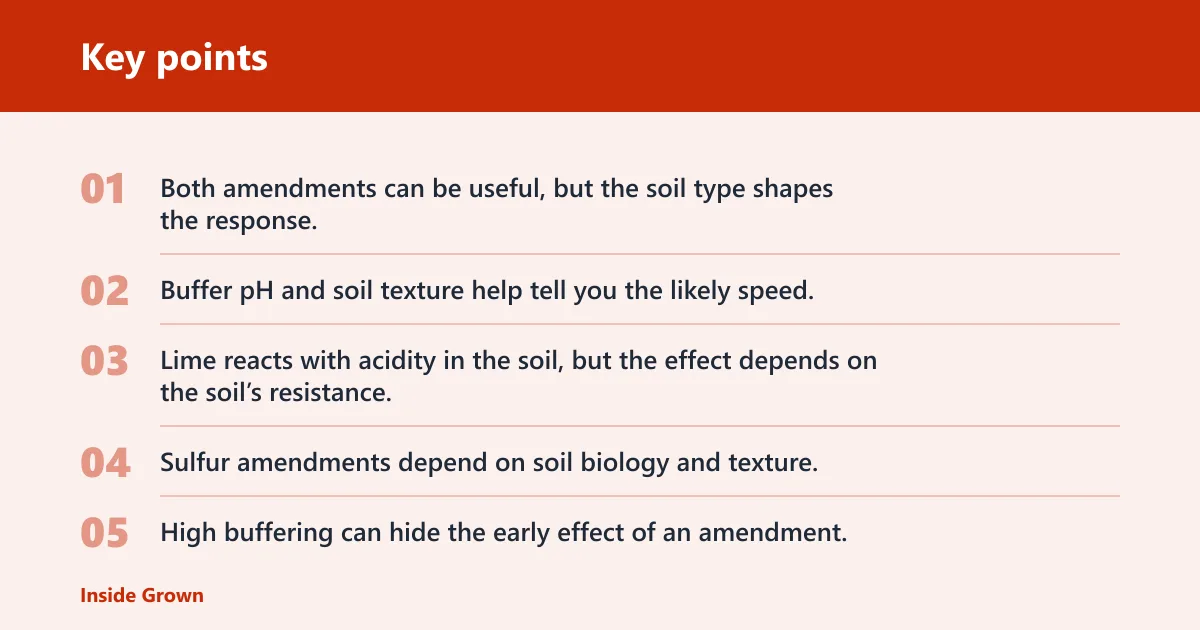
Both amendments can be useful, but the soil type shapes the response. Current pH tells you the direction. Buffer pH and soil texture help tell you the likely speed.
When lime raises pH slowly
Lime reacts with acidity in the soil, but the effect depends on the soil’s resistance. A high-CEC clay soil or an organic-matter-rich bed may need more lime and more time than a sandy bed with the same current pH.
Overapplication is a real risk. If the soil is strongly buffered, it is tempting to add more lime when the first round seems slow, but that can overshoot the target once the reaction finally catches up.
When sulfur lowers pH slowly
Sulfur amendments depend on soil biology and texture. In a highly buffered soil, the shift can be slow because the soil keeps absorbing some of the acidifying effect before the pH changes much.
That is one reason sulfur should be followed by retesting, not repeated guesswork.
Why overapplication can miss the target
High buffering can hide the early effect of an amendment. A gardener may think the treatment did nothing, add more, and then see a late pH jump or drop that goes past the target.
That pattern is common when the soil test is read without the buffer pH. The right amount depends on the soil’s resistance, not only on the first pH reading.
Soil buffering decision table
The table below turns common soil test patterns into likely amendment behavior. Use it as a decision aid, then confirm with the recommendations on your own report and retest after the soil has had time to respond.
| Current pH | Buffer pH | Texture | Organic matter | Likely amendment behavior | What to do next |
|---|---|---|---|---|---|
| 5.2 | 6.4 | Sandy | Low | pH should shift quickly with a modest lime dose; response is often visible sooner than in heavier soil. | Use the lab’s lime recommendation, apply in split doses if the report is broad, and retest before adding more. |
| 5.4 | 6.0 | Loam | Moderate | pH should shift at a moderate pace; buffering is present but not extreme. | Apply the recommended amendment rate, mix evenly, and retest after the soil has had time to react. |
| 5.6 | 5.8 | Clay loam | High | pH may change slowly and may need a larger lime dose than the current pH alone suggests. | Follow the buffer-based lime recommendation closely and avoid a second application until retesting shows the first effect. |
| 6.8 | 6.7 | Sandy | Low | Acidifying amendments can move pH quickly, and overshoot is a real risk. | Use small sulfur adjustments only if the crop truly needs lower pH, then retest before repeating. |
| 7.4 | 6.2 | Clay | High | pH is likely to resist sulfur, so the drop may be slow and incomplete at first. | Expect gradual change, avoid large sulfur doses, and verify the need for acidification before applying more. |
| 6.1 | 6.5 | Loam | Very high | Buffering is strong, so both lime and sulfur may move the pH slowly and less predictably. | Use the soil test recommendation, keep applications conservative, and retest rather than chasing a fast correction. |
Can you reduce soil buffering?
You can influence buffering over time, but you usually cannot remove it quickly. Organic matter management can change how strongly the soil resists pH shifts, yet clay content and much of the CEC are built into the soil’s structure and change slowly.
That means the practical goal is usually better pH management, not a promise of instant lower buffering. Compost can help in a gradual way, but it is not a quick fix for a soil that resists change.
What organic matter can and cannot do
Organic matter can increase buffering in sandy soil and improve nutrient retention. It can also make pH swings less abrupt, which helps roots cope with fertilization and rainfall changes.
What it cannot do is erase strong buffering from clay or instantly change a soil test result. It is a management tool, not a shortcut.
Why long-term management matters more than quick fixes
Repeated fertilizer use, compost additions, and crop residue handling all shape buffering over time. Those choices change how much the soil can hold and how quickly it responds to future lime or sulfur applications.
That is why pH management works best as a repeat process.
How to use buffering in a soil test report
Start with the current pH, then read the buffer pH if the report includes it. The pair tells you both the current condition and the likely resistance to change, which is what you need before buying lime or sulfur.
If the report gives a specific amendment recommendation, use that number instead of guessing from pH alone. If it does not, ask the lab or extension service for a recommendation based on the buffer pH and soil type.
Read pH first. Check whether the soil is too acidic or too alkaline for the plants you are growing. This tells you whether you need lime, sulfur, or no pH change at all.
Check buffer pH next. Use that number to judge resistance to change. In many lime-recommendation systems, a lower buffer pH usually means stronger buffering and a larger lime need.
Match texture and organic matter. Sandy soils often respond faster, while clay-heavy or organic-matter-rich soils respond more slowly. This helps you decide whether a change should appear quickly or after more time.
Apply only the recommendation. Use the soil test’s amendment rate instead of guessing from current pH alone. That lowers the chance of overshooting the target in a low-buffer soil or under-treating a high-buffer soil.
Retest before repeating.
Say your raised bed tests at pH 5.5 with a buffer pH that suggests strong resistance, and the bed is mostly clay with high organic matter. A light lime dressing may not move the number much at first, so the safer move is to follow the lab rate, wait, and retest before adding more.
Picture a sandy garden row testing at pH 7.2 with a low buffer pH and little organic matter. A sulfur amendment may shift the pH faster there than in a clay bed, so a small, careful application and follow-up testing matter more than a large correction all at once.
Frequently asked questions
What is soil buffering?
Soil buffering is the soil’s resistance to pH change. High-buffer soils take more lime or sulfur to shift, and they usually change more slowly than low-buffer soils. Clay, organic matter, and higher CEC usually increase that resistance.
What is soil buffering capacity?
Soil buffering capacity is how strongly a soil resists pH change when something acidic or alkaline is added. It is closely tied to clay content, organic matter, and CEC. Higher buffering capacity usually means slower pH movement and a larger amendment requirement.
Why is my soil buffering pH instead of changing quickly?
Your soil is likely holding the added ions on clay or organic matter surfaces before the pH shifts much. That is normal in high-CEC soils and in soils with more organic matter. It does not mean the amendment failed; it means the soil is resisting change.
What is buffer pH in a soil test?
Buffer pH is a lab value used to estimate how much lime a soil needs to reach a target pH. It is different from regular soil pH. The current pH tells you where you are now, while buffer pH helps predict how much amendment it will take to move there.
What is the difference between buffer pH and soil pH?
Soil pH measures current acidity or alkalinity. Buffer pH estimates the soil’s resistance to change and is mainly used to calculate lime needs. A soil can have the same pH as another sample but a very different buffer pH, which changes the recommended amendment rate.
Why is soil pH harder to change in some gardens than others?
Soils with more clay, more organic matter, and higher CEC usually resist pH change more strongly. Sandy soils are easier to shift because they buffer less. The same lime or sulfur dose can act very differently depending on those soil traits.