When to Use Lime in Garden Soil
Use garden lime only after a soil test shows pH is below about 6.0 for most vegetables, or below about 5.5 for acid-tolerant beds; apply it in fall or early spring so it has time to react before planting. Apply it blindly and you can push pH too high, which locks up iron, manganese, and phosphorus. This guide covers pH targets, crop fit, soil texture, lime types, and timing.
What lime does in soil
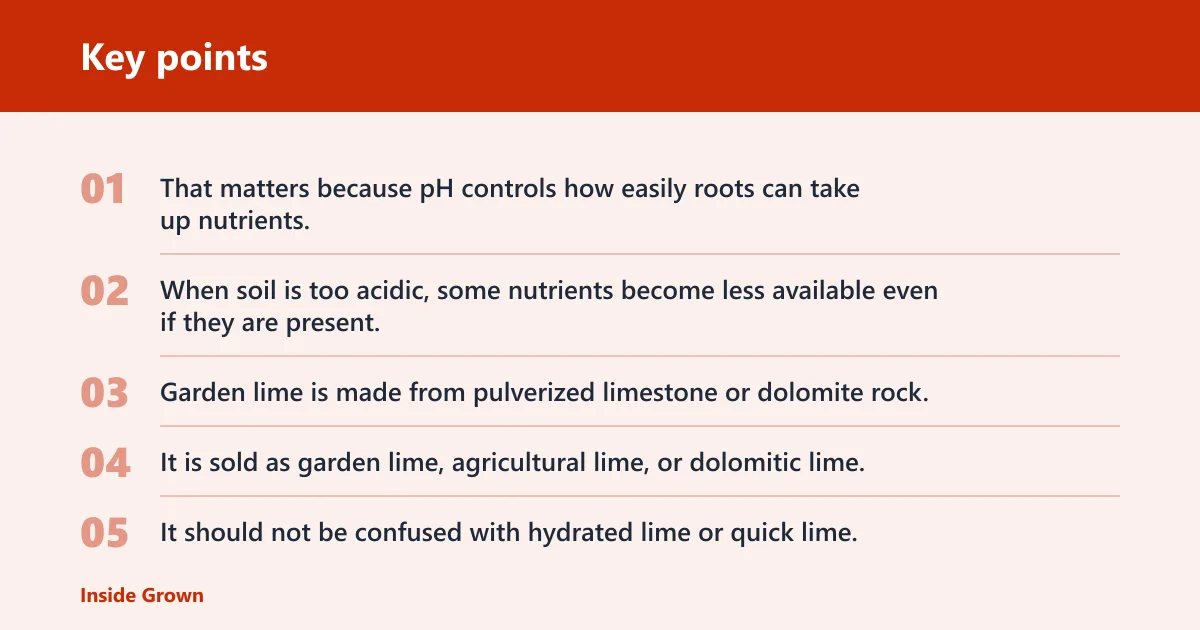


Garden lime raises soil pH in acidic soil. That matters because pH controls how easily roots can take up nutrients. When soil is too acidic, some nutrients become less available even if they are present.
Garden lime is made from pulverized limestone or dolomite rock. It is sold as garden lime, agricultural lime, or dolomitic lime. It should not be confused with hydrated lime or quick lime, which are not suitable for garden beds.
Which crops usually need near-neutral soil?
Most lawn grasses and vegetable gardens do well at pH 6.0 to 7.0. Many plants prefer a pH between 5.5 and 6.5, so crop choice matters. A blueberry bed and a broccoli bed do not want the same soil reaction.
What you’ll need before you start
- Soil test report from a lab, or a home pH kit for a quick screen
- Garden lime label that lists agricultural lime or dolomitic lime
- Spreader for larger areas, plus a rake or hoe
- Measuring container for the product rate
- Gloves and eye protection
Should you lime now?
Start with the soil test, then match the result to the crop and soil texture. If pH is already in range for your crop, skip lime. If it is low and the bed is open, workable, and not waterlogged, lime can go on now or soon.
Read the soil test pH
A lab test is the most accurate way to decide whether lime is needed and how much to use. A home pH kit can tell you whether the soil is clearly acidic, but it cannot replace a lab result for rate decisions.
Match the crop target range
Most lawn grasses and vegetables grow best in soil with pH 6.0 to 7.0. If you are planting acid-loving crops, do not lime just because the soil looks “low.” Use the crop target, not a generic rule.
Check soil texture and moisture
Clay and other heavy soils often need more lime than sandy soil for the same pH change. Fine powder reacts faster than pellets, but pelletized products are easier to spread. Avoid liming when soil is muddy, frozen, or crusted hard.
When is the best time to apply lime?
Fall is the best time to use garden lime in one source, and spring is the next workable window if you missed fall. Summer can still work if irrigation, crop timing, and soil moisture are managed. The point is reaction time, not deep movement.
Fall application window
Cool fall temperatures and winter moisture help lime react over time. That makes fall the strongest choice for beds you plan to plant later. If you need pH correction before spring planting, fall gives the soil more time to settle.
Spring application window
Spring is fine when you need a quicker turnaround. Work the lime into the topsoil, then give it time before transplanting or seeding. If the bed is already planted, top-dressing may help less than incorporation, so use test results to guide the choice.
When summer application can still make sense
Summer is workable if the bed will not be planted immediately and you can irrigate after spreading. Avoid hot, dry conditions when the surface dries out fast. Lime still works, but it needs time in contact with moist soil to react.

- Measure the bed or lawn area and read the rate on the soil report or product label.
- Choose the form that fits the job: pelletized for easy spreading, powder for faster reaction.
- Spread the lime evenly over the surface.
- Work it into the topsoil with a rake, hoe, or tiller when possible.
- Water lightly if the soil is dry and the forecast is calm.
How much lime should you use?
Use the soil test rate first. If you only have a pH reading and not a lab recommendation, treat that as a screen, not a dose calculator. Texture changes the amount needed, and clay-heavy soil usually needs more than sandy soil for the same correction.
A common rate example: if a lab report recommends 50 pounds per 1,000 square feet for a bed that is 2,000 square feet, you would need 100 pounds total. If the report says 25 pounds per 1,000 square feet for a 400-square-foot bed, that equals 10 pounds total.
Strongly acidic or heavy clay soil may need as much as 100 pounds per 1,000 square feet. Split the treatment if the report suggests a very high rate, especially on established beds, so you can recheck pH before adding more.
Sample lime logic by soil type
Sandy soil often needs less lime and reacts faster. Clay soil usually needs a larger rate because it holds acidity more tightly. If the lab gives a range, start at the lower end when the crop can tolerate it and retest before the next application.
Say your raised vegetable bed reads pH 5.3 and the lab says it needs lime, but the crop mix includes beans and tomatoes. A moderate rate applied in fall gives time for reaction before spring planting without overshooting the target.
Suppose a lawn renovation site reads pH 5.4 on a clay loam and the turf target is near-neutral. A heavier rate may be justified, but it should still be spread evenly and worked in, then checked again rather than repeated blindly.
Garden lime decision table
| Soil test pH | Soil texture | Season | Crop type | Recommended lime type | Timing window |
|---|---|---|---|---|---|
| 5.0 to 5.4 | Sandy to loam | Fall | Most vegetables | Agricultural lime or dolomitic lime if magnesium is low | Apply now if soil is workable |
| 5.0 to 5.4 | Clay or heavy loam | Spring | Vegetable bed or lawn renovation | Fine powder for quicker reaction, or pelletized if spreadability matters | Apply now, then retest later |
| 5.5 to 6.0 | Any | Fall or spring | Lawn grasses | Agricultural lime | Apply only if the test recommends it |
| 5.5 to 6.5 | Any | Any workable season | Acid-tolerant crops | Usually skip or use only a light correction if the lab says so | Wait unless the crop target is higher |
| 6.0 to 7.0 | Any | Any | Most vegetables and lawns | Skip | Do not lime now |
Common mistakes to avoid
These are the situations where lime is often wasted or applied at the wrong time. The fix is simple: stop, check the soil, and match the product to the bed.
| Mistake scenario | Correct action |
|---|---|
| Too wet soil | Wait until the bed is workable and not sticky or smeared |
| Hot weather | Apply only if you can water and manage timing; otherwise wait for cooler conditions |
| Container mix | Do not treat pots like garden beds; use a separate potting-mix plan or fresh mix |
| Overliming risk | Stop at the tested rate and retest later instead of adding more “just in case” |
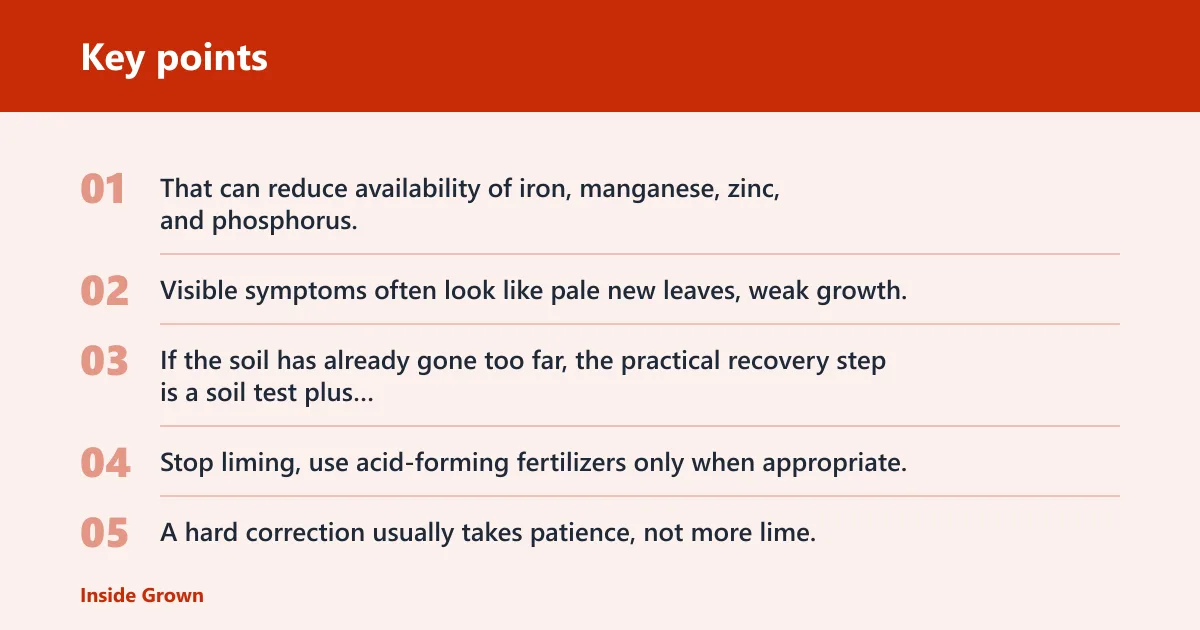
Too much lime can make soil too alkaline. That can reduce availability of iron, manganese, zinc, and phosphorus. Visible symptoms often look like pale new leaves, weak growth, or odd nutrient deficiency signs even after fertilizing.
If the soil has already gone too far, the practical recovery step is a soil test plus time. Stop liming, use acid-forming fertilizers only when appropriate, and recheck the bed before the next season. A hard correction usually takes patience, not more lime.
Container and potting-soil use needs special care. Potting mixes are different from in-ground beds, and lime is not a default fix for potted plants. If the container mix is off, replacing or refreshing the mix is often the cleaner move.
How to use lime in garden soil comes down to three checks: the pH result, the crop target, and the soil texture. If all three point the same way, apply it. If they do not, wait.
Frequently asked questions
When to put lime on garden soil
Put lime on garden soil after a test shows acidic soil and before the crop needs a higher pH. Fall is usually the easiest window because it gives the material time to react. Spring works too if the soil is workable and planting is still ahead.
What does lime do for your garden soil?
It raises soil pH in acidic ground and can make some bound-up nutrients more available to plants. It is not a general fertilizer. It is a soil correction for acidity, and the effect depends on the test result and the amount used.
When should I add lime to my garden soil?
Add lime when the soil test calls for it and the bed is not frozen, waterlogged, or already in the target range. If you need a turnaround before planting, apply it in fall or early spring so it has time to react.
What kind of lime should I use in garden beds?
Use agricultural lime for standard pH correction and dolomitic lime when the soil also needs magnesium. Pelletized lime is easier to spread, while fine powder reacts faster. Avoid hydrated lime and quick lime in garden beds.
What happens if you use too much lime in garden soil
Soil can become too alkaline, which reduces the availability of iron, manganese, zinc, and phosphorus. If that happens, stop liming, retest the soil, and wait for the next adjustment cycle. More lime is not the fix.