How to Use Compost Tea in Landscape Beds
Use compost tea in landscape beds only as a light top-dress or soil drench for established, mulched plantings; if the bed needs organic matter, water retention, or weed suppression, plain compost and mulch do more. Wasted applications cost time, money, and usually little plant response. This guide explains when compost tea helps, how to apply it in landscape beds, and when to skip it for compost or mulch instead.
What compost tea


Compost tea is a living liquid made by soaking finished compost in water and then using the strained liquid. Its value comes from soluble nutrients and microbes moving out of the compost and into the brew, which is why the starting compost and the water quality matter so much. This article focuses on finished compost steeped in water, with aeration used when you want an actively aerated brew.
Finished compost should smell earthy, not foul, ammoniac, or sulfur-like. If the base material is not fully mature, the brew can carry odor problems, unstable nutrients, or unwanted microbes into a landscape bed.
Finished compost as the starting point
Use mature, finished compost only. That matters more than any additive. A good brew starts with compost that is dark, crumbly, and free of sharp ammonia odors, because poor compost quality limits the tea quality from the start.
Aerated vs. non-aerated tea
Compost tea can be brewed two ways: aerated compost tea and non-aerated compost tea. Aerated compost tea is brewed with active aeration to keep oxygen high, while non-aerated tea steeps passively in water and can slide toward low-oxygen or anaerobic conditions.
That oxygen difference can matter in landscape beds. Aerated tea is often brewed for about 12 to 36 hours, while non-aerated tea may steep for one to several days. The longer the passive steep, the more odor risk you take.
Why freshness matters
Use compost tea soon after brewing. Once aeration stops, the microbial mix changes quickly, and the liquid loses the point of brewing it in the first place. That is one reason compost tea works better as a same-day or near-same-day input than as a stored product.
📊 Oregon State University Extension says compost should be mixed into new landscape soil to a depth of 6–8 inches. Source: Oregonstate.
When compost tea is worth using
Compost tea is most useful when you want a mild biological and nutrient push in an already workable bed. It is not a substitute for adding organic matter, and it is a poor use of time if the bed has bare soil, shallow mulch, or clear compaction problems that need actual compost.
Newly planted beds
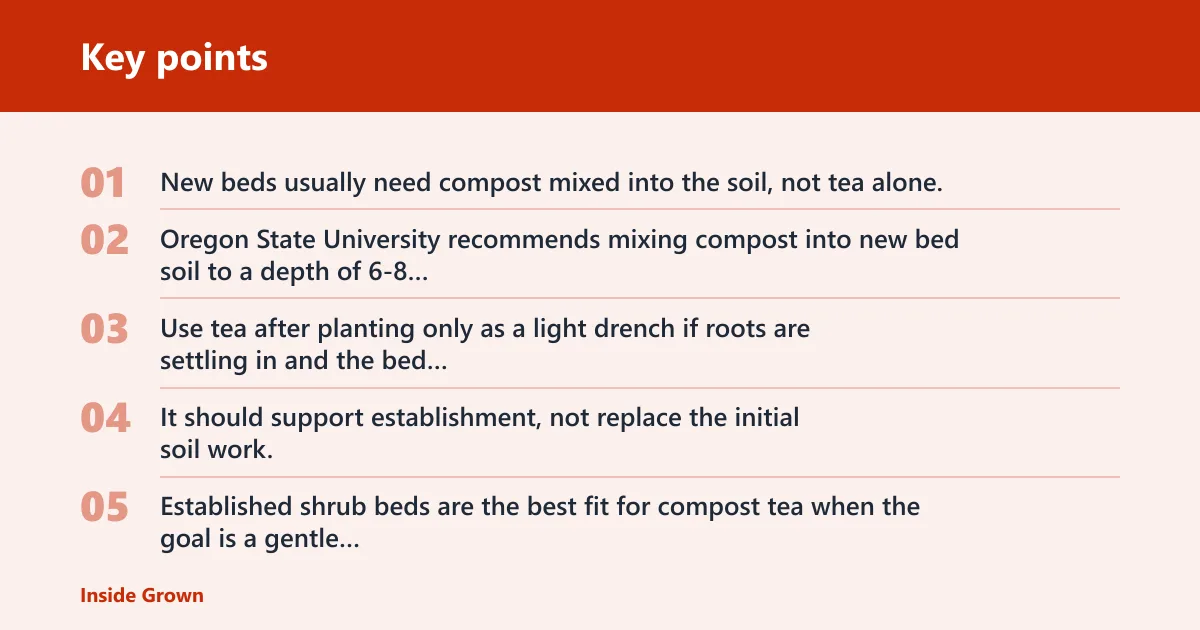
New beds usually need compost mixed into the soil, not tea alone. Oregon State University recommends mixing compost into new bed soil to a depth of 6-8 inches, and that kind of soil building does more for rooting, moisture holding, and structure than a spray or drench can do.
Use tea after planting only as a light drench if roots are settling in and the bed already has mulch. It should support establishment, not replace the initial soil work.
Established shrub beds
Established shrub beds are the best fit for compost tea when the goal is a gentle seasonal feed. If the bed is already mulched and the shrubs are actively growing, a soil drench can reach feeder roots without dumping a lot of soluble fertilizer into the site.
Oregon State University Extension says existing garden beds should get a quarter-inch to 1-inch compost layer each year. That regular topdressing usually matters more than tea for long-term soil condition.
Disease-prone plantings
Use extra caution around disease-prone plantings. Foliar spraying can leave leaf wetness behind, which is exactly what many leaf-spot problems like. In those beds, soil drench is usually the safer first choice unless the foliage stays dry quickly and the weather is calm.
Compost tea decision table
| Bed type | Plant stage | Soil condition | Best application method | Dilution or brew priority | Timing | Stop-signs |
|---|---|---|---|---|---|---|
| Newly planted beds | Transplants, first season | Often disturbed, uneven moisture | Light soil drench after planting | Favor a fresh, well-aerated brew; do not rely on a strong mix | After planting, in cool calm weather | Skip if bed still needs compost mixed in or mulch added |
| Established shrub beds | Woody shrubs, settled roots | Mulched, moderate fertility | Soil drench around the root zone | Moderate strength; keep brew fresh | Early morning or late day during active growth | Skip if the bed already had a recent compost topdress |
| Drought-stressed beds | Wilting perennials or shrubs | Dry, hydrophobic, hot surface | Soil drench only | Prioritize water quality and even wetting; no heavy brew | When irrigation can follow soon after | Do not foliar spray in heat or wind |
| Clay soils | Any established planting | Slow drainage, tight surface | Soil drench in smaller passes | Use a clean, well-aerated brew | When soil is moist, not sticky | Stop if water ponds or runoff starts |
| Sandy soils | Perennials, shrubs, young roots | Fast drainage, low organic matter | Soil drench paired with mulch | Use fresh tea, but do not expect long nutrient hold | Just before a light irrigation cycle | Skip if the bed lacks mulch or organic matter |
| Disease-prone plantings | Leaf-spot-prone shrubs or perennials | Humid, shaded, slow-drying canopy | Soil drench preferred over foliar spray | Avoid thick brews; freshness matters most | Cool, still weather with drying time | Do not spray foliage if rain or evening dew is due |
How do you apply it in beds?
Apply compost tea to landscape beds as a soil drench unless the foliage is dry, the weather is calm, and you have a specific reason to spray leaves. A drench is the better default because it places the liquid where ornamental roots can use it and it avoids wetting leaf surfaces that may hold disease.
Soil drench method
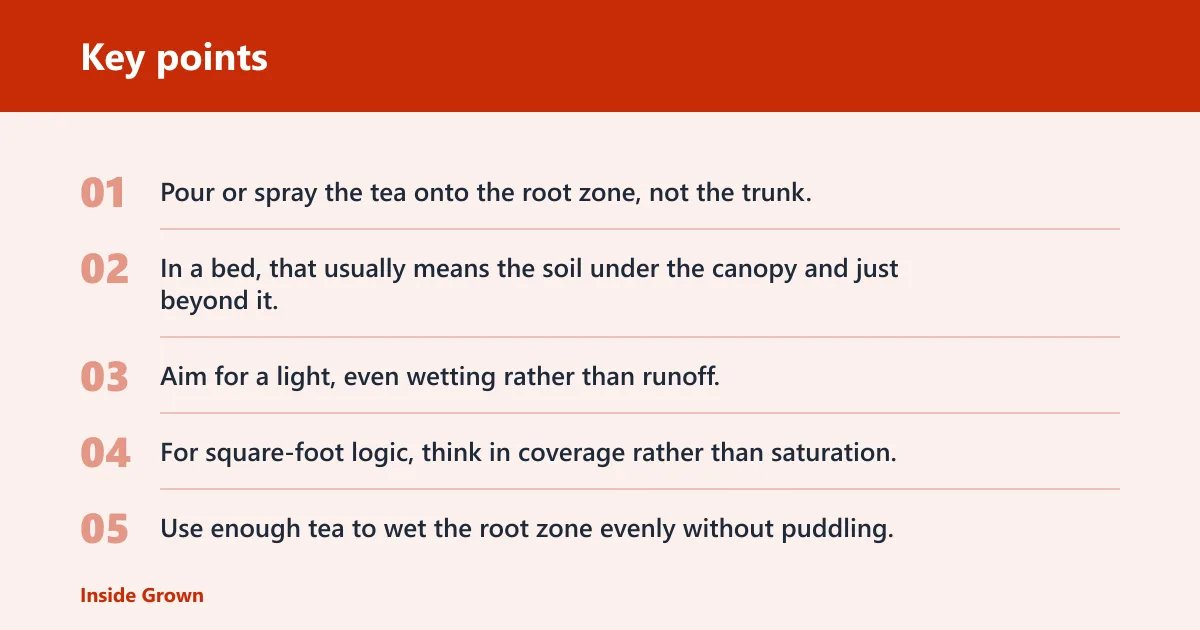
Pour or spray the tea onto the root zone, not the trunk. In a bed, that usually means the soil under the canopy and just beyond it, where feeder roots are active. Aim for a light, even wetting rather than runoff.
For square-foot logic, think in coverage rather than saturation. Use enough tea to wet the root zone evenly without puddling; a 5-gallon bucket is commonly enough for a small landscape bed or several shrubs when applied as a light drench, rather than all at one point in the bed.
Foliar spray method
Foliar spraying can place microbes and dissolved compounds on leaves, but it is the riskier method in landscape beds. Use it only when the plant can dry quickly, the wind is low, and the bed is not already prone to leaf spot or powdery mildew.
Suppose a 6-foot shrub bed has black spot issues and the forecast calls for a humid evening. A foliar spray is the wrong move there. A soil drench is safer, because it keeps extra moisture off the leaves and still reaches the roots.
Choosing the right method for bed conditions
Choose soil drench for new plantings, drought stress, clay soil, and disease-prone canopies. Choose foliar spray only for healthy foliage, dry weather, and cases where the aboveground parts need the contact more than the root zone does.
A common first-timer mistake is applying compost tea at the same strength to both shaded foundation beds and sun-baked border beds. That wastes tea in dry sandy beds, or worse, wets leaves in a crowded shrub border where airflow is already poor.
What brew setup do you need?
A home-scale setup can be simple: a bucket, water, finished compost, and, for aerated tea, an aquarium air pump with an air stone. The goal is to keep the brew from going stale or anaerobic before you apply it.
5-gallon bucket basics
A 5-gallon bucket is a common brewing vessel because it is easy to handle and gives enough volume for a small planting bed or several shrubs. Leave headspace for foam and stirring. A full bucket is harder to manage and more likely to spill.
Aquarium air pump and air stone
An aquarium air pump is a low-cost way to keep oxygen moving through the brew. Paired with an air stone at the bottom of the bucket, it diffuses air through the liquid and helps maintain aerobic conditions during the brew window.
If you are making aerated compost tea, the pump is not optional. Without oxygen, the brew shifts toward the odor and risk profile of non-aerated tea.
Water quality and optional molasses
Water quality matters. Chlorine and chloramine can suppress microbes, so filtered, dechlorinated, rainwater, or well water is preferred. Keep the water at a moderate temperature rather than very cold or hot.
Molasses is optional and should be used sparingly. Unsulfured molasses is the usual preference, but too much can drop oxygen fast and push the brew in the wrong direction. If you use it, keep it light.
How long should compost tea brew before use?
Brewing time depends on the method. Aerated compost tea is commonly brewed for 12-36 hours, while another guide gives 36 to 48 hours and says not to brew for more than 72 hours. Non-aerated tea may steep for one to several days, but the odor risk is higher.
For landscape beds, shorter and cleaner is usually better than longer and smellier. Once the brew is ready, apply it soon after brewing so the biology stays active and the liquid does not drift toward anaerobic conditions.
How often should you apply it?
Use compost tea conservatively. For most established landscape beds, a few applications during active growth is enough if the bed is already mulched and maintained. After planting, one gentle drench can help settle the root zone, but repeated use should wait until the plants have actually needed another pass.
Do not schedule tea on a fixed weekly routine just because the calendar says so. If the bed already has adequate mulch, regular irrigation, and yearly compost topdressing, more tea often adds little.
When to skip an application
Skip compost tea when the bed is waterlogged, when the foliage will stay wet for hours, or when the brew smells wrong. Skip it too if the bed needs compost, not liquid input. Oregon State University Extension notes that compost’s fertilizer value is low compared with chemical salt fertilizers, but its soil-building role is the point in beds that need structure and moisture storage.
How compost tea fits with mulch and compost
Compost tea should stay in a supporting role. Plain compost and mulch do the heavy lifting for soil organic matter, moisture retention, and weed suppression, while tea works as a short-lived input for established beds that already have a decent base.
Oregon State University Extension says compost can improve soil’s ability to accept and store water. That is the kind of change landscape beds need over time, and tea alone does not replace it.
When plain compost is the better choice
If the bed is new, thin, compacted, or quick to dry, use compost first. A 3- to 4-inch compost layer for new garden beds and a quarter-inch to 1-inch annual layer in existing beds give the soil more lasting benefit than tea. (Oregonstate)
Picture a shrub bed with bare patches and shallow mulch. Compost plus a fresh mulch layer will do more for root comfort and weed control than a whole season of tea sprays.
How mulch and irrigation support the bed
Mulch helps hold moisture at the soil surface, and irrigation keeps that moisture moving into the root zone. Compost tea works best when the bed already has those basics in place, because the liquid can then move into soil instead of evaporating or running off.
Why tea should stay in a supporting role
Use tea to complement, not replace, compost and mulch. In landscape beds, the strongest long-term results usually come from soil building first, then occasional liquid inputs when the plant stage and weather make them worthwhile.
Frequently asked questions
How do you use compost tea in planting beds?
Use compost tea as a light soil drench around the root zone or, less often, as a foliar spray on healthy, dry foliage. In landscape beds, the drench method is usually safer and more useful because it puts the liquid where roots can take it up.
How often should you apply compost tea to planting beds?
Apply it sparingly, tied to bed condition rather than a fixed schedule. Established, mulched beds may only need a few applications during active growth, while newly planted beds usually need compost and mulch more than repeated tea applications.
Should compost tea be sprayed or watered into the soil?
Watering it into the soil is the better default for landscape beds. Spraying is mainly for situations where foliage contact is useful and the leaves will dry quickly. If the bed is disease-prone, windy, or humid, choose a soil drench instead.
What is the best compost tea ratio for plants?
For a practical home-scale batch, use a 5-gallon bucket of clean water with finished compost and keep the brew light enough to stay aerobic and manageable. If you are making aerated compost tea, brew it for 12-36 hours and apply it as a light drench over the root zone rather than a heavy soak.
Do you need an aerator to make compost tea?
You do if you want aerated compost tea. An aquarium air pump with an air stone helps keep oxygen high and supports aerobic microbes. Without aeration, the brew can become low oxygen more quickly and smell worse.
Can you use compost tea on shrubs and perennials?
Yes. Shrubs and perennials in established landscape beds are among the better uses for compost tea, especially as a soil drench. It is most helpful where the bed already has mulch, moderate fertility, and active root growth.