
How to Repair Sinkholes in Landscape Soil
A true sinkhole is usually a sudden, enlarging depression with slumped edges or missing soil. Treat it as unsafe, mark the area, and call a geotechnical professional before any repair. Ignoring it can hide a drainage failure, damage foundations, or trap people and equipment. This guide shows how to tell sinkholes from ordinary settling or washout and what repair path fits each case.
Is it a sinkhole?
Start by looking for a surface depression that is getting wider, deeper, or softer at the edges. A sinkhole can appear suddenly or slowly, and it may affect yards, driveways, slabs, foundations, or roads. Ordinary settling usually moves more gradually and stays shallow.
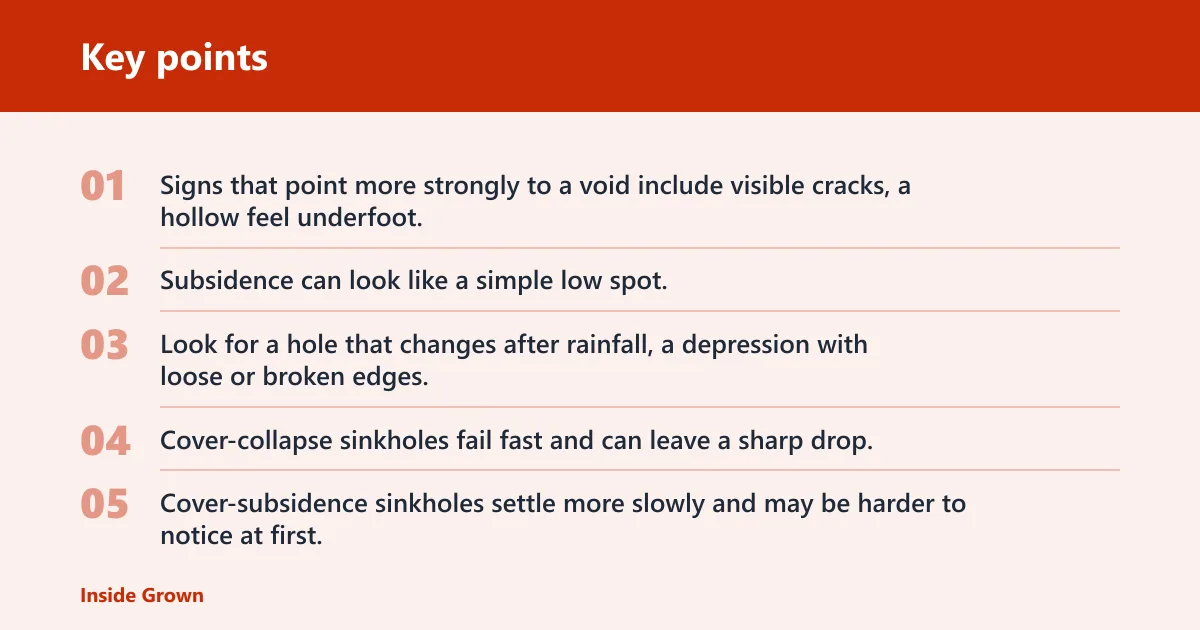
Signs that point more strongly to a void include visible cracks, a hollow feel underfoot, fresh slumping around the rim, or soil that seems to disappear after rain. Subsidence can look like a simple low spot, but it is really gradual settling into openings below, so it deserves the same caution until the cause is clear.
Surface signs that point to a void
Look for a hole that changes after rainfall, a depression with loose or broken edges, or ground that sinks when you walk near it. Cover-collapse sinkholes fail fast and can leave a sharp drop, especially where impermeable cover soils bridge a cavity. Cover-subsidence sinkholes settle more slowly and may be harder to notice at first.
Clues that suggest simple settling instead
A broad, shallow low spot with no cracking, no fresh soil loss, and no nearby utility or structure damage is more often ordinary settling in the yard. Buried debris, old fill that was not compacted, or a poor finish grade can create the same look without a true geologic sinkhole. That said, the cause still needs checking before you add soil.
What you’ll need
- Stakes or marking paint
- Warning tape or temporary fencing
- Gloves and sturdy boots
- Flashlight for checking edges and nearby cracks
- Camera or phone for before-and-after photos
- Measuring tape or ruler for noting change
- Shovel only for shallow, clearly safe surface inspection
- Stormwater map, irrigation plan, or utility markings if available
Landscape sinkhole checklist
| Symptom | Likely cause | Safest next step |
|---|---|---|
| Small dip with soft soil after heavy rain | Drainage washout or grading that sends water into the subgrade | Mark it, keep off it, and check downspouts, grading, and irrigation leaks |
| Depression over a spot where fill was added years ago | Improperly compacted fill or buried debris voids | Inspect the area carefully; shallow isolated repair may need excavation and backfill |
| Cracks, slumping edges, or sudden soil loss | Probable sinkhole or active subsidence | Keep people away and call a geotechnical or structural professional |
| Hole near a slab, wall, driveway, or utility line | Possible subsurface void or leaking utility | Stop using the area and get a professional inspection before any digging |
| Repeated settling after rain or irrigation cycles | Water infiltration, pipe leak, or unresolved drainage path | Fix the water source first, then repair the fill |
| Depression in limestone or dolomite terrain | Dissolution sinkhole in karst geology | Treat as karst-related ground failure and call a specialist |
When should you call a pro?
Call a geotechnical or structural professional any time the depression is near a building, pavement, retaining wall, or utility line. That matters because sinkholes can affect slabs, foundations, and roads, and leaking utilities can create voids below the surface. In karst geology, limestone and dolomite can dissolve where water contacts the bedrock, so the repair plan may need deeper stabilization.
If the area is growing, cracking, or dropping after rain, do not treat it as a cosmetic yard issue. A professional inspection helps separate a simple low spot from active ground failure and can determine whether excavation, grouting, or drainage correction belongs in the plan.
Signs of active ground failure or karst geology
R.J. Potteiger notes that sinkholes may appear suddenly, with visible ground cracks, holes, or depressions. Kagaoan identifies leaking utilities, improperly compacted fill, stormwater mismanagement, and natural limestone dissolution as causes. Those clues raise the odds that the problem is deeper than topsoil and need more than a surface patch.
How to repair a sinkhole in yard
Begin with safety, not fill. Keep people, pets, and vehicles away, mark the edges, and watch for widening cracks or new settling. If the hole is near a structure or utility, stop there and arrange inspection. For a shallow, isolated sinkhole in open ground, the repair may be excavation and backfill; for deeper voids, grouting or other stabilization may be needed.
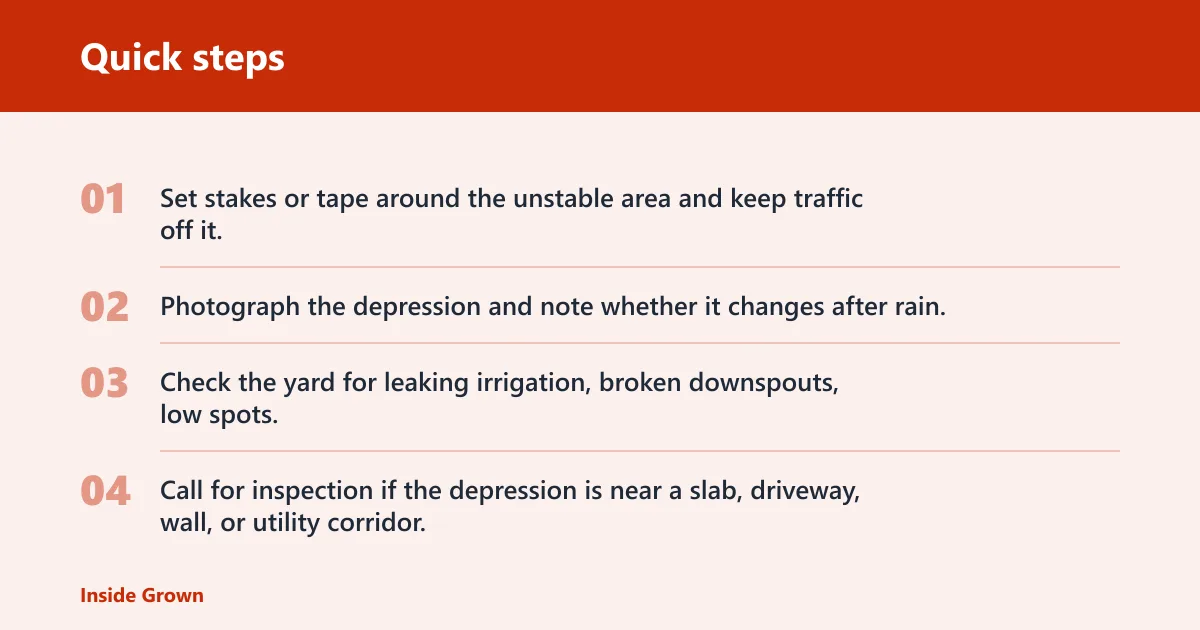
- Set stakes or tape around the unstable area and keep traffic off it.
- Photograph the depression and note whether it changes after rain.
- Check the yard for leaking irrigation, broken downspouts, low spots, and runoff that points toward the hole.
- Call for inspection if the depression is near a slab, driveway, wall, or utility corridor.
Step 1: Secure the area
Keep everyone back from the edge and avoid driving, mowing, or digging into the depression. A cover-collapse sinkhole can fail fast, and even a shallow subsidence area can shed more soil after a rain. Mark the perimeter so you can see whether it is expanding.
Step 2: Find the cause
Check the surface water first. Look for downspouts that empty beside the depression, grading that sends runoff toward it, and irrigation lines that may leak underground. Kagaoan notes stormwater mismanagement and leaking utilities as causes, and USS warns that improper grading can allow water to infiltrate the subgrade.
Suppose a 3-foot-wide dip keeps reappearing beside a bed edge after every sprinkler cycle. That pattern points more toward water infiltration or a leak than toward a one-time cosmetic dip. In that case, drainage correction comes before any fill is placed.
Step 3: Choose the repair path
Shallow, isolated sinkholes are often repaired by excavation and backfill. That means removing loose material, rebuilding support, and placing suitable stone, soil, gravel, or geotextile fabric only where the design calls for it. USS notes that an inverted cone filter method may be used in some repairs, and R.J. Potteiger includes grouting as a repair method.
If the void extends deeper or the ground keeps moving, compaction grouting is a common professional option. Rembco describes a grid pattern of injection pipes advanced to bedrock, with compaction grouting placed as the pipes are withdrawn. That method is for deeper stabilization, not for a simple topdress fix.
Step 4: Correct drainage before the final fill
Drainage correction is part of the repair whenever water infiltration is part of the cause. Redirect downspouts, repair leaks, and fix the grading so runoff moves away from the area. USS warns that simply throwing dirt into the hole is not enough, because the void or washout can remain active beneath the surface.
After the fill is placed, recheck the area after the next heavy rain. If it settles again, the cause was not fully addressed and a deeper repair may be needed.
Can you repair a shallow sinkhole?
Yes, but only when the problem is truly shallow, isolated, and away from structures or utilities. A shallow excavation and backfill can work when loose material is limited and the cause is understood. If water movement, buried debris, or deeper voids are still active, the repair should shift to drainage correction or professional stabilization instead.
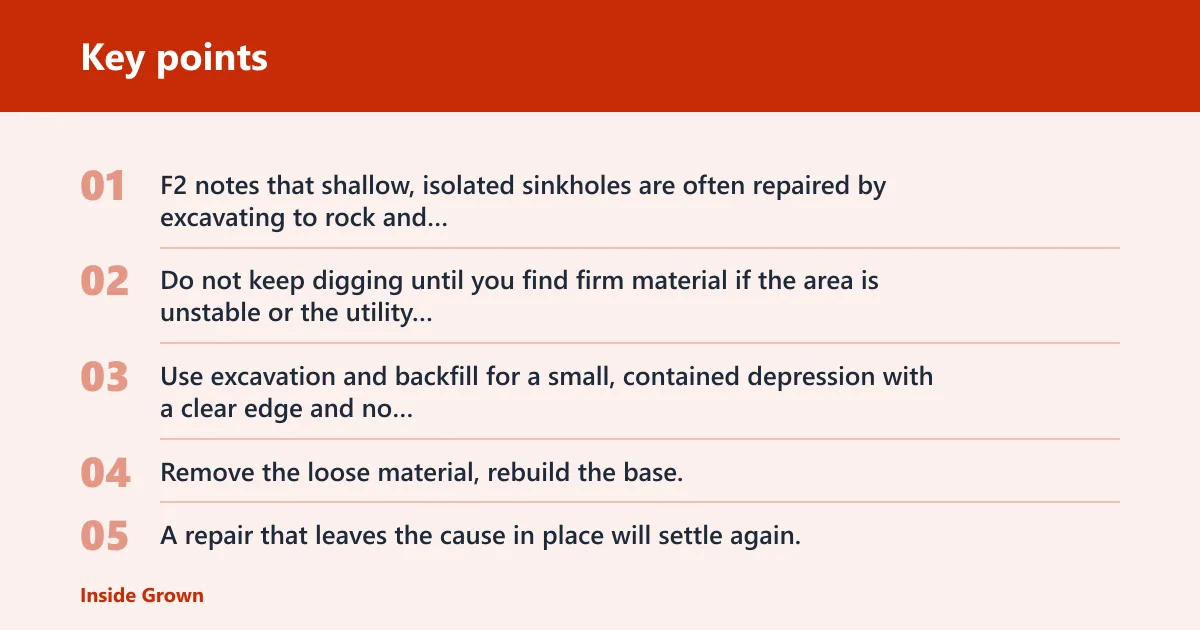
F2 notes that shallow, isolated sinkholes are often repaired by excavating to rock and building a plug, but that approach only fits sites where rock is present at a reachable depth and where excavation is safe. Do not keep digging until you find firm material if the area is unstable or the utility layout is unknown.
When excavation and backfill fit the problem
Use excavation and backfill for a small, contained depression with a clear edge and no sign of active enlargement. Remove the loose material, rebuild the base, and compact in lifts that match the material and the site conditions. A repair that leaves the cause in place will settle again.
When drainage correction comes first
If water is entering the subgrade, fix that before final backfill. Improper grading, leaking irrigation, blocked drainage, and failed downspouts can all feed the same void or washout. A patch on top without water control usually hides the issue for a while and then fails again.
When grouting or deeper repair is the safer route
Use grouting when the void is deeper than a simple yard repair, when surface cracking keeps spreading, or when the site is part of karst geology. Compaction grouting can restore bearing capacity below the surface, but it is specialized work. Near foundations, roads, or slabs, that decision belongs with a geotechnical professional.
Common mistakes
Dumping loose soil into the hole is the biggest mistake. It can bridge over a void, hide the problem, and settle again after the next rain. USS specifically warns that simply throwing dirt into the hole is not enough.
Another common error is using the same fix for every depression. A drainage washout, a buried-debris void, and a dissolution sinkhole do not call for the same repair. Say your yard dips every time the sprinkler zone runs. That is a drainage problem until proven otherwise, not a place to pile soil.
Skipping follow-up checks also causes repeat failures. After the fill is in place, monitor it through the next storm cycle. If the surface drops again, the underlying void or water path is still active.
Prevention means reducing water movement into vulnerable ground and keeping fill properly compacted. Maintain grading so water runs away from the area, repair leaking utilities quickly, and keep downspouts from discharging beside the foundation or bed edge. In karst areas, any new depression deserves faster inspection because dissolution can continue below the surface.
Frequently asked questions
How do sinkholes get fixed?
Most fixes start with inspection, then move to excavation and backfill for shallow isolated problems or grouting for deeper voids. If water is part of the cause, drainage correction comes with the repair. Near a building, slab, pavement, or utility line, get a geotechnical or structural professional involved first.
How are sinkholes repaired?
Repair depends on depth, location, and cause. A shallow yard hole may be dug out and rebuilt with proper fill, while a deeper void may need compaction grouting or another stabilization method. If the cause is water, fix the grading, leaks, or runoff path before final backfill.
How to fix a small sinkhole
A small depression is only a candidate for homeowner repair if it is isolated, stable, and away from structures and utilities. Remove loose soil, correct any drainage issue you can verify, and rebuild the base with suitable material. If the hole grows or cracks appear, stop and call a professional.