How to Lower Soil Salinity in a Home Garden
Lower soil salinity by testing first to find the source, whether salts come from irrigation, fertilizer, container mix, or poor drainage. If water or excess fertilizer is the source, flush the root zone with low-salt water. If drainage is blocked, fix that before leaching. Ignoring the source can burn roots, slow growth, and make repeated flushing waste water while salt returns. This guide shows how to diagnose the source, choose the right fix for beds or containers, and avoid making salinity worse.
What soil salinity does to plants
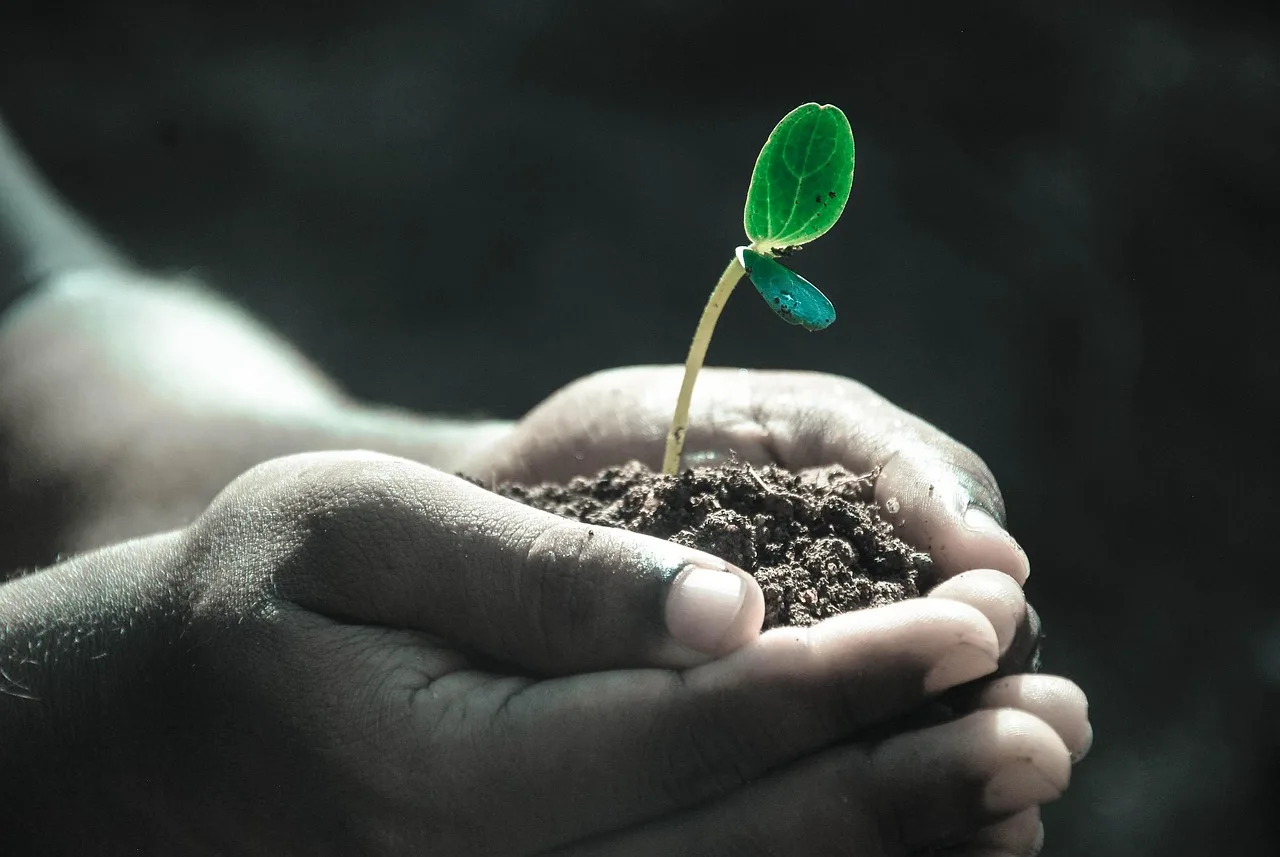


Soil salinity means excess soluble salts in the root zone. It is often measured during soil testing with electrical conductivity, or EC. High salt levels make it harder for roots to take up water, and they can also interfere with germination and nutrient uptake, so plants may wilt even when the soil looks wet.
That is why salty soil often looks like drought, nutrient deficiency, or root damage. Leaves may yellow, edges may scorch, growth may stall, and seeds may fail to sprout. The symptoms can also vary by location: containers dry and salt up faster, raised beds can collect salts near the surface, and low spots can keep salts after runoff or irrigation concentrates there.
Why excess salts cause drought-like stress
Plants absorb water by moving it from lower-salt soil solution into root tissue. When the soil solution is already salty, roots have to work harder to take up water. The plant can look thirsty even right after watering. That is one reason flushing the wrong bed wastes effort if drainage still traps salts in place.
Why the problem shows up differently in small gardens
Containers fail fastest because the root zone is small and evaporation is high. Raised beds dry faster than in-ground beds, so salts can build at the top if irrigation is frequent and shallow. Flat sites and clay soils behave differently: water may sit, move slowly, or leave behind high-salt pockets.
How do you tell salinity from sodicity?
Saline soil and sodic soil are not the same problem. Saline soil has too much soluble salt. Sodic soil has too much sodium on the soil exchange sites, which damages structure and permeability. EC helps identify salinity, while SAR or ESP can matter more when sodium is the real issue. pH alone does not answer the main question.
Signs that point to saline soil
Look for crusting on the surface, poor germination, tip burn, and wilting that improves briefly after watering but returns fast. If the soil still drains reasonably well, and the main issue is water stress plus high EC, salinity is more likely than sodicity.
Signs that point to sodic soil
Sodic soil often drains badly, seals over when wet, and turns hard when dry. Water may puddle or run off before soaking in. The structure problem matters because even clean water may not move through the profile well enough to carry salts below the root zone.
Where pH fits
pH can help explain some nutrient issues, but it does not diagnose salinity by itself. Many cultivated plants prefer pH between 6.0 and 7.0, and soils above pH 7.5 are considered alkaline. Still, a pH reading will not tell you whether sodium is causing poor infiltration. Use pH as one clue, not the main decision point.
What should you test first?
Start with a soil test before changing amendments or watering patterns. Soil salinity is often assessed during soil testing, and EC gives a practical read on whether salts are mild, moderate, or severe. EC below 2 millisiemens/cm suits many agricultural uses, EC from 2 to 8 millisiemens/cm may suit only some crops, and soil exceeding EC 8 millisiemens/cm is generally unsuitable for most cultivation.
Simple checks before you spend money
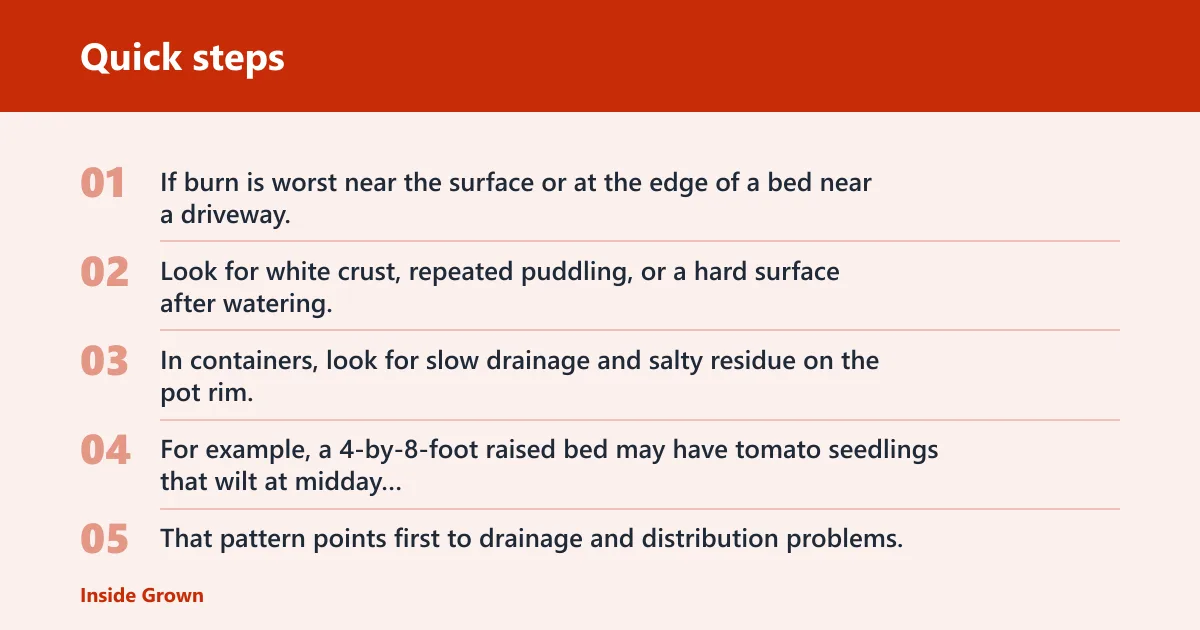
Check where symptoms appear. If burn is worst near the surface or at the edge of a bed near a driveway, irrigation splash, fertilizer bands, or runoff may be the source. Look for white crust, repeated puddling, or a hard surface after watering. In containers, look for slow drainage and salty residue on the pot rim.
For example, a 4-by-8-foot raised bed may have tomato seedlings that wilt at midday while the center of the bed stays wet for hours after irrigation. That pattern points first to drainage and distribution problems, not just missing nutrients. A flush without fixing the wet center may leave the roots in low-oxygen, salty soil.
When to use a meter or lab test
A home EC meter or a lab sample is worth using when the problem is not obvious, when you are deciding whether to reclaim a bed, or when you need to separate saline from sodic soil. If you suspect sodium, ask for the sodicity metrics that matter, especially SAR or ESP, instead of relying on total sodium alone.
Salt recovery decision table
| Symptom pattern | Likely cause | First action | Red flag to abandon reclamation |
|---|---|---|---|
| White crust, normal drainage, seeds fail to sprout, leaves scorch after watering | Saline | Test EC, then leach with low-salt water after confirming drainage | EC stays above 8 millisiemens/cm after repeated flushing and the bed has shallow soil |
| Puddling, crusting, slow soak-in, hard clods when dry, water runs off the surface | Sodic | Test for SAR or ESP, improve drainage, then use gypsum if sodium is confirmed | Water still ponds after structure repair and root zone remains sealed |
| Edge burn near pavement, driveway, or salt-treated walkways | Irrigation-related or runoff-related | Stop the salt source, reroute runoff, then flush the affected zone | The source cannot be controlled and the bed is repeatedly re-salted each season |
| Container plants wilt fast, pot rim has residue, drainage holes are slow | Irrigation-related plus container buildup | Leach the pot and switch to lower-salt water or fresh mix | The mix stays wet, salty, and stale after a full reset |
Common mistakes that raise salts again
| Mistake | Why it keeps salinity high |
|---|---|
| Adding compost as the only fix | Compost can help structure, but it does not remove salts |
| Using gypsum on every salty bed | Gypsum helps sodic soil, not every saline soil |
| Leaching without drainage | Water moves salts downward only if it can keep moving out of the root zone |
| Heavy fertilizer use after symptoms appear | Extra fertilizer can add more soluble salts |
Should I leach salty soil or add amendments first?
Fix drainage first, then leach. Leaching is the main practical way to remove soluble salts, but it only works when water can move below the root zone. If drainage is poor, extra water can make waterlogging worse and can keep salts trapped where roots live. Amendments do not directly remove high salt concentrations.
What leaching needs to work
Leaching needs enough water to move salts downward, plus infiltration that is good enough for that water to pass through the soil profile. If the soil seals, compacts, or sits flat with no outflow path, flushing is weak or counterproductive. Good drainage is the surest way to reduce soil salt.
How to think about water volume
There is no one-size-fits-all flush amount. The right amount depends on texture, rooting depth, starting EC, and drainage speed. In a container, water should move through the potting mix and out the bottom. In a bed, repeated light watering will not clear salts if the soil never drains far enough below the roots.
How should you improve drainage before leaching?
Water has to move below the root zone before salts can leave the problem area. In clay soils, compacted beds, and flat sites, drainage is often the first bottleneck. If you leach before fixing that, you may only spread the salts around or create a soggy root zone.
Small-garden fixes that matter most
- Break surface crusting and compaction with shallow cultivation where roots allow it.
- Add a gentle grade so water does not sit in one spot.
- Use raised beds when the native soil stays wet or salty after rain.
- Check that any drain outlet can move water away from the bed and does not dump saline runoff into another planting area.
- In containers, use pots with enough drainage holes and discard mixes that stay saturated and crusty.
Suppose a coastal front yard bed sits on clay and gets sprinkler water with a high salt load. Even if the plants look dry at noon, the real fix is not only more watering. The bed needs a better outlet path first, or the salts will stay near the surface and the roots will keep struggling.
When raised beds help most
Raised beds help when the native soil is flat, compacted, or slow to drain. They are less useful if the irrigation water itself is salty and the bed is repeatedly re-salinized. In that case, the source must be controlled or the bed will keep building salt again.
Which amendments fit the problem?
Use amendments to fix the soil condition that is blocking recovery, not as a shortcut around flushing. Gypsum is useful for sodic soil because calcium helps replace sodium on soil exchange sites. Organic matter can improve structure and infiltration. Neither one directly removes salts on its own.
Gypsum for sodic soil
Use gypsum only when sodium is the real issue or when a test points to sodicity. It can help open structure so water can move through the soil and carry sodium away. If the soil is simply saline, gypsum alone will not solve the problem.
Organic matter for structure
Compost can help soil tilt toward better aggregation and infiltration, and MIgardener recommends it as a pH buffer. That is useful support, especially in beds that crust or seal. But compost is not a salt remover, and too much salty compost can add to the problem if the input material is contaminated.
What plants can cope while soil recovers?
If the soil is highly affected or the site cannot be reclaimed quickly, choose salt-tolerant plants and keep the use case realistic. Salt-tolerant plants are a fallback, not a cure. Match the plant to the site severity, whether that is a hot parking strip, a windy coastal border, or a bed that still needs rehabilitation.
Examples that often handle more salt
For ornamentals and edging, try plants commonly used in tougher sites such as rosemary, sea thrift, lavender, daylily, yarrow, and salvia species suited to your climate. For crops, some gardeners have better results with beets, Swiss chard, and asparagus than with salt-sensitive seedlings. Always match the plant to your local conditions and irrigation water quality.
When to stop reclaiming and start over
If EC remains above 8 millisiemens/cm after repeated drainage fixes and flushing, or if sodic structure will not open enough to drain, stop pouring time into the same bed. At that point, replacement soil, re-bedding, or a salt-tolerant planting plan is usually a better use of space and water than repeated salvage attempts.
How do I reduce salinity in soil?
First find the source, then fix drainage, then leach the salts out of the root zone with low-salt water. If the source is fertilizer, cut it back. If the source is irrigation water or runoff, change that source. If the soil is sodic, add gypsum only after confirming the diagnosis.
How can salinized soil be fixed?
Most fix attempts start with a soil test, because you need to know whether the bed is saline, sodic, or both. Then improve drainage, leach soluble salts, and use the right amendment only if the test supports it. Severe cases may need replacement soil or a switch to salt-tolerant plants.
What is soil salinity and why is it a problem?
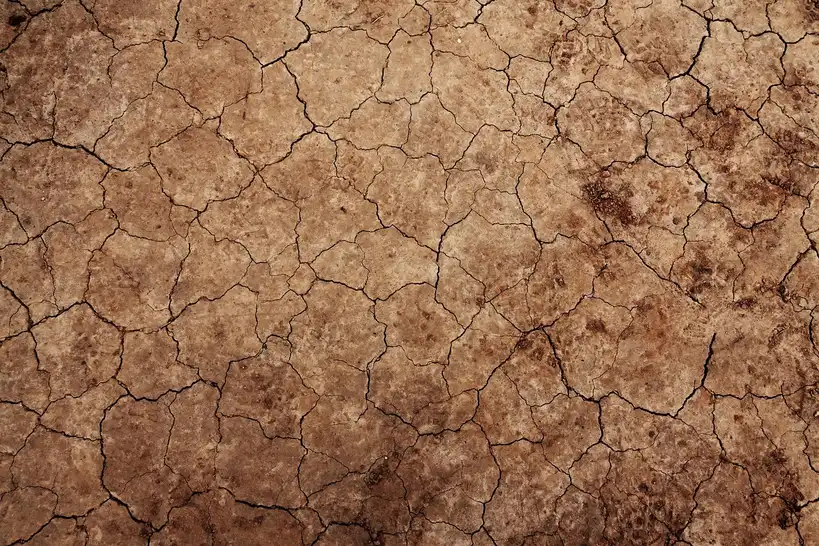
Soil salinity is excess soluble salt in the root zone. It matters because it makes water harder for roots to absorb, slows germination, and disrupts nutrient uptake. Plants can wilt, stunt, or fail even when the soil is moist. High salinity is often linked to irrigation water, drainage problems, and evaporation.
How do I tell if my garden soil is too salty?
Look for crusting, poor seed sprouting, leaf burn, and wilting that does not match the watering schedule. Then confirm it with EC testing or a lab sample. EC below 2 millisiemens/cm suits many agricultural uses, EC from 2 to 8 millisiemens/cm may suit only some crops, and EC above 8 millisiemens/cm is generally unsuitable for most cultivation.
What is the difference between saline and sodic soil?
Saline soil has too much soluble salt. Sodic soil has too much sodium on soil exchange sites and often has poor structure and slow infiltration. EC is commonly used as a main salinity measure, while SAR or ESP are often more useful for sodicity. pH may be part of the picture, but it is not enough on its own.
Can compost lower soil salinity?
Compost can help soil structure and infiltration, and that can support recovery. It does not directly remove salts. If the compost is itself salty or if drainage is poor, adding more organic matter will not solve the problem. Use compost as support after you have identified the cause and planned the flush.
What plants can grow in salty soil if I can’t fix it yet?
Choose salt-tolerant plants for the site and severity. Rosemary, lavender, yarrow, salvia, daylily, beets, Swiss chard, and asparagus are common starting points, depending on climate and bed conditions. If the EC stays very high or the soil will not drain, switch to replacement soil or a new bed rather than forcing sensitive crops to struggle.
How do I prevent soil salinization in a home garden?
Use lower-salt irrigation water when possible, avoid overfertilizing, and keep drainage working so salts do not accumulate in the root zone. Rinse containers periodically, keep pet urine off small beds, block coastal spray where possible, and keep de-icing runoff away from planting areas. Small changes here prevent a lot of repeat damage.
How to lower salinity in aquarium
That is a different system, so the fix is not garden leaching. In an aquarium, salinity is managed by water changes, source-water quality, and careful mixing of saltwater or freshwater as needed for the livestock. Do not transfer garden soil advice to aquarium water chemistry.