Weekly landscaping services vs monthly service plans
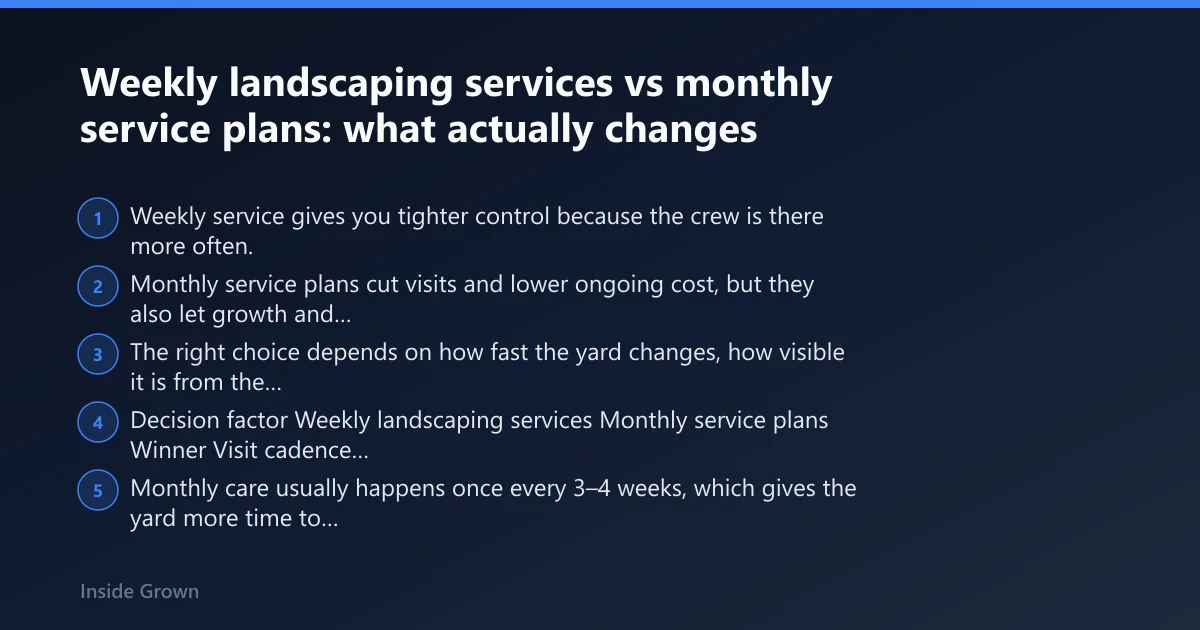
Weekly service gives you tighter control because the crew is there more often. Monthly service plans cut visits and lower ongoing cost, but they also let growth and mess build between stops. The right choice depends on how fast the yard changes, how visible it is from the street, and how much abuse it takes between visits.
Weekly landscaping services vs monthly service plans: what actually changes
| Decision factor | Weekly landscaping services | Monthly service plans | Winner |
|---|---|---|---|
| Visit cadence | Once per week | Once every 3–4 weeks | Weekly service |
| Typical scope | Mowing, edging, trimming, cleanup, weed checks, irrigation checks | Basic cleanup, edging touch-ups, pruning touch-ups, weed control, seasonal care | Weekly service |
| Appearance consistency | Higher, more manicured look | Acceptable for slower yards, but can drift between visits | Weekly landscaping services |
| Plant health monitoring | Earlier detection of pests, disease, and dry spots | Less frequent observation, so problems can sit longer | Weekly landscaping services |
| Budget fit | Higher ongoing cost | More affordable than weekly services | Monthly plans |
| Best-fit property type | Active yards, fast growth, front-facing visibility | Quiet yards, slow growth, lower-use properties | Depends on the yard |
Visit cadence changes what gets controlled
Weekly care means regular visits, usually once a week, so growth, debris, and small issues stay under control. Monthly care usually happens once every 3–4 weeks, which gives the yard more time to change between visits. That gap works on slow, low-use properties. It is where active yards start slipping.
Scope changes from maintenance to catch-up
Weekly maintenance typically includes mowing, edging, trimming, and basic cleanup. Monthly maintenance focuses more on general upkeep than detailed work, so it fits best when the yard does not need constant correction. If the property needs trimming, pruning, blowing, weed control, and irrigation checks to stay presentable, weekly usually holds the line better.
When monthly looks fine on paper but fails in practice
A monthly plan can look economical until the yard starts forcing extra work. Fast plant growth, regular foot traffic, and visible front beds can create overgrowth, soft edges, and weed pressure long before the next visit. Then the crew spends the visit catching up instead of maintaining, which is a bad sign.
According to Weekly vs Monthly Lawn Maintenance: Which Is Better? — Monthly care is usually performed once every 3–4 weeks.
What weekly yard care usually includes
Weekly landscape maintenance usually includes mowing, edging, trimming, and basic cleanup on a once-per-week cadence. It also commonly adds weed checks, pruning touch-ups, debris removal, and irrigation walk-throughs. That frequency helps the yard stay ahead of fast growth instead of reacting after it has already gone shaggy.
Trimming and pruning stay lighter
When plants are checked weekly, trimming and pruning are usually smaller jobs. The crew can correct new growth before it turns into heavy cutback work. That matters on shrubs, hedges, and beds that respond quickly in warm weather or under regular irrigation.
Cleanup stays routine, not corrective
Blowing, leaf pickup, and debris removal are easier when they happen before the mess spreads. Weekly visits keep clippings, sticks, and spent growth from building up around walkways, beds, and corners. That also keeps the property looking cared for instead of recently rescued.
Weed checks and irrigation checks matter more than people think
Weekly care helps detect lawn issues early, including pests, diseases, and dry spots. It also gives the crew more chances to catch irrigation problems before they show up as stress or uneven growth. On a yard that changes quickly, that early read can matter as much as mowing.

What monthly yard care usually includes
Monthly landscape maintenance is usually a 3–4 week cadence built around basic cleanups, edging, pruning touch-ups, weed control, and seasonal care. It is a better fit when the yard stays fairly stable between visits and does not need constant shaping. The goal is upkeep, not tight visual control.
It works best when growth is slower
Monthly service can hold up on slow-growing plants, low-use yards, and properties with steady irrigation and limited weed pressure. In those settings, there is enough time between visits for the yard to stay presentable without crossing into neglect. That is the sweet spot for lower-frequency care.
It is weaker at fine detail
Where monthly plans often stop short is edge sharpness, consistent cleanup, and the kind of weed control that keeps a yard crisp week to week. A yard can still be healthy on monthly service and look slightly behind. That is acceptable in quiet areas, less so on front-facing lots.
Monthly is maintenance, not correction
Monthly service is enough when the property mainly needs general upkeep and seasonal touch-ups. It is less effective when the yard already needs correction every visit. If the crew has to reset the same borders, rebalance the same growth, or chase the same weeds, the schedule is too slow.
Which yards need weekly service?
Weekly service can be a good fit for fast-growth properties, high-visibility front yards, and yards that get regular use. It is the better choice when the yard changes quickly enough that a 3–4 week gap creates visible decline. That includes active irrigation, warm-season flushes, dense beds, and properties with frequent gatherings.
Fast growth pushes the schedule up
Plant growth rate is one of the clearest triggers for weekly care. Fast growth, heavy irrigation, or seasonal surges can make a monthly schedule feel stretched before the next visit. Weekly service keeps the growth curve flatter and the work smaller.
Visibility changes the standard
Curb appeal matters most on homes that face the street, especially front yards that people see every day. Weekly care keeps a more manicured look, which is useful when the yard is part of the home’s first impression. Lower visibility gives you more room to stretch the schedule.
Use level changes the workload
Frequent gatherings, pets, kids, and daily outdoor use create more debris, more disturbance, and more wear on edges and beds. Weekly care handles that churn better because the property is being reset before the next round of traffic. A quiet yard can often wait longer.
Which yards can stay on monthly service?
Monthly service fits slow-growing, low-traffic yards with simple planting layouts and limited street visibility. It is also a workable choice for second homes, rental properties, or steady yards that do not change much between visits. These yards usually need basic cleanup and seasonal touch-ups more than constant correction.
Simple yards are easier to hold
When beds are simple and plant density is modest, there is less to trim, less to prune, and less to clean. That means a 3–4 week cadence can still keep the property orderly. The lighter the plant load, the more monthly service makes sense.
Low weed pressure makes monthly more realistic
If weeds are not rebounding fast, there is less risk that the yard will look unkempt before the next visit. Stable irrigation and slower growth help too. In those cases, monthly service can preserve both appearance and plant health without unnecessary frequency.
Lower visibility buys time
Yards that are not highly visible from the street can tolerate a little more drift. If the property is tucked away, shaded from view, or mainly seen by the people who live there, monthly service often covers the need well enough. The same schedule would look thin on a corner lot.
Decision matrix: 8 yard scenarios and the right cadence

This matrix uses five yard-condition scores: growth rate, foot traffic, plant density, weed pressure, and curb-facing visibility. Score each factor as low, medium, or high. The more high-risk boxes a property has, the more likely weekly service is the minimum that keeps appearance and plant health on track.
| Scenario | Growth rate | Foot traffic | Plant density | Weed pressure | Curb-facing visibility | Recommended cadence |
|---|---|---|---|---|---|---|
| 1. High-growth front yard near the street | High | Medium | Medium | High | High | Weekly landscaping services |
| 2. Low-use backyard with simple beds | Low | Low | Low | Low | Low | Monthly service plans |
| 3. Family yard with pets and regular use | Medium | High | Medium | Medium | Medium | Weekly landscaping services |
| 4. Shaded lot with slower growth but persistent leaf drop | Low | Low | Medium | Medium | Low | Monthly service plans |
| 5. Dense planting with irrigation and fast weed rebound | High | Medium | High | High | Medium | Weekly landscaping services |
| 6. Vacation or part-time occupied property | Low | Low | Low | Medium | Low | Monthly service plans |
| 7. Corner lot with constant visibility | Medium | Medium | Medium | Medium | High | Weekly landscaping services |
| 8. Mixed property with front weekly and back monthly needs | High front, low back | High front, low back | High front, low back | Medium | High front, low back | Weekly front, monthly back |
Scenario 1: high-growth front yard near the street
This is a weekly yard because the visible part of the property changes too quickly. A monthly visit leaves time for edges to blur, growth to shoot past the cut line, and curb appeal to slide. The front yard is doing too much work to wait that long.
Scenario 2: low-use backyard with simple beds
This is a monthly yard because the whole property changes slowly and is not under constant view. There is not much to correct between visits, and the cleanup load stays light. The lower cost of monthly service fits the actual maintenance demand.
Scenario 3: family yard with pets and regular use
Weekly service wins because use level matters as much as growth rate. Pets, kids, and routine outdoor activity kick up debris and rough up edges. A monthly plan can leave the yard looking tired before the next cleanup.
Scenario 4: shaded lot with slower growth but persistent leaf drop
This one can stay monthly if the leaf drop is manageable and the plants are not growing fast. Shade slows growth, which reduces the need for weekly trimming. The main job is general upkeep, not constant shaping.
Scenario 5: dense planting with irrigation and fast weed rebound
Weekly service is the safer choice. Dense beds take more time to clean, and irrigation plus fast rebound weeds can turn a tidy yard into a messy one quickly. Monthly care often arrives after the yard has already drifted too far.
Scenario 6: vacation or part-time occupied property
Monthly service usually fits because the property is not being used heavily and does not need constant presentation. It can hold up well if the plants are slow-growing and the irrigation is stable. This is one of the clearest monthly cases.
Scenario 7: corner lot with constant visibility
Weekly service is the better fit because the yard is seen from more angles and more often. A corner lot can look unkept faster even when the actual work load is average. Visibility alone can push the schedule up.
Scenario 8: mixed property with front weekly and back monthly needs
This is where a split plan makes sense. The front yard carries the appearance burden, while the back yard may only need periodic upkeep. A mixed schedule can control cost without letting the visible areas slip.
Choose weekly landscaping services if… / Choose monthly service plans if…

Choose weekly landscaping services if the yard grows quickly, gets used often, or is visible enough that a 3–4 week gap would look rough. Choose monthly service plans if the property is quiet, simple, and stable enough to stay tidy between visits. The best plan is the lightest one that still protects appearance and plant health.
Choose weekly landscaping services if…
Choose weekly when curb appeal matters every week, not just after a visit. Choose it when the yard has fast growth, dense planting, heavy weed pressure, active irrigation, or regular gatherings. Choose it when the cost of catching up later is higher than the cost of staying ahead now.
Choose monthly service plans if…
Choose monthly when the yard is slow-growing, low-traffic, and not highly visible from the street. Choose it when basic cleanup, edging, pruning touch-ups, and seasonal care are enough to keep the property in shape. Choose it when budget matters more than a consistently manicured look.
Budget check and switching rule
Monthly plans are typically more affordable than weekly services, so they fit tighter budgets better at the start. Weekly plans cost more, but they can prevent overgrowth, missed weeds, and bigger cleanup bills later. A practical rule is simple: move up in peak growth months, then move down when growth slows.
Frequently asked questions
Is weekly landscaping service worth it compared with monthly service plans?
Weekly service is worth it when the yard changes fast enough that monthly care cannot keep pace. That usually means active growth, frequent use, high visibility, or dense beds. If the property stays tidy for 3–4 weeks without slipping, monthly service is usually the better value.
What does weekly landscaping maintenance usually include?
Weekly maintenance usually includes mowing, edging, trimming, and basic cleanup. It can also include weed checks, pruning touch-ups, debris removal, pest spotting, and irrigation walk-throughs. The point is to keep the yard controlled before growth and mess start stacking up between visits.
What should monthly landscaping service include?
Monthly service should include basic cleanup, edging, pruning touch-ups, weed control, and seasonal care. It should also cover any general upkeep needed to keep the yard from drifting between visits. Monthly service is best when the property does not need constant detail work.
When is monthly service enough for a yard?
Monthly service is enough when growth is slow, weed pressure is light, and the property has low foot traffic. It also works well for quiet yards, second homes, rental properties, and low-visibility spaces. If the yard stays presentable for 3–4 weeks, monthly care usually holds.
How often do active yards need landscape maintenance?
Active yards usually need weekly landscape maintenance because the combination of growth, use, and cleanup demand outpaces a monthly schedule. Regular gatherings, pets, kids, and front-facing visibility all make the yard change faster. Weekly visits keep appearance and plant health more stable.
Can I switch between weekly and monthly landscaping plans by season?
Yes. Many homeowners combine weekly and monthly service by season. Weekly care often fits the growing season, while monthly care can work better during slower months. Switch when growth rate, weed pressure, and use level drop enough that the yard stays tidy longer between visits.