How to Get a Landscaping Estimate for Your Home
Request about three written landscaping estimates after you define the scope, site conditions, and materials in one short packet. Without that, bids are hard to compare, and change orders can push the final price far above the first quote. This guide shows what details to gather, what to leave out, and how to check each estimate for apples-to-apples pricing.
What should I prepare before I ask for landscaping estimates?

Prepare one clear request packet before you contact contractors. Include the property address, photos, rough measurements, access notes, and a short scope description so each bidder prices the same work. If the project involves plant layout, drainage, or irrigation, include drawings or a plan set when available so the estimate reflects the same assumptions from the start.
What you’ll need before you ask
- Property address
- Primary contact name, phone number, and email
- Photos of each work area from several angles
- Rough measurements of beds, lawn, patio, or walk areas
- A short list of desired materials, such as mulch, sod, gravel, pavers, or plant types
- Notes on drainage, slope, and any low spots
- Removal and disposal needs for existing plants, turf, edging, concrete, or debris
- Access limits, such as narrow gates, stairs, or limited street parking
- Timeline or target start window
- Budget range, if you have one
Copyable estimate request template
Use this template in an email or quote form so each contractor gets the same starting information. Keep it short, but make it specific enough that the company can decide whether the job needs a site visit, drawings, or an itemized proposal.
Subject: Request for landscaping estimate for [property address]
Thank you.
Landscaping estimate scorecard
Use this scorecard to compare bids on the same terms instead of only comparing totals. If one company leaves out plant counts, irrigation counts, or disposal, the lowest price may not be the best value because the scope is not actually the same.
| Quote comparison item | Company A | Company B | Company C | Notes |
|---|---|---|---|---|
| Scope match | Same areas, same tasks, same finish level | |||
| Labor | Crew size, hours, and task coverage | |||
| Materials | Plant sizes, mulch type, stone, pavers, soil, sod | |||
| Allowances | Budget placeholders that may change later | |||
| Exclusions | What is not included in the price | |||
| Disposal | Haul-off, dump fees, and debris handling | |||
| Drainage | Grading, runoff fixes, drain lines, slope work | |||
| Access | Gate width, stairs, parking, equipment access | |||
| Warranty | Plant replacement, workmanship, or coverage limits | |||
| Timeline | Start window, duration, and sequencing | |||
| Payment terms | Deposit, progress payments, final payment timing |
How do I get a landscaping estimate for my home?
Start with a clear scope, then ask for written estimates from contractors who can review the site and price the same work. A site walk-through is the best first step because it reveals access, slope, terrain, removal, and drainage constraints that shape labor and materials. A quick online request works best for small, simple jobs.
What you should send first
Send the property address, photos, rough measurements, and a short scope summary before the first call or visit. That packet helps the contractor see whether the work is a basic front-yard refresh, a planting project, or a larger job that needs drawings. The more precise the packet, the fewer surprises later.
- Write down the exact areas you want priced.
- List what must stay, what must go, and what should change.
- Gather photos, measurements, and access notes.
- Ask for itemized written estimates with scope, assumptions, inclusions, and exclusions.
- Compare the responses on the same scope, not just the total.
What information do landscapers need to give an estimate?
Landscapers need enough detail to price labor, material cost, and site-specific work without guessing. At minimum, they need the address, photos, measurements, desired materials, removal needs, drainage concerns, access limits, and your target timeline. For larger projects, planting plans, irrigation plans, and other drawings may be needed to keep the bid accurate.
What counts as a quote, estimate, or proposal?
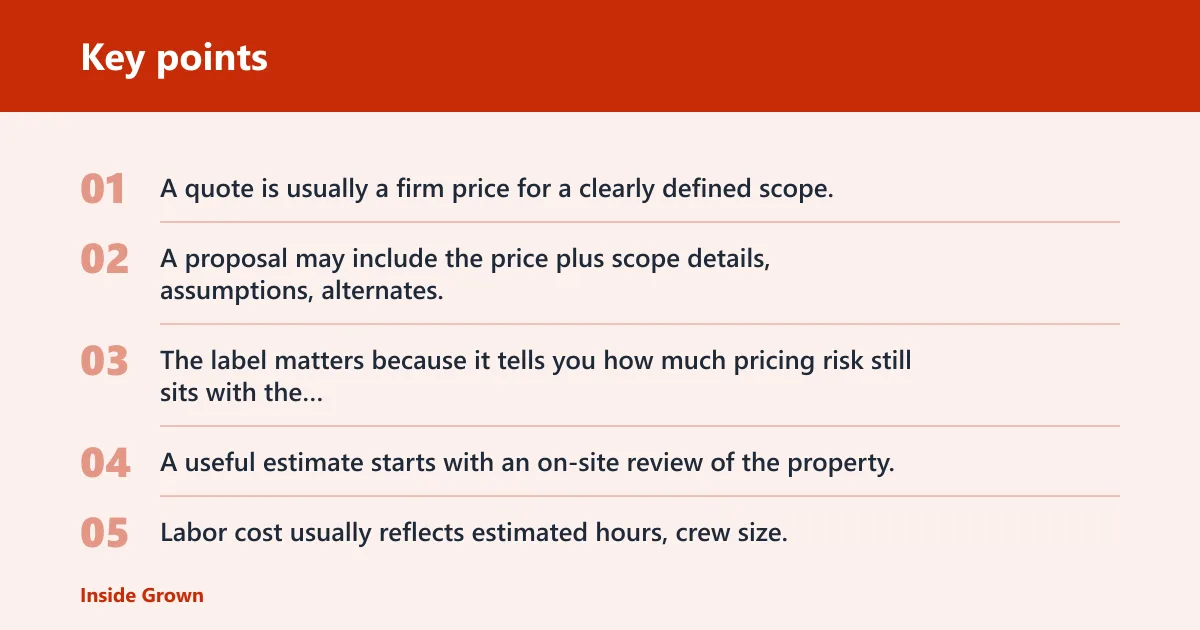
A quote is usually a firm price for a clearly defined scope, while an estimate is a projected price that can change if the site conditions or quantities change. A proposal may include the price plus scope details, assumptions, alternates, and contract terms. The label matters because it tells you how much pricing risk still sits with the homeowner versus the contractor.
How to do estimates for landscaping
A useful estimate starts with an on-site review of the property, then breaks the job into labor, materials, and any added site work. Labor cost usually reflects estimated hours, crew size, and a burdened hourly rate that includes payroll taxes or overhead. Material cost should include plants, mulch, soil, sod, gravel, pavers, delivery fees, waste factor, and markup on sourced materials.
Accurate landscaping estimates balance on-site meetings, labor calculations, expense tracking, and markup. Markup is often built into the price so a contractor can cover overhead and profit, but the exact percentage can vary by company, job complexity, and whether materials are supplied by the contractor or homeowner. If a bid does not explain how markup is handled, ask for the materials, labor, and allowances to be shown separately.
Say your front yard only needs fresh mulch, edging, and a few shrubs. A photo set plus rough bed measurements may be enough for a quick quote. If the same yard also needs a retaining edge, grading corrections, and haul-off of old concrete, that moves into site-specific pricing, where an on-site review is far more useful.
Should I get an on-site estimate or an online estimate?
Choose an on-site estimate for anything that depends on access, slope, drainage, demolition, grading, or material quantities that are hard to judge from photos. Use an online estimate for a simple scope where the yard is easy to see, the access is straightforward, and the work is limited enough that a rough price will still be useful. For complex yards, on-site pricing is the safer choice.
What a site walk-through lets a contractor confirm
A site walk-through lets the contractor verify the scope, measure the area, inspect terrain, and see whether existing landscaping removal or finish grade changes are part of the job. It also helps identify hauling needs, hose access, delivery limits, and any spot where water may collect. That information supports better labor and material pricing.
When a quick quote is enough
A quick quote can work for small, visible projects with limited risk, such as replacing mulch in a front bed or adding a short run of sod. For straightforward work, a contractor may be able to return a rough price quickly after reviewing photos and measurements, but the number should still be treated as preliminary if the site has hidden constraints. For larger or more complex work, that same speed is less useful than accuracy.
What should be included in a landscaping estimate?
A complete landscaping estimate should state the scope of work, itemized line items, assumptions, inclusions and exclusions, and whether the document is a proposal or a quote. It should also separate labor and materials when possible. If the contractor includes only one total number, you have less to compare and more room for dispute later.
Estimate format to look
Look for a breakdown that names each task and each major material. If the bid covers planting, it should identify plant counts or sizes. If it covers hardscape, it should identify base material, pavers or stone, edge restraint, and compaction or setting work. If irrigation is involved, ask whether heads, trenching, valves, and tie-ins are included.
| What to gather | Why it matters to pricing | What a contractor may misquote if it is missing |
|---|---|---|
| Photos of each work area | Shows layout, condition, and visible obstacles before a visit | Labor hours, access issues, and removal needs |
| Measurements | Supports material counts and area calculations | Mulch volume, sod square footage, gravel tonnage, paver quantity |
| Desired materials | Changes unit cost, delivery, and waste factor | Plant size, mulch type, soil quality, paver series, gravel grade |
| Drainage concerns | Can add grading, drain lines, or extra labor | Finish grade, slope correction, runoff control |
| Removal and disposal | Requires hauling, dump fees, and extra labor | Existing shrubs, turf, roots, concrete, and debris disposal |
| Access restrictions | Affects crew movement, equipment use, and delivery time | Gate width, stairs, narrow driveways, street parking limits |
| Timeline | Can affect scheduling and crew availability | Rush labor, phased work, and seasonal material timing |
How do I compare landscaping quotes from different companies?
Compare quotes by matching the same scope, materials and specs, assumptions, and timeline. Then judge price against value, not price alone. To make the comparison fair, define whether the document is a quote, estimate, or proposal, and confirm whether allowances or change orders could affect the final total.
What to check line by line
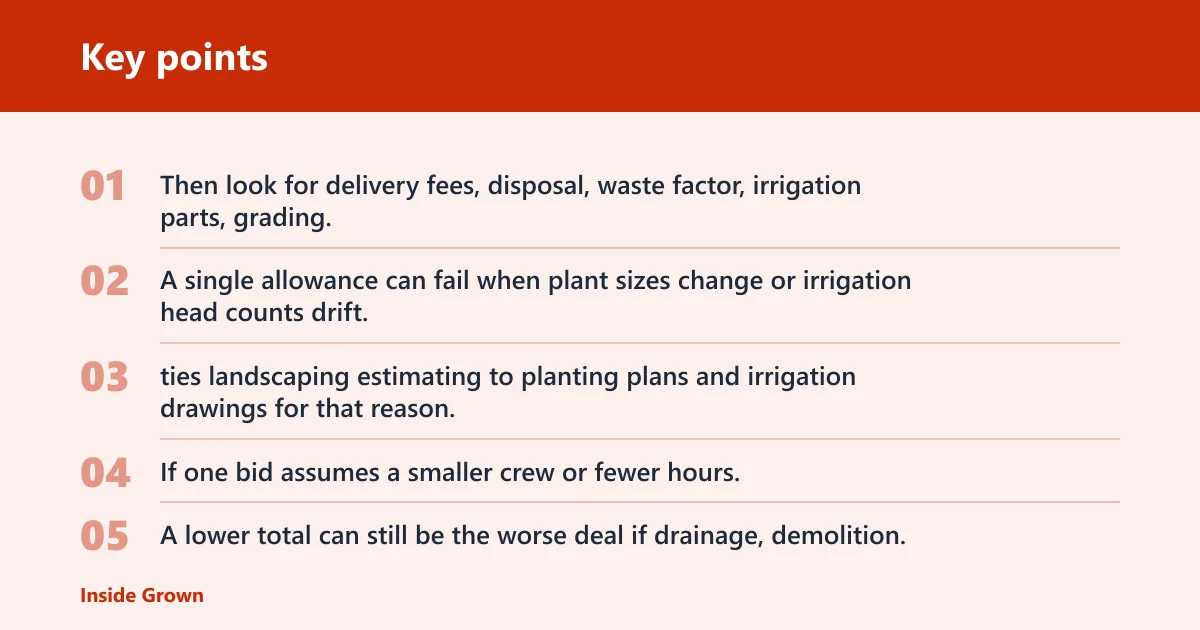
Read the inclusions and exclusions first. Then look for delivery fees, disposal, waste factor, irrigation parts, grading, and any allowance that could shift later. A single allowance can fail when plant sizes change or irrigation head counts drift, so ask what happens if the final field count is different. Construction Estimating Co. ties landscaping estimating to planting plans and irrigation drawings for that reason.
Check the labor line too. If one bid assumes a smaller crew or fewer hours, the price may look lower because the scope is thinner, not because the company is cheaper. A lower total can still be the worse deal if drainage, demolition, or finish grade is left out.
How missing drawings, plant sizes, or irrigation counts distort bids
If a contractor has no drawings, each bidder has to guess the same areas differently. Missing plant sizes can turn a full-size shrub into a liner or a gallon plant, which changes both material cost and labor. Missing irrigation counts can affect trenching, valve work, and the number of heads or zones, so two bids that look similar may not describe the same job at all.
Why landscaping estimates vary so much
Estimates vary because scope gaps, site conditions, and exclusions change the number. One contractor may include haul-off, another may leave it out. One may price plants by size and source, while another uses a cheaper substitute. A third may count only installation labor and not the overhead needed to run the job.
What questions should I ask before accepting a landscaping quote?
Ask questions that expose scope gaps before you sign. The goal is to confirm exactly what is included, what could change later, and how the contractor will handle surprises on site. A short clarification call can prevent an expensive change order after work starts.
Questions to ask before you say yes
- Is this a quote, estimate, or proposal?
- What is included in labor and what is excluded?
- Are plant sizes, quantities, and species listed in writing?
- Are disposal, delivery, and soil or mulch waste factor included?
- What allowances are built into the number?
- What triggers a change order?
- How will drainage, grading, or hidden site issues be priced if they appear?
- What is the payment schedule?
- What warranty or follow-up support is included?
- How long is the price good for?
Common mistakes
The biggest errors come from vague requests and one-number quotes. If you avoid those, you cut most of the comparison problems before they start.
- Accepting a vague line-item total instead of a written scope.
- Ignoring delivery, disposal, or waste factor.
- Comparing bids with different materials or plant sizes.
- Skipping drainage, demolition, or finish grade questions.
- Letting one estimate include labor and another omit it.
- Choosing the lowest price without checking assumptions and exclusions.
A common first-timer mistake is asking for “the backyard” without naming the beds, patio edge, or drainage problem. That usually leads to a quote that sounds low until the contractor starts adding exclusions. Better to define each area and ask the bidder to price only that scope.
Prevention: keep one written scope sheet and send the same version to every contractor.
Frequently asked questions
Why do landscaping estimates vary so much?
They vary because companies may price different scopes, materials, and site conditions. One may include removal and disposal; another may not. One may use a different crew size or burdened hourly rate. Another may price plants, mulch, or pavers with a different markup or delivery method.