How to Tell If Your Yard Soil Is Acidic or Alkaline
Horticultural review: University-extension guidance on soil testing, pH interpretation, and amendment timing informs this article. Soil pH basics, sample handling, and lime/sulfur decisions are cross-checked against extension sources from land-grant universities.
Soil pH below 7 is usually acidic and above 7 is usually alkaline; for most yards, readings of about 6.0 to 7.5 are often suitable for many plants. Wrong assumptions can lead to needless lime or sulfur, wasted money, and plants that still struggle. This guide shows how to spot true pH issues, test your soil correctly, and decide whether a correction is worth doing.
What soil pH means



Soil pH runs from 0 to 14, with 7 as neutral. Because the scale is logarithmic, a small number change matters more than it looks. A shift from 6 to 5 is not a minor tweak; it is a meaningful change in acidity that can alter nutrient uptake. University extensions such as University of Minnesota Extension and Penn State Extension explain that pH is a chemistry reading first, and a plant-growth clue second.
pH affects what roots can absorb. High pH commonly limits iron availability. Low pH can increase aluminum and manganese availability, which can stress roots and slow growth even when water and fertilizer seem adequate. That is why the number matters more than a vague “good” or “bad” label.
It also explains why leaf symptoms alone can mislead you. Yellowing can come from pH, but it can also come from poor drainage, root damage, compacted soil, or a nutrient shortage unrelated to pH. In regional extension bulletins, homeowners in limestone-heavy parts of the Midwest and Southwest often see the same pale new growth from different causes, including iron lockout, overwatering, and shallow fill soil.
📊 Soil pH is measured on a scale from 0 to 14. Source: Familyhandyman.
Can you spot acidic or alkaline soil?
Sometimes you can suspect a pH issue from the way plants respond, but you cannot confirm it from appearance alone. The same symptom can come from drought, compaction, overwatering, salinity, or a nutrient shortage. Treat visible clues as a starting point, not a diagnosis. Extension guides from Oregon State University Extension and University of Georgia Extension emphasize that symptoms need confirmation, especially when lime or sulfur is on the table.
Symptoms that can point to low pH
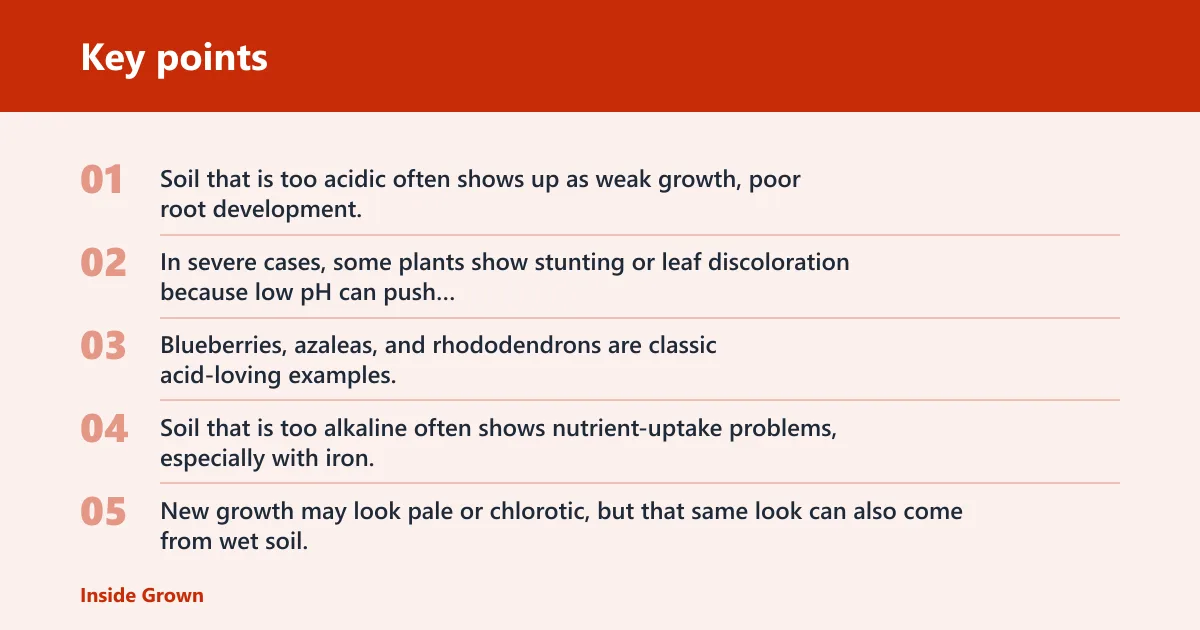
Soil that is too acidic often shows up as weak growth, poor root development, and nutrient problems that do not improve after watering or feeding. In severe cases, some plants show stunting or leaf discoloration because low pH can push aluminum and manganese availability too high. Blueberries, azaleas, and rhododendrons are classic acid-loving examples; Clemson Extension commonly places blueberries near pH 4.5 to 5.5, while many ornamentals tolerate a broader band.
Symptoms that can point to high pH
Soil that is too alkaline often shows nutrient-uptake problems, especially with iron. New growth may look pale or chlorotic, but that same look can also come from wet soil, root injury, or a fertilizer mismatch. High pH is more likely when iron symptoms repeat across the same bed. Many extension sources note that turfgrass is usually happiest near neutral, often around pH 6.0 to 7.0, while lavender usually tolerates or prefers slightly alkaline-leaning soil compared with blueberries.
Lookalikes that are not pH problems
Compacted soil can mimic nutrient stress by limiting roots. Drought can produce curling, scorch, and slow growth. Overwatering can leave roots short of oxygen. Poor drainage, salt buildup, and irrigation patterns can all create symptoms that look like a pH problem from above ground. In clay-heavy yards in the Southeast, for example, a soggy root zone may trigger iron-type chlorosis even when the pH is only slightly off.
Picture a shrub bed near a driveway where new leaves turn pale each spring. That could be high pH from masonry runoff, but it could also be waterlogged roots from a downspout outlet. The symptom is real. The cause is not obvious yet.
Yard pH diagnosis matrix
Use the pattern below to sort symptoms before you reach for lime or sulfur. The “likely pH direction” column is only a clue. Confirm with a test if the symptom is persistent, widespread, or tied to a plant with a known pH preference.
| Symptom | Likely pH direction | Common lookalikes | Next step |
|---|---|---|---|
| Repeated iron-type yellowing on new growth | High pH | Overwatering, root rot, cold soil | Test pH; check drainage before amending |
| Stunted growth with weak roots | Low pH or high pH | Compaction, drought, poor fertility | Test pH and inspect soil structure |
| Plants decline near concrete edges | High pH | Heat stress, runoff, shallow soil | Test the bed in more than one spot |
| Patchy problems in one area only | Either direction | Fill soil, irrigation imbalance, mulch depth | Sample that zone separately |
| Slow growth after heavy liming history | High pH | Nitrogen shortage, compaction, dry soil | Confirm with a lab test if possible |
| Plants in one bed fail while others do fine | Either direction | Different soil mix, shade, drainage | Compare test results across beds |
Homeowner decision tree: If the symptom is mild and isolated, test first. If the reading is within the plant’s preferred range, wait and fix irrigation or drainage instead. If the reading is borderline, retest from a second sample. If the reading is clearly outside range and the plant is a keeper, get a lab test before amending. If the plant is optional, choose a better-matched plant instead of forcing the soil.
How to test your soil pH
The best answer to “how to tell if soil is acidic or alkaline” is to test it. A home soil pH test kit can give a broad read on pH, but most home kits are not highly reliable. A laboratory soil test is more accurate and can also include a nutrient profile. Extension sources from University of Georgia Extension and Michigan State University Extension note that home kits can be useful for screening, but not for precise liming decisions.
Fall is a popular time for soil testing, especially if you want results before the next planting season. For a first pass, a home kit is fine. If symptoms are unclear, severe, or tied to a valuable planting area, a lab test is the better choice. That advice is especially important in mixed-soil yards, where one bed may be native clay and another may be construction fill.
Using a home soil pH kit
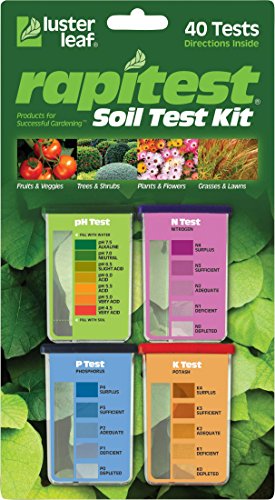
Most home kits sold at garden centers and hardware stores use a color chart or indicator solution. Follow the kit directions exactly, because sample amount, water, and timing affect the color reading. Use the result as a screening tool, not a final verdict. Gardeners often see disagreement between a strip-style kit and lab results when the sample is too wet, too dry, or taken from a single odd spot instead of a blended sample.
When a lab test is the better choice
Choose a lab test when the bed contains high-value plants, when symptoms do not match the kit result, or when the soil has a history of repeated amendments. A lab result is more useful when you need both pH and nutrient data, especially iron, phosphorus, or other clues that help explain plant decline. It is also the better call when a homeowner has already limed a bed for years and the plants still show chlorosis or stunting.
How to sample a yard bed or lawn
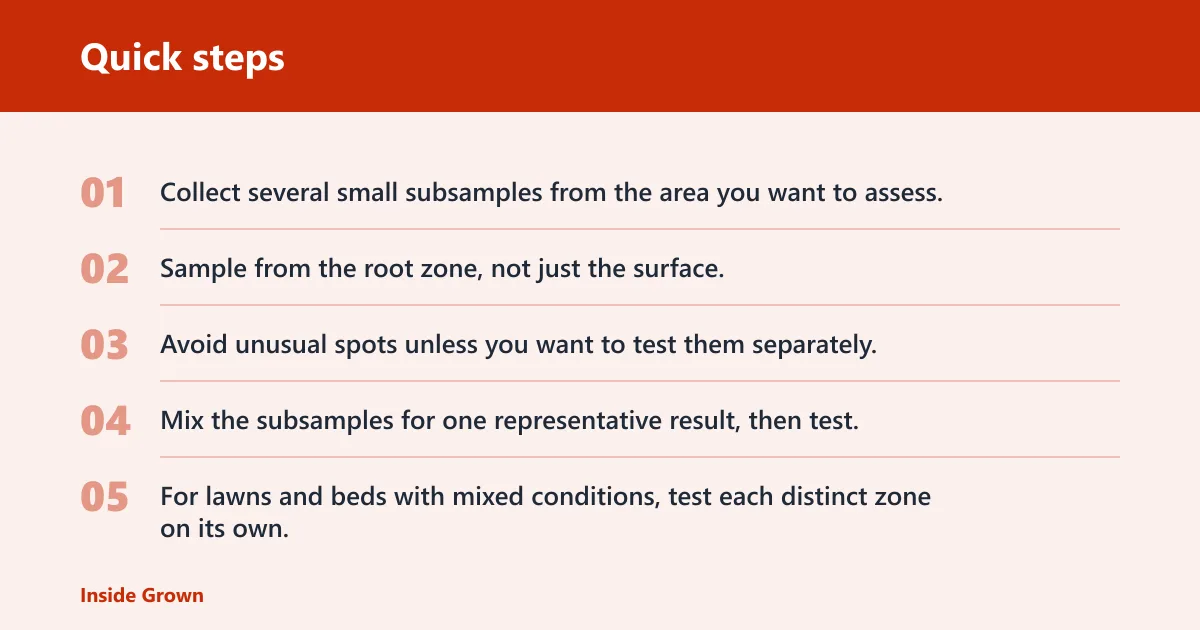
- Collect several small subsamples from the area you want to assess.
- Sample from the root zone, not just the surface.
- Avoid unusual spots unless you want to test them separately, such as a strip beside concrete or a low area that stays wet.
- Mix the subsamples for one representative result, then test.
- For lawns and beds with mixed conditions, test each distinct zone on its own.
Suppose a front flower bed sits 2 feet from a concrete path and a second bed sits in open lawn soil. Do not combine them into one sample. The concrete edge may read higher in pH than the open bed, and blending the two can hide the real problem. That mistake is common in older suburban yards, especially where runoff from walks and patios changes the soil chemistry along the margin.
How to read the result
A pH number tells you direction and urgency. Below 7 is acidic, above 7 is alkaline, and 7 is neutral. A result near the middle may be fine for many plants, but it still may not suit blueberries, lavender, or a lawn with a narrow target range. North Carolina Extension and other university guides commonly show blueberries in the low-acid range, while many turf species prefer a near-neutral soil band.
Use the number with the plant in mind. A lawn often does best near neutral soil. Blueberries prefer acidic soil. Lavender prefers a more alkaline-leaning range than blueberries. The same yard can hold more than one pH target if the plants are different. For example, a bed for blueberries may need a target around pH 4.5 to 5.5, while many lawns tolerate a wider band near 6.0 to 7.0.
When a borderline result needs a retest
Retest when the reading is close to your target, when the color in a home kit is hard to judge, or when symptoms and the number do not agree. A borderline result should not trigger a quick amendment. Confirm it first, especially if you are deciding for a whole bed or lawn. A second sample from a different point in the same zone often settles the question.
When the number does not match the symptom
If the test says pH is acceptable but the plant still looks stressed, look for drainage issues, compaction, irrigation problems, or nutrient shortage. If the pH is clearly off but the plant looks fine, the plant may simply tolerate a wider range than your test crop. Plant tolerance matters. A lavender bed may look acceptable at a slightly higher pH, while blueberries can struggle at the same number.
Should you change the pH?
Often, the best answer is no. If the number sits in a workable range for the plant you want, leave it alone. If the plant choice is flexible, pick a species that fits the existing soil instead of forcing the soil to fit the plant. The most practical yards are the ones that avoid unnecessary correction.
Change pH only when the reading, the planting plan, and the site all point the same way. That is especially true for blueberries, lavender, and lawns, since each has a different tolerance. Do not treat one bed’s target as universal for the whole yard. A home site in the Northeast with naturally acidic soil may be ideal for blueberries but not for a lawn renovation, while a calcareous West or Midwest yard can push the decision in the opposite direction.
When no action is the right answer
No action is often best when the soil falls within a plant’s tolerance range and the plant is otherwise healthy. A slight pH offset does not always need correction. Fix irrigation, drainage, or compaction first if those are the real constraints. University extension guidance commonly recommends waiting and monitoring when the plant is performing well and the pH is only marginally outside the ideal.
When plant choice should drive the decision
If you want blueberries, choose an acidic site or plan for long-term acid management. If you want lavender, do not start from the same expectation. For a lawn, a near-neutral range is often the easier target. The plant choice should set the pH goal. In practice, that means the “right” pH is the one that matches the crop, the soil texture, and the maintenance level you can sustain.
When to amend before planting
Amend before planting when a lab test shows the soil is outside the preferred range for the crop and the site will support a slow correction. That gives you time to mix the amendment evenly and avoid fighting an established root system later. Extension recommendations consistently favor preplant correction over trying to steer a mature bed with repeated small fixes.
How to correct soil pH
Lime raises pH. Elemental sulfur lowers pH. Both work slowly, so you should base the rate on a soil test and the soil texture. Sandy soil responds faster. Clay soil usually needs more amendment and more patience. Extension resources from Oregon State University Extension and University of Arkansas Extension stress that amendment choice and rate should follow the test result, not a guess.
Lime to raise pH
Use lime when the test shows acidity that is limiting the plants you want to grow. Calcitic and dolomitic lime are the common types. The right choice depends on the soil’s calcium and magnesium needs, which is one reason a lab test is more useful than a kit for serious corrections. In many extension recommendations, lime is incorporated before planting whenever possible because surface-applied lime moves through the soil more slowly.
Elemental sulfur to lower pH
Use elemental sulfur when the test shows alkaline soil and the target plant needs a lower pH. It works slowly and should be mixed into soil before planting when possible. In established beds, surface applications move more cautiously and still need time before the pH shifts. For acid-loving crops like blueberries, university guides typically recommend gradual adjustment rather than a large one-time correction.
How soil texture changes the rate
Soil texture affects how fast pH changes and how much amendment the soil can hold. Sandy soil changes faster because it has less buffering. Clay soil usually needs more amendment because it resists change. That is why blanket rates are a bad idea without soil data. In heavier soils, repeat testing after the amendment has had time to react is more useful than assuming the first pass solved everything.
What can skew yard pH?
Several yard inputs can tilt pH away from the main soil body. Concrete and masonry can push nearby soil alkaline. Irrigation water can shift pH over time, especially in beds watered often. Imported fill can arrive with a different pH than the soil around it. In newer developments, mixed fill and construction debris are frequent reasons one bed tests differently from the next.
Mulch can also confuse the picture. It may change surface conditions, moisture, and microbial activity, even when it does not fully explain the root-zone pH. If a problem sits in one narrow strip, check whether a border, pathway, or fill layer is changing that zone. A small strip next to a patio can behave differently from the center of the bed for years.
Concrete and masonry runoff
Beds next to concrete walks, driveways, or block walls can test higher in pH than the rest of the yard. That effect often shows up along the edge first. Test that strip separately before you treat the whole bed. If the problem is localized, correcting the whole yard may waste time and leave the true problem untouched.
Irrigation water and fill soil
Water quality matters if irrigation is frequent. Repeated watering with alkaline water can move soil pH upward over time. Fill soil is another common source of mismatch, especially in newer yards where one bed was built from different material than the surrounding ground. A homeowner may see the same plant struggle in one side of the front yard but not the other because the beds were never built from the same soil.
Mulch and other yard inputs
Thick mulch layers can change how quickly the surface dries and warms, which affects root performance and can make pH symptoms harder to read. Compost, ash, and other amendments can also shift pH. Keep a list of what went into the bed before you test again. If a bed recently received wood ash, for example, high pH is more plausible than if it was only top-dressed with compost.
Frequently asked questions
How to test your soil for acidity
Use a home soil pH kit for a first pass or send a sample to a lab for a more accurate result. Home kits use a color chart or indicator solution and are useful for general screening. A lab test is better when symptoms are unclear or the bed matters more. If a kit and a lab disagree, the lab result should carry more weight.
Acidic soil vs alkaline soil: what’s the difference?
Acidic soil has pH below 7, while alkaline soil has pH above 7. The difference matters because pH changes nutrient availability. High pH often limits iron, while low pH can raise aluminum and manganese availability. A small numeric shift can change plant performance, especially for plants with narrow targets such as blueberries or alkaline-tolerant herbs.
How do you know if your soil is too acidic?
If a pH test shows a low reading and the plants are stunted, poorly rooted, or otherwise failing despite normal care, the soil may be too acidic for them. A lab test is the better check when the result is severe or the symptoms are hard to interpret. Do not guess from leaf color alone; yellow leaves can come from nitrogen shortage, cold soil, or root stress too.
How do you know if your soil is too alkaline?
Look for repeated iron-type yellowing on new growth, then confirm with a pH test. If the reading is above the range your plant prefers, the soil may be too alkaline. Nearby concrete, irrigation water, or imported fill can be part of the cause, so test the specific zone. If the affected area is next to masonry, sample that strip separately.
How accurate are home soil pH test kits?
Most home soil pH kits are not highly reliable, but they can still give a general idea of pH. That makes them useful for first-pass diagnosis. If the number is borderline, the color is hard to read, or the plant symptoms are serious, confirm with a laboratory soil test. In real-world use, kit readings often drift when samples are taken unevenly or from only one spot.