How to Grade Soil Away from Your House Safely: Steps
Grade soil so it falls away from the foundation at roughly that rate for the first several feet, and stop if the job starts turning into major reshaping or hardscape work. Bad grading sends water to the footing, where it can crack walls, wet basements, and rot framing. I usually verify the slope before I touch a shovel, because fixing a wet foundation later costs far more than moving a few buckets of dirt now. This guide shows how to measure slope, move soil safely, and verify the new grade without creating a drainage problem uphill or at the lot line.
This guide is part of our Soil and landscape basics for gardeners series.
What you’ll need before you move any soil


- Laser level or string line
- 4-foot level or line level
- Shovel and rake
- Wheelbarrow
- Hand tamper
- Clean fill dirt
- Topsoil for the finish layer
- Gloves and boots
- Utility mark check before digging
- Measuring tape and marking stakes
How to grade soil away from your house safely
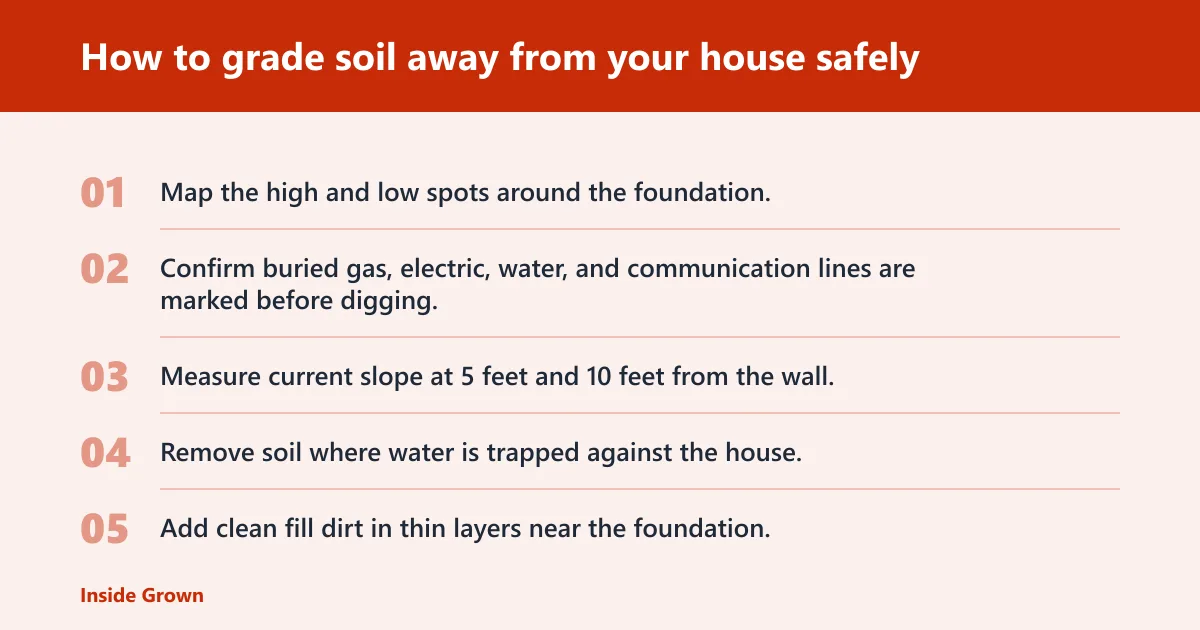
- Map the high and low spots around the foundation.
- Confirm buried gas, electric, water, and communication lines are marked before digging.
- Measure current slope at 5 feet and 10 feet from the wall.
- Remove soil where water is trapped against the house.
- Add clean fill dirt in thin layers near the foundation.
- Tamp each layer before adding the next.
- Blend the finish grade into the yard with a rake.
- Keep the final surface sloped away from the wall, not crowned against it.
Mark the current high and low spots
Start by finding where water sits after rain. That often shows the low point before any digging does. Stake the wall line, then mark puddles, soft spots, and places where soil slopes back toward the house. Those are the areas to cut or rebuild first.
Remove soil where the grade traps water
Cut down small humps that push runoff toward the foundation. Do not dig so deep that siding, footings, or exposed foundation walls stay buried in wet soil. The goal is a smooth fall away from the house, not a trench along the wall.
Add clean fill in thin layers near the foundation
Use clean fill dirt close to the house because it compacts predictably and should not contain roots, mulch, or other debris that later decays. Build in lifts a few inches thick, then tamp each lift. Thick dumps settle later and can reverse the slope after a few storms.
Shape the final surface so runoff keeps moving
Use a rake to feather the new grade into the rest of the yard. Leave no ridge at the wall. A sharp edge there can trap water against siding or create a lip that sends runoff into the foundation zone instead of away from it.
How do you check the slope before and after grading?
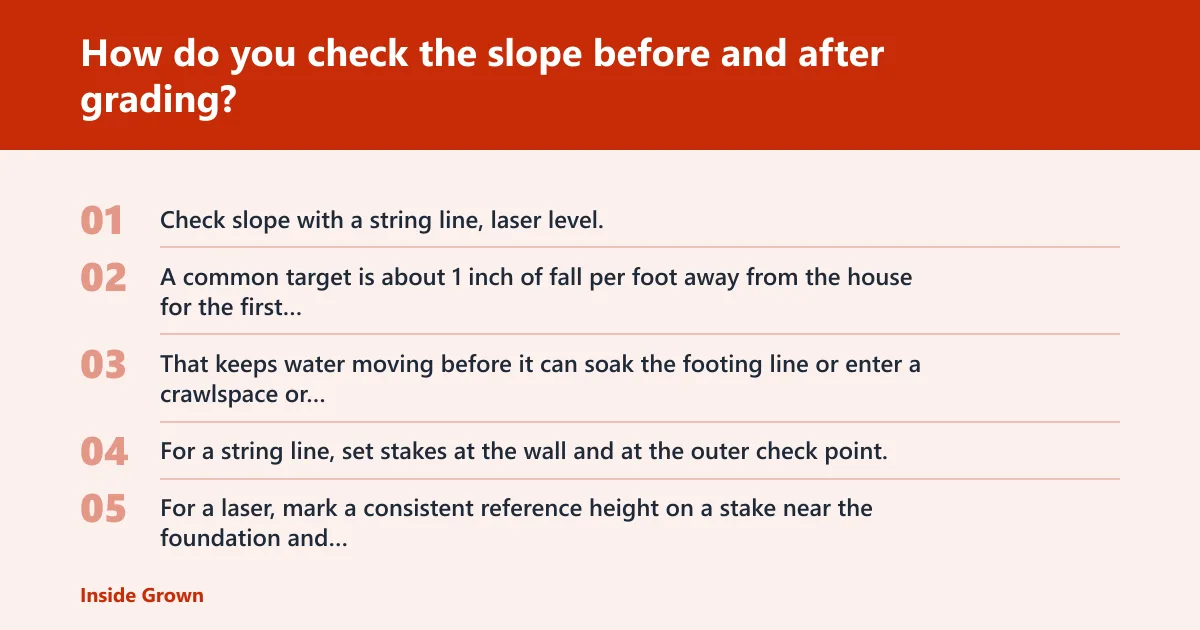
Check slope with a string line, laser level, or simple level before you move soil and again when you finish. A common target is about 1 inch of fall per foot away from the house for the first several feet. That keeps water moving before it can soak the footing line or enter a crawlspace or basement.
Set a reference line
For a string line, set stakes at the wall and at the outer check point, then pull the line level between them. For a laser, mark a consistent reference height on a stake near the foundation and compare the reading at each check point.
Measure drop over distance
Measure from the wall outward at 5 feet and 10 feet. A 5-foot run should drop roughly 5 inches, give or take. A 10-foot run should drop roughly 10 inches, give or take. Record the start distance, measured drop, and whether the spot passes or fails the target.
Walk the line after a hose test or a storm
Run a hose along the wall long enough to wet the grade, then watch where the water settles. Any place where water sits near the wall, or where the grade climbs back toward the house, needs more cut or fill. Small pockets matter because they collect water right where protection is weakest.
| Check point from wall | Target drop | Pass/fail | Notes |
|---|---|---|---|
| 5 feet | 5 inches | Pass if at least 5 inches | No standing water near siding |
| 8 feet | 8 inches | Pass if at least 8 inches | Blend into yard grade |
| 10 feet | 10 inches | Pass if at least 10 inches | No ridge at the wall |
When should you use clean fill dirt, topsoil, or both?
Use clean fill dirt in the structural grading zone near the foundation, then topsoil above it where plants will grow. Clean fill holds shape better and leaves less decay behind. Topsoil belongs in the upper finish layer only, because organic material settles and holds moisture longer.
Clean fill dirt near the foundation
Place clean fill within the first several feet from the house, especially where you need to rebuild slope. Keep roots, wood chips, leaves, and mulch out of that zone. Organic debris breaks down, creates voids, and can pull the surface down after rain.
Topsoil above the structural grading zone
Spread topsoil farther out, where the grade transitions into lawn or beds. That layer supports turf and planting, but it should not be used as the main structural slope right next to the wall. It compresses more and can lose shape under repeated wet-dry cycles.
Match the finished grade to the yard
Blend the repaired area into the surrounding yard so it does not look mounded at the house. If the repair ends in a hard lip, water can slow there and soak back toward the foundation. A gradual blend is safer than a steep fix.
How do downspouts, sump discharge, and swales fit in?
Grading fails if roof water and sump water still dump beside the house. Downspouts should carry water well away from the foundation, sump discharge should exit clear of the wall, and any swale should move runoff away from the house and away from neighboring property without creating a new low point.
Downspout extensions and splash blocks
Extend downspouts so they discharge several feet from the foundation rather than right at the wall. Splash blocks help only when the surrounding grade already carries water away. If water still pools, route the discharge farther out with a solid extension or into a surface drain that stays open.
Keep sump outlets clear
Where a sump line exits, make sure the outlet stays visible, unblocked, and above a grade that will not bury it later. The discharge point should not feed back toward the foundation or under a walkway where ice, dirt, or debris can stop the flow.
Use a swale only where it has an exit
A shallow swale can redirect runoff around a low area, but it should have a clear path to daylight or another allowed drainage point. Do not cut a swale that points toward the house, a neighbor’s lot, or a spot where water will sit with no way out.
Foundation grading checklist and slope worksheet
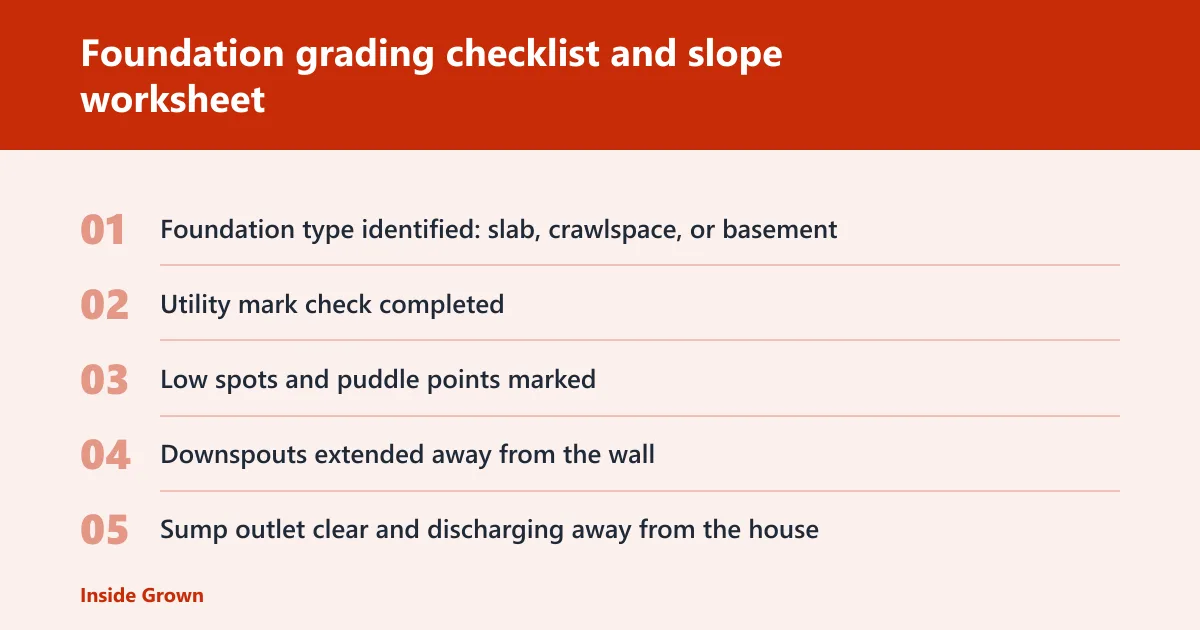
Use this checklist before and after the repair. It keeps the work focused on drainage, not just appearance. Pass means the water path is moving away from the structure and the surface is stable enough to hold that slope after settling.
Foundation grading checklist
- Foundation type identified: slab, crawlspace, or basement
- Utility mark check completed
- Low spots and puddle points marked
- Downspouts extended away from the wall
- Sump outlet clear and discharging away from the house
- Clean fill used in the structural zone
- Topsoil kept above the structural zone
- Grade should fall away from the wall for the first several feet.
- Avoid reverse slope, ridges, or trapped pockets at the foundation
- No heavy compaction near plants
Slope verification worksheet
| Starting distance from wall | Measured drop | Target drop | Pass/fail | Soil type notes | Red-flag conditions |
|---|---|---|---|---|---|
| 5 feet | ___ inches | 5 inches | ___ | Clean fill / topsoil / mixed | Pooled water, settled spot, reverse slope |
| 10 feet | ___ inches | 10 inches | ___ | Clean fill / topsoil / mixed | Water against siding, hardscape blocks flow |
Red-flag conditions that need a pro
Stop and bring in a pro if water keeps getting into a basement or crawlspace after normal rain, if the foundation seems to be moving, if the lot slopes strongly toward the house, or if the fix may require major excavation, retaining walls, or work near buried utilities. Those cases go beyond a simple grade correction.
Common mistakes
Most grading failures come from settling, poor drainage planning, or creating a new low spot while fixing the old one. The surface may look right on day one and still fail after the first heavy rain. That is why verification matters before the job is considered done.
- Do not dump soil in thick lifts; compact each layer before adding more.
- Do not use mulch or compost in the fill zone near the foundation.
- Do not build a ridge at the wall that traps water against siding.
- Do not tamp hard around roots or foundation plantings.
- Do not leave downspouts short of the problem area.
When should you call a pro instead of DIY grading?
Call a pro when the site needs more than surface shaping to stay dry. That includes chronic water entry, visible settlement, cracks that keep widening, crawlspace moisture that returns after simple grading, or a yard layout that cannot carry water away without changing walls, drains, or hardscape.
If that didn’t work, try this next
- Extend downspouts several feet from the foundation if needed.
- Recheck slope at 5-foot and 10-foot points after the next rain.
- Add clean fill only where the grade still falls back toward the wall.
- Install or adjust a shallow swale only if it can drain to a safe outlet.
- Stop if the fix starts affecting steps, patios, siding clearance, or foundation exposure.
Frequently asked questions
How do I slope soil away from my house?
Measure out 5 to 10 feet from the wall, then build or cut the grade so it drops at least 1 inch per foot in that zone. Use a laser level or string line to confirm the fall, and finish with a rake so there is no ridge at the foundation.
What is the right slope away from a foundation?
A common target is 1 inch of fall per foot for the first 5 to 10 feet away from the structure. That gives runoff a clear path before it can soak the footing line. If the yard cannot hold that slope, the drainage system needs more than grading.
Can I grade dirt away from my house myself?
Yes, if the correction is shallow, the foundation is stable, and the fix does not require major excavation or hardscape changes. Keep the work to small lifts, check slope as you go, and stop if water keeps returning to the same spot after rain.
How far should soil slope away from the house?
Check the first 5 to 10 feet from the wall, not just the first foot. That is usually the most important zone for keeping runoff off the footing line. Beyond that, the yard can transition more gradually as long as water still moves away.
What tools do I need to grade around a house?
Use a shovel, rake, wheelbarrow, hand tamper, measuring tape, and either a laser level or a string line. Add boots, gloves, and a utility mark check before any digging. Those basic tools are enough for small corrections around most homes.
When should I call a pro instead of DIY grading?
Call a pro if the house already has water entry, the foundation is moving, the slope correction would require digging close to footings, or the property needs a swale, drain, or retaining structure to work. Surface grading cannot fix every drainage problem.