How Many Plants Per Row in a Market Garden?
Quick answer: plants per row equal usable row length divided by in-row spacing, with end allowances subtracted before you round down to a whole plant. A 50-foot row can hold roughly 20 to 200 plants depending on spacing, but the usable count is always set by the crop’s spacing, the bed layout, and the room you leave for access. This guide shows the formula, spacing examples for common crops, and how to turn row length into a workable market-garden plan.
How row spacing and plant spacing differ
Quick answer: row spacing is the distance between rows, while in-row spacing is the distance between plants in the same row. Row spacing sets access and airflow; in-row spacing sets how many plants fit, how dense the canopy becomes, and how much harvest room you have.
What row spacing controls
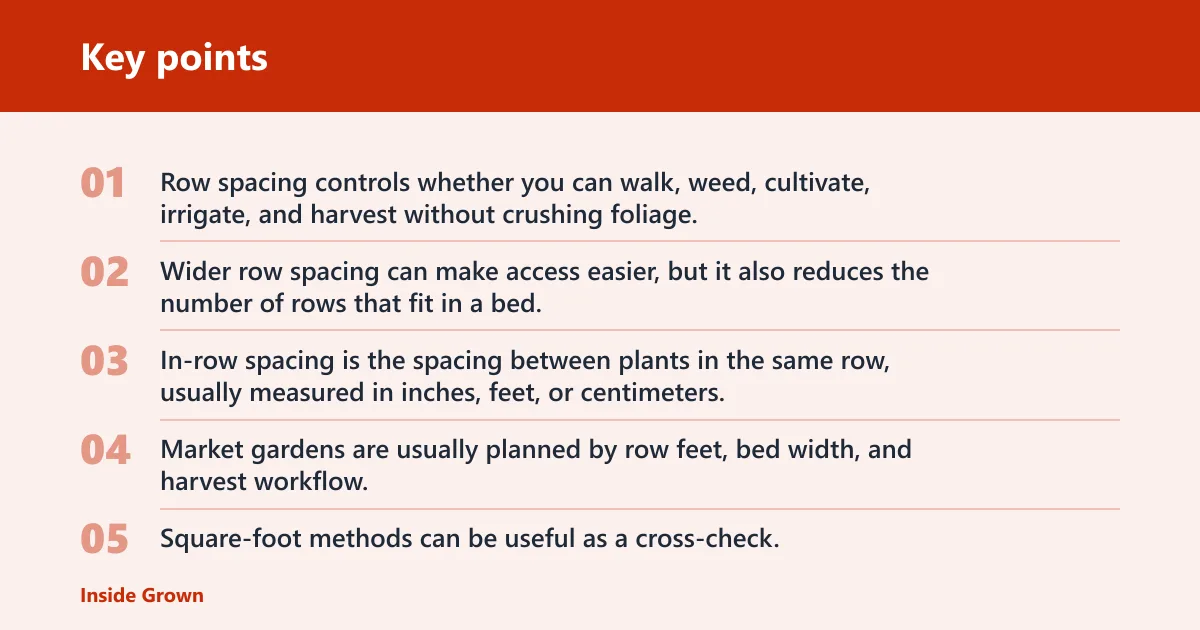
Row spacing controls whether you can walk, weed, cultivate, irrigate, and harvest without crushing foliage. It also affects airflow, which matters for disease pressure, especially in dense crops and trellised plantings. Wider row spacing can make access easier, but it also reduces the number of rows that fit in a bed.
What in-row spacing controls
In-row spacing is the spacing between plants in the same row, usually measured in inches, feet, or centimeters. It sets plants per row directly. Crop-specific spacing is the starting point, but variety vigor, bed system, and seed packet guidance can shift the final count.
Why both numbers matter in market gardens
Market gardens are usually planned by row feet, bed width, and harvest workflow. That means a row plan is not just a plant-count exercise. It is a layout decision that has to fit row spacing, path width, and the equipment or hand tools you plan to use.
Square-foot methods can be useful as a cross-check. The linked square-foot planning model uses foot-square sections, and square foot garden plots are set up in grids of 4 x 4 squares. Plant spacing in a square foot garden can be 1, 4, 9, or 16 plants per square, which is a different planning model from row-based market gardening.
How many plants fit in one row?
Quick answer: divide usable row length by in-row spacing, then subtract any end allowance for turning space, irrigation fittings, or harvest access. Use the same unit throughout, then round down to the nearest whole plant so the row stays practical instead of crowded.
In market gardens, row feet is the key planning unit because it lets you estimate seed, transplants, and succession timing from total row length instead of from bed area alone.
Plants-per-row formula
The formula is:
Plants per row = usable row length ÷ plant spacing
To keep the math clean, convert everything to the same unit before dividing. If spacing is 12 inches, convert row length to inches; if spacing is 30 centimeters, keep everything in centimeters. Then subtract end allowance from the row length first, and round down to a whole plant after dividing.
Using row feet for seed and transplant counts
Row feet means the total length of all rows of a crop. That makes it easier to plan seed orders, transplants, and succession plantings from length rather than from bed area alone. If you plant one row per bed, row feet and bed feet match. If you plant more than one row, total row feet increases fast and so do plant counts.
Imperial and metric examples
A 10-foot row planted at 12-inch spacing holds about 10 plants before end allowances. At 30 centimeters apart, a 3-meter row holds 10 plants as well. The math stays the same; only the units change. If you reserve space at both ends, the usable count drops before you round down.
Measure usable row length. Subtract obvious end space for turns, supports, or irrigation hardware. A row that measures 25 feet on paper may offer less usable planting length once access at both ends is reserved.
Check the in-row spacing. Use the seed packet or plant tag first, then compare it with a crop spacing chart. Variety-specific guidance can differ, especially for tomatoes, peppers, and cucumbers.
Divide length by spacing. Keep the units consistent. A 25-foot row at 6-inch spacing gives about 50 plants, before end allowances.
Adjust for layout and access. If the crop needs trellising, hand harvest space, or wider equipment clearance, reduce the count. The goal is a row that can be managed cleanly all season.
Say your bed has an 8-foot row of tomatoes at 24 inches apart. That row fits four plants when the row is measured as usable planting space, and the same spacing also uses 36 inches between rows. If the crop is trellised, the row count may stay the same while bed access becomes the limiting factor, not the plant count.

How many rows fit in a bed?
Quick answer: the number of rows in a bed comes from bed width divided by row spacing, then adjusted for path width, edging, and the room needed to work the crop. A wider bed does not automatically mean more plantable rows if the middle row cannot be reached or the outer rows block access.
The number of rows in a bed is only useful when it leaves enough room to plant, weed, irrigate, and harvest without damaging the crop.
Bed width and path width
Bed width and path width have to be planned together. A bed can hold several rows on paper, but if the row spacing leaves no room for a wheel hoe, harvest tote, or your own reach, the extra row can cost more labor than it returns in yield.
Row width also affects airflow and disease pressure. Proper spacing reduces overcrowding and disease spread. That matters most when foliage is dense, when the crop stays in the bed for a long time, or when rain and dew linger under the canopy.
Single-row, double-row, and trellised layouts
A single-row layout is the simplest choice and often the best fit for crops that need access on both sides. A double-row layout can raise yield per bed foot for compact crops, but only when row spacing still leaves enough room to harvest cleanly. Trellised layouts are useful for vertical crops that would otherwise sprawl across the bed.
When wider row spacing is the better choice
Wider row spacing is the better choice when the crop is large, the canopy closes fast, or you need to move tools through the bed. It is also the better choice when a tight layout would force plants into one another and reduce airflow. Wider spacing wastes bed space only when the crop could be packed tighter without harming access or yield.
A common first-timer mistake is forcing every crop into the same bed layout. A 30-inch row spacing may work for corn or squash, but it is usually too wide for lettuce and too narrow for sprawling squash that needs real room to move.
How many plants per table
This table gives a starting point for common market-garden crops. Check seed packets or plant tags before finalizing a plan, because variety-specific guidance can differ. The counts below assume straight rows and no end allowance.
| Crop | In-row spacing | Row spacing | Plants per 10 ft row | Plants per 25 ft row | Layout recommendation |
|---|---|---|---|---|---|
| Tomatoes | 24 inches | 36 inches | 5 | 12 | Trellised single row |
| Peppers | 18 inches | 18 to 24 inches | 6 | 16 | Single row |
| Lettuce | 12 inches | 12 to 18 inches | 10 | 25 | Single or double row |
| Carrots | 3 inches | 12 to 18 inches | 40 | 100 | Single row |
| Bush beans | 6 inches | 18 to 24 inches | 20 | 50 | Single or double row |
| Corn | 12 inches | 30 to 36 inches | 10 | 25 | Block or double row |
| Squash | 36 inches | 48 to 72 inches | 3 | 8 | Single row |
| Cucumbers | 12 inches | 36 to 48 inches | 10 | 25 | Trellised single row |
| Onions | 4 inches | 12 to 18 inches | 30 | 75 | Single or double row |
| Kale | 18 inches | 18 to 24 inches | 6 | 16 | Single row |
The tomato example uses 24-inch in-row spacing and 36-inch row spacing. Its 8 ft by 4 ft bed fits four tomato plants, which shows how one crop can stay on a single row while bed width still limits the practical layout. The count changes if you reserve more end allowance, so the usable row length matters more than the bed’s outside measurement.
Triangular offset planting
Triangular offset planting uses a staggered pattern instead of straight rows. Offset planting can fit about 15% more plants in the same space, but it is less common in market gardens that depend on clean row access and easy harvest paths.
When staggered spacing can fit more plants
Offset spacing can help with compact crops where every inch matters and harvest access is still manageable. It works best when the canopy is small, the crop is short-lived, and the space between plants is more important than easy hand movement through the row.
Why straight rows are still more common
Straight rows are easier to plant, cultivate, irrigate, and count. They make row feet more useful for seed orders and succession timing. They also make it easier to compare a bed plan with a crop spacing chart, which is why most market-garden row plans still start with straight rows.
Where offset spacing can create access problems
Offset spacing can complicate weeding passes, side dressing, and harvest timing because the plants no longer line up cleanly. That matters in larger beds and on equipment-friendly farms where a consistent row pattern saves labor. If the crop needs hand harvest and repeated access, straight rows are usually the safer choice.
Row planning examples
Row planning turns spacing math into a bed plan. Start with bed feet, check the crop’s row spacing, then decide whether the crop should stay in one row, use two rows, or climb a trellis. The result is a planting plan that fits both yield goals and work flow.
Tomatoes in an 8-foot row
An 8-foot row of tomatoes at 24-inch spacing fits four plants. The same crop spacing chart also points to 36-inch row spacing, which means the limiting factor is often bed width and trellis access, not the number of plants in a row. If the plants will be pruned and tied, leave room for that work from the start.
Planning by bed feet
Bed feet is a 1-foot slice across a planting bed, and it helps compare bed layout to row layout. If a crop needs one row per bed, bed feet and row feet match. If the crop needs two rows, the total row feet doubles, which changes seed needs and transplant counts fast.
Adjusting for trellis width and harvest access
Trellised crops need more than plant spacing. They need room for stakes, string, clips, or wire, and they need a path for harvest access without bending or breaking vines. That is why a crop can fit in the math and still fail the workflow test if the trellis makes the bed too tight.
At 12-inch spacing, a 25-foot row of lettuce holds about 25 plants per row, which can help with succession planting. The row count works only if the bed also leaves enough room to cut, clean, and move without crushing neighboring plants.
Frequently asked questions
How many plants fit in one row of a market garden?
Quick answer: it depends on the crop and the usable row length. Divide usable row length by in-row spacing, subtract end allowances, and round down to a whole plant. A short lettuce row may hold dozens of plants, while tomatoes may hold only a handful because the spacing is much wider.
How do I calculate plants per row from bed length and spacing?
Use the formula row length ÷ plant spacing, with both values in the same unit. Then adjust for access at the ends of the row. If your row is 20 feet long and the spacing is 10 inches, convert 20 feet to 240 inches and divide by 10.
What row spacing should I use for market garden crops?
Use the crop’s spacing recommendation, then adjust for your bed width, path width, and equipment. Tight spacing can cut airflow and access, while wide spacing can leave too much bed unused. The best spacing is the one that matches the crop habit and your harvest method.
How many rows fit in a garden bed at proper spacing?
Divide bed width by row spacing, then check whether the remaining space still allows cultivation and harvest. A bed may physically fit more rows than it can practically support. Single-row, double-row, and trellised layouts all change the answer.
What is the difference between row spacing and in-row spacing?
Row spacing is the gap between rows. In-row spacing is the gap between plants within a row. Row spacing controls access and airflow; in-row spacing controls how many plants fit in each row. They work together, but they are not the same measurement.
Should I use square or triangular spacing for rows?
Use straight rows for most market-garden crops, especially when you need simple harvest access and easy counting. Triangular offset spacing can fit about 15% more plants, but it is less common because it can complicate cultivation and row access. Use it only when the crop and workflow support it.
How many vegetable plants per square foot?
That depends on the crop and on whether you are using a square-foot model or a row model. Square-foot gardening uses foot-square sections, and plant spacing in that system can be 1, 4, 9, or 16 plants per square. Row planning uses bed length and row spacing instead.
How many plants per person for garden?
That depends on the crop, how often you harvest, and whether the plants are for fresh eating, preserving, or market sales. For market gardens, it is better to plan by row feet and expected harvest timing than by people alone. Yield targets usually matter more than headcount.
How many plants per row do I need for a crop plan?
Start with your sales target or household demand, then divide by expected yield per plant or per row. Once you know the row count, convert that into bed feet and total row feet. That keeps the plan tied to output instead of to a generic spacing chart.