How Many Plants Should You Put in a Keyhole Garden?
A small keyhole garden usually holds about 6 to 12 plants in a 6-foot bed, though the actual count depends on bed area, each crop’s mature spread, and the space taken by the central basket and paths. Skip that math and roots pack too tightly, air moves poorly, and yields drop. This guide shows how to calculate plant count, place crops by moisture zone, and avoid overpacking a keyhole bed.
How many plants fit in a keyhole garden?


Start with mature spread, not seedlings. A keyhole garden is a circular raised bed with a central compost basket and an access notch, so part of the circle is set aside for reaching the center and part of the planting area is shaped by moisture flow, airflow, and the basket itself.
Most beds are 6 to 10 feet in diameter, 2 to 3 feet tall, with an access path typically 1.5 to 2 feet wide and a central compost basket roughly 1 foot in diameter. That layout leaves less usable area than a plain round bed, so the same crop often fits in smaller numbers than a gardener expects.
Why mature spread matters more than seed count
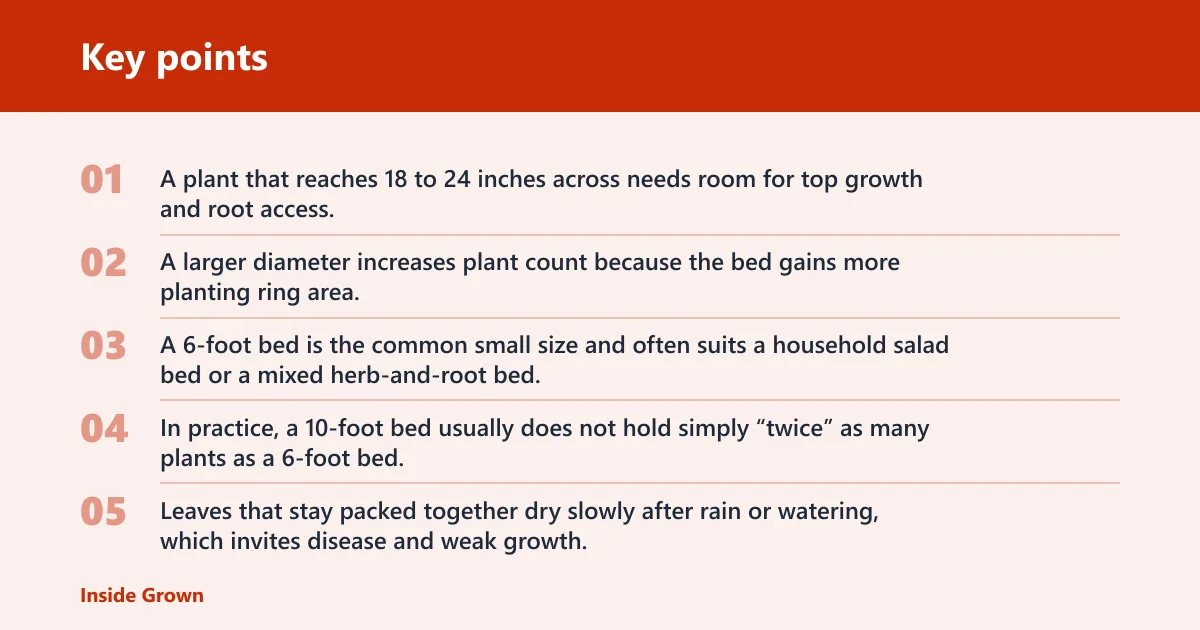
Seed packets count potential plants. Your bed has to hold full-size plants. Lettuce, for example, can fit tightly at transplant size, then swell into a dense mass that blocks light and slows drying. A plant that reaches 18 to 24 inches across needs room for top growth and root access.
For a keyhole bed, count from the final width each plant needs, then subtract space for the center basket, the notch, and a few inches of walking or working room at the edge. That leaves enough room for airflow, which matters in a raised bed built to keep producing instead of turning into a tight tangle.
How bed diameter changes the total plant count
A larger diameter increases plant count because the bed gains more planting ring area. A 6-foot bed is the common small size and often suits a household salad bed or a mixed herb-and-root bed. An 8-foot bed gives more margin for mixed crops, and a 10-foot bed can hold a noticeably larger set of plants if the center is kept open.
The plant total rises more slowly than the diameter might suggest because the center basket, access notch, and outer reach all take space. In practice, a 10-foot bed usually does not hold simply “twice” as many plants as a 6-foot bed. It holds more, but the spacing rules stay the same.
How airflow and access limit the usable space
Airflow is not optional in a small bed. Leaves that stay packed together dry slowly after rain or watering, which invites disease and weak growth. The access notch also changes the shape of the bed, since the opening has to remain usable instead of being planted wall to wall.
A common first-timer mistake is tucking a dozen lettuce starts into one small wedge and leaving no room for the roots to spread. That can look productive for two weeks, then the bed closes over and becomes hard to water, thin, and crowded. Leave room to reach the basket, pinch back herbs, and harvest greens without stepping into the soil.
Plant count table
This table gives a practical starting range for common keyhole bed sizes. It assumes a central compost basket about 1 foot across and leaves enough room for the access notch and airflow. Use the lower end when plants are larger or when you want easier maintenance.
| Bed diameter | Approx. usable planting width | Leafy greens | Herbs | Root crops | Larger fruiting crops |
|---|---|---|---|---|---|
| 6 feet | About 3.5 to 4.5 feet of planting ring after basket and access space | 6 to 8 plants | 4 to 6 plants | 10 to 16 plants | 1 to 2 plants |
| 8 feet | About 5.5 to 6.5 feet of planting ring after basket and access space | 10 to 14 plants | 6 to 10 plants | 16 to 24 plants | 2 to 3 plants |
| 10 feet | About 7.5 to 8.5 feet of planting ring after basket and access space | 14 to 20 plants | 10 to 14 plants | 24 to 36 plants | 3 to 4 plants |
These ranges are for full-size plants spaced by mature spread, not packed seedlings. If you want a bed that is easy to harvest, stay near the low end. If you want more total yield from quick crops, such as lettuce or radishes, use the higher end only when the varieties stay compact.
How do you size the bed for the crop mix you want?
Size the bed around the crop type you plan to grow most often. A 6-foot bed works well for salad production or a compact mix of greens and roots. An 8-foot or 10-foot bed is a better fit if you want a broader mix with more room for herbs, succession sowing, and one or two larger plants.
The key is to match bed size to the crop’s mature spread and the amount of harvesting you want to do from the edge. A bed that is too small for the crop mix will lose airflow and become hard to pick cleanly.
Beds for salad greens
For a salad-focused bed, use compact lettuces, spinach, arugula, or similar greens, and leave space to replant after harvest. A 6-foot bed can hold enough plants for steady picking if you use transplants in a ring and keep the middle open for access and moisture management.
Because greens are shallow-rooted and quick to fill in, they fit the moisture gradient well. They can sit closer to the center than drought-loving crops, but they still need room for leaves to open without shading one another.
Beds for cooking herbs
Herb beds work best when the plants are grouped by vigor. Parsley and cilantro fill space faster than thyme or oregano, which stay lower and tighter. A 6-foot bed can hold a useful herb mix if you resist the urge to plant every gap.
Herbs that spread by seed or self-sow heavily need extra restraint. Too many at once can turn the bed into a mat, which blocks airflow and makes harvesting awkward.
Beds for mixed family use
A mixed family bed usually needs the most restraint. It should combine greens, a few roots, and a modest herb section rather than trying to fit every favorite crop. In that setup, an 8-foot bed is often easier to manage than a 6-foot bed because each crop can occupy a clearer zone.
Suppose a 6-foot bed is planted with 6 lettuce plants, 8 radishes, and 4 herb plants. That mix can work if the lettuce stays compact and the herbs are clipped regularly. Add a large tomato or squash, and the bed quickly becomes crowded.
Where should each crop go in the bed?
Place crops by moisture need, not by a random pattern. The compost basket sits in the center and releases moisture and nutrients into the surrounding soil, so the inner zone stays wetter than the outer edge. Moisture-loving crops go near the center, and drought-tolerant crops belong at the outer edges.
This is the main difference between a keyhole garden and a plain raised bed. The bed is not equally wet everywhere. The planting plan should follow the water pattern.
Center zone for moisture-loving crops
Put the thirstier crops closest to the compost basket. Leafy greens, celery-like crops, and other plants that prefer steadier moisture do well in that inner ring. The center can also support crops that need frequent feeding, since the basket sends nutrients outward as compost breaks down.
Do not plant so close that foliage seals off the basket opening. Keep enough room to add compost and water without crushing stems or compacting the soil.
Middle ring for steady growers
The middle ring suits crops that want regular moisture but do not need the wettest spot. Many root crops and compact herbs fit here well. This zone often gets enough moisture from the basket while still drying a bit faster than the center.
A practical approach is to use this ring for crops that stay upright and small at maturity. That keeps the bed open and makes it easier to harvest without disturbing nearby roots.
Outer edge for drier-tolerant crops
Place drought-tolerant plants at the outer edge, where the soil is usually less moist than the center. Drought-tolerant plants belong at the outer edges because they handle a little less water and because that area is easier to keep open for access and airflow.
Outer-edge crops should stay compact enough that they do not spill over the path or shade the interior. Low herbs and smaller root crops are often better here than tall, sprawling vegetables.
Which plants fit best in a keyhole garden?
The best crops are compact, quick to harvest, and easy to space by mature spread. Leafy greens, herbs, and root crops are the most reliable choices. Space-conscious vegetables can also work when they stay within a manageable spread and do not dominate the bed.
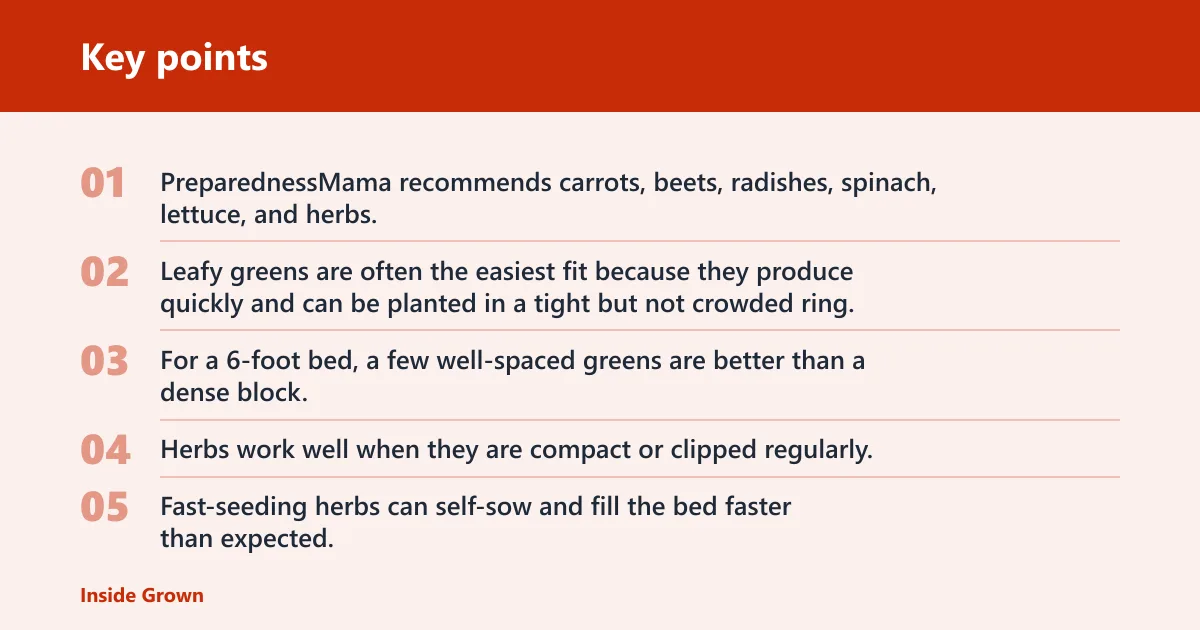
PreparednessMama recommends carrots, beets, radishes, spinach, lettuce, and herbs. Those crops fit the small-bed logic well because they stay relatively contained and do not demand a large rooting area.
Leafy greens
Leafy greens are often the easiest fit because they produce quickly and can be planted in a tight but not crowded ring. Lettuce, spinach, and similar greens can go near the center if the bed is kept moist, but they still need spacing for airflow and clean harvests.
For a 6-foot bed, a few well-spaced greens are better than a dense block. That leaves room for succession sowing and reduces the chance of bolting from stress.
Herbs
Herbs work well when they are compact or clipped regularly. Parsley, chives, dill, and basil can fit in a keyhole bed if they are spaced for the final width they reach, not the tiny transplant size. Woody or spreading herbs need more caution.
Fast-seeding herbs can self-sow and fill the bed faster than expected. That is useful only if the bed has extra room. In a small keyhole garden, self-seeding herbs can crowd seedlings and make maintenance harder.
Root crops
Root crops are often a strong match because they use depth more than width. Carrots, beets, and radishes stay relatively contained aboveground, which helps in a bed with limited surface area. They also fit the moisture gradient well when placed in the inner or middle zones.
Thin them early. A crowded stand of roots gives smaller harvests and tangles the canopy before the roots size up.
Space-conscious fruiting crops
Small determinate tomatoes, compact peppers, and similar restrained fruiting crops can fit only when the bed is large enough and the rest of the planting is sparse. Even then, one or two plants are usually enough in a 6-foot bed. An 8-foot or 10-foot bed gives more flexibility.
Use supports that keep the plant upright and contained. A sprawling cage that leans into the access path can block harvesting and shade nearby crops.
What should you avoid planting?
Avoid crops that need a lot of room, send out aggressive roots, or sprawl across the bed. The same source lists tomatoes, cabbage, peppers, eggplant, chilies, maize, peas, beans, potatoes, and squash as not recommended in keyhole beds. In a small bed, those crops can compete for water and nutrients or shade out better fits.
That warning matters most when the bed is 6 feet across or smaller. Even if a crop is technically possible, it may not be the best use of the limited planting ring.
Large or aggressive root systems
Plants with broad, deep, or aggressive root systems can crowd the bed below the surface. That competition is hard to see early, then obvious later when nearby plants stall or dry out faster than expected. Potatoes are especially hard to manage in a small keyhole bed because they expand belowground and demand soil space.
Large brassicas can also overreach the bed. Cabbage and similar crops often need more room than a compact circular bed can give without sacrificing access and airflow.
Sprawling vines
Vines are a poor match because they spread beyond the bed and make the keyhole opening harder to use. Squash and similar crops can quickly cover the surface, block light, and trap moisture where leaves overlap. That creates maintenance problems even before the crop reaches full size.
If a vine crop is planted anyway, it should be treated as a special case in a very large bed, not as a standard choice for a compact setup.
Crowding-prone crops in small beds
Some crops fail not because they are large, but because they fill in too fast. Bolt-prone greens, self-seeding herbs, and thick stands of seedlings can crowd one another long before harvest. The result is a bed that looks full and then becomes thin, tangled, or difficult to water.
A 6-foot keyhole bed can stay productive, but only if the plant count matches the mature spread. Overplanting is the fastest way to turn the design into a maintenance problem.
- Measure the bed diameter. Confirm the planting circle first, then note the access notch width and the basket size. A 6-foot bed will need a tighter plant count than an 8-foot or 10-foot bed.
- Pick the main crop group. Choose leafy greens, herbs, roots, or a small mix before you buy plants or seed. The crop type determines how many plants fit and how close they can be placed.
- Map the moisture zones. Put moisture-loving crops near the center, steady growers in the middle ring, and drought-tolerant crops along the outer edge. This matches the way water moves from the compost basket.
- Set spacing by mature spread. Use the final width of each plant, not the transplant size, to decide the gap between plants. Leave extra room where leaves overlap or where you need to reach in for harvest.
- Leave harvest lanes open. Keep the access notch and the basket opening clear enough to add compost and water. If those areas fill in, the bed becomes harder to manage and less productive.
Frequently asked questions
How many plants should you put in a keyhole garden?
A small keyhole garden usually holds about 6 to 12 plants in a 6-foot bed, depending on crop size. Use fewer plants for larger greens or fruiting crops and more plants for compact roots or herbs. The best count comes from mature spread, not the number of seedlings you can fit in at once.
How many vegetables fit in a 6-foot keyhole garden?
A 6-foot keyhole garden often fits a modest vegetable mix, such as 6 to 8 leafy greens, 10 to 16 small root crops, or a few herbs plus roots. If you add larger vegetables, reduce the count quickly. The access notch and center basket lower the usable planting area more than many gardeners expect.
How far apart should plants be in a keyhole garden?
Space plants by their mature spread, not by transplant size. Compact herbs may need only a small gap, while lettuce or similar greens need more room to open out and dry after watering. Leave a little extra space near the center basket and along the access path so air can move through the bed.
What plants grow best in a keyhole garden?
Leafy greens, herbs, carrots, beets, and radishes are usually the best fits. These crops stay relatively compact and respond well to the moisture pattern created by the compost basket. Drought-tolerant plants should go toward the outer edge, while moisture-loving crops belong closer to the center.
Should you plant more densely near the compost basket?
Only to a point. The center stays moister and more fertile, so moisture-loving crops can be grouped there more closely than outer-edge crops. Even then, leave enough room for airflow and for adding compost or water. Dense planting is useful only when the plants stay small at maturity.
How many tomato plants can a keyhole garden hold?
Usually only one or two, and sometimes none if the bed is small. Tomatoes need room, support, and strong airflow, which makes them a poor fit for many keyhole gardens. A larger 8-foot or 10-foot bed can hold a small tomato planting more safely than a 6-foot bed.
What should you not plant in a keyhole garden?
Avoid large or aggressive crops that crowd roots or spread far beyond their allotted space. Squash, maize, potatoes, cabbage, and similar high-demand crops are often poor matches for a small keyhole bed. They can compete for water and nutrients, block access, and crowd out smaller, better-fitting vegetables.
How big should a keyhole garden be?
Keyhole gardens are typically 6 to 10 feet in diameter, with many small beds built around 6 feet across. That size is easier to reach from the edge and easier to manage without stepping into the bed. A 6-foot bed suits compact planting; larger beds allow a broader crop mix.
Is a keyhole garden good for dry climates?
Yes. The design helps conserve water and nutrients, and the compost basket can improve water retention by 30 to 50 percent versus flat beds. That makes keyhole gardens useful where water is limited or soil is poor. The moisture gradient also lets you place thirsty crops where they can use the water most efficiently.
How do you arrange plants in a keyhole garden by moisture needs?
Put moisture-loving crops near the center, steady growers in the middle, and drought-tolerant plants near the outer edge. The center basket releases moisture and nutrients, so the inner zone stays wetter. This arrangement helps the bed stay productive without overwatering the entire circle or crowding the access path.