How Many Plants Can You Space in a Triangle Layout?
A triangle layout fits about 15% more plants than square spacing at the same center-to-center distance. Ignore that difference, and you can crowd a bed or waste room. Here’s how to estimate plant counts for triangular spacing, and how to compare it with square spacing for common crops.
What triangle spacing means
Triangle spacing places plants in a staggered pattern, so each plant sits between two plants in the next row rather than directly behind one. That creates a tighter layout than square spacing, which lines plants up in straight rows and columns.
This matters because the spacing on a plant tag or product page is usually written as a center-to-center distance in inches. Triangle spacing changes how many plants fit in the same bed area, but it does not change the tag spacing itself.
Triangle spacing vs. square spacing
Square spacing is easier to mark and read. Triangle spacing usually fits more plants in the same footprint because each row is offset by half the spacing distance. That denser pattern can help in small beds, but it also leaves less open space around each plant.
In practice, triangle spacing works best when the crop stays compact and does not need much airflow. Square spacing is often the safer choice for larger plants, spreading herbs, and crops that are more prone to mildew in tight conditions.
How to calculate plant spacing in a garden bed
A plant spacing calculator asks for garden length in feet, garden width in feet, and plant spacing in inches. It then gives an approximate plant count based on a standard grid planting pattern. That makes it useful for planning, but the result is still an estimate, not a guarantee.
The spacing value should come from the plant tag or product page. Use that number first, then decide whether the crop can handle a triangular layout or needs the simpler square pattern.
Measure the bed. Record the garden length in feet and the garden width in feet. If the bed has a narrow border, a path, or a curve, measure the usable growing space instead of the outer frame.
Read the spacing tag. Check the plant tag or product page for the recommended plant spacing in inches. That number is the starting point for both square and triangle layouts.
Choose the layout. Use square spacing for a simple grid or triangle spacing for a staggered pattern. Triangle spacing usually gives the denser count, but only if the crop can support it.
Estimate the count. Divide the bed area by the space each plant needs, then adjust for the layout. Square spacing uses the full spacing distance in both directions. Triangle spacing uses the same spacing from plant to plant, but the offset rows pack more plants into the same area.
How many plants fit in a triangle layout?
For a quick estimate, triangle spacing is commonly reported to give about 15% more plants than square spacing at the same spacing distance. A useful shortcut is to treat the triangle layout as about 1.15 times the square count, then round to a whole plant after you account for edges and paths.
Mature spread can change that answer. If a plant tag lists a spacing that seems tight for a crop with broad leaves, heavy branching, or a wide canopy, use the larger mature spread instead of the minimum tag number. That matters for vegetables that sprawl, herbs that thicken up, and flowers that need airflow.
Quick triangle-spacing table
This table converts common spacing values into estimated plants per square foot and the percent lift versus square spacing. The triangle figure is approximate, and the edge of a real bed may reduce the final count.
| Plant spacing | Square spacing, plants per square foot | Triangle spacing, plants per square foot | Percent lift |
|---|---|---|---|
| 6 inches | 4.00 | 4.62 | 15% |
| 8 inches | 2.25 | 2.60 | 15% |
| 10 inches | 1.44 | 1.66 | 15% |
| 12 inches | 1.00 | 1.15 | 15% |
| 18 inches | 0.44 | 0.51 | 15% |
| 24 inches | 0.25 | 0.29 | 15% |
Triangle spacing vs square spacing for crops
Triangle spacing is often a better fit for small crops that stay compact, such as many salad greens, some herbs, and smaller flowers. Square spacing is usually the easier choice for crops that broaden quickly or need room for air movement. The right answer depends on the mature canopy, not only the tag spacing.
Small-space vegetables
Leafy crops often handle tighter spacing better than sprawling crops, especially when you harvest them young or frequently. Still, if the crop forms a wide head or large leaves, triangle spacing can become too tight once the plants mature. A common first-timer mistake is using the seedling stage size instead of the final spread.
Herbs and compact flowers
Compact herbs and smaller flowers may fit triangle spacing well because their mature width stays modest. Even then, check for air movement and the way the plant branches. Dense rows can keep leaves wet longer after rain or watering, which raises disease pressure.
Larger crops that need airflow
Larger crops usually need more room than triangle spacing seems to promise. Wider spacing helps sunlight reach lower leaves and gives wind a path through the bed. That matters when the crop is prone to mildew, leaf spot, or soft growth from crowding.
Why spacing affects plant health
Proper spacing keeps each plant from fighting for the same light, water, and nutrients. Too little room can leave plants weak, reduce blooms, and raise pest and disease pressure. Triangle spacing can pack more plants into a bed, but that tradeoff only works when the crop can handle the crowding.
Sunlight and airflow
When plants sit too close together, leaves shade one another and air moves more slowly through the bed. That can leave foliage damp for longer periods. Less light and less airflow often mean weaker growth and fewer blooms.
Water and nutrient competition
Close spacing makes roots compete in the same soil zone. In a small bed, that can dry out the root area faster and make feeding less even. If the crop already has a strong appetite or shallow roots, tight spacing becomes a bigger risk.
Crowding, pests, and disease
Crowded plants are harder to inspect and harder to dry out after rain or irrigation. That can make pests easier to miss and disease easier to spread. Triangle spacing can be useful, but it should never replace crop-specific airflow needs.
Suppose you plant bush beans in a 4×4 bed and use the tag spacing as if the crop were a lettuce mix. The bed may fill fast, but the canopy can close early and cut down airflow. Changing only the crop type changes the spacing decision.
Worked examples for common beds
These examples show how triangle spacing changes plant count versus square spacing in real bed sizes. The counts are approximate and assume a regular bed shape with usable growing space across the full area.
4×4 bed example
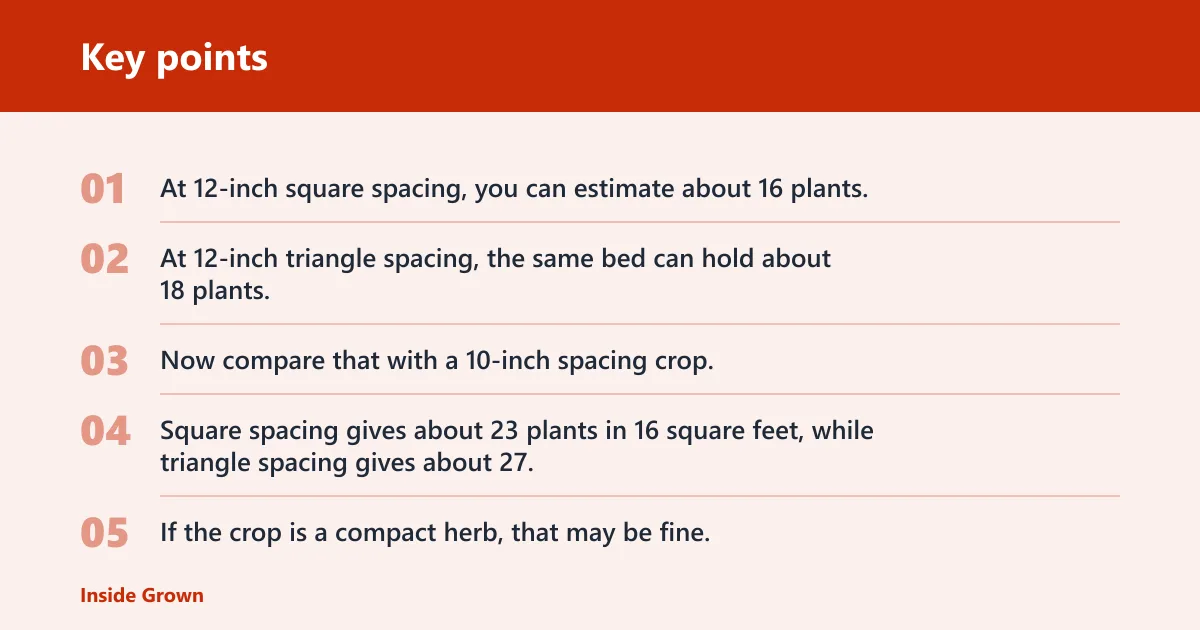
A 4×4 bed has 16 square feet of area. At 12-inch square spacing, you can estimate about 16 plants. At 12-inch triangle spacing, the same bed can hold about 18 plants. That is the same spacing distance, but the staggered layout uses the space more tightly.
Now compare that with a 10-inch spacing crop. Square spacing gives about 23 plants in 16 square feet, while triangle spacing gives about 27. If the crop is a compact herb, that may be fine. If it is a wider vegetable, the mature canopy may make the triangle count too dense.
4×8 bed example
A 4×8 bed has 32 square feet of area. At 18-inch square spacing, a common estimate is about 14 plants. With triangle spacing at the same 18-inch center-to-center distance, that estimate rises to about 16 plants. The gain is useful, but only if the crop still has room to breathe at full size.
For a smaller crop at 8-inch spacing, square layout gives about 72 plants in a 4×8 bed, while triangle spacing gives about 83. That difference is large enough to matter in a harvest plan, but it also makes row ends and borders more important because the outer plants lose some of the theoretical gain.
Frequently asked questions
How many plants can I space in a triangle layout?
A triangle layout usually holds about 15% more plants than square spacing at the same center-to-center distance. The exact count depends on the bed size, the spacing from the plant tag, and whether the crop needs extra room for mature width. Edge rows can reduce the final number.
What is triangle spacing for plants?
Triangle spacing is a staggered planting pattern that places each row offset from the one before it. That creates a denser layout than square spacing. It can be useful for compact crops, but it is not the right choice for every plant.
How do I calculate plant spacing in a garden bed?
Start with the garden length in feet, the garden width in feet, and the plant spacing in inches from the plant tag or product page. Use those numbers to estimate how many plants fit in the bed. Then reduce the count if borders, paths, or mature canopy width take up space.
Is triangle spacing better than square spacing?
Not always. Triangle spacing can fit more plants in the same area, but square spacing is simpler and often better for crops that need airflow or spread more at maturity. The best layout depends on the plant tag spacing, the crop size, and how much room you have in the bed.
What spacing should I use for my plant tag?
Use the spacing listed on the plant tag or product page as your starting point, and read it as a center-to-center distance. If the crop is likely to spread widely, use the larger mature spread instead of trying to force the tightest number into the bed.
How many plants will fit in my garden space?
That depends on the bed area, the spacing you choose, and the layout pattern. A calculator gives an approximate plant count from garden length, garden width, and plant spacing. Triangle spacing usually gives a higher count than square spacing, but crop size and edge space can change the result.