How Many Houseplants Are Too Many for One Room?
A typical room has too many houseplants once light is blocked, airflow gets crowded, or weekly care becomes hard. For many average rooms, about 8 to 12 medium pots is a practical ceiling. Too many plants raise mold, pest, and rot risk, and weak light makes growth stall. This guide shows how to judge room capacity by light, airflow, and maintenance load.
How many houseplants are too many?
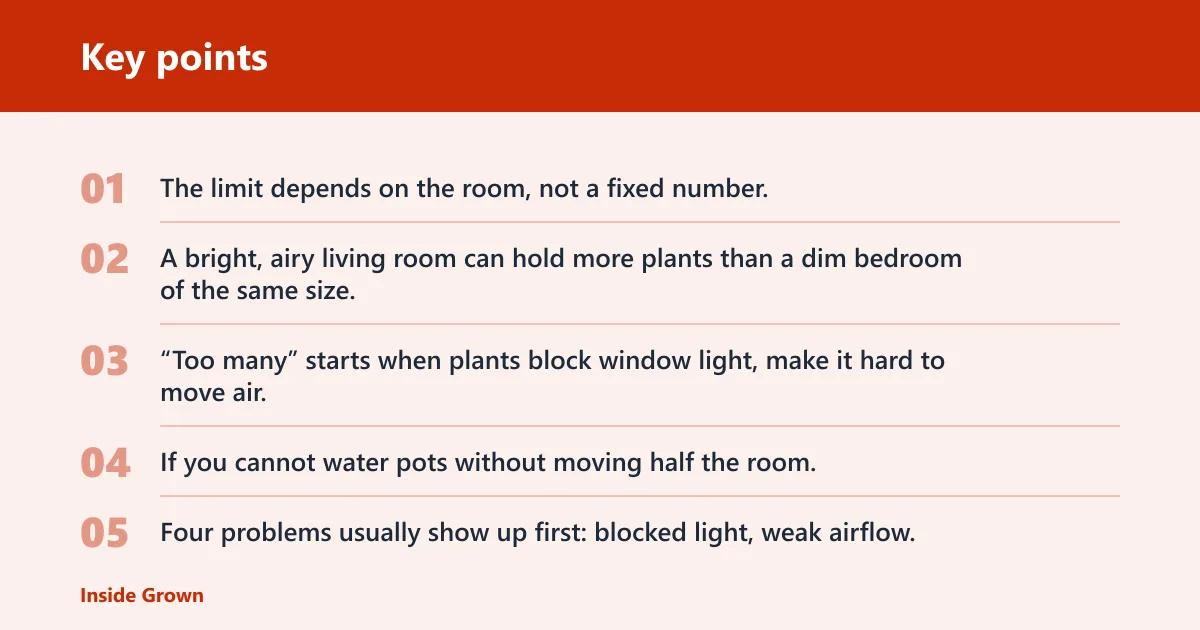


The limit depends on the room, not a fixed number. A bright, airy living room can hold more plants than a dim bedroom of the same size, while a small room with poor ventilation reaches crowding much sooner.
“Too many” starts when plants block window light, make it hard to move air, or turn basic care into a chore. If you cannot water pots without moving half the room, the setup is past the comfortable point.
What turns a full room into an overcrowded one
Four problems usually show up first: blocked light, weak airflow, cramped watering access, and higher humidity around the pots. Those conditions can slow growth, invite fungus gnats, and create damp surfaces near windows or walls.
Plant size matters as much as plant count. Three large floor plants can crowd a room faster than ten small pots on a shelf. Fast growers also change the count quickly because they need more pruning, more water, and more space over time.
What room density means
Room density is a practical mix of light, floor space, ceiling height, ventilation, and plant growth rate. A tall room with a big window can handle more green mass than a low-ceiling room with the same floor area.
Window distance matters too. The farther a plant sits from window light, the less energy it gets for growth. In a low-light room, a row of plants far from the glass can stall and become thin or leggy even if the room looks full enough.
Ventilation and watering access
Air movement helps leaf surfaces dry after watering and after normal transpiration. Good airflow also makes a dense plant group easier to maintain because pots dry at a more even pace. Tight corners, closed curtains, and crowded shelves work against that.
Watering access is part of the density limit. If you must move pots every time you water, check for pests, or clean fallen leaves, the room is likely carrying too many plants for everyday use.
Plant size, growth rate, and spacing
Fast-growing, thirsty, physiologically active plants move water and gas through their tissues more than slow, dry-site plants. Peace lilies and devil’s ivy are practical examples because they keep that activity going and can do better where gas exchange is stronger.
Spacing matters because leaves need air around them. Crowding plants shoulder to shoulder can trap moisture, reduce airflow, and make pest checks harder. A room can look lush while still being overloaded.
Do houseplants improve air quality?
Houseplants can help with memory, productivity, mood, and indoor air pollution control, but they are not a replacement for ventilation or filtration. They may affect volatile organic compounds, carbon dioxide, and nitrogen dioxide, yet the room still needs fresh air exchange to stay healthy.
Plants take in pollutants through stomata on leaves, diffusion across leaf surfaces, and soil microbes that break down compounds carried into the soil. That can matter, but the effect depends on plant number, plant type, room size, and air movement.
Why plant count alone does not make a room healthier
A small room needs probably at least five or six plants for measurable CO2 impact. That is a useful benchmark, not a promise of clean air. A room with fewer plants may still look better and feel calmer without producing measurable air-quality change.
A 2006 study in 60 offices found VOC levels fell by 50 to 75 percent after adding plants. That result shows potential, but office conditions, plant mix, and ventilation all matter. A crowded, sealed bedroom will not behave the same way.
Why ventilation still matters most
Indoor air pollution can cause asthma, wheezing, conjunctivitis, dermatitis, and eczema. Plants can be part of the room plan, but they do not cancel the need for outdoor air, exhaust fans, or dust control.
Carbon dioxide is also part of the discussion because indoor CO2 can affect thinking and decision making. Plants take up CO2, yet the practical fix for a stuffy room is still airflow first, then plant choice.
Room density checklist
Use this checklist to decide whether a room can take more plants. A “yes” on all three checks means the room can usually handle a little more density. A “no” on any one check means you should slow down or adjust placement before adding more pots.
| Room size/light/ventilation | Safe plant-count range | Warning signs of overcrowding | Best-fit plant types |
|---|---|---|---|
| Small bedroom; modest window light; limited air movement | 3 to 6 medium pots, or a few small plants if the window is bright | Window blocked, sheets stay damp near pots, soil dries slowly, hard to reach blinds | Small, slow growers; a few peace lilies or devil’s ivy only if light and airflow are decent |
| Living room; broad window area; regular cross-breeze or fan use | 8 to 12 medium pots, more if several are small and spaced apart | Dusty leaves from poor access, crowded shelves, furniture blocked, humidity buildup near corners | Mixed plants, including peace lily and devil’s ivy; larger statement plants if the room stays bright |
| Office; bright desk light or window light; moderate ventilation | 4 to 8 plants, depending on desk space and walking room | Glare blocked from the window, clutter around work surface, watering interruptions, pests missed in plain sight | Compact plants, a few thirsty growers, and one or two easy-care options near the brightest spots |
| Bathroom; high humidity; variable light; exhaust fan preferred | 1 to 4 plants, mainly if the room gets bright indirect light | Mildew smell, wet walls, no airflow after showers, pots staying damp too long | Humidity-tolerant plants; avoid packing in too many pots if the fan is weak |
Yes/no scoring rule: if the room has good window light, steady airflow, and easy watering access, score 3 yeses. If it has only one or two yeses, keep the plant count low and choose smaller pots. If it scores 0 yes, the room is already at its practical limit.
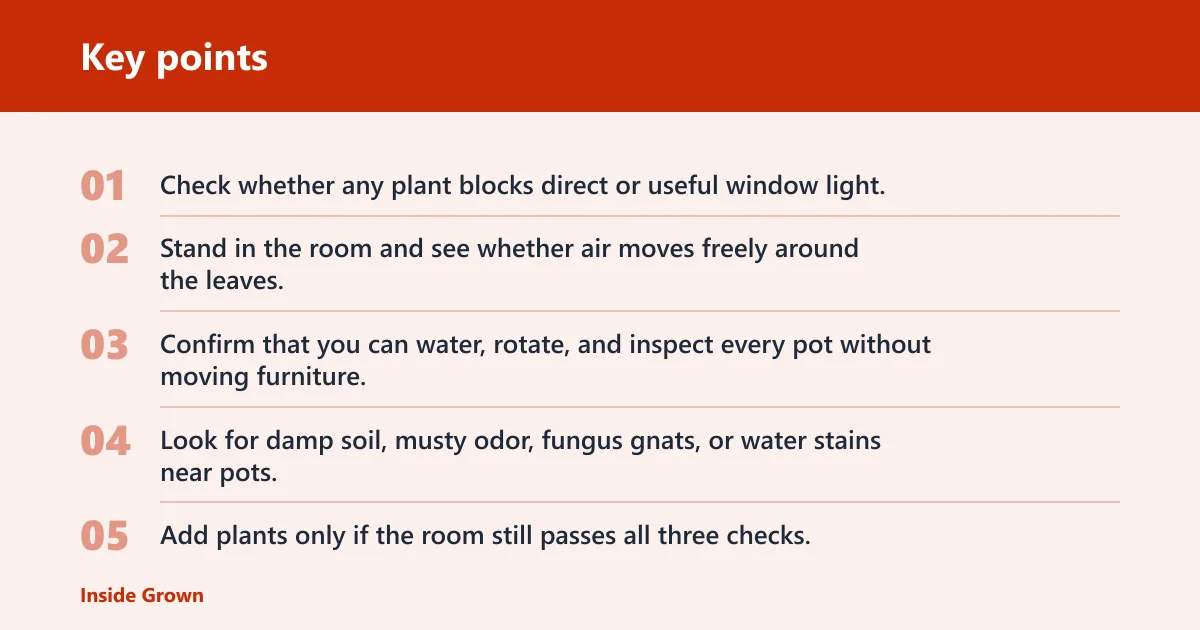
- Check whether any plant blocks direct or useful window light.
- Stand in the room and see whether air moves freely around the leaves.
- Confirm that you can water, rotate, and inspect every pot without moving furniture.
- Look for damp soil, musty odor, fungus gnats, or water stains near pots.
- Add plants only if the room still passes all three checks.
Which plants fit a small room?
Small rooms do best with plants that match the available light and do not need constant rearranging. Fast-growing, thirsty plants can work well in brighter spots, while low-demand plants suit shelves and corners where care needs to stay simple.
Choose plants for room conditions, not for appearance alone. A plant that looks perfect in a shop can become a burden if your room is dim, dry, or hard to ventilate.
Peace lily and devil’s ivy for active growth
Peace lily and devil’s ivy are useful when you want a plant that is physiologically active and likely to contribute more gas exchange than a slow, dry-site plant. They are not magic air cleaners, but they are better fits for rooms where light and maintenance are both available.
These plants also suit people who want visible growth. Their fast pace means you need to watch watering, pruning, and root crowding more closely, especially in a small room.
Succulents for low-demand spots
Succulents are easier to care for in dry rooms and tight spaces, but they do very little in terms of gas exchange. They are useful when you want a hardy, compact plant, not when you want the strongest air-related effect.
Do succulents count as good plants for indoor air benefits? Only in a limited sense. They can still be part of a room plan, yet they are not the best choice if your main goal is measurable plant-air interaction.
Best matches for low light, bright light, and humid rooms
Low-light rooms need restraint. Use fewer plants, place them near the brightest window, and avoid filling dark corners with dense foliage that cannot keep up with the light available.
Bright rooms can handle more plants because the window light supports growth and recovery. Rooms with higher humidity, such as some bathrooms, can also support certain plants, but too many pots can push moisture higher and create new problems.
Say your bedroom is 10 by 12 feet with one north-facing window and no fan. Four small plants near the glass may work, but ten medium pots around the room would likely crowd the light and slow dry-down after watering.
How do you know a room has too many plants?
A room has too many plants when the setup stops working day to day. The warning signs are usually obvious: blocked light, stale air, damp surfaces, hard-to-reach pots, and more pests than you want to manage.
The room can still look full and attractive while being over its practical limit. Decorative fullness is not the same as a setup that works for light, airflow, and care.
Blocked windows and weaker daylight
If plants sit in front of the main light source, the whole room can lose usable daylight. That matters most in small rooms, where even a few large leaves can change the light pattern across the space.
Distance from the window matters because each step away from the glass reduces the strength of the light reaching the plant. In bright rooms, you have more room for error. In low-light rooms, you do not.
Stale air, damp surfaces, and mold risk
Too many plants can hold humidity in the room longer, especially if soil stays wet and the air does not move. That can help with dry-air skin and eye issues in some spaces, but too much moisture can also lead to mold risk on walls, windowsills, and pots.
Plants increase humidity through transpiration, which is why a modest cluster can make a dry room feel more comfortable. The same process becomes a problem when the room is already damp or poorly ventilated.
More pests and harder watering access
Crowded plants make pest checks harder. If you cannot inspect undersides of leaves or spot damp soil quickly, fungus gnats, mites, and mildew can spread before you notice.
A common first-timer mistake is adding one more plant to “fill the corner” and then discovering there is no easy way to water it. Once access becomes awkward, the room is already carrying too much plant load.
What happens when plants raise humidity?
Plants release moisture through transpiration, and that can reduce dry-air discomfort for skin and eyes. In a dry bedroom or office, a modest increase in humidity may make the room feel easier to sit in for long periods.
The same effect can become a problem if the room already traps moisture. In that case, more plants can add to condensation, damp plaster, or mildew around windows and behind furniture.
Rooms that need extra caution
Bathrooms, small bedrooms with closed windows, and offices with no fresh-air exchange need the most caution. These rooms can cross from cozy to damp very quickly if they hold too many pots or too much wet soil.
Kitchen spaces also need careful plant placement because they should be bright and resilient around activity. Heat, splashes, and regular movement make cramped setups harder to maintain.
Frequently asked questions
How many houseplants are too many for one room?
Too many is the point where plants block light, crowd airflow, or make weekly care difficult. For many average rooms, 8 to 12 medium pots is a practical ceiling, but a small, dim room can reach its limit much sooner.
Is there a limit to how many houseplants you can keep in one room?
Yes, but it is a practical limit rather than a fixed number. Room size, window area, ceiling height, ventilation, and plant size all change the answer. A bright, airy room can hold more plants than a cramped one with poor airflow.
How many houseplants do you need for a small room?
A small room needs probably at least five or six plants for measurable CO2 impact, but that does not mean you should pack the room to that number. Start with the room’s light and airflow, then add only what you can water and inspect easily.
Can a room have too many plants for light and airflow?
Yes. If plants block window light or sit so close together that air cannot move through the leaves, the room has too many for its conditions. Weak airflow also raises the chance of damp soil, mold, and pest problems.
How many houseplants should I put in a bedroom?
A bedroom usually needs fewer plants than a living room because light and airflow are often more limited. Start small, keep plants near the brightest window, and avoid crowding the bed area or blocking the path to blinds and vents.
Do houseplants improve air quality in a room?
They can help with VOCs, carbon dioxide, and nitrogen dioxide, and they may also raise humidity a bit. Still, plants are not a substitute for ventilation. For indoor air pollution, moving air in and out of the room remains the main control.
What houseplants work best in a small room?
Peace lily and devil’s ivy are good choices if the room has enough light and you want active growth. Succulents suit dry, low-care spots, but they do very little in terms of gas exchange, so they are not the strongest choice for air-related benefits.