How Many Flower Bulbs Per Pot Is Too Many?
Overcrowding starts when bulbs fill more than half the pot’s soil volume or sit closer than one bulb-width apart; small bulbs may fit 6 to 10 in a 10-inch pot, while large tulips or daffodils need far fewer. Too much density cuts drainage, shrinks root space, and usually means weaker blooms or rot. This guide gives container-size rules by bulb type and whether you want one season or a longer-lasting display.
What counts as overcrowding in a pot?


Overcrowding begins before the pot looks full. The real limit is root room, not the number of noses you can squeeze into the compost. When bulbs sit too close, the compost can bulge, stems may lean, and flowers often come up smaller or fail to hold themselves upright.
In containers, you can plant more tightly than in borders, but the limit still exists. A crowded pot leaves less air around the bulb bases, less room for drainage, and less soil for roots to spread. That is why a pot can look generous on top and still be too small below.
The first limit: root volume, not just visible space
Bulbs need enough compost above and below them to root cleanly. If the root zone is squeezed into a shallow or narrow column, the bulbs compete for moisture and oxygen. The result is often soft stems, patchy flowering, and higher rot risk after watering or rain.
The warning signs of too many bulbs in one container
- Compost rises or domes above the rim after planting.
- Stems wobble because the bulbs never anchored well.
- Flowers open unevenly, or some buds stall.
- Water sits on the surface instead of draining quickly.
- Bulbs are forced together so tightly that roots have no clear paths downward.
Why dense pot plantings still fail when depth is too shallow
Density is only safe when depth is also safe. The pot needs drainage holes, and those holes need to stay open, often with broken pot pieces or a similar coarse layer above them. The compost should still leave room below the rim; a final layer of 5-10cm above the bulbs is a useful target.
Pot size and depth rules
Pot diameter is the main sizing input. A wider pot changes the bulb count more than variety alone, and a 40cm container can hold noticeably more bulbs than a 30cm one. Depth matters just as much, because larger bulbs need a deeper compost column and enough headroom above them.
Why 30cm is the minimum useful benchmark
RHS recommends a pot at least 30cm wide and deep. That is a practical floor for spring bulbs because it gives enough room for a basic bulb-depth planting system, drainage material at the base, and a top layer of compost that still leaves space below the rim.
How 40cm and 45cm pots change bulb count
Once you move past 30cm, bulb count rises fast. A 40cm pot gives much more root room than a 30cm pot, and a 45cm pot allows a larger block or a layered display without crowding the lower bulbs. The increase is structural, not only visual.
Depth, rim clearance, and drainage holes
- Choose a pot with drainage holes.
- Cover the holes with broken pot pieces or another coarse layer that still lets water escape.
- Add free-draining compost or potting mix.
- Set bulbs at the right depth for their size.
- Finish with a final compost layer that leaves 5-10cm below the rim.
Flower bulbs is a catch-all term in garden use, and it often includes true bulbs plus corms, tubers, and rhizomes. They do not behave the same way in containers. Spring-flowering kinds and summer-flowering kinds can differ in rooting speed, stem strength, and how much crowding they tolerate.
Bulb density matrix
This table uses conservative counts for common pot diameters. Treat it as a safe ceiling, not a target you must always hit. For one-season displays, you can stay near the upper end. For bulbs you want to keep for future years, stay lower so roots have more room and the bulbs can recover.
| Pot diameter | Small bulbs | Medium bulbs | Large bulbs | One-season display | Future years |
|---|---|---|---|---|---|
| 30cm | 12-16 | 6-8 | 3-5 | Use the upper end only for crocus or mixed top layers. | Stay at the lower end, especially for tulips and daffodils. |
| 35cm | 16-22 | 8-10 | 5-7 | Good for a fuller spring pot or a light layered mix. | Choose the lower half of each range. |
| 40cm | 20-30 | 10-14 | 6-9 | Best for dense seasonal impact or bulb lasagne planting. | Trim counts back if you want bulbs to return. |
| 45cm | 28-40 | 14-18 | 8-12 | Handles the most crowded display, provided drainage is strong. | Use the lower end if the bulbs need another season. |
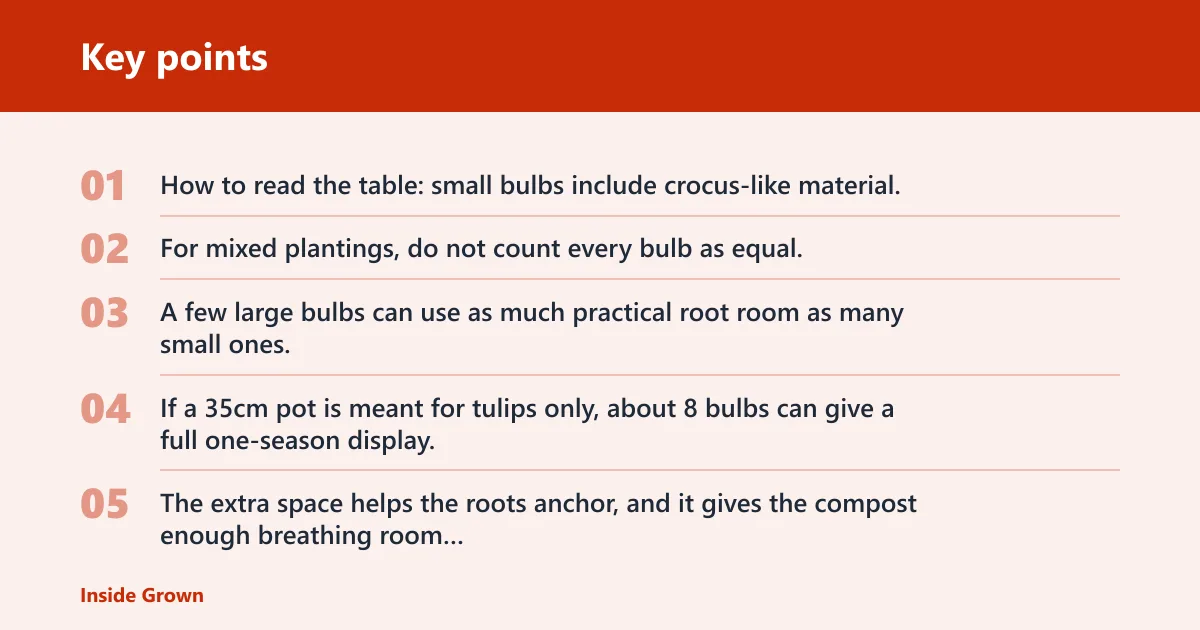
How to read the table: small bulbs include crocus-like material, medium bulbs fit the tulip or daffodil range, and large bulbs are the biggest, thicker kinds. For mixed plantings, do not count every bulb as equal. A few large bulbs can use as much practical root room as many small ones.
If a 35cm pot is meant for tulips only, about 8 bulbs can give a full one-season display, but about 6 is a safer cap if the bulbs need to come back next year. The extra space helps the roots anchor, and it gives the compost enough breathing room after watering.
A common first-timer mistake is to judge by the flower heads alone. A 40cm pot packed with small bulbs can still fail if the lower layer has no space to root. The top may look lush for a few weeks, then collapse into weak stems and uneven bloom.
Can you layer different bulbs?
Yes. Layering works well when you match bulb size to depth and give each layer enough compost to root. The largest, latest-flowering bulbs go deepest, and the smallest, earlier bulbs sit near the top. That order gives succession of bloom in one container without forcing every bulb into the same depth.
Bulb lasagne order
Start with the deepest layer and work upward. Put larger bulbs low, then cover them with compost before adding smaller bulbs above. Crocus works well near the top, while tulips and daffodils are usually better lower down, where they can build stronger roots before flowering.
How much spacing each layer needs
RHS advises spacing bulbs only a bulb’s width apart, and Flowerbulbs.com says bulbs can be planted no farther apart than their diameter. In pots, that means close spacing is fine, and for maximum impact bulbs can be almost touching. Even so, each layer still needs its own root room.
When layering works better than one dense layer
Layering is the better choice when you want fullness from a small footprint. It also helps when the top flowers are small and the lower bulbs are larger. You get a longer run of bloom without making one layer so thick that the roots choke each other.
Which bulbs tolerate tighter spacing?
Some bulbs handle close planting better than others. Tulips, daffodils, and crocus all work well in pots, but they do not use space the same way. Small bulbs can be packed more tightly, while larger bulbs need more depth and more root volume even when the visible spacing looks similar.
Tulips in pots
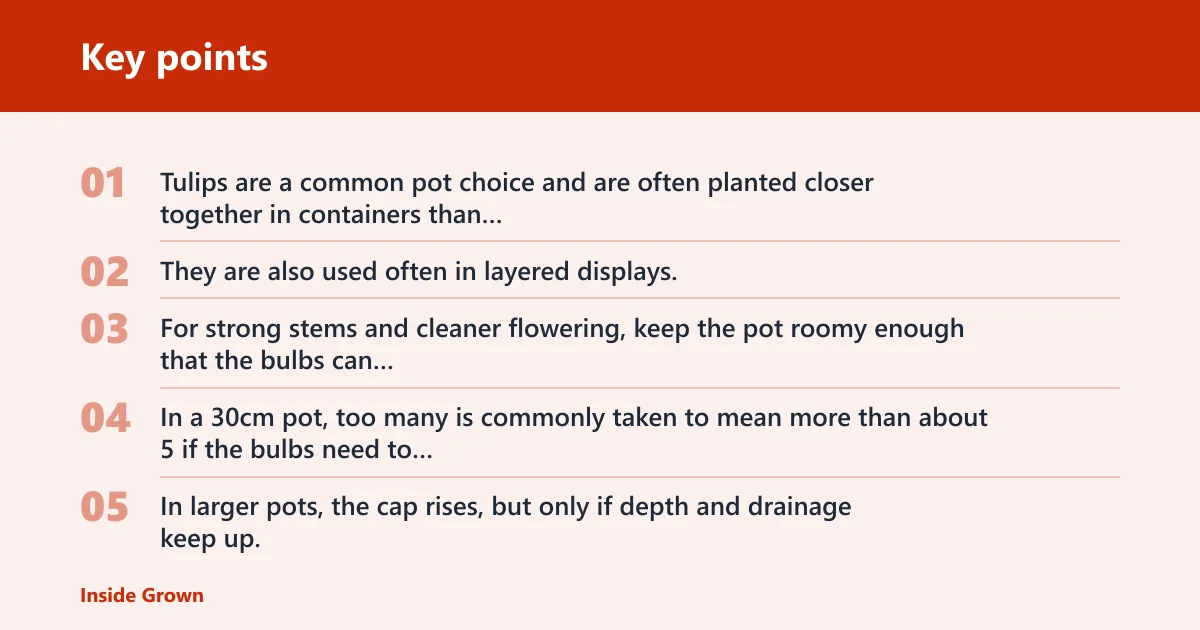
Tulips are a common pot choice and are often planted closer together in containers than in borders. They are also used often in layered displays. For strong stems and cleaner flowering, keep the pot roomy enough that the bulbs can root without pressing hard against one another.
How many tulip bulbs per pot is too many? In a 30cm pot, too many is commonly taken to mean more than about 5 if the bulbs need to return next year, or more than about 6-8 for a one-season display. In larger pots, the cap rises, but only if depth and drainage keep up.
Daffodils in pots
Daffodils are also common in spring containers and can be planted denser than many in-ground settings. They can work in mixed layers, but large types still need more room than crocus. If the pot is shallow or narrow, daffodils often suffer first because their root mass is more demanding.
Crocus in pots
Crocus bulbs suit close spacing and are useful in top layers of bulb lasagne plantings. They are one of the best choices for high-density container displays because their small size leaves more shared compost space. Even so, they still need drainage and a clear finish below the rim.
How many flower bulbs per square foot should I plant? As a broad guide, tulips at about 50-60 bulbs per square metre work out to about 4.6-5.6 per square foot, daffodils at about 30-50 per square metre to about 2.8-4.6, and crocus at about 100-150 per square metre to about 9.3-13.9. In pots, density is often two to three times border density, but container depth still sets the limit.
When should you stop adding bulbs?
Stop when the pot stops behaving like a container and starts behaving like a plug of bulbs. If stems wobble, compost bulges, or the bulbs sit so close that roots cannot spread, the display has crossed the line. For next-year planting, that stop point comes sooner than for one-season color.
If stems wobble or lean after potting
Wobbly stems usually mean the bulbs did not anchor well enough. That can happen when the pot is too crowded, too shallow, or too loose at the base. A dense top can look fine until wind or watering exposes the lack of support beneath it.
If compost bulges above the rim
Bulging compost usually means the pot is packed too full or the root mass is pushing upward because it had nowhere else to go. That is a warning sign, not a success signal. A good container planting should settle, drain, and stay level.
If you want bulbs to return next year
Do not use the same count you would choose for a single spring show. Bulbs that must survive and multiply need more space than bulbs planted only for temporary color. Do flower bulbs multiply in containers? Some do, but usually more slowly than in open ground, because the root room is tighter and the compost volume is fixed.
Frequently asked questions
How many tulip bulbs per pot is too many?
Too many depends on pot width, depth, and whether you want one season or repeat bloom. As a practical rule, a 30cm pot is crowded above 5 bulbs for future years or above 6-8 for a one-season display. Larger pots allow more, but only if drainage and depth stay generous.
How many flower bulbs per pot can I fit?
Fit is controlled by diameter, depth, and bulb size, not just empty surface space. A 30cm pot may hold 3-5 large bulbs, 6-8 medium bulbs, or 12-16 small bulbs safely. A 45cm pot can hold more, but the safe count still drops if you want the bulbs to last.
How many flower bulbs per square foot should I plant?
For broad bed planning, tulips work out to about 4.6-5.6 per square foot, daffodils about 2.8-4.6, and crocus about 9.3-13.9. Use that only as a rough guide. In pots, the container’s diameter and depth matter more than square-foot coverage.
How many plants fit in a flower pot size?
Use pot diameter and the mature root volume of each bulb, corm, or tuber. A 30cm pot is a floor, not a generous target, while 40cm and 45cm pots give much more room. If the bulbs are mixed, count the largest ones first and let them set the limit.
Does two bulbs in a pot make overcrowding?
Usually no, not if the pot is large enough and deep enough for the bulb type. Two large bulbs can still be too close in a shallow container, while two medium bulbs may be fine in a small pot. The issue is root room, drainage, and the bulb’s depth requirement.
What happens if a pot is too big for bulbs?
An oversized pot does not automatically hurt bulbs, but it can hold too much wet compost around a small planting. That extra moisture can slow rooting and raise rot risk if drainage is poor. Use a free-draining mix, a hole-covered base, and enough bulbs to fill the root zone without leaving it soggy.
Can I layer different bulbs in one container?
Yes, and it is one of the best ways to get longer bloom from a single pot. Put the largest, latest-flowering bulbs deepest, then work upward to smaller, earlier bulbs. Keep each layer spaced by at least a bulb’s width, and leave a final 5-10cm of compost above the top layer.
How close can I plant bulbs in pots?
In pots, bulbs can be planted almost touching for strong visual impact, and close spacing is usually tighter than in borders. A bulb’s width apart is a safe practical guide. Go tighter only if the pot is wide, deep, and well drained, and if you are planting for one season rather than years.