How Many Daffodil Bulbs Should You Plant for a Full Look?
For a full daffodil display, a common rule of thumb is at least 7 bulbs in tight spots, about 12 to 25 in most beds, and 25 or more for borders seen from farther away. Too few bulbs read as scattered and thin for weeks each spring. This guide shows how to size bulb counts by bed width, viewing distance, and the style of display you want.
What you’ll need


- Daffodil bulbs
- Bulb planter or trowel
- Measuring tape or ruler
- Garden gloves
- Compost or a well-drained soil mix for containers
How many bulbs make a full look?
Start with a cluster. A single bulb rarely reads as a designed planting. Five to 7 bulbs gives a small, believable patch. For a stronger block of color, 10 or more bulbs creates clearer visual impact, especially when the planting sits farther from the viewer.
In a front bed, count for the view from the sidewalk or house, not just the space in the ground. A few bulbs can look fine up close and still seem sparse from about 20 feet away. Larger drifts repeat the same count in several pockets instead of one tight line.
Use view distance to set the count
Close-up areas may only need 5 to 7 bulbs. For larger views across a yard, counts of 25, 50, or even 100 bulbs may be more appropriate when you want the color block to read clearly from a distance.
Think in clumps and drifts
Spring-flowering Narcissus bulbs look strongest when they repeat in clusters or drifts. Larger bulbs usually make stronger stems and blooms, so the same count can look fuller when the bulbs are substantial.
How many daffodil bulbs should you plant together?
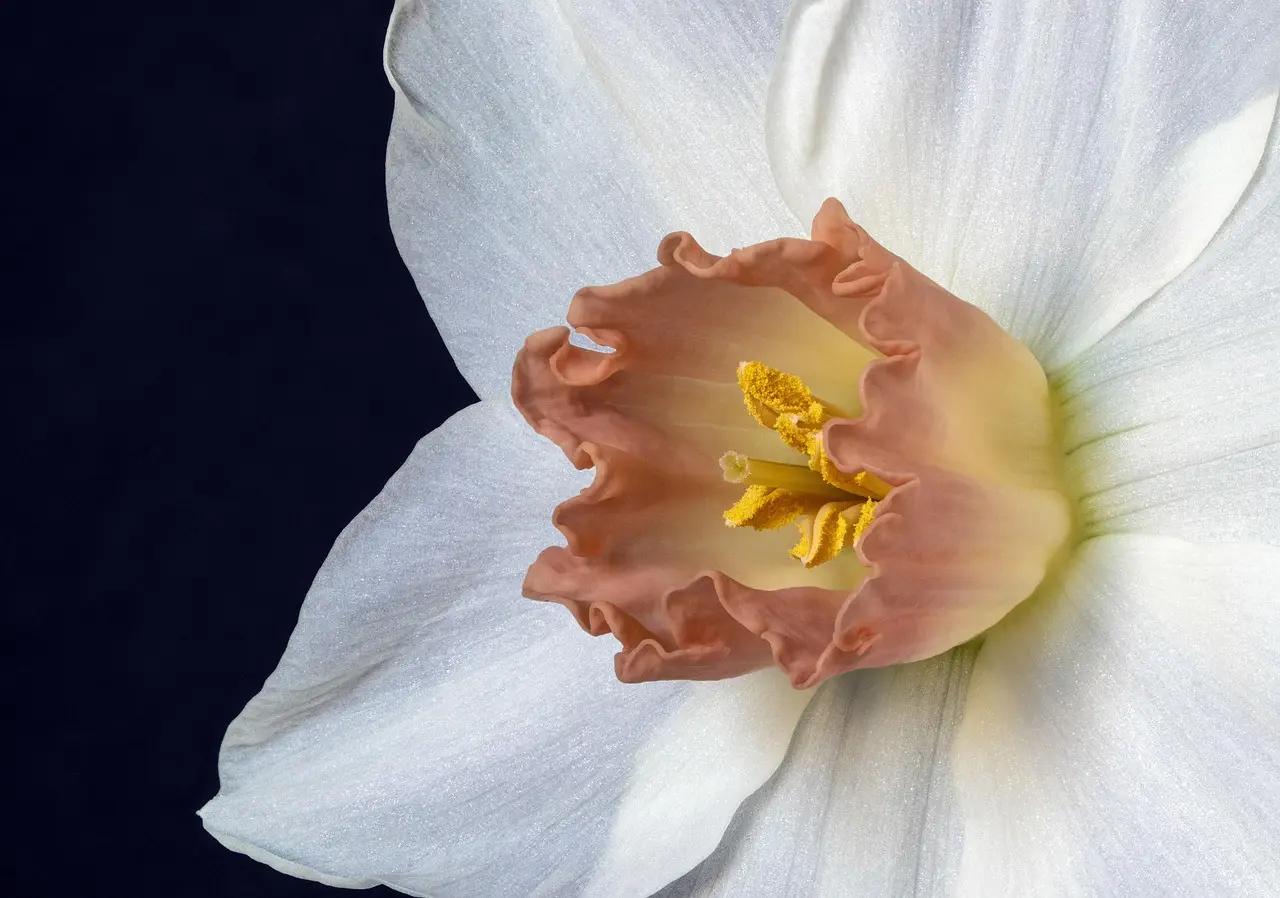
Plant daffodils in groups of 5 to 10 bulbs when you want a natural display, and use 10 or more bulbs of one variety when you want clear visual impact. Odd-numbered clusters often look looser and less rigid, while even counts can feel more formal.
Keep the bulbs close enough to read as one planting, but never touching. A bouquet-style hole works better than a long row when the goal is a soft drift rather than a line of isolated plants.
Single holes versus bouquet holes
Use one bulb per hole for a traditional bed when you want spacing control and a more scattered look. Use 3 to 5 bulbs in one wide hole when you want a tighter grouping that still feels natural. The wider hole helps you place them in a loose triangle or arc.
When odd numbers help
Odd-numbered clusters fit drift planting and clump planting because the eye reads them as irregular. For a small patch, 5 or 7 bulbs usually feels calmer than a straight row of 6. For impact, the irregular shape matters as much as the count.
How far apart should daffodil bulbs be?
In garden beds, space daffodil bulbs about 4 to 6 inches apart. 6 to 8 inches apart, which suits larger varieties or sites where you want the clump to expand a little more over time. Keep bulbs separated so they do not touch.
In containers, about 5 cm between bulbs is a useful target when the pot is large enough. If the pot is small, fewer bulbs is better than forcing a dense planting that crowds the roots and reduces bloom quality.
Adjust spacing for bulb size
Variety size changes the spacing decision. Larger daffodil bulbs usually need a bit more room because the stems and blooms need air and light. Smaller bulbs can sit closer together, but even then, touching bulbs are too tight.
Suppose the bed is narrow. Suppose a 3-foot-wide border sits beside a path. A dense row every few inches will look forced, but a few 5- to 7-bulb pockets spaced across the length will feel fuller and easier to maintain. The pattern matters as much as the total count.
How deep should daffodil bulbs go?
Plant daffodil bulbs at about 2 to 3 times the bulb height. For many standard bulbs, that means about 6 to 8 inches deep. This depth supports steady rooting and helps stems stand up well after spring growth begins.
For grouped planting, use a trench or a wide hole instead of separate holes if you are setting several bulbs together. That makes it easier to keep the same depth across the group and keeps the arrangement visually even.
Use a trench for repeated bulbs
A trench depth of at least 2 to 3 times the depth of a bulb gives you room for a cluster or a row of clusters. Set the bulbs at the same level, then backfill once the spacing looks balanced from above.
Top up the depth if the soil is loose
If the soil settles after watering, add 1 inch of soil over the bulbs and recheck the planting line before finishing. Then firm the surface lightly so the bulbs stay at the target depth instead of sitting too shallow.
Daffodil bulb count by space type
| Space type | Recommended bulb count | Spacing | Depth | Visual result |
|---|---|---|---|---|
| Small bed | 5 to 7 bulbs | 4 to 6 inches apart | 6 to 8 inches deep | Natural |
| Medium border | 10 to 15 bulbs | 4 to 6 inches apart | 6 to 8 inches deep | Full |
| Large border or meadow | 25 to 30 bulbs or more | 6 to 8 inches apart | 6 to 8 inches deep | High-impact |
| Front walkway | 5 to 10 bulbs per pocket | 4 to 6 inches apart | 6 to 8 inches deep | High-impact |
| Container | Enough to fill the pot without crowding | About 5 cm apart | 2 to 3 times bulb height | Full |
How many daffodil bulbs should you plant for a border?
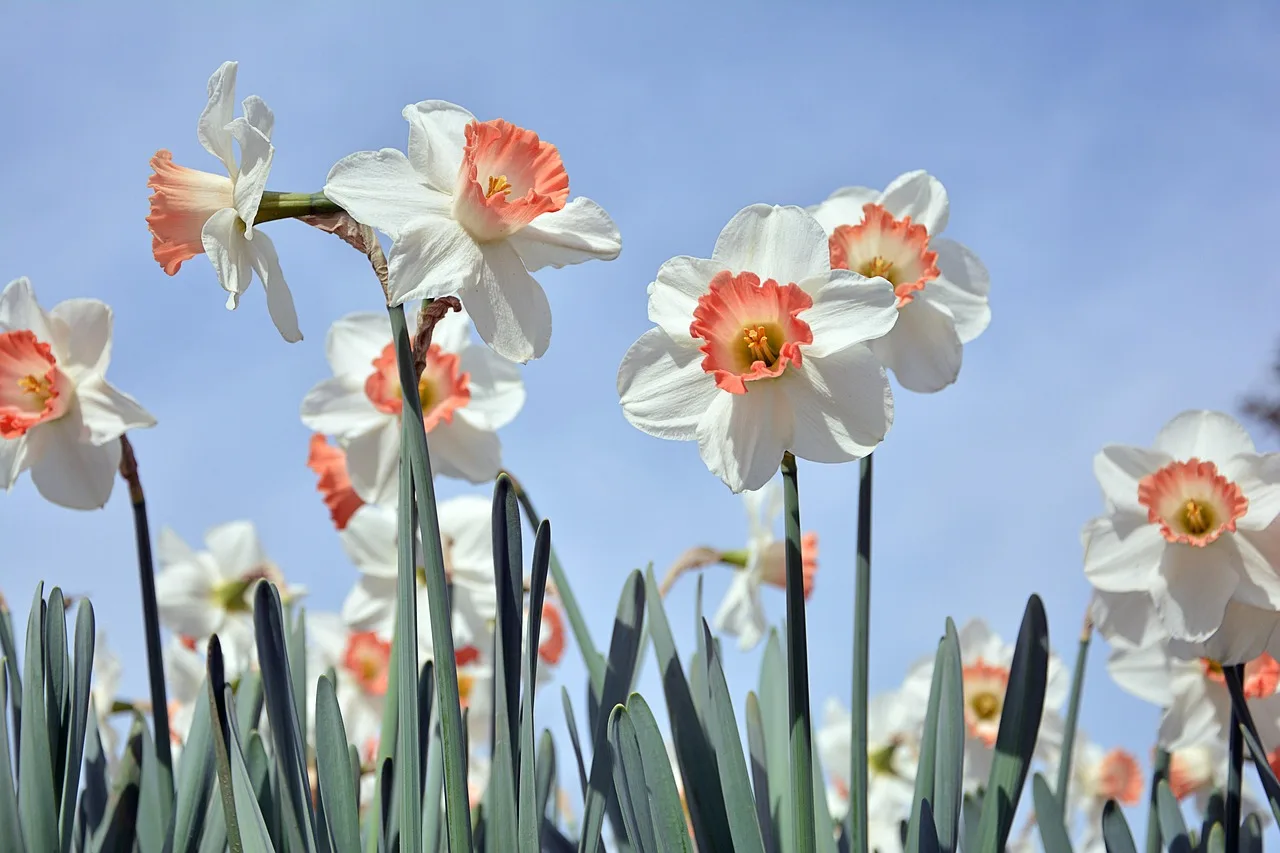
For a strong border display, 25 to 30 bulbs is a useful target. That count gives enough repetition to read as a band of spring color instead of a few isolated blooms. Smaller borders can use 10 to 15 bulbs if the bed is short or seen close up.
Border planting works best when the bulbs repeat in irregular pockets rather than a straight line. A long border can hold several 5- to 7-bulb clusters, which often looks more natural than one large block placed in the center.
How many bulbs for distance?
Longfield Gardens says larger views may need 25, 50, or even 100 bulbs. That is the right scale when the planting must be seen from the house, driveway, or street rather than from arm’s length.
For containers and pots
Containers can be planted more densely than many garden beds, but not crammed. Use enough bulbs to fill the pot, keep about 5 cm between bulbs, and leave drainage open at the base. A pot that looks packed above ground can still fail if the bulbs are crowded below.
Common mistakes
Planting too few bulbs for the viewing distance is the most common problem. A small cluster can disappear in a long border, while the same count can look perfectly full in a narrow bed near a door.
Another mistake is packing bulbs so tightly that they touch. That can reduce airflow and make the planting harder to divide later. Containers also fail when drainage is poor, so a pot needs an open base and a mix that drains freely.
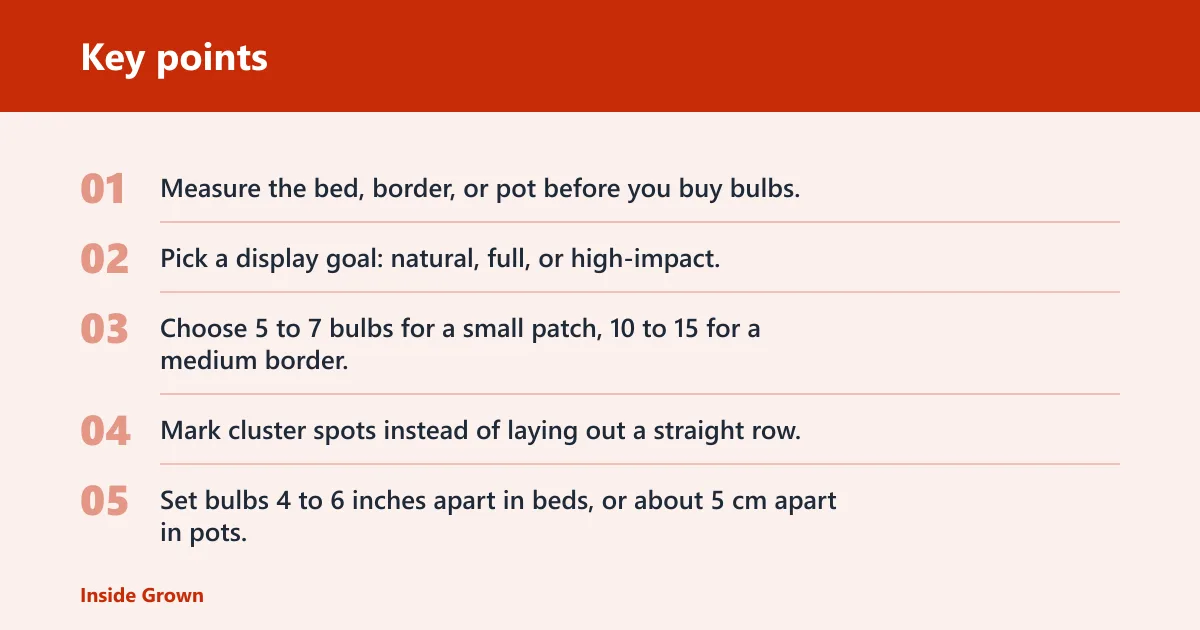
- Measure the bed, border, or pot before you buy bulbs.
- Pick a display goal: natural, full, or high-impact.
- Choose 5 to 7 bulbs for a small patch, 10 to 15 for a medium border, or 25 to 30 for a larger border.
- Mark cluster spots instead of laying out a straight row.
- Set bulbs 4 to 6 inches apart in beds, or about 5 cm apart in pots.
- Plant at 2 to 3 times bulb height, which is about 6 to 8 inches for many standard bulbs.
- Backfill, water once, and recheck for exposed bulbs or settled soil.
Say your front walk has two narrow planting pockets, each about 2 feet wide. A 5-bulb cluster in each pocket can look balanced and close-up friendly, while a single bulb in each spot would read as unfinished.
Picture a meadow edge viewed from a kitchen window. Three separate groups of 10 bulbs each can read fuller than one 30-bulb mass if the groups are spaced across the view and allowed to repeat naturally.
Planting timing and soil conditions
Plant in early fall, usually September to November, after the soil has cooled and before the ground freezes. That timing gives the bulbs enough time to root before winter and settle into growth for spring.
If the site stays wet, wait for better drainage before planting. Daffodil bulbs do best in soil that drains well, especially in containers where excess water can collect fast.
Frequently asked questions
How many daffodil bulbs should you plant together for a full look?
For a full look, start with 7 bulbs in a tight area, then move to 12 to 25 bulbs for most beds. If the planting is meant to be seen from farther away, 25 or more bulbs usually gives a fuller read than a small cluster.
How many daffodil bulbs should you put in one hole?
Use one bulb per hole for a traditional layout. If you want a grouped planting, put 3 to 5 bulbs in one wide hole so they read as a single clump without touching.
How many daffodil bulbs do you need for a border?
A border often needs 25 to 30 bulbs for a strong display. Smaller borders can use 10 to 15 bulbs, but the count should rise as the border gets longer or is viewed from farther away.
How many daffodil bulbs can you plant in a pot?
Plant enough bulbs to fill the pot without crowding, keeping about 5 cm between bulbs. The pot size sets the limit, so a wider container can hold more bulbs than a small one while still leaving room for roots and drainage.
Should daffodil bulbs be planted in odd numbers or even numbers?
Odd numbers usually look more natural in small drifts and clumps. A group of 5 or 7 bulbs often feels less rigid than an even-numbered row, especially in front beds where the shape matters as much as the count.
How deep should daffodil bulbs be planted?
Plant at 2 to 3 times the bulb height, which is about 6 to 8 inches deep for many standard bulbs. That depth works for both single-bulb holes and grouped planting, as long as the bulbs sit at the same level.