How to Choose Grow Lights for Houseplants
Choose grow lights for houseplants by matching light output, spectrum, and coverage to the plant’s needs: low-light plants need roughly 100 to 300 foot-candles, medium-light plants 300 to 1,000, and sun-lovers more. Pick the wrong light, and plants stretch, yellow, or stop flowering. This guide shows how to choose by plant type, room light, and budget.

How to choose by plant need
The plant comes first. A bulb only follows. Low-light foliage can do well with a modest fixture, while variegated plants and flowering houseplants need stronger output, tighter placement, and longer daily coverage. Match the light to the plant’s intensity needs first, then choose the fixture style that fits your space.
Low-light foliage plants
Peace lilies, pothos, snake plants, and similar foliage types usually need gentle supplemental light more than a high-output lamp. A compact LED with a color-balanced output is often enough if your window light is weak but not absent. If the plant already sits near a bright window, the light can fill the gap instead of acting as the main source.
For this group, look for even coverage and low heat. A lamp that is too strong or too close can bleach leaves or dry the top layer of the potting mix faster than expected. If new growth turns pale or cupped, move the light farther away or reduce daily hours.
Variegated plants
Variegated plants usually need more light than their all-green relatives because their pale sections do not contribute much to photosynthesis. That does not mean they all need the strongest fixture available. It means you should favor a brighter LED, keep the light closer, and watch for fading or crisping at the leaf edges.
Say your variegated pothos sits in a room with only one dim window. A small clip-on lamp may keep it alive, but a stronger panel or dual-head light will usually hold color better because the plant gets more usable light across the whole canopy. Rotate the pot if one side leans toward the source.
Flowering and fruiting houseplants
Flowering plants need enough light to support buds, blooms, and, where relevant, seed or fruit production. Red light is associated with germination, flowering, and seed production, while blue light supports green growth. A balanced white LED often works well for home use because it covers both needs without making the room feel harshly tinted.
Do not assume every orchid, jasmine, or citrus plant wants the same setup. Species differ. A bright, sun-loving flowering plant needs a stronger lamp and closer placement than a bloom that naturally tolerates partial shade. The safest rule is to match the lamp to the plant’s actual light habit, not the category on the tag.
What type of grow light is best?
For most home growers, LED grow lights are the best overall choice because they are energy-efficient, long-lasting, and low in heat. Fluorescent lights can still make sense for small budgets, and HID lights belong mostly in higher-output or commercial-style setups. The best type depends on your space, plant load, and tolerance for heat and power use.
LED grow lights
LED grow lights are the most popular choice for plant growth. They usually run cooler than other options, last a long time, and use less energy for the light they produce. Many home-friendly models use a full-spectrum or color-balanced output, which is easier to live with than the purple glow of older fixtures.
The main drawback is that LED quality varies a lot. Wattage alone does not tell you whether a fixture has enough output, and some low-cost LEDs spread light too narrowly for a shelf of plants. Check the listed coverage, brightness details, and dimming control when they are provided.
Fluorescent grow lights
Fluorescent grow lights, including CFLs and tube formats, are a lower-cost option and produce minimal heat. CFLs can fit in regular incandescent bulb fixtures, which makes them useful for a quick, low-cost setup. They are best used close to plants because their output is weaker than many LEDs.
The tradeoff is efficiency. Fluorescents are less efficient overall than LEDs, and tube fixtures may take more space than a small apartment shelf allows. They still make sense for seedlings, a few foliage plants, or a budget setup where cooler operation matters more than long-term power savings.
HID lights
HID lights produce high-intensity output and are common in commercial growing operations. They can cover larger plant groups and drive strong growth, but they also use more energy and generate more heat. That heat can be a problem in small rooms, cabinets, or tight apartment corners.
For most houseplants, HID is more light than you need. It becomes relevant only if you are lighting a larger display or trying to support high-light plants at a scale that goes beyond a few pots. In a home setting, the extra heat and power draw are hard to justify for casual use.
Which light specs matter most?
Spectrum matters, but it is not the only spec worth checking. A good houseplant grow light should match the plant’s needs, fit the space, and deliver enough brightness at the distance you can actually use. When the listing includes PPFD or DLI, those are more useful than wattage alone for plant decisions.
Spectrum and color temperature
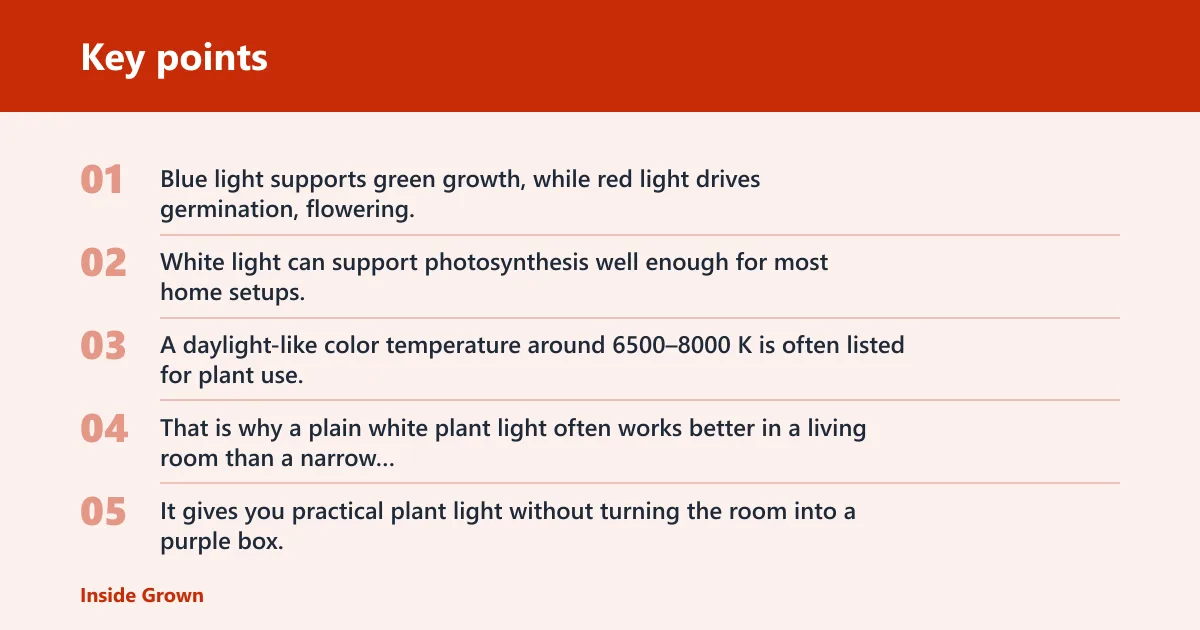
Blue light supports green growth, while red light drives germination, flowering, and seed production. White light can support photosynthesis well enough for most home setups, especially when the fixture is designed for plants rather than task lighting. A daylight-like color temperature around 6500–8000 K is often listed for plant use, though many effective white LEDs also sit lower in the white-light range.
That is why a plain white plant light often works better in a living room than a narrow red-blue lamp. It gives you practical plant light without turning the room into a purple box. For foliage plants, a balanced white output is usually the easiest place to start.
Wattage vs lumens
Wattage is not a reliable standalone comparison. Different bulb types and driver efficiencies can make the same wattage mean very different things. A better buying habit is to treat wattage as a rough clue, then look at lumens, listed coverage, and any plant-specific output data the maker provides.
Lumens are more helpful for comparing lamp brightness, especially when wattage is misleading. They still do not tell you everything about plant performance, but they are better than guessing from watts alone. If a seller gives both watts and lumens, use the lumen figure as the more useful brightness cue.
PPFD and DLI when listed
PPFD and DLI are the most relevant plant-light metrics when a product listing includes them. They speak more directly to how much usable light reaches the plant over time. If you see those figures, use them to compare fixtures before you rely on wattage, lumen counts, or marketing terms.
If a listing does not provide PPFD or DLI, do not assume the light is unsuitable. It just means you need to lean more on the plant type, fixture form, brightness details, and placement distance. For home growers, that combination is often enough to make a sound choice.
How close should the light be?
Grow lights should usually sit close enough to the plant to matter, because distance changes usable brightness fast. Exact spacing depends on fixture output, canopy size, and plant need. Compact setups often work best when the lamp is closer and aimed directly at the leaves rather than trying to light the room from across it.
Fixture output and distance
A stronger fixture can sit farther away than a weak one and still do useful work. A weaker fixture needs closer placement, and even then it may only suit low-light foliage or a single small plant. If you can dim the lamp, that gives you more control than constantly moving the stand or clip.
Picture a two-foot shelf with three plants under one panel. If the outer plants look stretched while the center plant looks fine, the issue is often spread, not just power. In that case, widen the coverage or add a second light instead of simply hanging the single fixture lower.
Single bulb setups
Single bulb setups work best for one plant or a small cluster. They are easiest to use when the bulb has a standard base, a focused beam, and enough brightness for the pot size below it. They are less reliable for wide shelving, because one bulb rarely covers a whole bench evenly.
For a single plant, place the bulb close enough that the canopy receives direct light without heat stress. If the leaves lean hard toward the lamp or new growth becomes weak and elongated, the bulb is usually too far away or too dim for the job.
Shelf and cabinet setups
Shelves and cabinets benefit from strip lights, panels, or linked fixtures that spread light across the full width of the plants. This matters because a single bright point often leaves corners dark. A broader fixture can reduce the need to keep every pot directly under one hot spot.
Suppose a plant shelf sits in a windowless hallway. A pair of linked strips or a small panel usually does more for the plants than one bright bulb at one end. The point is even coverage, not maximum output in one spot.
Grow light decision table
Use this table as a quick buying filter. It maps common houseplant situations to the light type, spectrum, placement distance, and the main mistake to avoid.
| Scenario | Recommended light type | Target spectrum | Placement distance | What to avoid |
|---|---|---|---|---|
| Low-light foliage | LED panel or compact LED bulb | White or color-balanced light | Close enough for steady leaf exposure, usually within short arm’s reach of the canopy | Overpowering the plant with a hot, high-output lamp |
| Variegated plants | Brighter LED with dimming if possible | Balanced white light with solid blue content | Closer than a weak foliage setup, adjusted until growth stays compact | Putting the lamp too far away and losing color intensity |
| Flowering plants | LED panel or stronger multi-bulb fixture | White light with both blue and red support | Close enough to maintain bud production without bleaching | Using a dim bulb that keeps leaves alive but fails to trigger blooms |
| Winter supplement | LED or fluorescent depending on budget | White light for daily support | Close and consistent, because winter sun is weak indoors | Assuming a dim window alone will carry the plant through short days |
| Small shelf | Strip lights, clip-on lights, or a compact panel | Color-balanced white | Close to the top leaves, with even spread across the shelf | Single-bulb coverage that leaves the ends of the shelf dark |
| Dark room | Higher-output LED or linked fixtures | Balanced white with enough intensity for the full area | Close enough to reach the plant canopy across the whole space | A decorative lamp that looks bright but does not deliver usable plant light |
Our picks by need
These picks are based on the manufacturer’s specs, published product details, and buyer feedback. They are not substitutes for plant-specific planning, but they do fit common home setups better than one-size-fits-all bulbs. Each one has a clear use case and a clear limitation.
Best overall LED panel: Tmsluody 2-panel plant light

This is the most flexible option in the group for a small to medium houseplant setup. The two-panel format, three color modes, ten dimming levels, and timer make it easier to tune the light to foliage, variegated plants, or a mixed shelf. That control matters when one fixture needs to do several jobs.
The drawback is that a two-panel light can still be too small for a wide display, and the listing does not solve placement for you. If the panels are too far apart or hung too high, coverage falls off fast. It is best for targeted plant zones, not a whole room.
Best budget fluorescent option: mfxmf LED grow light bulbs

This pair of E26 bulbs is the easiest low-cost way to add plant light to an existing lamp. The full-spectrum output and standard socket fit make it simple to use in a floor lamp, desk lamp, or table fixture. For a starter setup, that convenience is hard to beat.
The limitation is coverage. Two bulbs can support a small cluster, but they are not a replacement for a broad panel when you need even light across a shelf. They also depend on the shade and fixture you pair them with, which can block or scatter useful light.
Best for a dark room or large display: Barrina T5 plant lights

This is the strongest fit for a bigger plant area, especially where a magnetic, linkable strip system makes installation easier. The individual switches are useful when you want to run only part of the set, and the 4-foot format gives you better spread than a single bulb can manage.
The drawback is size and commitment. It is more fixture than a casual windowsill setup needs, and the linked-strip style can be overkill for one or two pots. It suits a dark room or a larger display more than a small tabletop collection.
Mistakes to avoid
Most grow-light failures come from setup errors, not from the plant itself. A light can be perfectly good and still fail if it is too weak, too far away, or on the wrong schedule. Start with the plant, then set the fixture, timer, and distance to match the goal.
- Using wattage alone — wattage varies by bulb type and efficiency, so it should not be your main comparison tool. Check lumens, coverage, and any plant-specific output data when available.
- Putting the lamp too far away — distance reduces usable light quickly. If the plant stretches toward the source, the fixture is likely too weak or too far from the canopy.
- Running the schedule too long or too short, grow lights are especially helpful in winter, but plants still need a sensible cycle. Too little light leaves growth weak; too much can stress leaves and interrupt normal rhythm.
- Choosing the wrong fixture for the plant, a low-light foliage plant and a flowering plant do not need the same output. One bulb that works for pothos may fail on a bloom-heavy plant or a variegated specimen.
A common first-timer mistake is putting one bright bulb over a wide shelf and assuming the whole shelf is covered. The center pot may look fine while the corners stretch toward the light. In that case, the fix is usually better coverage, not a longer timer.
Frequently asked questions
Grow lights vs regular lights
Regular household lights can help a little, but they are usually not designed to deliver enough usable plant light at the right distance. CFLs in standard fixtures can work as a backup for a small plant, but ordinary room lighting is not a substitute for a true grow light when plants need serious support.
How many hours a day should houseplants be under grow lights?
A common home range is about 10 to 14 hours a day, adjusted to the plant’s light needs and the amount of natural daylight it already gets. Lower-light plants often need less supplemental time than flowering or variegated plants. Keep the schedule consistent, and change it only if the plant’s response shows a need.
How close should a grow light be to a houseplant?
Close enough that the plant gets useful light without heat stress. The exact distance depends on fixture output, plant type, and canopy size, so there is no single universal number. Stronger fixtures can sit farther away; weaker ones usually need to be closer to the leaves.