How to Get Rid of Spider Mites on Indoor Plants
Isolate the plant, rinse leaves hard, then treat with insecticidal soap or horticultural oil every 5 to 7 days for 3 to 4 rounds. Discard plants with severe, repeated infestations. If you skip containment, spider mites spread quickly and can strip foliage, weaken growth, and infect nearby plants. This guide shows how to confirm mites, stop spread, pick the least disruptive treatment, and judge when disposal is the better call.
How to tell if it is spider mites


Spider mites are tiny arachnids, not insects, and they are often hard to see without magnification. They usually live on leaf undersides, where they feed fast in hot, dry conditions. Fine webbing is often the first visible sign, and a whole life cycle can take just one week under favorable conditions.
Look for stippling, which shows up as tiny pale dots on the leaf surface. As feeding continues, leaves may yellow, curl, brown, or drop. Webbing often gathers between stems, petioles, and the tight spaces where new growth forms. A two-spotted spider mite is the most common on houseplants, and a red spider mite is a commonly searched color variant that also turns up indoors and in greenhouse settings.
How to use the white paper shake test
Shake an affected stem or leaf cluster over a plain white sheet of paper. Tiny moving specks on the paper support a spider mite diagnosis. This test works best with a magnifier nearby, because the mites are so small that a quick glance can miss them.
Do not rely on webbing alone. Some plants trap dust or create harmless threadlike debris that can look similar at first glance. Fine webbing paired with stippling, leaf undersides full of moving specks, and quick spread to nearby plants points much more strongly to spider mites.
Spider mite triage table
| Plant type | Infestation severity | Best first action | Follow-up interval | When to discard |
|---|---|---|---|---|
| Large-leaf plant with open canopy | Light: a few leaves with stippling, little webbing | Quarantine, then shower or hose both sides of leaves | Repeat in 5 to 7 days; inspect nearby plants daily | Discard if new damage keeps appearing after 3 to 4 rounds |
| Medium houseplant with moderate webbing | Moderate: webbing on stems or leaf undersides, visible specks | Wash hard, then apply insecticidal soap to all leaf undersides | Repeat after 3 to 7 days; several applications may be needed | Discard if foliage keeps declining and coverage stays incomplete |
| Dense plant or small-leaf plant | Moderate to heavy: hard-to-reach foliage, mites hidden deep in the canopy | Prune lightly if possible, then use soap only if you can reach undersides well | Repeat every few days; keep checking hidden inner growth | Discard if you cannot wet the canopy thoroughly or the plant is mostly damaged |
| Delicate foliage plant | Any level where washing or soap causes damage | Try a gentle rinse and spot treatment on one leaf first | Recheck in a few days before wider treatment | Discard if leaves scorch, collapse, or cannot tolerate repeated treatment |
| Very damaged plant | Severe: heavy webbing, widespread yellowing, leaf loss, stalled growth | Quarantine, inspect nearby plants, then decide quickly | Only continue if new growth remains and coverage is possible | Discard if most foliage is gone or mites keep returning after repeated rounds |
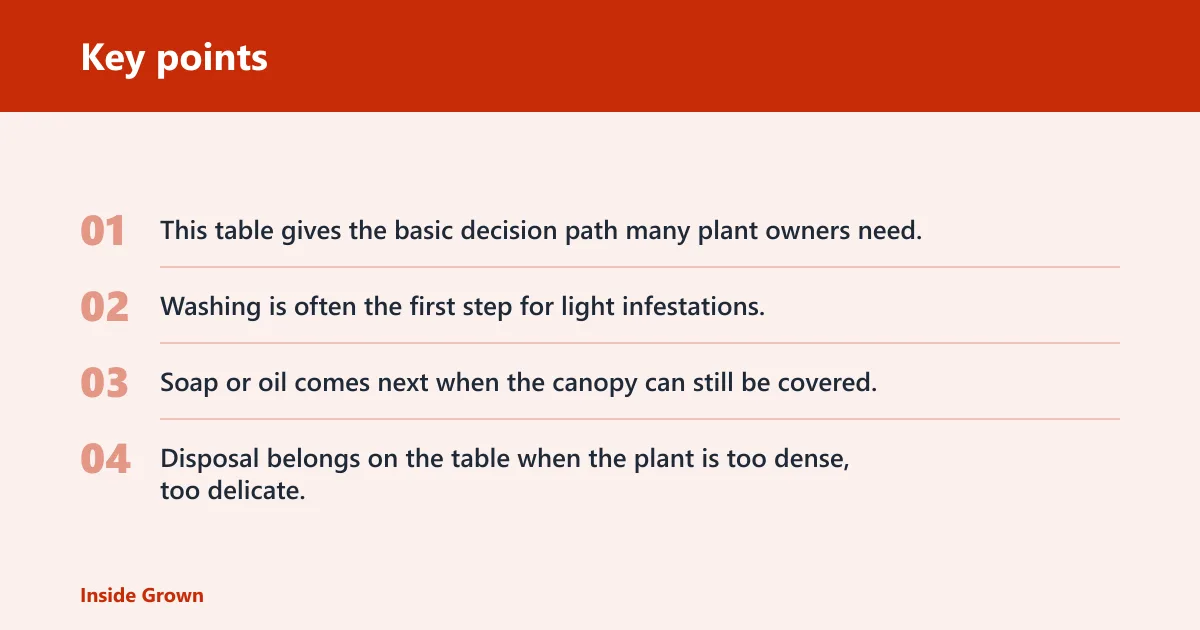
This table gives the basic decision path many plant owners need. Washing is often the first step for light infestations. Soap or oil comes next when the canopy can still be covered. Disposal belongs on the table when the plant is too dense, too delicate, or too far gone to treat well.
What to do in the first 72 hours
The first few days matter because spider mites can spread quickly throughout houseplant collections. Start with quarantine, then clean the plant and the area around it. Do not wait to see whether the problem goes away on its own.
- Move the infested plant away from the rest of the collection.
- Spread nearby pots apart so leaves do not touch.
- Shake one or two leaves over white paper to confirm moving specks.
- Rinse the plant under a shower or spray stream, focusing on leaf undersides and stems.
- Wipe remaining residue from leaves, stakes, and branch junctions.
- Check nearby plants with the same paper test.
- Clean the shelf, windowsill, or saucer area around the pot.
Say your pothos has faint stippling on three leaves and wisps of webbing between two stems. Quarantine it, shower the foliage, then follow with soap a few days later if new specks still appear. The key is speed, not cosmetic perfection.
Picture a fiddle-leaf fig with a tight canopy and dust on the lower leaves. Washing only the outer surface will miss mites tucked inside the inner growth. In that case, the plant may need pruning before any treatment has a chance to reach enough leaf undersides.
How do you get rid of spider mites on indoor plants naturally?
Start with mechanical washing, then move to insecticidal soap or neem oil if the infestation persists. Organic methods can control spider mites, but “natural” does not mean one-and-done. You need coverage, repetition, and close follow-up because eggs and immature stages survive the first round.
Mechanical washing with water or a shower
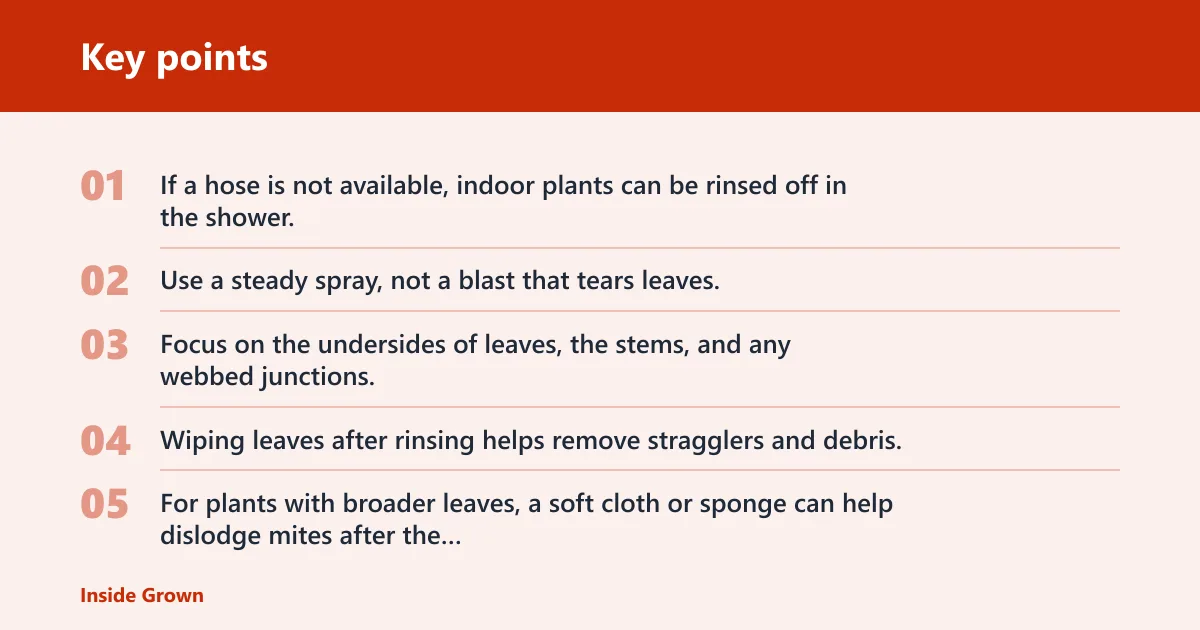
If a hose is not available, indoor plants can be rinsed off in the shower. Use a steady spray, not a blast that tears leaves. Focus on the undersides of leaves, the stems, and any webbed junctions. Wiping leaves after rinsing helps remove stragglers and debris.
For plants with broader leaves, a soft cloth or sponge can help dislodge mites after the rinse. This works best on plants that can tolerate wet foliage without marking or rot. If the plant is small enough to handle, you can also tilt it and rinse the inner canopy from several angles.
Insecticidal soap and dish soap cautions
Insecticidal soap is a common low-toxicity option, but it must cover leaf undersides to work well. Repeated applications are usually needed. A single pass rarely reaches every mite, and eggs can survive long enough to start the cycle again.
Dish soap needs more caution. Use it only if the formulation is appropriate for plant contact, test a small area first, and rinse if needed. Some soaps are harsher than others, and delicate foliage can burn or spot. For many plants, a labeled insecticidal soap is the safer first choice.
Neem oil as a follow-up treatment
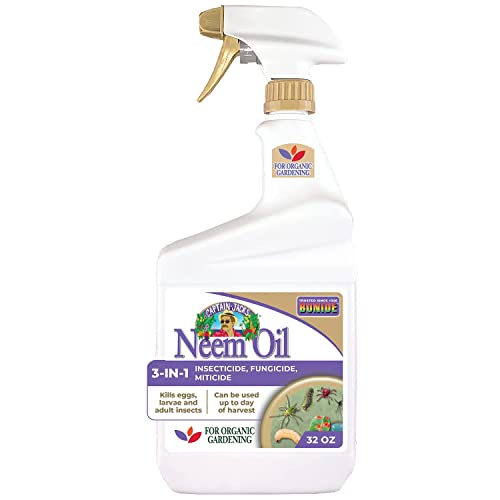
Neem oil is often used as a follow-up control method after washing or soap. It can help slow remaining mites and disrupt re-infestation, but it should not be treated as a single rescue step. Apply it with the same attention to leaf undersides and stems.
Neem works best when the plant has already been cleaned and the canopy is still reachable. It is less useful on a plant with heavy webbing buried in dense growth, because the spray still has to get where the mites live.
Should you treat the soil for spider mites on indoor plants?
Usually, no. Spider mites live on the plant surface, especially on leaf undersides, stems, and new growth. The soil is not the main target. If you only change the potting mix and ignore the foliage, the infestation can continue unchanged.
That said, clean the area around the pot. Remove fallen leaves, old webbing, and dust from the saucer, rim, and shelf. If the pot is crowded among other plants, move it apart so mites do not crawl or blow onto nearby foliage. Soil changes may help if the potting mix is old, compacted, or holding debris, but they do not replace plant treatment.
How do you stop them from coming back?
Prevention works best as a system. Low humidity increases the risk of spider mites indoors, and hot, dry air gives them an edge. A humidifier can help keep mites at bay. A pebble tray is a smaller humidity boost, though it usually changes conditions less than a humidifier does.
Dust also matters. Dusty leaves make inspection harder and may create a better foothold for pests. Wipe leaves routinely, keep plants spaced apart, and inspect new plants before they join the collection. Quarantining new houseplants can help prevent mite problems, especially on the undersides of the leaves.
Do not overpack a windowsill or shelf. Crowding makes it harder to spot early webbing and harder to spray well. It also helps mites move from one plant to another more easily. The best prevention is boring: clean leaves, separated pots, and a quick quarantine period for anything new.
Frequently asked questions
How often should I re-treat plants for spider mites?
Repeat treatment after a few days, then continue until you stop finding new mites or fresh webbing. A common cadence is every 5 to 7 days, with some cases needing a 3-day follow-up if the infestation is active. Eggs survive the first pass, so one treatment is rarely enough.
How do I know if spider webs on indoor plants are spider mites?
Fine webbing plus stippling on leaves is a strong clue. If you shake affected leaves over white paper and see tiny moving specks, spider mites are likely. Thin, isolated strands alone are not enough to confirm them, because dust and harmless debris can look web-like too.
How do I get rid of red spider mites on indoor plants?
Use the same approach as for other spider mites: quarantine, rinse, then treat leaf undersides with insecticidal soap or neem oil on a repeat schedule. “Red spider mite” is a commonly searched color variant, not a separate control strategy. The main issue is still coverage and follow-up.
Can you get rid of spider mites on indoor plants?
Yes, especially if you catch them early and can reach the undersides of the leaves. Light infestations often respond well to washing and repeated soap treatments. Heavy infestations are harder, and plants with severe leaf loss or dense canopies may not recover even after several rounds.
How do I get rid of spider mites on my house plants?
Start with isolation, then confirm with the white paper shake test. Rinse the plant, wipe the leaves, and apply insecticidal soap or neem oil to the undersides. Recheck after a few days and repeat as needed. Nearby plants should be inspected immediately, even if they look clean.
When should I throw away a plant with spider mites?
Discard the plant when the infestation keeps returning after several treatment rounds, the canopy is too dense to spray well, or the foliage is so damaged that recovery is unlikely. If most leaves are gone or the plant is collapsing, keeping it often costs more time than it is worth.