How Many Tulip Bulbs Fit in a Border?
In a 12-inch-wide border, plant about 5 to 7 tulips per linear foot for a tidy display, or 8 to 10 for a denser spring block. Too few bulbs leave gaps. Too many crowd stems, flatten the effect, and waste money. This guide turns border length and width into realistic tulip counts, spacing, and planting layouts.
Quick border bulb count

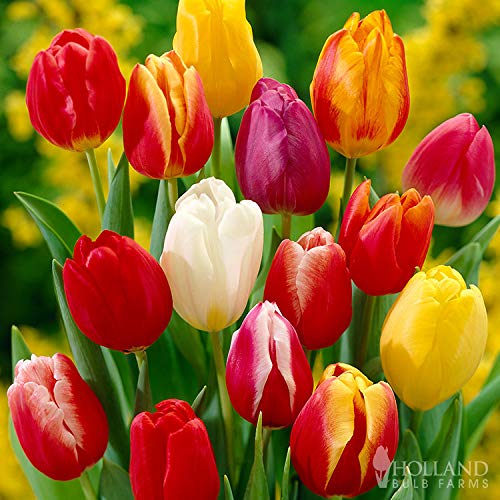

The fastest way to estimate tulips is to treat the border as an area, then choose a density that fits the look you want. For a neat border, use 4-inch spacing. For a looser drift, use fewer bulbs and let the group shapes do more of the visual work.
Border width matters as much as length. A 1-foot border cannot take the same pattern as a 3-foot border because there is less room for staggered placement. As width increases, you can use more than one row, or you can form drifts that move front to back instead of a straight line.
The main choice is simple: use a grid for a formal, full look, or use drifts for a softer border that still reads as planted, not scattered. Single-row planting looks stiff and unnatural.
Tulip border calculator
This calculator uses about 4-inch spacing as the dense border standard, then shows how totals change when you shift to a looser drift. The dense figure assumes a grid-like layout with bulbs close enough to create a solid spring block, while still keeping bulbs from touching.
| Border size | Area | Low count | Medium count | Dense count |
|---|---|---|---|---|
| 1 x 8 ft | 8 sq ft | 32 bulbs | 40 bulbs | 48 bulbs |
| 2 x 10 ft | 20 sq ft | 80 bulbs | 100 bulbs | 120 bulbs |
| 3 x 12 ft | 36 sq ft | 144 bulbs | 180 bulbs | 216 bulbs |
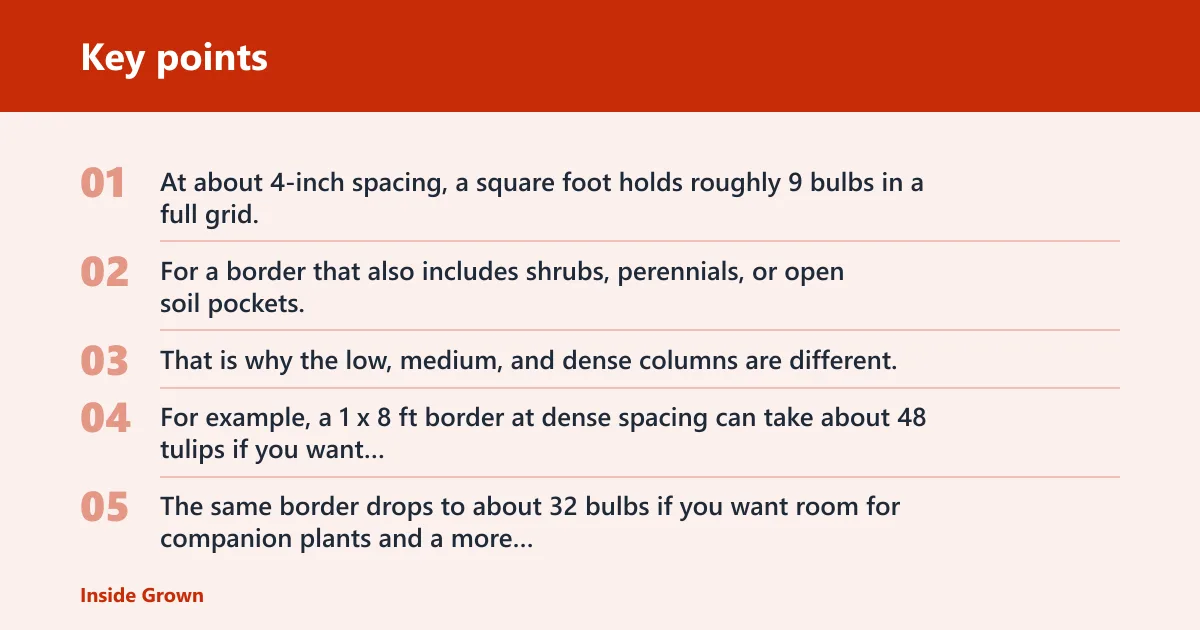
The table uses a simple rule. At about 4-inch spacing, a square foot holds roughly 9 bulbs in a full grid. For a border that also includes shrubs, perennials, or open soil pockets, the practical count often drops below that. That is why the low, medium, and dense columns are different.
For example, a 1 x 8 ft border at dense spacing can take about 48 tulips if you want full coverage. The same border drops to about 32 bulbs if you want room for companion plants and a more natural finish. A 3 x 12 ft border scales quickly, which is why width and spacing should be decided before buying bulbs.
How drift planting changes the total: instead of filling the whole rectangle evenly, you place bulbs in groups of 7 or more and leave small open pockets between clusters. That usually lowers the total by about 10 to 25 percent, depending on how much bare ground you keep between drifts.
Say your border is 2 feet wide and 10 feet long, with a front edge reserved for low edging plants. A dense plan may still use close to 100 bulbs, but a drift plan might use 75 to 90 bulbs because the tulips sit in clusters rather than covering every square foot evenly.
How many tulips per square foot should I plant?
For bulb-only plantings, a good working range is about 6 to 9 tulips per square foot. In mixed borders, the total is often lower because tulips need to share space with perennials, shrubs, or edge plants. If the goal is a dense spring block, stay near the upper end.
The same bed can take fewer or more bulbs depending on layout. A front border that includes low perennials may only need a few tulip drifts. A bare bed that exists mainly for spring color can take far more. The question is how much of that area should read as tulip planting.
Dense bulb-only beds
Use the higher end when the border is mostly tulips and you want a near-continuous display. This is where 4-inch spacing works best. It gives you enough density for a strong spring block without forcing bulbs to touch.
Mixed border planting
Use fewer bulbs when the tulips weave through other plants. That style reads better if the bulbs are placed in groups rather than evenly across the whole border. Blooming Back Yard notes that interspersed border tulips can be spaced about four inches apart, which still keeps the look full.
How far apart should tulip bulbs be spaced?
Space tulip bulbs 4 to 5 inches apart on center. That is close enough for a full border display, but wide enough that bulbs do not touch. As a rule of thumb, the spacing should be about twice the bulb width, which helps reduce crowding and allows stems room to rise cleanly.
Do not press bulbs against each other in the hole. Several bulbs can go in one hole if they do not touch, but contact invites crowding and can reduce the clean, upright look tulips need. The more crowded the bulbs, the less balanced the display becomes.
A common first-timer mistake is planting a straight row because it feels easy to measure. A straight row often looks stiff, especially in a border. Staggered placement gives the eye more movement and makes the planting read as intentional.
How deep should tulips go?
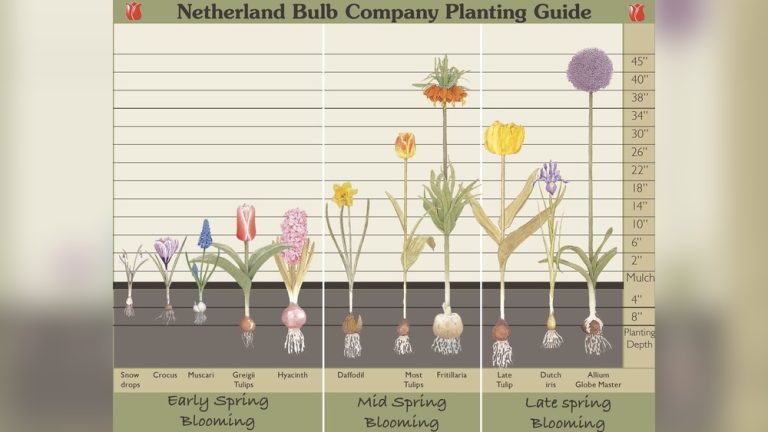
Plant tulip bulbs 6 to 8 inches deep. That is also close to three times the bulb height, and it fits the common guidance to plant bulbs 2 to 4 times their height. Deeper planting often gives better protection from cold and can support stronger perennial performance in the ground.
Shallow planting is a problem because bulbs can heave, dry out more quickly, or make weak stems. Deep planting is usually the safer choice if the soil drains well. The key limit is drainage, not depth alone.
Place the bulbs pointy side up, then backfill with loose soil. If the soil is heavy or wet, improve the site before planting rather than planting shallower as a fix. Shallow bulbs in soggy soil still struggle.
Tulip groups and drifts
For the fullest border effect, plant tulips in informal groups of 7 or more bulbs. Rectangular, triangular, and oval groupings all work well, as long as the pattern feels relaxed rather than rigid. Single-row tulip planting looks stiff and unnatural.
Groups should follow the border shape. A long border can handle repeated ovals or triangles. A wide bed can take a larger rectangle near the middle and smaller clusters along the edge. Odd-number groupings usually feel more natural than even, symmetrical blocks.
Drifts are useful when you want the border to feel less uniform. Instead of laying bulbs in one exact grid, place clusters at intervals and let the eye connect them. The count may be lower than a full-grid plan, but the planting can still look full because the groups repeat across the space.
How row shape changes the look
Rectangular drift shapes create a more ordered border. Triangular and oval shapes soften the pattern. If the bed is narrow, keep the clusters shallow in front-to-back depth and wider side to side. That keeps the planting from feeling cramped at the edge.
Bulb quality and site conditions
Choose plump, clean, and heavy bulbs with a firm texture. Avoid bulbs with mold, deep cuts, dark spots, or premature shoots. Larger bulbs usually produce stronger stems and bigger blooms, so size matters when you are planning both the look and the budget.
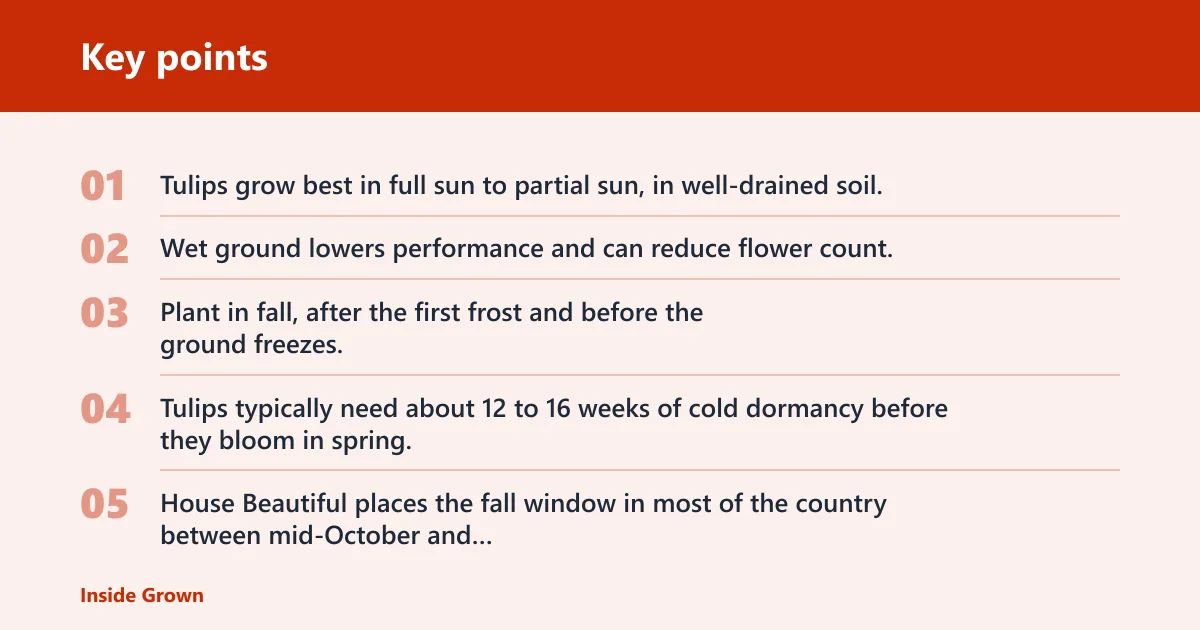
Tulips grow best in full sun to partial sun, in well-drained soil, with neutral to slightly alkaline conditions. Sharp drainage matters. Wet ground lowers performance and can reduce flower count, especially if bulbs stay damp through winter.
Plant in fall, after the first frost and before the ground freezes. Tulips typically need about 12 to 16 weeks of cold dormancy before they bloom in spring. House Beautiful places the fall window in most of the country between mid-October and early December.
Say your border sits in a low spot that stays wet after rain. A dense tulip grid there is a bad trade. Fewer bulbs will still struggle if the soil holds water, so the better fix is drainage improvement or a different site, not just a lower bulb count.
For border edges, think in layers. Put taller tulips slightly farther back in the bed, and keep shorter types near the front edge. That keeps flowers visible and avoids a flat wall of foliage. The layout matters just as much as the raw count.
Frequently asked questions
How many tulip bulbs fit in a border?
The total depends on border area and planting style. A dense border at 4-inch spacing can hold about 9 bulbs per square foot, while a looser drift uses fewer. A 1 x 8 ft border might take 32 to 48 bulbs, while a 3 x 12 ft border can take 144 to 216.
How many tulip bulbs should I plant together for a full look?
Plant tulips in groups of 7 or more for a fuller look. Odd-number clusters read more naturally than a straight line. In a border, repeat those groups across the bed instead of scattering single bulbs, which tends to look thin and unfinished.
How many tulips can I plant in one hole?
You can plant several bulbs in one hole if they do not touch. That works well for grouped plantings and keeps the layout efficient. The main rule is simple: each bulb still needs room around it, so do not pack them tightly into a single cramped pocket.
How many tulips grow from one bulb?
In most cases, one tulip bulb produces one upright flower stem. The same source gives that one-flower-per-bulb rule directly. A larger bulb usually makes a stronger stem and a bigger bloom, but it still counts as one flowering shoot for planning purposes.
Do tulip bulbs multiply in the ground?
Yes, tulip bulbs can multiply over time in the ground, but flowering often declines in many gardens if conditions are poor or crowded. If you want repeat performance, give bulbs good drainage, enough depth, and space to settle without touching.
Can I plant tulip bulbs in containers instead of a border?
Yes. Tulips can grow in pots and windowboxes, which is useful when border space is tight. Greigii tulips and double early tulips are especially suitable. In cold areas, container bulbs may need winter protection because pots cool and dry faster than ground soil.