Gardening Tips for Indoor Grow Lights: Placement and Timing
Set indoor grow lights to match canopy shape: keep compact seedlings and herbs about 6 to 12 inches below the lamp, place broad houseplants farther back, and begin with about 12 to 16 hours a day before adjusting based on plant response. Wrong height or hours leads to stretch, leaf scorch, weak stems, and slower growth. This guide shows how to set placement room by room, then use symptom checks to fine-tune height and daily light time.
What you’ll need


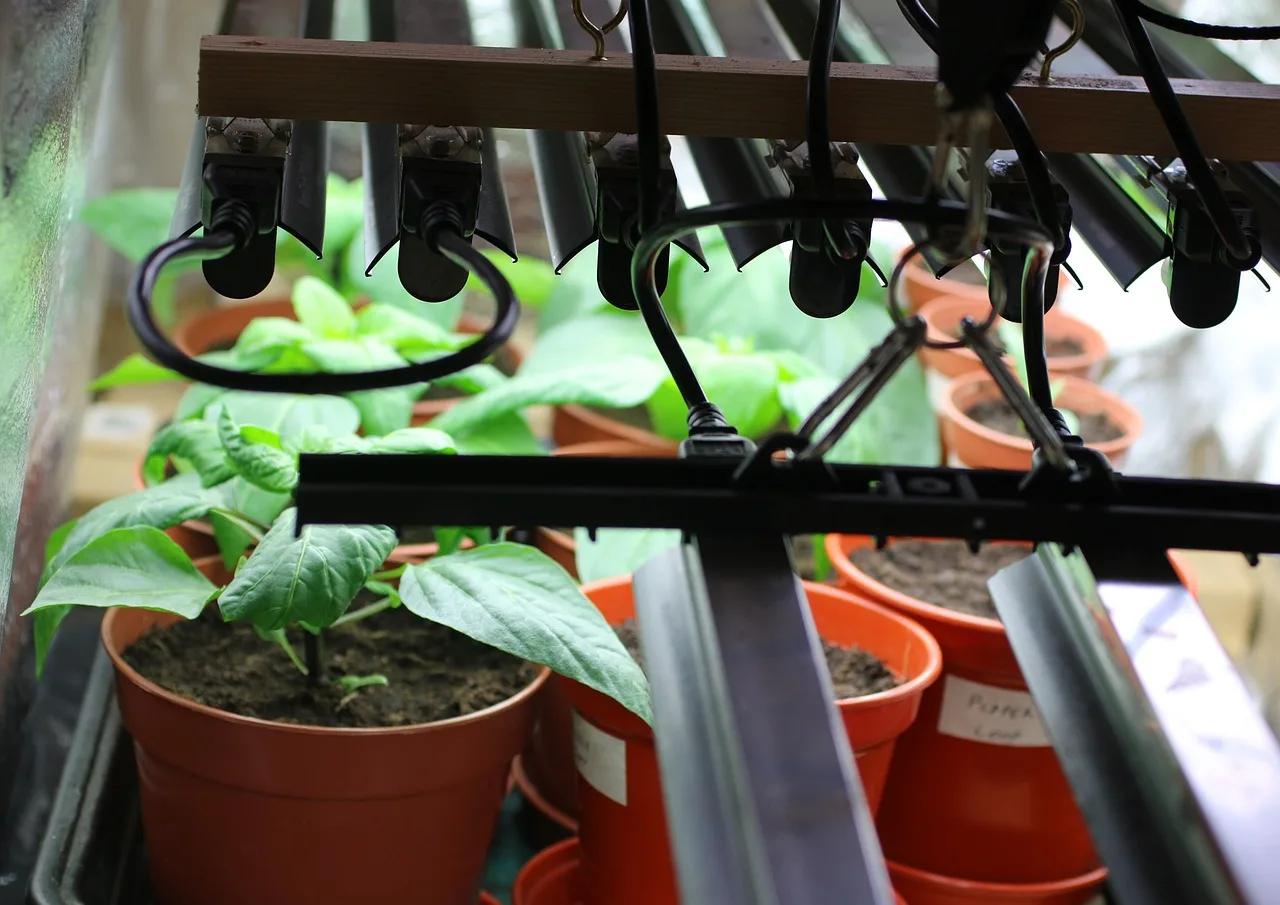
- Grow light fixture: LED, fluorescent, or HID; choose full-spectrum if you want one light for mixed plant types.
- Mounting hardware: clip-on, gooseneck, S-hooks, rope clip hangers, or a shelf/rack with enough load capacity.
- Timer: a plug-in timer or smart plug with repeat scheduling.
- Measuring tape: to set canopy distance and recheck after growth.
- Simple light check: a phone lux app is enough for a rough check; a PPFD meter is better if you have one.
- Plant support: stakes or a stable shelf if one light covers several pots at different heights.
Set the light up in room order
- Place the fixture above the canopy first. Overhead light keeps stems upright and spreads light more evenly across leaves than side lighting.
- Match the mounting to the room. Use a clip-on or gooseneck on a desk, S-hooks or rope clip hangers on a rack, and stronger shelf support for heavier HID fixtures.
- Set the starting height by plant type. Use 6 to 12 inches for cooler LEDs in some houseplant setups, 12 to 24 inches for general houseplants, and 24 to 36 inches for seedlings or higher-wattage fixtures.
- Pick the first timer schedule. Start at 12 to 16 hours for most indoor plants, 14 to 16 hours for herbs and edibles, and 8 to 10 hours only when the light is clearly supplementing a bright window.
- Recheck once a week. Raise or lower the lamp as the canopy changes, then adjust again after each visible flush of new growth.
Suppose a 2-foot rack holds basil on the top shelf and pothos below. Put the lamp over the basil canopy, not between the shelves, then lower the lower plant or add a second fixture if the bottom leaves stay in shade. One light can cover multiple plants, but only if the coverage area matches the shelf width and the canopy heights stay close.
Should grow lights sit above plants?
Yes. Top placement is the default because plants bend toward the strongest light, so side lighting often creates lean and uneven growth. Use side lighting only when the room forces it, such as a narrow corner or a window ledge where a top mount cannot fit.
When side lighting is acceptable
Side lighting works best as a fill light, not the main source. In a corner, aim the fixture across the canopy only after you have tried a top mount, and expect to shorten the distance because the usable coverage area is usually smaller from the side.
How fixture heat changes clearance
LEDs usually run cooler than fluorescent or HID fixtures, so they can sit closer in some setups. Fluorescent and HID lights need at least 12 inches of clearance, and incandescent bulbs need at least 24 inches because heat, not only brightness, can damage tissue near the canopy.
How far should the light be from plants?
Start distance depends on plant type, fixture heat, and whether the lamp is replacing sun or only topping up a bright room. A common rule is to start a little farther away, then move closer in steps if stems stretch, or farther away if leaves bleach, curl, or crisp.
Starting distances by plant segment
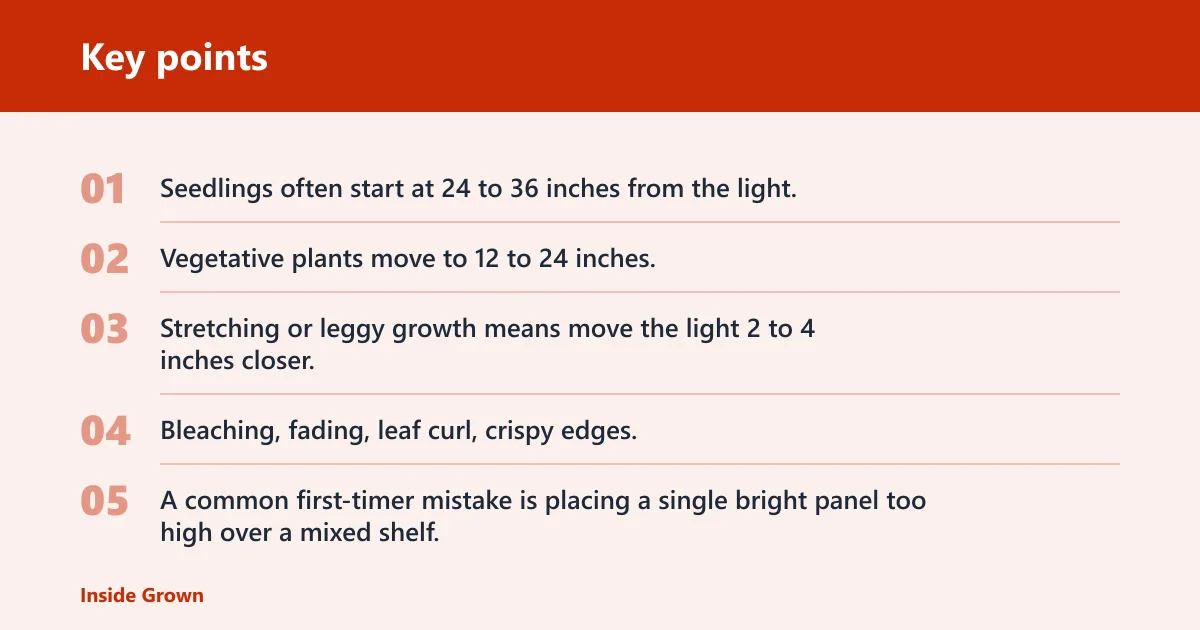
Seedlings often start at 24 to 36 inches from the light, especially under stronger fixtures. Vegetative plants move to 12 to 24 inches, flowering plants in one guide are kept 12 to 16 inches away, and LED grow lights can sit 6 to 12 inches from houseplants in one guide.
What to change after stretch, bleaching, or curl
Stretching or leggy growth means move the light 2 to 4 inches closer, or add 1 to 2 hours per day if the fixture is already at the shortest safe height. Bleaching, fading, leaf curl, crispy edges, or brown tips mean move the fixture 2 to 4 inches farther away, or shorten exposure by 1 to 2 hours.
A common first-timer mistake is placing a single bright panel too high over a mixed shelf. The herbs under the center may look fine while the outer leaves stretch. Move the light closer to the tallest canopy, then level the shorter pots with risers or a second fixture.
How many hours should you run grow lights?
Most indoor plants need a steady schedule, usually 12 to 16 hours each day. Herbs and other edibles usually get 14 to 16 hours, while supplemental window setups may only need 8 to 10 hours because natural light is already doing part of the work. Plants still need darkness.
Window top-up versus full-time indoor light
If the light sits near a bright window, count the window as part of the daily load and start shorter. If the plant lives in a corner, basement, or windowless room, use the full schedule from the start and keep it steady rather than changing hours every few days.
Why plants still need darkness
Give plants at least 8 hours of uninterrupted darkness; another guide allows 8 to 12 hours. Timer-based consistency matters more than checking the clock by eye, because irregular light can confuse flowering plants and make compact foliage plants grow unevenly.
Light types, intensity, and coverage
LED, fluorescent, HID, and incandescent fixtures all behave differently. LEDs give off less heat and can sit closer in many setups. Fluorescent lights spread softer light across a smaller area. HID units cover a larger area but run hotter. Incandescent bulbs are the least forgiving because of heat and the 24-inch clearance need.
How to use PPFD and lux without a meter
PPFD is the cleaner target if you have a meter, but you can still work from plant type and distance if you do not. One guide lists herbs and leafy greens at 100 to 200 PPFD, and fruiting plants like tomatoes and peppers at 400 to 600 PPFD. A phone lux app can help compare spots in the same room.
When coverage area matters more than brightness
If one panel hangs over several pots, check the outer edges. A bright center with dim corners usually means the fixture is too small for the shelf width or too far away. Move the lamp closer, rotate pots weekly, or split the shelf into two lighting zones.
Grow light placement matrix
| Plant segment | Starting distance | Timer schedule | First corrective move |
|---|---|---|---|
| Seedlings, window top-up | 24 to 36 inches | 8 to 10 hours | If they stretch, lower 2 to 4 inches or add 1 to 2 hours. |
| Seedlings, full-time indoor light | 24 to 36 inches | 12 to 16 hours | If stems lean, move the fixture closer in 2-inch steps. |
| Herbs and leafy greens, window top-up | 12 to 18 inches | 8 to 10 hours | If growth thins, shorten the gap by 2 to 4 inches. |
| Herbs and leafy greens, full-time indoor light | 6 to 12 inches for cooler LEDs; otherwise 12 to 24 inches | 14 to 16 hours | If leaf tips curl, raise the light 2 to 4 inches. |
| Bright indirect light houseplants | 12 to 24 inches | 12 to 14 hours | If leaves fade, move it closer before adding more hours. |
| Fruiting plants like tomatoes and peppers | 12 to 16 inches | 14 to 16 hours | If blossoms stall, check whether the lamp is too far or the room is too dim. |
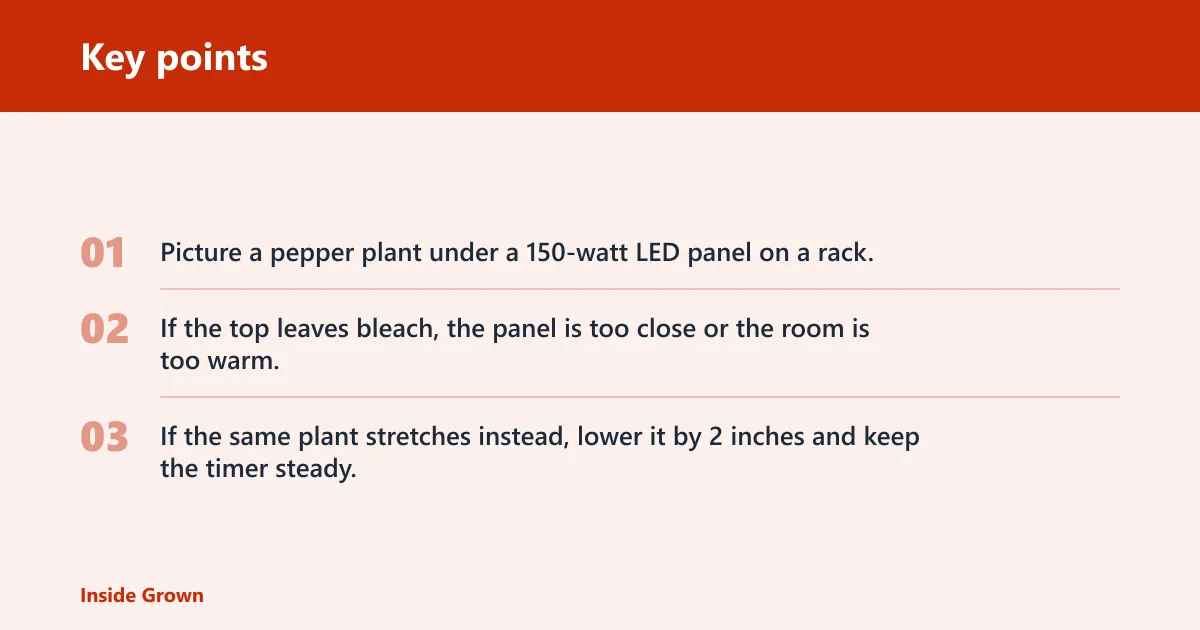
Picture a pepper plant under a 150-watt LED panel on a rack. If the top leaves bleach, the panel is too close or the room is too warm; move it up 2 to 4 inches and recheck after three days. If the same plant stretches instead, lower it by 2 inches and keep the timer steady.
Common mistakes
- Keeping the lamp too far away. Stretching, weak stems, and sparse leaves are the usual signs. Move the fixture closer in 2 to 4 inch steps.
- Running the timer inconsistently. Random on-off timing can disrupt growth. Use a timer and keep the schedule fixed each day.
- Ignoring canopy growth. New growth can cut the distance in half over a few weeks. Recheck height weekly.
- Using one setting for every plant. Seedlings, herbs, and fruiting crops do not want the same distance or hours.
- Overloading racks or shelves. Heavy fixtures need stronger support than a light clip-on. Check the load rating before hanging HID or large panels.
Mark the starting height on the wall or rack and check it every 7 days. That keeps the canopy from drifting into the wrong zone before symptoms show up.
Frequently asked questions
How far should a grow light be from indoor plants?
Start with 6 to 12 inches for some LED houseplant setups, 12 to 24 inches for general houseplants, and 24 to 36 inches for seedlings or stronger fixtures. Move the lamp in 2 to 4 inch steps after checking stretch, bleaching, or curl.
How many hours a day should I run grow lights?
Use 12 to 16 hours for most indoor plants, 14 to 16 hours for herbs and other edibles, and 8 to 10 hours only when a bright window is already contributing. Put the schedule on a timer so the dark period stays uninterrupted.
Do plants need darkness when using grow lights?
Yes. Give plants at least 8 hours of uninterrupted darkness; another common recommendation is 8 to 12 hours. A timer is the easiest way to keep that dark period stable from day to day.
Why are my seedlings still leggy under grow lights?
The lamp is usually too far away, the daily hours are too short, or both. Lower the fixture by 2 to 4 inches, keep the schedule steady, and make sure the seedlings are getting the center of the beam, not the edge.
Should grow lights be directly above plants or off to the side?
Directly above is better for most rooms because it keeps growth upright and evenly lit. Side lighting is a fallback for corners or narrow shelves, but it usually needs a closer distance and gives less even coverage.
What’s the difference between LED, fluorescent, and HID grow lights?
LEDs usually run cooler and can sit closer in many setups. Fluorescent lights spread softer light but need at least 12 inches of clearance, and HID fixtures also need 12 inches or more because they throw more heat across the canopy.