How Many Succulents Can Share One Container?
Count by mature width, and leave about 1–2 inches between plants and the pot edge. Too many plants crowd roots, slow drying, and raise rot risk. This guide shows how to size a container by mature rosette width, growth habit, and drainage needs.
How container size changes plant count
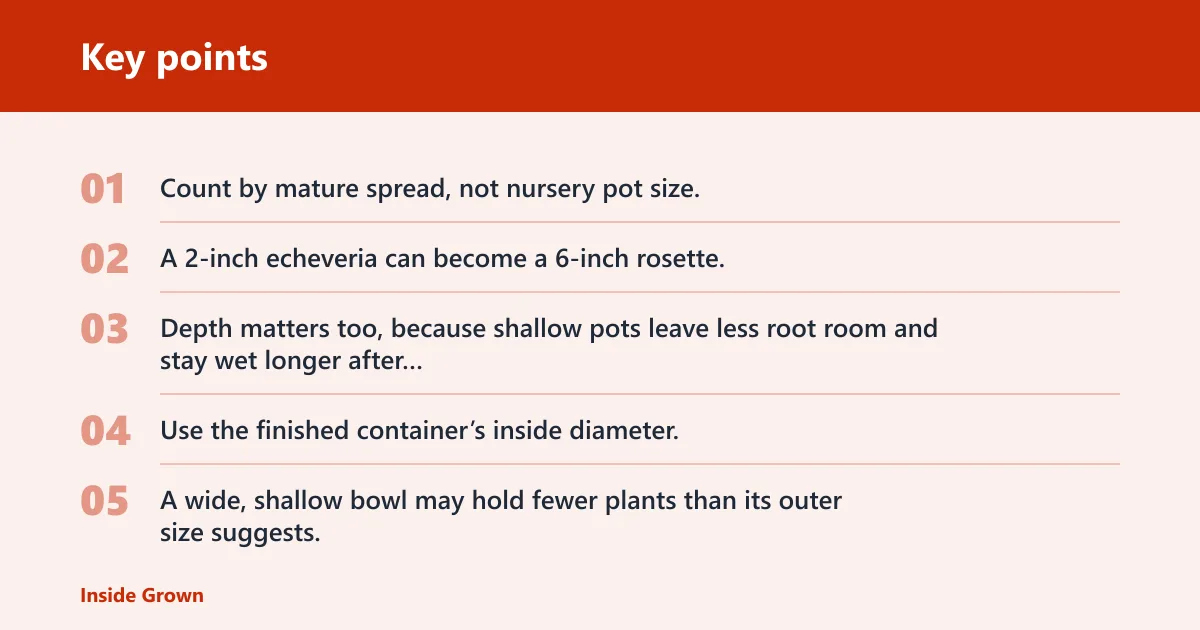


Count by mature spread, not nursery pot size. A 2-inch echeveria can become a 6-inch rosette, and that final width decides how many plants can share one container. Depth matters too, because shallow pots leave less root room and stay wet longer after watering.
Measure pot diameter, not nursery pot size
Use the finished container’s inside diameter. A wide, shallow bowl may hold fewer plants than its outer size suggests, while a deeper pot can support a little more root volume if it has a drainage hole. The goal is room for mature leaves, airflow, and drying time.
Match depth to root room and drainage
Most succulents have shallow fibrous roots rather than deep taproots, so they do not need a very tall pot. They do need drainage holes. Without them, water lingers at the base, and the lower roots stay wet long enough to rot, especially in a crowded arrangement.
Why shallow pots fill faster than deep ones
Shallow planters limit both root space and soil volume. That means fewer plants fit before the root zones meet and the mix dries unevenly. A shallow, broad dish is best for a small composition, not a dense cluster that needs extra rooting room.
- Choose a pot with a drainage hole and the right diameter for the mature rosette width.
- Fill it with a fast-draining cactus/succulent mix, adjusted with perlite or pumice if needed.
- Set the largest plant first, then place smaller plants with 1 to 2 inches of space where possible.
- Keep the crown above the soil line so water does not sit against the stem base.
- Water once after planting, then wait for the mix to dry before watering again.
Succulent container table
The table below uses mature rosette width and growth habit, not nursery pot size. “Small rosettes” means roughly 2 to 3 inches across at maturity. “Medium rosettes” means about 4 to 6 inches. “Trailing types” need spill room, so the count stays lower than the same pot size for compact rosettes.
| Pot diameter | Small rosettes | Medium rosettes | Trailing types |
|---|---|---|---|
| 6 inches | 1–2 | 1 | 1 |
| 8 inches | 2–3 | 1–2 | 1–2 |
| 10 inches | 3–5 | 1–2 | 1 |
| 12 inches | 4–6 | 2–3 | 1–2 |
For mixed plantings, use the lower end of the range. One upright rosette plus one small trailer usually fits better than several plants of the same size, because the canopy can open without trapping shade and moisture in the center.
Say your 8-inch bowl has two 3-inch echeverias and one trailing sedum. That can work if the soil is fast-draining and the plants are set with gaps between leaves. Add a second trailer, and the center often stays shaded longer after watering.
How much space do succulents need?
Most small rosettes need about 1 to 2 inches of breathing room around the leaf edge, while larger rosettes need more. Trailing succulents need extra space for stems to drape without piling on top of neighboring plants. The right gap depends on mature width, not the size of the nursery plug.
Small rosettes versus medium rosettes
Small rosettes can sit closer together because their canopy stays compact. Medium rosettes need more room fast, especially if the species offsets or widens as it grows. Echeveria often spreads into a flat, open circle, so it fills horizontal space sooner than a haworthia.
Trailing types need spill room
Trailing sedums and graptopetalum send stems outward and over the rim. If those stems press against upright plants, airflow drops and the center of the pot dries more slowly. That is why a trailing plant usually gets one fewer neighbor than a compact rosette in the same diameter.
Leave room for growth, not just display size
A plant that looks sparse on planting day may be properly spaced for the long term. A crowded arrangement often looks finished for a few weeks, then tightens as leaves enlarge and offsets appear. Planning for the mature spread prevents a midseason repot.
What container shape and depth change
Shape changes capacity as much as diameter. A wide, shallow planter suits low rosettes and small trailers, while a narrower deep pot can work for a single aloe or another upright plant with a larger root base. Depth also changes how long the mix stays damp after watering.
Shallow planter limits
In a shallow planter, roots run out of space quickly and the soil mass dries unevenly. That makes crowding more risky, because the lower layer can remain wet while the top looks dry. Shallow containers are best for fewer plants, not for squeezing in extras.
Drainage hole requirement
Drainage holes are not optional. They let excess water leave the pot, which lowers rot risk after a soak-and-dry watering. If a decorative cachepot has no hole, keep the succulent in a nursery pot inside it and empty runoff after watering.
When wide pots work better than tall ones
Wide pots fit rosette succulents better because the leaves spread sideways. Tall pots can look attractive, but extra depth does not help most succulents unless the container has a broad surface area and free drainage. A wide base also reduces tipping as offsets and trails develop.
Can you mix different succulents in one pot?
Yes, but only when the plants share similar light and water needs and have compatible growth habits. Upright rosettes, clumping kinds, and trailers can mix well in a larger container, yet the arrangement still needs space for airflow and root separation. Mixed planting is manageable, not risk-free.
Pairing upright and trailing types
One upright rosette with one light trailer is easier to manage than several plants that all spread in the same direction. The upright plant anchors the design, while the trailer can move over the edge without shading the center too much. Give the trailer the rim edge, not the middle.
Why species behave differently
Echeveria usually forms a broad rosette and wants bright light. Haworthia stays tighter and tolerates a bit more indoor shade, so it can fit a smaller space. Sedum often trails or creeps. Aloe usually needs more root room and can outgrow a tight arrangement quickly. Graptopetalum tends to offset and spread, so it can crowd a pot faster than its first size suggests.
When mixed planting stays manageable
Mixed planting works best when you choose one growth pattern as the lead. A clumping haworthia with a small sedum trailer may stay organized in an 8-inch pot. A dense mix of several rosettes plus a trailer often turns crowded before the season ends.
A common first-timer mistake is placing a small echeveria, a haworthia, and two sedum cuttings into a 6-inch pot because each plant looks tiny on planting day. Two months later, the sedum shades the center, the soil stays damp longer, and the rosette leaves begin to press against each other.
Water, light, and soil that keep crowded pots healthy
Bright light matters because low light makes succulents stretch. Stretching widens the mess in a crowded pot, lifts leaves away from the soil line, and weakens the compact form that keeps airflow decent. Full sun suits many outdoor species, but some indoor succulents need bright indirect light to avoid scorch.
Bright light versus full sun
Echeveria and many sedums handle stronger sun than haworthia. Aloe also prefers bright exposure, though intense heat can stress it in a small pot. Graptopetalum often colors up in strong light but can stretch if the light is too low. When light is weak, crowding looks worse because the plants reach outward and upward.
Fast-draining mix and mineral amendments
Use a cactus/succulent mix, then lighten it with perlite or pumice if the blend feels too peat-heavy. A fast-draining mix reduces the time roots sit wet. In a crowded container, that difference matters because more roots mean more moisture held in the soil mass.
Soak-and-dry watering for container plants
Water thoroughly, then let the mix dry before watering again. Small pots dry faster than large ones, but crowding slows drying because there is less exposed soil and more shade between leaves. In cooler months or lower light, the interval stretches longer. Yellowing, soft leaves, and a lingering damp surface are warning signs.
How do you know if a succulent pot is overcrowded?
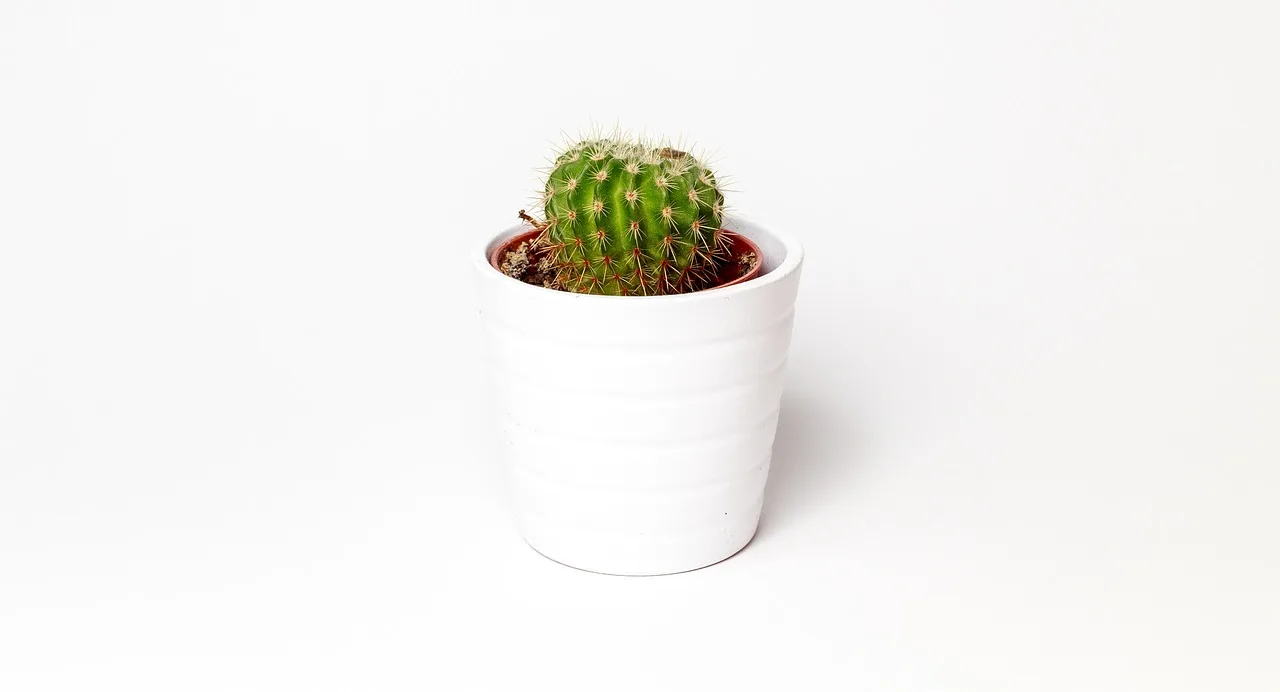
An overcrowded succulent pot shows physical crowding above and below the soil line. Leaves touch and shade one another, airflow drops, and the container dries more slowly than a similar pot with fewer plants. If growth turns stretched or roots push against the sides, the arrangement has outgrown the container.
Crowded leaves and reduced airflow
If outer leaves press into neighbors, air cannot move well through the canopy. That traps humidity after watering and raises rot risk near the crown and lower stems. Crowded leaves also block light from the center, which can weaken the inner growth.
Leggy growth from low light
Stretching is a space problem as much as a light problem. When succulents reach for weak light, stems lengthen and the arrangement spreads faster. That makes a previously balanced container look packed, even if the plant count did not change.
Root-bound signs and slow drying soil
Roots circling the pot, lifting the plant, or filling the drainage hole point to root crowding. Another clue is soil that stays wet much longer than before. In a tight pot, roots consume space and water movement changes, so rot risk climbs.
- Leaves touch tightly across the whole surface.
- Airflow between plants is poor.
- New growth looks stretched or tilted.
- Soil stays damp longer than expected.
- Roots circle the pot or emerge from drainage holes.
- Lower leaves soften after watering and do not firm back up.
Frequently asked questions
How many succulents can share one container?
That depends on mature width, not nursery size. In a 10-inch pot, a common fit is 3–5 small rosette succulents, 1–2 medium growers, or 1 large specimen. Mixed plantings should stay on the low end so leaves do not crowd each other as the plants mature.
How many succulents should I put in a 6-inch pot?
A 6-inch pot is commonly said to fit about 1 small rosette, 1 medium succulent, or 1 trailing plant. Two tiny rosettes can work only if both stay compact at maturity and the pot drains well. If the container is shallow, one plant is often the safer choice.
How many succulents fit in an 8-inch pot?
An 8-inch pot is commonly said to fit about 2–3 small rosette succulents, 1–2 medium growers, or 1–2 trailing types. If you mix habits, keep the count lower. One upright rosette and one light trailer is easier to manage than a dense cluster of similar-sized plants.
How much space do succulents need between plants?
Plan for about 1 to 2 inches between the edges of small rosettes and the pot wall, with more room for larger plants. Trailing types need extra spill room so stems can drape without shading the center. Mature width is the number that matters most.
How do I know if my succulent pot is overcrowded?
Look for leaves that touch tightly, poor airflow, stretched growth, and soil that dries more slowly than before. Root-bound signs matter too, especially roots circling the pot or emerging from drainage holes. When several of these show up at once, repot into a wider container.