Bonsai Soil Drainage Problems and How to Improve Them
Fix bonsai drainage by finding the failure mode first: compacted soil needs aeration and repotting, broken-down mix needs full replacement, and unevenly wet pots usually need particle-size correction or better watering distribution. Left alone, poor drainage cuts root oxygen, triggers rot, and weakens growth quickly. This guide shows how to diagnose each problem from the soil, pot, and watering pattern, then match the right repair.
Bonsai drainage diagnosis matrix

Start with the symptoms you can check in minutes. Drainage holes matter, but they do not solve a water-holding substrate by themselves. The diagnosis below separates compacted soil, a hydrophobic dry core, and an oversaturated root zone so you can fix the right problem once.
| Failure mode | Symptom checks | Yes/no path | What to do now | Next mix adjustment |
|---|---|---|---|---|
| Compacted soil | 1) Surface stays crusted or hard. 2) Water pools before soaking in. 3) Roots are circling or sparse at the edge. 4) Pot feels heavy long after watering. 5) Fine particles wash out of the pot. 6) The mix has collapsed into mudlike fines. | Yes if the mix has hardened and water moves slowly; no if the top dries fast but the core stays wet or bone dry. | Repot if the root ball is tight or the mix has broken down. If the tree is not ready, gently scratch away crusted top material and improve watering distribution. | Use more sifted particle mix, less organic compost, and a better particle spread for your climate. |
| Hydrophobic dry core | 1) Water runs through the rim. 2) The center stays dry. 3) The pot dries from the outside inward. 4) The surface may look damp while the core stays light. 5) A chopstick or skewer comes out dry from the center. 6) Fine roots near the trunk look stressed despite frequent watering. | Yes if runoff is fast but the root ball is dry inside; no if the whole pot stays saturated. | Top-dress with a coarse, sifted layer and re-wet gradually in several passes until the core accepts water. Repot only if the mix also shows breakdown or compression. | Use a more even particle size distribution and avoid mixes that dry into water-repelling pockets. |
| Oversaturated root zone | 1) Soil stays dark and wet for days. 2) Sour smell from the pot. 3) Leaves yellow or wilt without a dry surface. 4) Lower growth softens. 5) Roots look brown or black instead of pale and firm. 6) Drainage holes drip slowly for too long after watering. | Yes if moisture stays high and roots show decline; no if the tree dries too fast and the problem is under-watering. | Repot immediately if root rot signs are present or the mix is waterlogged. Remove failing substrate and inspect roots. | Shift toward more lava rock or grit in wet climates; add more akadama or organic potting compost only where watering checks are infrequent. |
Say your juniper sits in a training pot with drainage holes, yet the soil still feels heavy three days after watering. That usually points to compaction or a broken-down mix, not a missing hole. The fix is substrate replacement, not a new container.
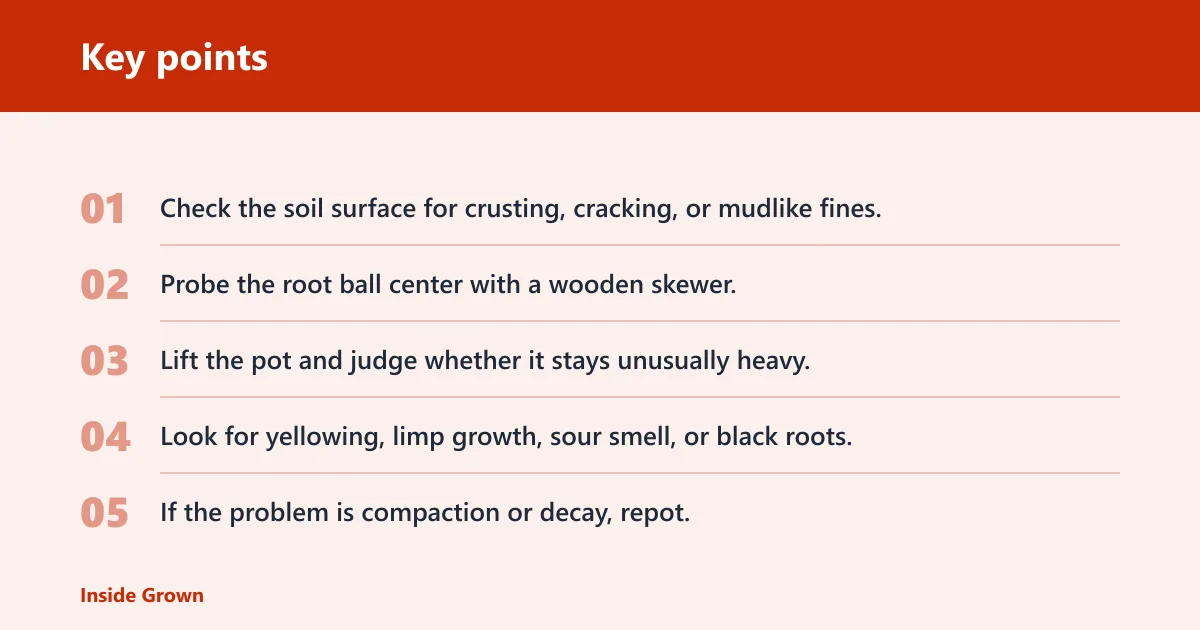
- Check the soil surface for crusting, cracking, or mudlike fines.
- Probe the root ball center with a wooden skewer.
- Lift the pot and judge whether it stays unusually heavy.
- Look for yellowing, limp growth, sour smell, or black roots.
- If the problem is compaction or decay, repot.
- If the core is dry but the edges stay wet, re-wet gradually.
Why bonsai soil stops draining
Bonsai substrate stops draining when particle structure breaks down, fines clog pore space, or the mix contains too much water-holding material for the tree and climate. Good bonsai soil must provide drainage, water retention, and aeration together. Drainage holes help excess water leave the pot, but they cannot correct a soil body that has collapsed into sludge.
Particle breakdown and sifted fines
Particle size matters. A bonsai mix should keep open spaces between particles so water moves through and air stays in the root zone. When the small particles fill those spaces, the mix behaves more like garden soil. Sifting out excessive fines before use helps preserve that open structure.
Akadama is hard-baked Japanese clay made for bonsai use. It holds water well at first, but it starts to break down after about two years. Once it crumbles, the substrate tightens and drains more slowly.
How compaction blocks air and water movement
Compacted soil hardens when dry and can block both water movement and air exchange. That is why ordinary garden soil is a poor bonsai choice, and why cheap potting compost often fails as a long-term substrate. Roots need oxygen as much as moisture, and once air space disappears, root health drops fast.
How organic material changes over time
Organic potting compost can be part of a mix, but not the whole mix. On its own, it tends to hold too much water, and as it breaks down it reduces drainage further. That slow collapse is one reason a pot can start out acceptable and later stay wet far too long.
Suppose a maple in a 6-inch pot looks fine in spring, then starts yellowing after several wet weeks. The issue may not be the watering itself. A finer, older mix can hold water longer than the roots can tolerate, especially once the organic fraction has broken down.
Why drainage holes are necessary but not enough
Drainage holes let excess water leave the container. They do not create aeration inside a compacted root ball. If the substrate is water-holding, the pot may still stay saturated even with large holes in the bottom.
What makes bonsai substrate drain well
Bonsai substrate is a particle-based mix built to balance drainage, water retention, and aeration. It may be organic, inorganic, or a blend, but the goal is the same: an open structure that holds enough moisture for the species without suffocating roots. Garden soil fails because it is too fine and collapses too easily.
Organic and inorganic ingredients in bonsai mixes
Organic ingredients can help with water retention, but they need support from stable particles. Inorganic components usually hold structure longer. The best mix depends on species, climate, pot size, and how often the tree gets checked.
What each component does
| Ingredient | Main role | Limit |
|---|---|---|
| Akadama | Holds water and supports a fine root environment. | Breaks down after about two years and then drains worse. |
| Pumice | Helps retain water and lets roots ramify well. | Needs screening so the size matches the rest of the mix. |
| Lava rock | Adds aeration, drainage, and structure. | Roots cannot grow into it, so it contributes support rather than root penetration. |
| Organic potting compost | Raises moisture retention in a blend. | Retains too much water alone and reduces drainage as it breaks down. |
| Grit | Can improve drainage in a mix. | Fine gravel or grit as a bottom layer is not a default fix. |
Which ingredients improve drainage?
Akadama, pumice, and lava rock do different jobs, and they work best together in a species-specific mix. If the substrate is staying wet too long, the fix is usually not one magic ingredient. It is better structure, better particle size, and a blend matched to climate and watering habits.
Akadama: water retention and structure
Akadama is useful when the tree needs a substrate that holds moisture but still drains. It is especially helpful for trees that benefit from even moisture and fine root development. Because it breaks down after about two years, it often sets the repotting schedule.
Pumice: drainage plus root support
Pumice adds open pore space while still holding some water. It also supports root ramification well, which is why it is common in bonsai blends that need both structure and moisture balance. It is a strong choice when the mix needs more air without turning too dry.
Lava rock: aeration and open pore space
Lava rock helps retain water and create a good structure in bonsai substrate. It also increases aeration, which matters in wet climates and with trees that dislike soggy roots. Because roots cannot grow into it, it keeps the mix open for longer.
Organic compost and grit: where they fit, and where they do not
Organic compost can be used in mixtures, but not alone. Grit can improve drainage, and some growers use fine gravel or grit as a bottom layer, though that approach has fallen out of favor in some expert practice. A better approach is to fix the whole particle mix instead of creating a drainage layer that does not solve the root zone.
A common first-timer mistake is adding a gravel band to the bottom of a pot and expecting the whole root ball to dry faster. If the upper mix is still fine and compacted, water can sit above that layer instead of moving through it. Change the substrate structure instead.
Should you add gravel to the bottom?
Usually no. A bottom layer of gravel or grit rarely fixes a water-holding bonsai mix because the upper root zone still controls most of the drainage behavior. Fine gravel or grit can improve drainage in some mixes, but using it as a separate layer often leaves the main substrate unchanged and still prone to saturation.
Why bottom layers often fail
A layered pot can create uneven moisture movement. Water may collect above the coarse layer rather than spread through the root ball. That leaves the upper mix wet and the lower roots poorly supplied with air. The problem looks like drainage, but the actual fault is the particle profile of the main substrate.
What to do instead of a gravel layer
Replace or amend the whole mix with particles that match your species and climate. Sift out excess fines. Keep the root zone evenly textured from top to bottom. If the tree is in a wet climate, add more lava rock or grit. If you will not have time to check trees twice a day, add more akadama or organic potting compost.
When do you need to repot?
Repot when the substrate has broken down, when roots are starved of air, or when the mix no longer matches the tree’s watering pattern. If akadama has started to crumble after about two years, that can become a repotting trigger. If root rot is already present, delaying repotting can be risky.
Signs the substrate has broken down
Look for slow drainage, muddy fines, a crusted surface, or a pot that stays heavy for days. If the soil hardens when dry and then turns sticky when wet, it has likely shifted out of the particle structure bonsai need. That is repotting territory.
When akadama breakdown changes the schedule
Akadama’s breakdown matters because the mix stops behaving the same way once the particles collapse. A tree in a fine akadama-heavy mix may need repotting sooner than the calendar suggests if the particles are already crumbling. The right timing depends on species, climate, and how fast the soil is degrading.
Root rot warning signs that mean immediate action
Root rot is linked to poor drainage and low aeration, and it can kill a bonsai tree. If leaves yellow, wilt, or drop while the soil stays wet, inspect the root zone right away. Brown, black, mushy, or foul-smelling roots are signs to repot immediately and remove failing substrate.
Bonsai soil mix by climate and species
Species matter, and so does climate. Deciduous trees often appreciate a mix that holds a bit more moisture, while conifers usually need a more open, fast-draining substrate. Tropical bonsai may need a balance that dries more slowly than a hot, dry climate would otherwise allow.
Deciduous bonsai
For deciduous bonsai, a blend with more akadama or organic potting compost can help if the tree is checked often enough. The goal is steady moisture without collapse. In a wet climate, add more lava rock or grit to keep the substrate open.
Coniferous bonsai
Conifers usually need more air around the roots and less persistent wetness. Pumice and lava rock are useful here because they maintain structure and keep drainage moving. Avoid mixes that stay dense for too long.
Tropical bonsai
Tropical bonsai often need a mix that stays evenly moist but never swampy. That usually means a careful balance of akadama, pumice, and lava rock, adjusted for indoor light, heat, and watering frequency. If the room dries quickly, more water-holding material may be needed, but not so much that the mix turns stale.
Wet climate versus fast-drying conditions
In a wet climate, add more lava rock or grit. In fast-drying conditions, increase the water-holding side of the mix with more akadama or, where appropriate, a measured amount of organic potting compost. The same tree can need a different mix in a different climate.
Frequently asked questions
Why is my bonsai soil not draining even though the pot has holes?
Drainage holes only let water exit the container; they do not fix a compacted or broken-down substrate. If the mix has too many fines, too much organic material, or collapsed particles, water still stays in the root zone. The correct fix is to diagnose the soil structure and repot if needed.
How do I know if bonsai soil is too compacted?
Compacted bonsai soil feels hard on top, resists water, and often stays heavy long after watering. A skewer may meet dense resistance near the middle. Garden soil and cheap potting compost are common culprits because they harden when dry and reduce air exchange as they settle.
Can I fix bonsai drainage without repotting the tree?
Sometimes. If the issue is a dry core, you can re-wet gradually in several passes. If the top crust is mild, top-dressing can help temporarily. But if the mix is compacted, broken down, or already causing root rot, repotting is the correct fix.
What soil ingredients improve bonsai drainage the most?
Pumice and lava rock are the main drainage helpers, with akadama adding water retention and structure. The best result comes from a particle-based mix with sifted fines removed. Organic potting compost can be part of the blend, but it should not be the whole substrate.
Should I add gravel to the bottom of a bonsai pot?
Usually not. A bottom gravel layer rarely solves poor drainage in the main root ball and can create uneven moisture movement. If you want better drainage, improve the whole mix with appropriately sized particles instead of building a separate layer that the roots may never benefit from.
What should I do if water runs straight through the pot but the roots are still dry?
That pattern usually points to a hydrophobic dry core or a mix with uneven particle size. Re-wet gradually with several light passes so water can penetrate the center instead of bypassing it. If the substrate also shows compaction or decay, plan a repot with a more even particle blend.