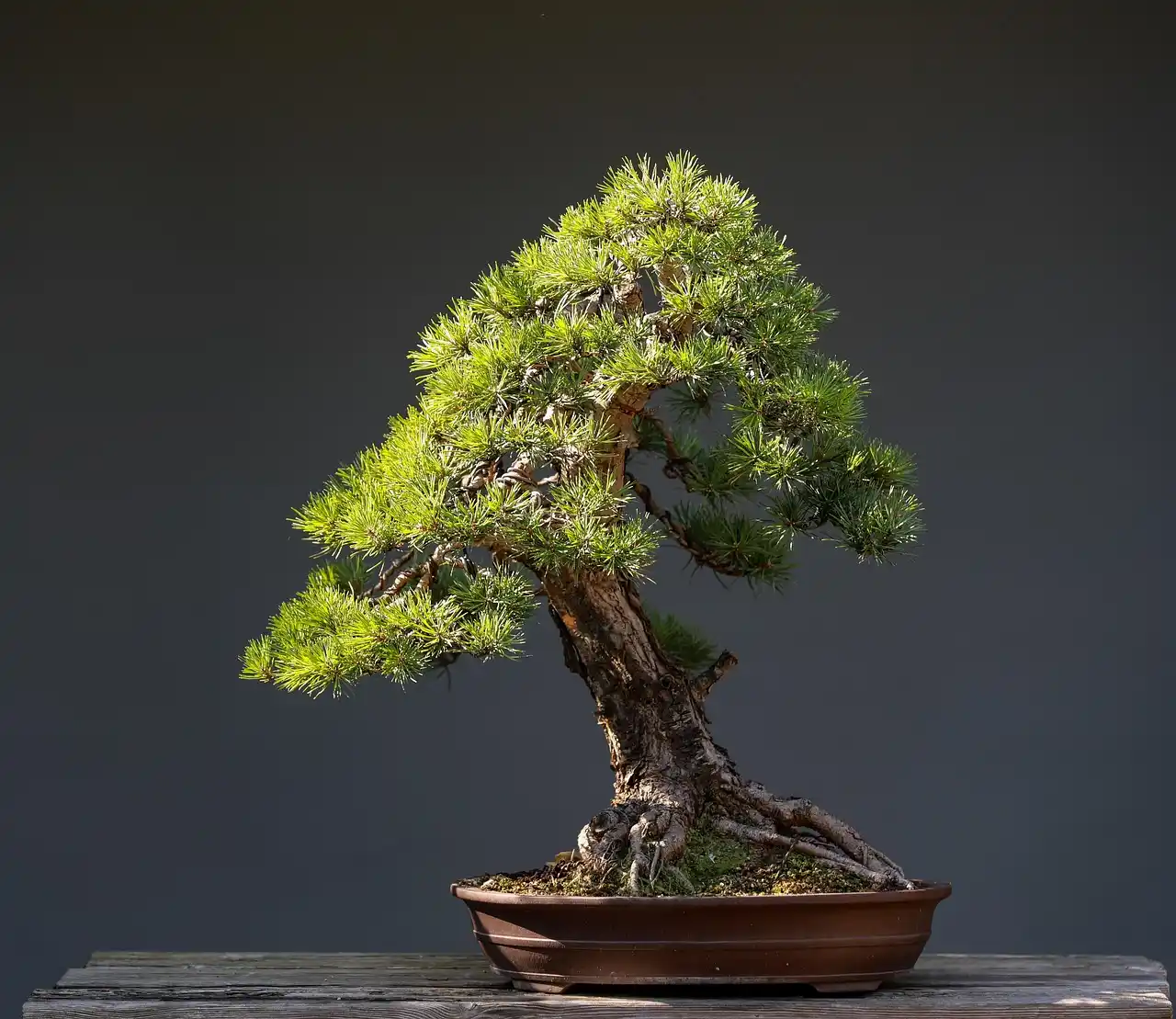
Bonsai Root Pruning Explained for Healthy Growth
Bonsai root pruning for healthy growth commonly means removing about 20 to 30 percent of the roots at repotting, and less for weak trees. Cut more, and the tree can stall, shed foliage, or fail to re-root after repotting. This article covers how much to trim, when to stop, and the aftercare that keeps recovery on track.
This guide is part of our Bonsai tree care guide series.
Root pruning basics and what to cut


Root pruning is part of repotting, not a separate styling task. The goal is to refresh the root zone, remove dead or circling roots, and keep enough fine feeder roots for recovery. Done well, it supports a compact root system that can keep the tree balanced in a shallow pot.
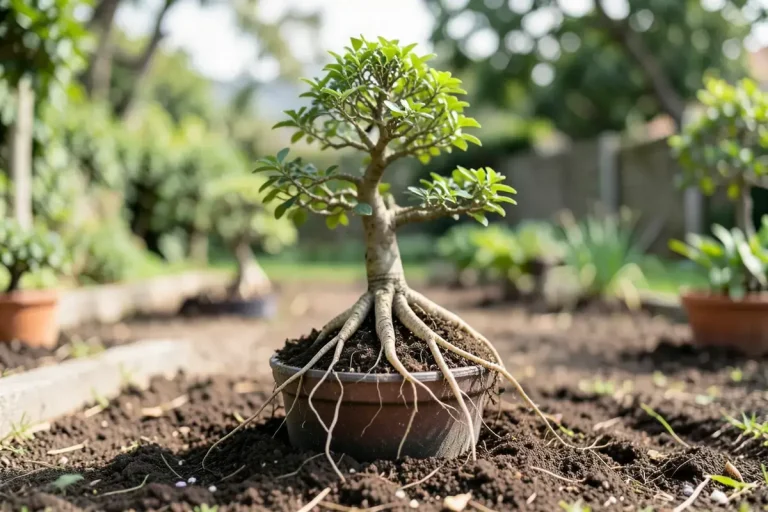
The work starts below the soil line because bonsai roots fill a container faster than many growers expect. As substrate breaks down, drainage slows, oxygen drops, and roots begin to circle or collapse into a dense mat. That is when root pruning and fresh bonsai soil become a health decision.
What to keep
Keep fine feeder roots and a stable base near the trunk. Those finer roots do most of the water and nutrient uptake. The outer root mat can be reduced, but the tree still needs enough live root mass to restart growth after repotting.
What to cut
Remove circling roots, dead roots, and crowded outer roots that no longer help the tree. Thick roots that spiral around the pot wall can be shortened if they block repotting, but the cut should stay conservative for beginners. Do not strip the root ball bare.
When should you root prune a bonsai?
For most species, the best time is early spring as buds start to swell. That timing gives the tree active growth right after repotting, which helps it replace lost roots faster. Bonsai Empire also says spring is the best time to prune, which matches the common repotting window.
Early spring for most outdoor trees
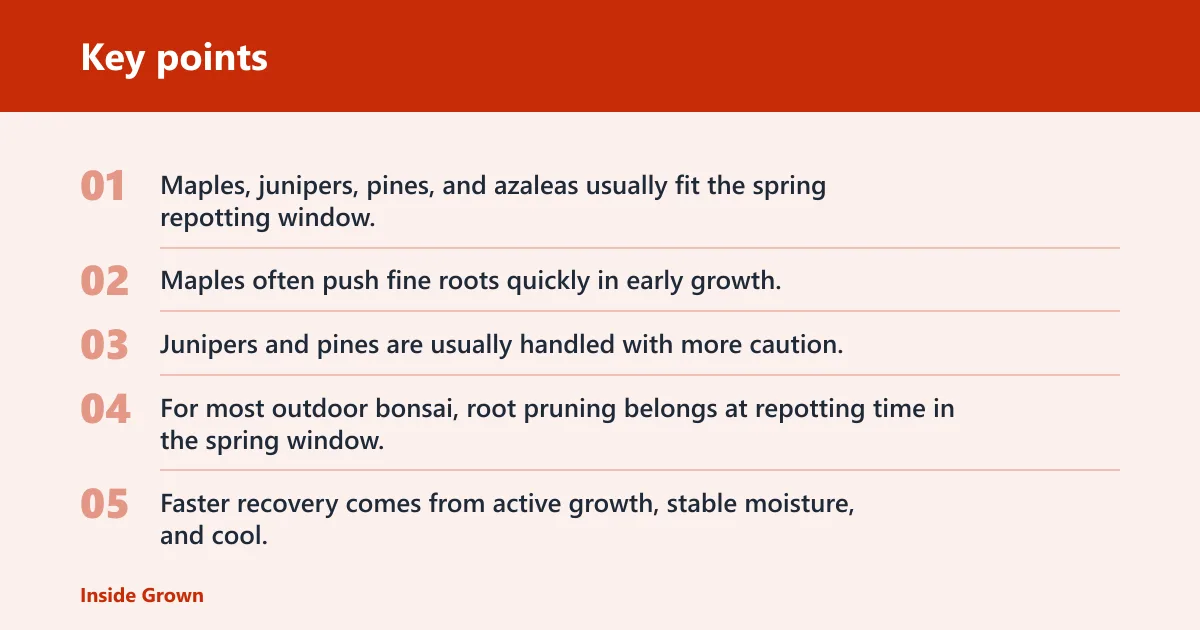
Maples, junipers, pines, and azaleas usually fit the spring repotting window, but they do not all recover at the same speed. Maples often push fine roots quickly in early growth. Junipers and pines are usually handled with more caution, and azaleas prefer a careful repot with their own soil needs in mind.
For most outdoor bonsai, root pruning belongs at repotting time in the spring window, not in the middle of the growing season without a clear reason. Faster recovery comes from active growth, stable moisture, and cool, even conditions after the work is done.
Warm-season timing for tropical indoor bonsai
Tropical indoor bonsai, including ficus, can often be repotted in warmer months if they are actively growing indoors. They are not tied to the same outdoor spring rhythm. Bright indoor light, warm temperatures, and steady growth matter more than the calendar here.
Ficus is the common example because it keeps pushing growth under indoor conditions. That said, active growth still matters. A tropical tree sitting in low light or cool indoor air should not be treated like a vigorous summer candidate.
Why a stressed tree usually needs a delay
Only prune roots on a healthy tree. If the tree is recovering from drought, heat damage, pests, or recent heavy pruning, it usually needs time first. A stressed tree has less reserve to replace lost roots, so even modest pruning can slow recovery sharply.
Say your maple dropped leaves after a dry spell and the soil crusts hard between waterings. That tree needs better recovery conditions before any root work. A lighter repot later is safer than forcing a normal reduction now.
How do you know if a bonsai is root-bound?
Root-bound signs are often visible at the pot and in the way the soil behaves, such as roots at drainage holes, water running through too quickly, faster drying, or a dense root mass that matches the pot shape. Look for roots at drainage holes, water running through too fast, the tree drying out faster than usual, and a dense root wall that matches the pot shape. Those are practical warnings, not abstract ones.
Roots at drainage holes
Roots pushing out of drainage holes can mean the tree has filled the pot. One or two roots are not always a crisis, but a heavy mass at the holes suggests the root system has little room left and should be checked at the next repotting.
Water running through too fast
If water disappears almost immediately, the substrate may have broken down or the root mass may be so dense that water channels straight through. In both cases, the pot can dry unevenly and starve parts of the root ball. That is one reason fresh bonsai mix matters.
Drying out faster than usual
A tree that needs watering far more often than it used to may be crowded in the pot or sitting in exhausted media. This is not always a root-bound issue alone. Compacted substrate can hold less useful moisture and air at the same time.
A dense root wall that matches the pot shape
When the root mass holds the exact shape of the container, the tree has likely reached the edge of usable space. That is the right time to repot, clean the root ball, and restore drainage before decline starts. Waiting too long makes the root mat harder to open up.
Root pruning tools and soil
Use a chopstick or root rake to tease roots apart, a sharp cutter for thicker roots, a fresh bonsai mix, drainage holes, and wire for anchoring. A concave bonsai branch cutter is suggested for thicker roots. The tool choice matters because torn roots heal less cleanly than cut roots.
The soil matters just as much. A free-draining bonsai soil mix keeps water moving away from the roots, and fresh substrate gives the root system air after the old mix has started to break down. If the old medium has compacted into a hard mass, root work alone will not fix drainage.
- Remove the tree from the pot and free the outer root mat.
- Tease roots apart with a chopstick or root rake.
- Trim dead, circling, and crowded outer roots.
- Set the tree into fresh bonsai mix in a pot with open drainage holes.
- Anchor the trunk with wire so the root ball cannot shift.
- Water until it runs clear through the pot.
How much root can you remove?
A safe beginner guideline is to remove about 20 to 30 percent of the root mass. That is conservative on purpose. More can be removed by experienced growers, but larger cuts raise the risk of leaf drop, dieback, and a slow restart after repotting.
When a more aggressive cut is justified
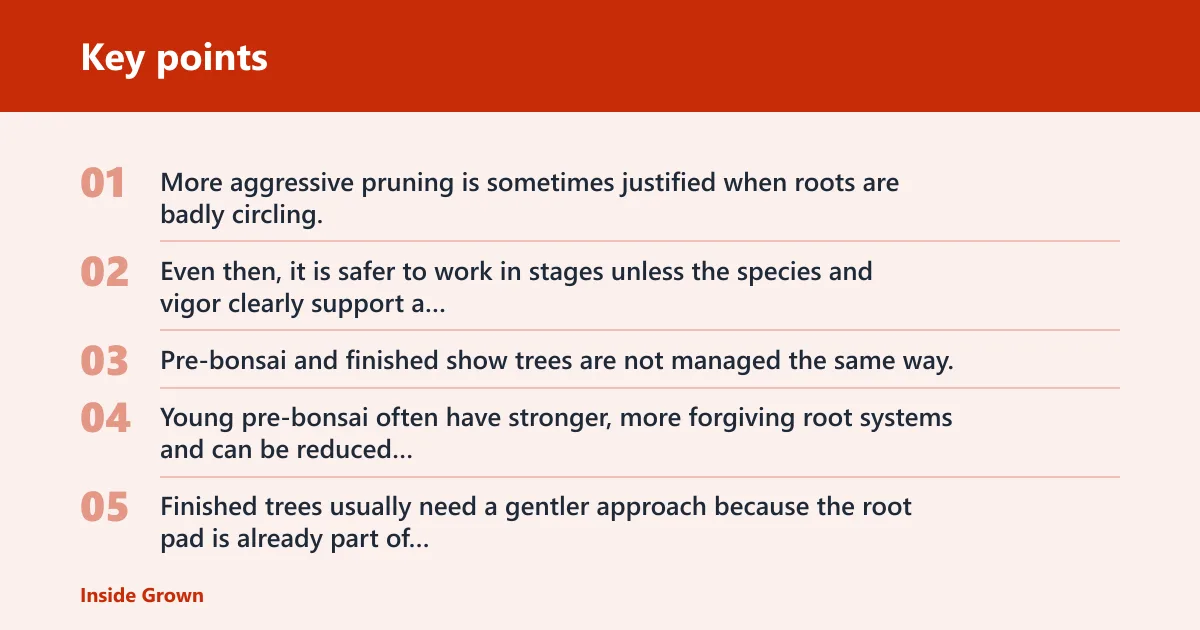
More aggressive pruning is sometimes justified when roots are badly circling, the substrate has collapsed, or the tree is being moved from an oversized training pot into a tighter container. Even then, it is safer to work in stages unless the species and vigor clearly support a stronger cut.
Pre-bonsai and finished show trees are not managed the same way. Young pre-bonsai often have stronger, more forgiving root systems and can be reduced more freely when training demands it. Finished trees usually need a gentler approach because the root pad is already part of the display form and the margin for setback is smaller.
Root-pruning decision table
| Scenario | Timing | Maximum root reduction | Repotting urgency | First-14-day aftercare |
|---|---|---|---|---|
| Healthy fast grower | Early spring as buds start to swell | 20 to 30 percent | High if roots are filling the pot; smaller pots and fast growers may need root work every 1–2 years | Bright shade, thorough watering, shelter from wind, no heavy feeding |
| Healthy slow grower | Early spring repotting window | About 20 percent, with caution | Moderate; slower growers or larger training pots may need root work every 2–3 years | Bright shade, steady moisture, protect from harsh sun, check that the pot drains freely |
| Recently stressed tree | Delay root work until strong new growth returns | Minimal or none at first | Low to moderate; fix the stress first unless roots are failing fast | Hold in bright shade, avoid wind, maintain even moisture, repot only after recovery is clear |
| Tropical indoor bonsai | Warmer months while actively growing indoors | 20 to 30 percent for a beginner, more only with experience | Moderate; active indoor growth matters more than season | Bright indoor light, warm stable temperatures, even watering, no direct hot sun through glass |
Picture a 6-inch ficus in a training pot that dries in one day and has roots circling the bottom. That tree can usually be repotted in warmer months if it is still pushing growth indoors. A 35 percent cut would be too much for a beginner, but a careful 20 to 30 percent reduction with bright recovery conditions is usually the safer path.
What should you do after repotting?
After repotting, water the tree thoroughly right away, then keep it in bright shade for about 1 to 2 weeks. Keep it out of harsh sun and wind during that period. The aim is simple: reduce water loss while the tree replaces the roots you removed.
Water until it runs clear through the pot after repotting. That flushes dust from the fresh mix and settles the substrate around the root system. Do not leave pockets of dry material near the roots, and do not let the pot sit in a saucer of stagnant water.
Indoor versus outdoor recovery
Outdoor trees should stay sheltered from hard sun and drying wind. Indoor tropical bonsai need bright placement without heat spikes from a south-facing window or direct midday glare through glass. Humidity helps, but it should not replace airflow and stable moisture in the pot.
Do not feed heavily right after root pruning. A tree that is rebuilding roots needs time first. New top growth, firm leaves, and steady color are better recovery signs than fast fertilizer response.
How to stop a bonsai from drying out after repotting
Use a free-draining mix, anchor the tree so roots are not torn by movement, and check moisture often during the first two weeks. The root ball should stay evenly moist, not saturated. A lightly shaded recovery spot reduces evaporation and gives the roots time to re-establish contact with the soil.
Suppose a juniper is repotted into fresh mix, then left on an open bench in hot afternoon wind. The top of the soil can dry fast even though the lower root zone is still settling. Moving it to bright shade cuts that risk immediately.
Frequently asked questions
When is the best time to prune bonsai roots?
For most species, early spring as buds start to swell is the best time. That timing gives the tree active growth to replace roots quickly after repotting. Tropical indoor bonsai are the main exception, since they can often be repotted in warmer months if they are actively growing indoors.
How much root pruning can a bonsai tolerate at once?
A beginner-friendly limit is about 20 to 30 percent of the root mass. That is usually enough to refresh the root pad without overtaxing the tree. Larger cuts are better left to experienced growers, and only when the tree is very vigorous and the species supports it.
How do I know if my bonsai is root-bound?
Check for roots at drainage holes, water running through too fast, faster-than-usual drying, and a dense root wall that matches the pot shape. Those signs often mean the root system has filled the container or the substrate has broken down enough to restrict air and water balance.
Should I root prune a healthy bonsai only or also a stressed one?
Healthy trees are the right candidates. Recently stressed trees usually need a delay, or at most a much lighter touch after recovery. Root pruning removes reserve capacity, so a tree already dealing with heat, drought, pests, or recent top pruning can be pushed too far.
What tools do I need for bonsai root pruning?
Use a chopstick or root rake to loosen the outer root mat, sharp cutters for thicker roots, fresh bonsai mix, drainage holes, and wire for anchoring. A concave bonsai branch cutter is often suggested for larger roots. Clean, sharp tools make cuts that heal more predictably.
How often should bonsai roots be pruned?
Smaller pots and fast growers may need root work every 1 to 2 years. Slower growers or larger training pots may need it every 2 to 3 years. The schedule changes with vigor, pot size, soil breakdown, and how quickly water starts moving through the container.