Landscaping Services for Sprinkler Repair and Maintenance
Sprinkler repair and maintenance make sense when one contractor can inspect zones, fix leaks, adjust heads, and correct drainage in the same visit. Skip that bundle and you risk dry spots, soggy beds, wasted water, and higher plant loss. This guide compares what contractors should include, when to hire an irrigation specialist instead, and how to judge drainage work before you sign.
What landscapers fix versus irrigation specialists
Sprinkler repair from a landscaping crew usually covers broken heads, leak repair, damaged pipe sections, freeze damage, and a system tune-up after diagnosis. A good scope also includes spray-pattern adjustment, controller timing changes, and a check for runoff or poor drainage that is making the irrigation problem look worse than it is.
Typical repair scope
For a standard service call, expect the contractor to inspect each active zone, identify visible leaks, replace cracked heads or nozzles, and correct head alignment. If the problem is limited to surface-level failures, a crew can often handle it without a separate trade. That bundle matters because irrigation faults often show up with mowing issues, bed erosion, or stressed turf in the same area.
When a landscape crew can handle the fix
Crews are usually a fit when the issue is mechanical and local: a broken head from a mower pass, a clogged nozzle, a leaking fitting, or a small pipe repair near the surface. They can also handle seasonal tuning, such as adjusting spray radius after plant growth changes the bed edge. Many local providers pair this with mowing, pruning, bed care, and seasonal cleanups.
When the job likely needs an irrigation specialist
Call a dedicated irrigation specialist when the problem points to wiring faults, repeated controller failures, a major underground line break, backflow trouble, or a redesign that changes zone count. Those jobs often need electrical testing, pressure verification, or layout changes that go beyond basic property maintenance. If a contractor cannot explain that limit clearly, ask what license or irrigation qualification they hold for that work.
When should you schedule sprinkler maintenance?
Sprinkler maintenance works best on a regular schedule: spring start-up, in-season checks, midseason tuning, and fall shut down before freezing weather arrives. The practical goal is to keep coverage even, prevent waste, and catch small leaks before they turn into soggy zones, dry strips, or drainage problems.
Spring start-up timing and inspection points
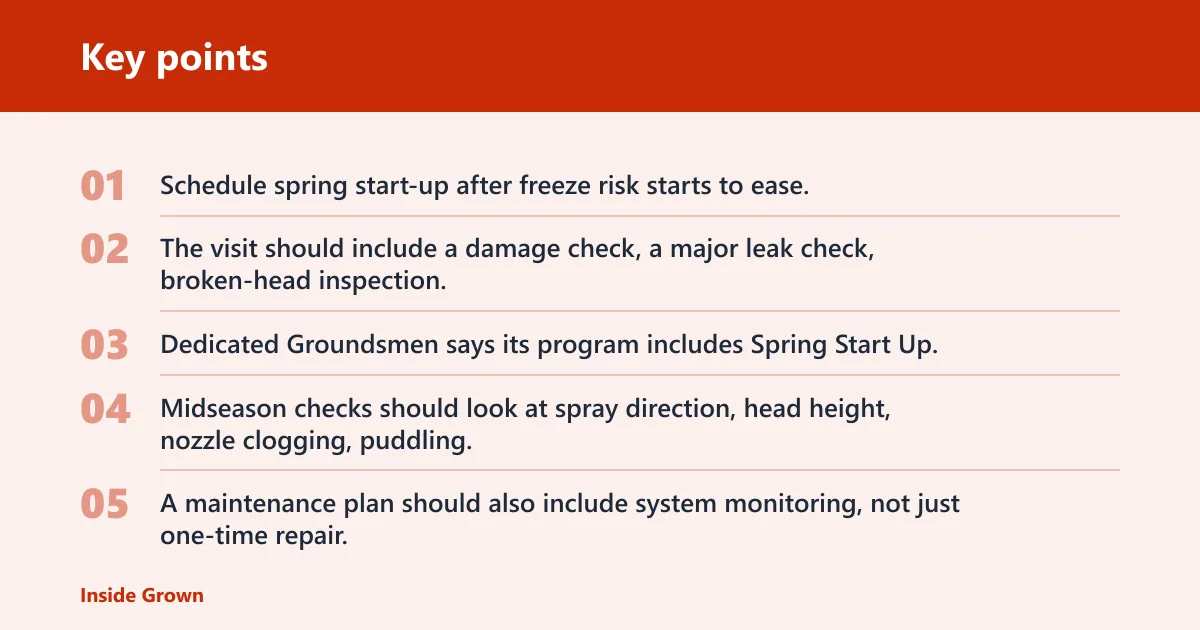
Schedule spring start-up after freeze risk starts to ease, but before the lawn begins to dry out or plants need regular irrigation. The visit should include a damage check, a major leak check, broken-head inspection, slow pressurization, and zone testing. Dedicated Groundsmen says its program includes Spring Start Up, and that kind of first visit should verify the system is ready before the hotter months.
In-season checks and midseason tuning
Midseason checks should look at spray direction, head height, nozzle clogging, puddling, and controller run times. A maintenance plan should also include system monitoring, not just one-time repair. If a turf area starts drying faster than the rest, the provider should check pressure, head overlap, and whether plant growth is blocking spray.
Suppose a front lawn has three dry strips after the maples leaf out. A sensible follow-up is not a guess at new heads first; it is a check for spray blockage, head mismatch, and whether the existing run time still fits the hotter months.
Fall shut down and winterization timing
Fall shut down should ideally happen before the first hard freeze. The same source recommends winterizing sprinkler systems, and that service should remove water from pipes and valves so trapped water cannot expand and split parts. In colder regions, winterization is not optional upkeep; it is freeze prevention for the entire irrigation network.
| Symptom | Likely cause | Service needed |
|---|---|---|
| Broken head | Mower impact or age-related cracking | Head replacement and spray check |
| Low pressure | Leak, clog, partial valve failure, or supply issue | Diagnostic inspection and pressure assessment |
| Overspray onto driveway | Misaligned head or wrong nozzle | Head tuning and nozzle adjustment |
| Clogged nozzle | Debris in the nozzle or filter | Cleaning and spray-pattern reset |
| Soggy zone | Leak, poor drainage, or overwatering | Leak repair and drainage review |
| Dry spot | Blocked spray, failed head, or low pressure | Coverage correction and repair |
| Freeze damage | Water left in pipes, valves, or heads | Winterization and damaged-part replacement |
| Slope runoff | Run times too long for the grade | Irrigation scheduling and runoff control |
| Leaking zone | Cracked pipe, loose fitting, or valve issue | Leak location and pipe repair |
| Patchy coverage after growth changes | Spray blocked by plants or bed expansion | Seasonal head tuning and pruning coordination |
| System will not pressurize evenly | Supply issue or major obstruction | Water supply assessment and diagnostics |
| Winter blowout not completed | No fall shut down service | Freeze-prevention service before cold weather |
Use the checklist before requesting bids. It helps you separate a quick head repair from a broader service call that should include drainage, grading, or controller changes. That comparison matters because the cheapest visit is not always the cheapest fix if the same zone fails again next week.
Sprinkler service scope checker
This checklist helps you match a symptom to the most likely cause and the service that should address it. Use it to decide whether one visit can handle the issue or whether you need a more specialized irrigation contractor.
| Symptom | Likely cause | Service needed |
|---|---|---|
| Broken heads | Impact damage or cracked plastic | Head replacement and zone check |
| Low pressure | Leak, supply problem, or partial blockage | Diagnostic inspection and pressure test |
| Overspray | Head misalignment or nozzle mismatch | Spray/head tuning |
| Clogged nozzles | Debris or mineral buildup | Nozzle cleaning and maintenance |
| Soggy zones | Leak or poor drainage | Leak repair and drainage review |
| Dry spots | Blocked coverage or weak pressure | Coverage correction and system tune-up |
| Freeze damage | Water left in lines or valves | Winterization and damaged-part repair |
| Slope runoff | Run time too long for grade | Irrigation scheduling and runoff control |
| Uneven turf growth | Inconsistent watering across zones | Zone balancing and controller review |
| Leaking valve box | Failed valve or fitting | Valve inspection and repair |
| Puddling near beds | Oversaturation or drainage failure | Drainage-related service |
| Spring startup failure | Damage from winter or closed supply | Spring start-up and leak inspection |
What happens during spring start-up?
Spring start-up should restore the system in a controlled way, confirm that the lines are intact, and catch winter damage before watering season begins. The visit should not be a quick flip of the controller. It should include pressurizing the system slowly, checking for major leaks, inspecting broken heads, and testing each zone.
Slow pressurization and major leak checks
Open the main supply slowly so water fills the system without slamming pipes or valves. That step helps reveal a hidden break before full pressure hits the line. The contractor should watch the backflow device, valve box, and visible pipe runs for leaks as the system fills. If a zone loses pressure immediately, the issue is likely bigger than a nozzle change.
Broken-head inspection and spray-pattern tuning
Each zone should be run long enough to identify broken heads, tilted spray, clogged nozzles, and overspray. A good spring visit also checks whether plant growth, bed changes, or soil settling altered the throw pattern since last season. That is where property maintenance and irrigation work overlap: pruning, bed care, and head tuning can solve the same coverage error.
Zone testing and controller review
Zone testing should confirm that each station opens, closes, and waters the intended area. The controller review should include watering days, start times, and seasonal run-time changes. For many homeowners, this is also the best time to ask whether the service includes watering-season readiness, not just emergency repair.
What should winterization include?
Winterization should remove water from pipes and valves, protect heads from freeze damage, and leave the system ready for the next spring start-up. A proper fall shut down uses an air compressor blowout sized for the system, but the pressure must stay within the equipment’s safe range. Too much pressure can damage heads, valves, and fittings.
Blowout method and safe pressure limits
Ask the contractor what pressure limit they use and how they control it. “Powerful” is not a service plan. The safer answer is a controlled blowout with the compressor matched to the system, not a blast that risks splitting components. The goal is to move water out of the lines, not to force the system beyond what its parts can handle.
For a small residential system, the contractor should explain the method in plain steps: shut off supply, isolate zones, run each zone until air and mist taper off, and stop before heat builds or the spray becomes harsh. If the provider cannot describe that sequence, keep looking.
Removing water from pipes and valves
Freeze prevention depends on draining the places water hides: horizontal piping, low points, valve boxes, and backflow assemblies where allowed by the system design. Water left in those areas can split PVC, crack valve housings, or damage seals. Fall shut down should also include a quick check for parts already weakened by summer heat or pressure swings.
Can crews adjust sprinklers for watering rules?
Yes, many crews can adjust sprinkler schedules for watering restrictions, hot weather, and seasonal plant demand. That work should include changing run times, spacing start times, and rebalancing zones so the system uses less water without starving turf or beds. The provider should explain what changed and why.
Run-time changes for hot weather and drought stress
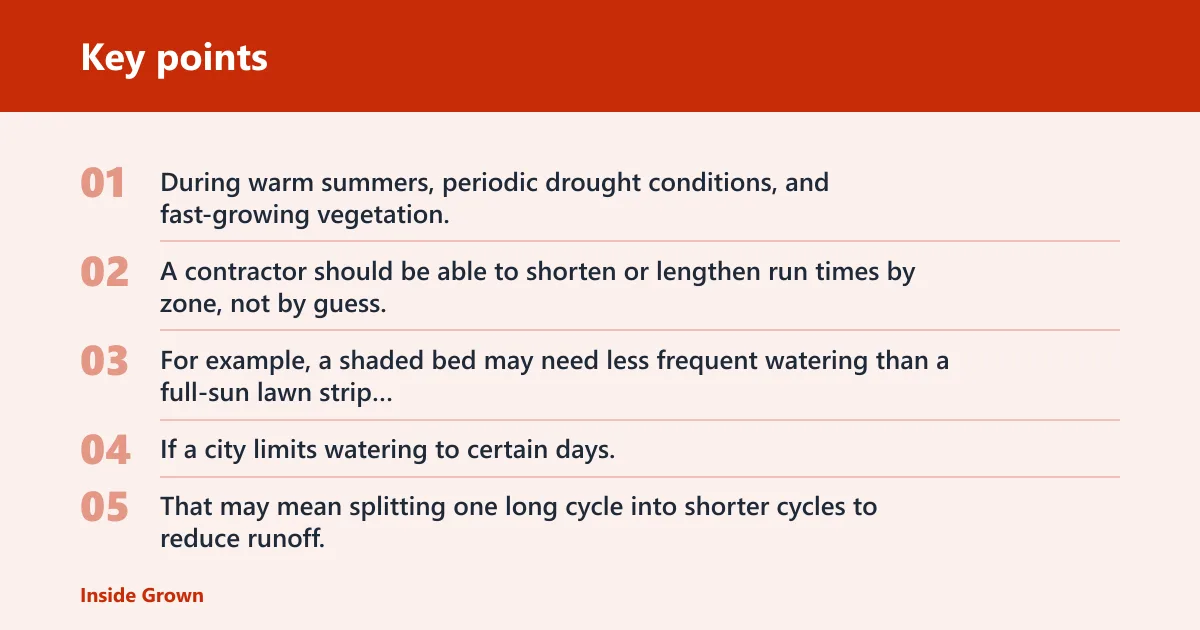
During warm summers, periodic drought conditions, and fast-growing vegetation, sprinkler timing often needs a reset. A contractor should be able to shorten or lengthen run times by zone, not by guess. For example, a shaded bed may need less frequent watering than a full-sun lawn strip near a curb.
Examples of schedule changes for city restrictions
If a city limits watering to certain days, the controller should be reprogrammed so every zone fits the allowed window. That may mean splitting one long cycle into shorter cycles to reduce runoff. It may also mean moving start times earlier in the morning so water soaks in before heat and wind increase evaporation.
Picture a 6-zone system that now has only two permitted watering days. A competent provider should reduce run time where soil stays wet, stretch cycles on the hottest zones only, and confirm that the lawn is not shedding water down a slope into the driveway.
How to tell whether the controller needs reprogramming
If the system runs too long after rain, waters during restricted hours, or leaves dry strips even though the heads look fine, the controller likely needs reprogramming. A crew may be able to handle that if the issue is scheduling. If the controller fails to respond, that is more likely a specialist job.
How do drainage and irrigation work together?
Irrigation and drainage should be judged together because runoff, slope, and soil saturation change how water reaches the roots. A soggy zone can mean too much irrigation, but it can also mean the yard cannot move water away fast enough. A contractor should look at both before recommending a repair.
Soggy zones, slope runoff, and erosion clues
Standing water near sprinklers, soil washing downhill, or muddy channels after a cycle point to drainage trouble, not just irrigation fault. On slopes, long run times often create runoff before the soil can absorb the water. That is why one zone may look “overwatered” even when the real issue is grading or flow direction.
Drainage fixes that reduce wasted water
Drainage-related services can include dry creek beds, erosion management, and stormwater protection. Sunlit Landscapes lists dry creek beds for drainage issues among its services, which is the kind of add-on that can stop repeated puddling near a sprinkler zone. Sunlit Landscapes also says Georgia yards face warm summers, periodic drought conditions, and fast-growing vegetation, so runoff control and irrigation timing should be adjusted for the climate, not left generic.
When dry creek beds or grading changes belong in the quote
If a repair visit keeps finding the same wet patch after valve and head work, ask for a drainage quote instead of another quick fix. The quote should say whether the work is limited to surface grading, a dry creek bed, or soil reshaping around beds and turf. That keeps irrigation repairs from being blamed for a drainage problem they cannot solve alone.
Should you hire a crew or a sprinkler specialist for repairs?

Choose a crew for broken heads, small leaks, spray adjustment, and seasonal maintenance when the company can explain exactly what it inspects and repairs. Choose a sprinkler specialist when the work involves controller failure, electrical faults, major line breaks, backflow testing, or a redesign. The right choice depends on scope, not just the word “repair.”
Licensing, scope, and repair limits to verify
Ask whether the contractor actually performs irrigation repair or only surface adjustments. Ken’s Sprinkler Service offers irrigation installation, maintenance, repair, and backflow test, which is a broader scope than a basic mowing company. Also ask whether the crew checks water supply in gallons per minute and pressure before zone count planning, since that is a sign they can judge whether the system has enough supply for the property.
Parts replacement versus full-system replacement
Repair is usually the better value when the system has isolated failures: a few heads, one pipe section, or a single valve. Replacement or redesign makes more sense when pressure is poor across multiple zones, parts are failing in series, or the layout no longer matches the yard. Ask the provider to state which option is cheaper over the next few seasons, not only on the day of service.
Questions to ask before you approve the work
- What exactly will you inspect: heads, valves, pressure, controller, and visible pipe runs?
- What will you adjust: run times, spray pattern, nozzle type, or zone timing?
- What will you repair on this visit, and what is outside your scope?
- Will you check drainage, slope runoff, or erosion if the lawn is wet in one area?
- Do you handle spring start-up and fall shut down, or only repairs?
- Will you tell me when replacement is a better value than repeated repair?
Frequently asked questions
What services include sprinkler repair and maintenance?
Services that include sprinkler repair and maintenance usually cover broken heads, leaks, pipe damage, freeze damage, tune-ups, and diagnostic inspection. The better providers also adjust spray patterns, reset run times, and check whether drainage problems are making the irrigation issue worse. Ask for that bundle in writing before work begins.
How often should sprinkler systems be serviced?
A practical cadence is spring start-up, one or more in-season checks, midseason tuning, and fall shut down before freezing weather. Systems in hotter months or drought-prone areas may need more frequent monitoring. If the property has slope runoff, fast-growing plants, or frequent clogging, add another inspection during peak summer.
What are signs my sprinkler system needs repair?
Look for broken heads, dry spots, overspray, low pressure, soggy zones, leaking valve boxes, or a controller that runs the wrong zones. Freeze damage often shows up as cracks or poor pressurization in spring. If water pools in one area and the rest stays dry, the problem may involve both irrigation and drainage.
Do crews winterize sprinkler systems?
Many do, but not every crew is set up for irrigation winterization. Ask whether they remove water from pipes and valves, use an appropriately sized air compressor, and can explain pressure limits. The same source recommends fall shut down to winterize sprinkler systems and uses a powerful air compressor, but the right contractor should still describe the process safely and clearly.
What is included in spring sprinkler start-up?
Spring start-up should include slow pressurization, major leak checks, broken-head inspection, zone testing, and controller review. The contractor should not just turn the system on and leave. The visit should confirm that each zone works, that no winter damage remains, and that spray patterns still fit the yard layout.
Can crews adjust sprinklers for watering restrictions?
Yes, many can adjust run times and start times so the system complies with city water restrictions. Ask for concrete examples of the changes, such as shorter cycles for wet soil, split runtimes to reduce runoff, or earlier morning watering during hot weather. If the controller fails to accept changes, a specialist may be needed.