How to Light a Fence Line Without Glare for Privacy
Use low-output, shielded fixtures a few feet from the fence. Aim them downward at roughly a 30–45° angle, and keep the light warm and fairly dim so the fence reads clearly without visible source glare. Bad spacing or exposed bulbs create hot spots, light spill, and complaints from the neighbor side. This guide covers fixture types, brightness, spacing, beam spread, and aiming for privacy-sensitive fence lines.
This guide is part of our Landscape lighting guide series.
Why fence-line glare happens

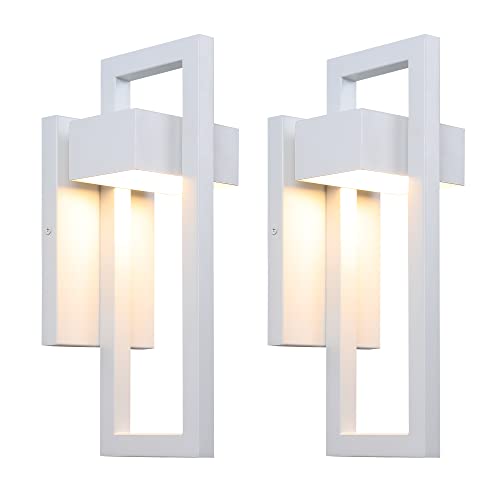
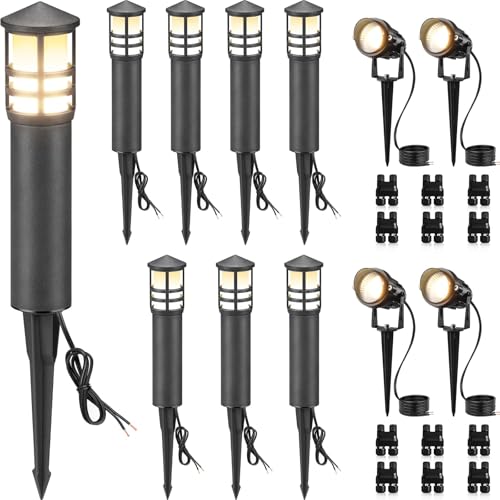
Fence-line glare usually comes from seeing the lamp itself, not only the light it gives off. The fix is simple: hide the source, aim the beam down or inward, and keep output low enough that the fence is visible without turning into a bright strip at eye level.
Side yards and shared fences make the problem harder. Narrow gaps bounce light off siding, windows, and pale fence boards, so even a modest fixture can feel brighter than expected from the neighbor side.
Visible light versus visible source
A fence can read clearly from your yard even when the bulb stays hidden. That is the goal. A shielded fixture, full-cutoff housing, or down-facing design reduces side views of the lamp and cuts the hard edge that causes glare and light trespass.
If the bulb is exposed, the eye locks onto the source first. The fence line may still be lit, but the fixture becomes the brightest object in view, which is usually what people notice from across the property line.
Why side yards and shared fences are harder
Light in a narrow corridor has fewer places to go. It reflects, bounces, and stacks up fast. A 300- to 500-lumen fixture can feel intrusive in a tight side yard even when it sounds modest on paper.
Shared fences also need more restraint. The best setup keeps the beam on your side of the boards and avoids hot spots that spill through gaps, over the top rail, or into neighboring windows.
📊 For most residential outdoor lighting, 2700K is the safest neighbor-friendly range. Source: Best Neighbor-Friendly Outdoor Lights for Low Glare and Safer Yards.
What type of fence light reduces light trespass?
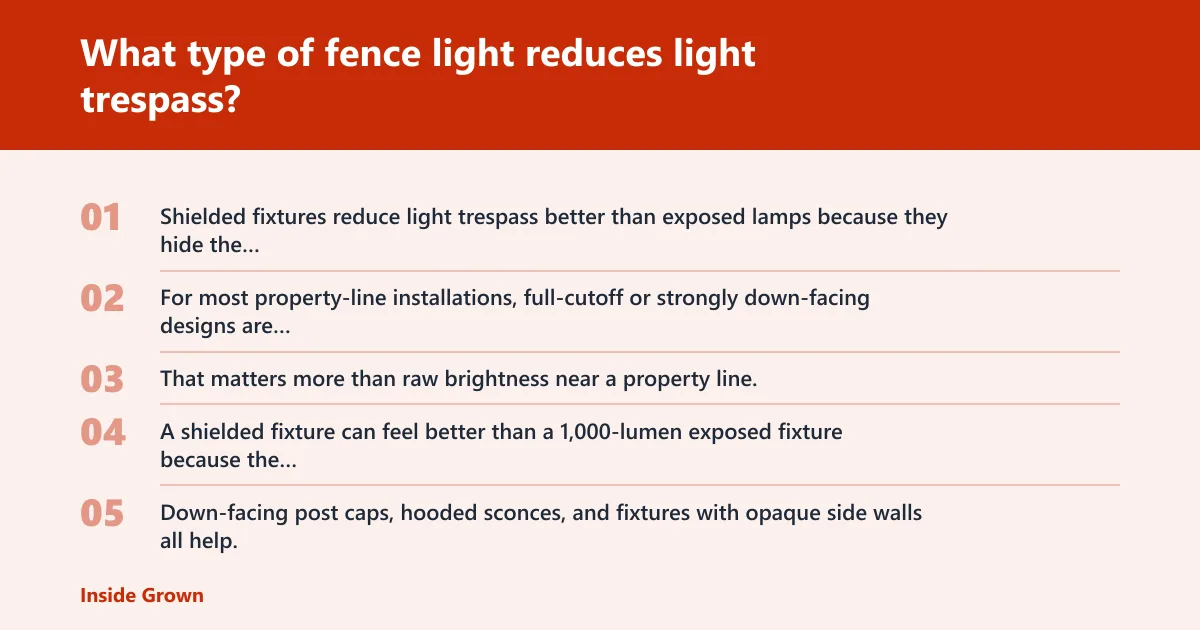
Shielded fixtures reduce light trespass better than exposed lamps because they hide the bulb from side views and direct output where you need it. For most property-line installations, full-cutoff or strongly down-facing designs are the safest starting point.
Shielded outdoor fixtures
Look for housings that block side glare. That matters more than raw brightness near a property line. A shielded fixture can feel better than a 1,000-lumen exposed fixture because the neighbor sees less source brightness, even if the fence itself still looks lit.
Down-facing post caps, hooded sconces, and fixtures with opaque side walls all help. The key is simple: if someone standing beside the fence can see the lamp directly, the fixture is probably too open for a privacy-sensitive line.
Post cap lights versus sconces versus motion lights
Post cap lights sit on fence posts and usually cast a downward or ambient glow. They are the most common fence-light type and are often spaced evenly along long runs. They work best when the cap itself blocks side views of the source.
Fence-mounted sconces attach to the fence face and can wash light down the boards. They are useful when you want a visible rhythm along the line, but they can be too noticeable if the lamp is exposed or the beam spreads sideways.
Motion-sensor fixtures work better for task lighting than for constant ambience. Better products let you aim the sensor across the walking path, so the light turns on when someone approaches rather than firing into open yard space or toward the neighbor side.
When solar works and when 12V wired is the better fit
Solar fence lights offer no wiring and simple DIY installation, which makes them appealing for short runs and accent lighting. Their brightness and runtime depend on sun exposure, and the batteries fade over a few years, so output becomes less predictable over time.
Low-voltage wired lighting uses a 12V system and needs a transformer, but it gives more consistent brightness and supports all-night operation. For long fence lines, shaded yards, or anyone trying to keep the neighbor side dark with precise control, wired 12V is usually the better fit.
How bright should fence lights be?
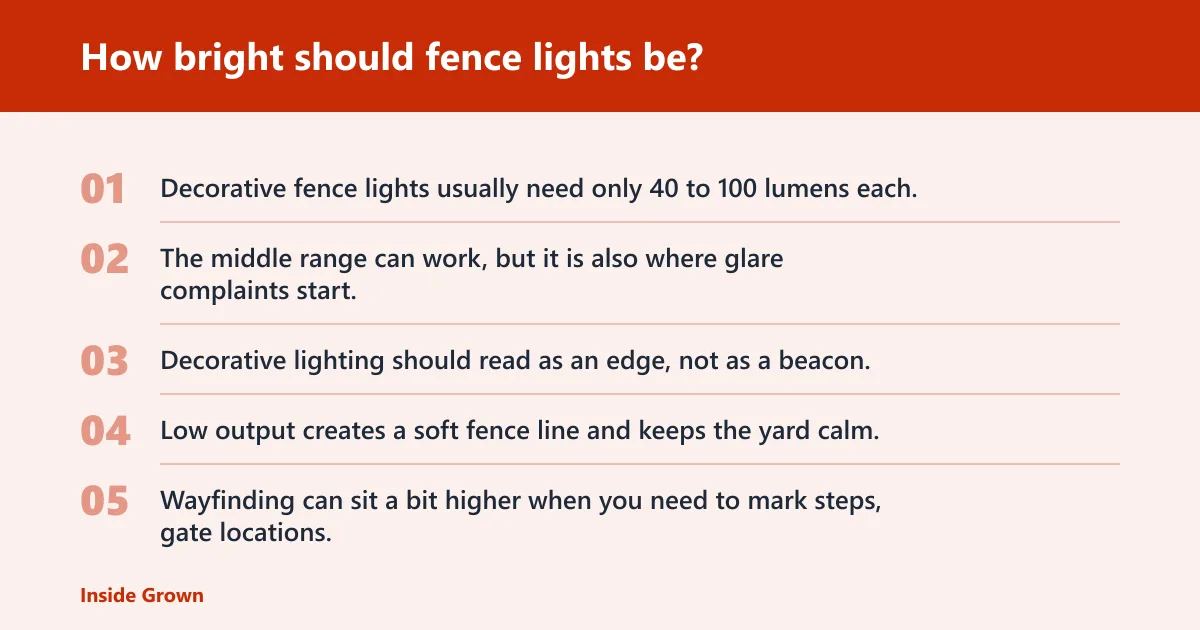
Match lumen output to the job. Decorative fence lights usually need only 40 to 100 lumens each, while security floodlights are in a much higher class at 700 to 2,000 lumens or more. The middle range can work, but it is also where glare complaints start.
Decorative, wayfinding, and security ranges
Decorative lighting should read as an edge, not as a beacon. Low output creates a soft fence line and keeps the yard calm. Wayfinding can sit a bit higher when you need to mark steps, gate locations, or a path along the fence.
Security lighting is a different category. It is meant to reveal faces, movement, and approach routes, so it uses much more output and usually belongs on poles, corners, or wider mounting points rather than on a privacy fence itself.
| Use case | Suggested lumens per fixture | Typical spacing | Best fixture style |
|---|---|---|---|
| Decorative edge lighting | 40 to 100 | 6 to 8 feet for post cap lights | Shielded post cap light |
| Wayfinding along a fence line | 100 to 300 | 8 to 10 feet, adjusted for output | Down-facing post cap or hooded sconce |
| Security-focused lighting | 700 to 2,000+ | Site-specific, not evenly decorative | Motion floodlight or aimed security fixture |
Why moderate output can still feel intrusive
A 300- to 500-lumen fence fixture may sound moderate, but in a narrow side yard it can feel bright and exposed. That is because close walls, short setbacks, and reflective surfaces concentrate the light, making the neighbor-facing side more noticeable than the lumen number suggests.
If the fence is only a few feet from a window or walkway, lower output and tighter shielding usually beat a stronger lamp every time.
What color temperature is best for a fence line?
For many residential fences, a warm color temperature around 2700K to 3000K is often a neighbor-friendly range. Warm white at that level usually looks softer, creates less harsh contrast, and feels more natural against wood, vinyl, and painted fence surfaces than cooler light.
Why warm white reads softer
Warm light tends to blend into a home setting instead of calling attention to itself. Around 2700K to 3000K, fence boards keep their color better, shadows look gentler, and the lit area feels less clinical from across the line.
For most residential outdoor lighting, 2700K is the safest neighbor-friendly range. It is a practical starting point when the goal is visibility without a bright, hard edge.
Why 4000K and above feels harsher
Once you move to 4000K and above, the fence line can look whiter and more severe. That higher color temperature often increases the sense of brightness even when the lumen number has not changed.
Near homes, that can make light seem less private and more obvious. A cooler beam also stands out more in windows and reflective surfaces, which is exactly what you want to avoid along a property line.
How far apart should fence lights be placed?
Post cap lights are typically spaced every 6 to 8 feet as a starting point. Wider spacing can look calmer if the fixture output and shield are strong enough to avoid dark gaps, but the right interval still depends on the beam pattern and fence height.
Spacing as a visual rhythm
Even spacing makes a fence read as one line instead of a row of bright spots. That is useful for decorative lighting, where the goal is gentle continuity rather than maximum brightness.
If the light source is well shielded, you can often widen spacing a little and keep the effect cleaner. The result is less visual clutter and fewer bright points visible from the other side.
When to tighten or widen spacing
Tighten spacing when the fixtures are very low output, the fence is tall, or there are dark pockets between posts. Widen spacing when the fixtures are brighter, the shields are effective, and overlapping pools of light still cover the path or fence face.
Suppose a 6-foot privacy fence has posts every 8 feet and you want a quiet edge line. A low-output, shielded cap on each post may be enough. Add more brightness only if the fence itself remains hard to read after dark.
How do I light a fence line without glare?
Start with shielded fixtures, warm 2700K to 3000K light, and low output. Then aim each fixture downward or inward so the fence is visible from your side while the bulb stays hidden from a normal standing view on the neighbor side.
Three-step aiming test
- Stand on your side and confirm the fence face is readable without a bright source in view.
- Walk to the neighbor-facing side and check whether the bulb, lens, or reflector is visible above eye level.
- Adjust tilt, shield, or mounting height until the light lands on the fence or ground, not into open space.
If the bulb is still visible from the other side, lower the aim or add shielding. If the fence looks too dark, increase overlap between fixtures before increasing brightness.
What to adjust when light spills over
First change the angle. A small tilt often solves more than a bigger fixture does. Next, reduce output or move the fixture a little farther from the line if the mounting point allows it. Only then consider a different family of fixture.
A common first-timer mistake is using a brighter lamp to fix a spill problem. That usually makes the neighbor side more obvious, not less.
Fence-light choices for shared fences and side yards
On a shared fence, the safest approach is to keep light low, downward, and close to your side of the structure. Decorative edge lighting can work well there. Real security lighting usually belongs away from the line unless the beam can be tightly controlled.
Decorative edge lighting versus actual security lighting
Decorative lighting is for visibility, rhythm, and a calm perimeter. Security lighting is for detection and deterrence. Those two jobs use different brightness targets, different spacing, and different mounting logic.
If the fence is close to a neighbor’s window or patio, decorative lighting is usually the better fit. If the area needs true security coverage, use a separate motion light aimed across the walking path rather than straight at the fence.
Motion sensor settings that reduce nuisance bursts
Motion sensor fixtures should be adjusted so the sensor looks across likely movement, not into the neighbor side. Better products let you aim the sensor across the walking path, which reduces false triggers from wind, pets, or distant motion.
A good motion light should trigger within about 8 to 20 feet. That range is useful for side gates and access paths, but it can be too sensitive if the sensor is pointed into shared space.
Fence-line glare control checklist and spacing table
Use this checklist before you buy or mount anything. It keeps the fence readable from your yard while reducing visible source glare and light spill toward the property line.
Fence-line glare control checklist
- Choose a shielded fixture, full-cutoff design, or down-facing housing.
- Use 2700K to 3000K light for a softer residential look.
- Keep decorative output near 40 to 100 lumens per fixture.
- Reserve 300 to 500 lumens for situations where the beam can stay tightly controlled.
- Use 12V wired lighting when you want relatively consistent brightness and long runtimes.
- Use solar only when lower output and sun-dependent runtime are acceptable.
- Start post cap spacing at every 6 to 8 feet.
- Aim each fixture downward or inward, then verify the bulb is hidden from the neighbor side.
- Use motion only where a triggered light is useful and the sensor can be aimed across the walking path.
Quick spacing and brightness guide
| Situation | Starting fixture choice | Starting output | Spacing note |
|---|---|---|---|
| Decorative fence line | Shielded post cap | 40 to 100 lumens | Begin at 6 to 8 feet |
| Wayfinding along a side yard | Down-facing cap or hooded sconce | 100 to 300 lumens | Open up spacing only if pools overlap cleanly |
| Security at a gate or corner | Motion fixture or separate floodlight | 700 to 2,000+ lumens | Do not use decorative spacing rules |
Say your side yard is only 5 feet wide and the fence sits close to a bedroom window next door. A row of exposed 500-lumen sconces would likely feel bright and obvious. A lower-output, shielded 12V cap light spaced more widely would usually read better and bother less.
Frequently asked questions
How do I light a fence line without glare?
Use shielded fixtures, warm 2700K to 3000K light, and low output. Aim each light downward or inward so the fence is visible from your side but the bulb stays hidden from a normal standing view on the other side. A quick three-step aiming check helps catch spill before final mounting.
What type of fence lights reduce light trespass?
Shielded outdoor fixtures reduce light trespass best. Full-cutoff designs, down-facing post cap lights, and hooded fence-mounted sconces keep the source out of side view. That matters more near property lines than simply choosing a lower-lumen bulb.
How far apart should fence lights be placed?
Post cap lights are typically spaced every 6 to 8 feet as a starting point. Wider spacing can work when the output is low and the shield is effective. If gaps appear dark, improve overlap before increasing brightness.
What color temperature is best for fence lighting?
Warm white around 2700K to 3000K is usually best for a residential fence line. It looks softer, feels less harsh, and is generally more neighbor-friendly than 4000K and above. Cooler light can make a fence feel brighter and more exposed.
Are solar fence lights bright enough for a fence line?
Solar fence lights can work for decorative or light wayfinding use, especially where wiring is impractical. Their brightness and runtime depend on sun exposure, and batteries fade over a few years. For steady output and longer nightly use, wired 12V lighting is usually more dependable.
Should I use low-voltage or solar for fence lights?
Use low-voltage wired lighting if you want consistent brightness, better control, and all-night operation. Use solar if you want no wiring and an easier DIY install, and if lower output and sun-dependent runtime are acceptable. Near a property line, control usually matters more than convenience.
Can I put lights on a shared fence without spilling light across the line?
Yes, if you keep the fixtures shielded, low-output, and aimed downward or inward. Mount them so the neighbor-facing side stays dark, then check from both sides before finishing. If the bulb is visible from next door, the fixture needs more shielding or a different placement.