
How to Review a Landscaping Contract Before Signing
Before signing, review the contract carefully and check the scope, materials, timeline, payment terms, and change-order language. Miss one vague clause, and you can pay extra for work you thought was included, or fight over delays and dead plant replacements. I compare every clause to the quote, flag loose wording, and turn the agreement into a plain work spec.
What you’ll need before you read the contract
- The written quote or proposal
- The site plan, drawing, or scope notes
- Any emails or texts that promise plants, cleanup, schedule, or warranty details
- A copy of the contract with room to mark changes line by line
- A pen or checklist to compare scope, price, and dates against the quote
How to review a landscaping contract before signing
- Match every line of the scope to the quote, and stop if tasks are missing, broader than the proposal, or buried in general language.
- Check payment terms for the total price, pricing structure, deposit, installment schedule, and invoice timing; ask for revision if the math or due dates do not line up.
- Verify the schedule for a start date, an estimated completion date, and any milestones; require written delay language if weather, inspections, or material lead times could move the job.
- Confirm who supplies plants, soil, mulch, stone, fixtures, irrigation parts, and equipment; reject any substitution rule that lets the contractor swap materials without approval.
- Read change-order language for written approval, cost impact, and schedule impact before extra work starts; then check the termination clause for breach, notice, and dispute steps.

What should I check in a landscaping contract before signing?

Check the contract against the quote, not against memory. A landscaping contract is a formal, legally binding agreement, so the paper should name the work, price, timing, materials, and approval process in plain terms. If any of those are vague, the contractor can bill extra or change the plan later.
Scope of work: what has to be spelled out
The scope should define lawn maintenance, garden design, irrigation, tree pruning, or hardscaping, depending on the job. For install work, look for exact tasks such as planting, edging, mulch, cleanup, and haul-away. For maintenance work, the contract should also say how often visits happen and what is included each visit.
Watch for broad phrases like “as needed,” “general landscaping,” or “miscellaneous site work.” Those words can hide extras. If the quote lists bed prep, planting, drip line installation, and final cleanup, the contract should list those same items. Anything not named is a likely dispute later.
Payment terms: what should be in the contract?
Payment terms may use hourly rate, fixed price, or cost per square foot. The contract should spell out the total price, any upfront deposit or installments, when invoices are issued, and when payments are due. If the contract does not say when the money moves, the homeowner carries the risk.
| Payment term | Acceptable wording | Stop-sign red flags |
|---|---|---|
| Pricing structure | “Fixed price for the listed scope” or “hourly rate with a cap stated in writing” | “TBD,” “time and materials,” or no total price at all |
| Deposit | Deposit amount is stated and tied to a signed scope | Large deposit with no written scope or refund rule |
| Invoices | Invoice timing and due dates are stated in the contract | “Pay as billed” with no billing schedule |
| Installments | Each installment is tied to a milestone or stage of work | Payments due before the related work starts |
Timeline: how to tell whether it is realistic
Look for a start date and an estimated completion date. The contract may include milestones or deadlines for phases, which is helpful on larger installs. If planting depends on weather, irrigation inspection, or hardscape delivery, the agreement should say how delays are handled and who must give the update.
A realistic timeline names the bottlenecks. If the schedule says “two weeks” but the quote includes special-order plants, irrigation parts, and a patio build, that timeline may be a little optimistic. Ask for written language on pauses, rescheduling, and notice when material or inspection delays occur. If deadlines matter, require a status update process in writing.
Materials and equipment: who brings what
The contract may clarify whether the provider supplies materials and equipment. That matters because plant grades, stone size, soil type, mulch color, and irrigation parts can change the final result. If the contractor can substitute items, the contract should require approval before any swap happens.
Look for wording on allowance, substitution, and shipping or rental costs. A clause that lets the contractor choose “equivalent materials” without saying who approves the change is too loose. So is a contract that leaves equipment costs off the table until the last invoice arrives.
What should a landscaping contract say about change orders?
Change orders should be handled in writing before any extra work begins. The contract should say how changes are requested, who approves them, how the price changes, and whether the schedule changes too. Without that, even a small request can become a billing fight.
Change-order language that protects the homeowner
Look for three things: written approval, a stated cost impact, and a stated schedule impact. If the contractor finds extra root removal, drainage work, or a better plant substitution, the price should be documented before the work continues. Verbal “okay” is too easy to forget later.
Reject any wording that says the contractor may proceed and bill later. Also reject vague phrases like “client agrees to reasonable additions.” Reasonable to whom? If the contract does not define the approval trail, ask for one signature line or one email approval method, and make that process part of the agreement.
Termination clause and dispute language
The termination clause can cover breach, unsatisfactory performance, or dispute resolution. Check for notice period, what counts as a breach, and whether mediation is required before a lawsuit or payment dispute. A clear exit clause does not mean conflict will happen; it means the homeowner knows the steps if it does.
If the contractor can walk away for nonpayment, the homeowner should also be able to end the job for repeated missed milestones, unsafe work, or refusal to correct defects. The clause should say how final billing, materials on site, and incomplete work are handled.
Proof asset: use the homeowner contract review checklist
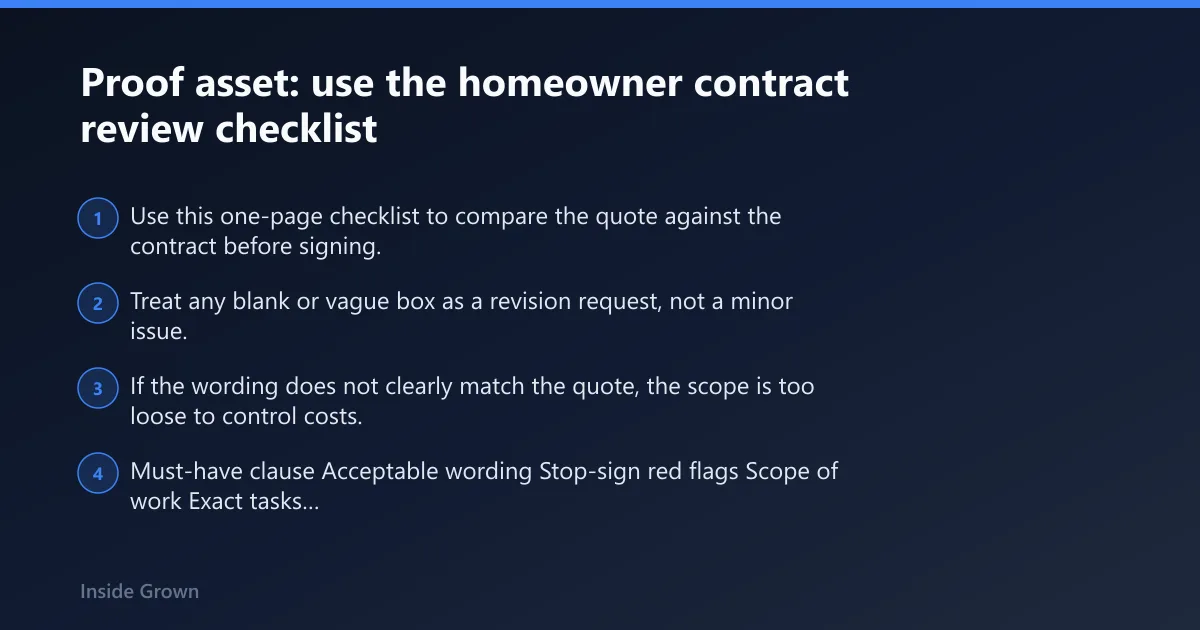
Use this one-page checklist to compare the quote against the contract before signing. Treat any blank or vague box as a revision request, not a minor issue. If the wording does not clearly match the quote, the scope is too loose to control costs.
| Must-have clause | Acceptable wording | Stop-sign red flags |
|---|---|---|
| Scope of work | Exact tasks listed, including exclusions and visit frequency where relevant | “Landscaping services,” “general maintenance,” or no exclusions |
| Payment terms | Total price, pricing structure, deposit amount, and invoice timing stated | No total, vague billing, or payment due before work is defined |
| Timeline | Start date, estimated completion date, and milestone dates included | “As soon as possible” or no date for completion |
| Materials and equipment | Who supplies plants, materials, and equipment is stated | Substitutions allowed without notice or approval |
| Change orders | Written approval required before extra work begins | Verbal approvals, “time-and-materials” add-ons, or open-ended extras |
| Termination | Notice period, breach language, and dispute resolution included | No exit language or one-sided termination rights only |
Sign only if: the deposit is stated, the scope matches the quote, the timeline is dated, and every change order needs written approval.
What should a landscaping contract say about recurring maintenance billing?
Seasonal landscaping billing should confirm the active scope, price, effective date, and approval trail before renewal. Recurring maintenance is different from one-time install work because the risk is repeated billing for a package that drifted from what was first approved. The contract should state the service package and renewal timing clearly.
Recurring maintenance review points
Confirm the visit frequency, the exact service list, and the renewal date. If the package says weekly mowing but the invoice covers pruning, bed cleanup, and fertilizer without a new approval trail, the scope has already changed. Recurring invoices should be reviewed against a register before sending.
Before renewal, check whether the price changed, whether the active scope changed, and who approved it. If the provider wants to add seasonal cleanup, irrigation startup, or extra visits, that addition should appear in writing with the effective date. No trail means no approval.
What should I do if the contract feels too vague to sign?
If the contract is too vague, it is usually better not to sign until it is clarified. Ask for revisions that match the quote line by line, and reject any clause that leaves scope, pricing, or approvals open-ended. A contract that cannot be compared to the proposal is not ready.
If that didn’t work, try this next
- Mark every mismatch between the quote and the contract.
- Send one revision request that lists the missing scope, dates, payment terms, and approval language.
- Ask for a clean redraft, not margin notes, when the contract leaves too many blanks.
- Walk away if the contractor refuses written change control, especially on substitutions, deposits, or deadlines.
Prevention: keep the quote, contract, and every approval email in one folder before work starts. That trail prevents later arguments over what was included.
Common mistakes homeowners make
The biggest mistake is treating a verbal promise as if it were written. Verbal agreements can be ambiguous and easily forgotten or misunderstood. Another common failure is signing before the quote and contract match, which lets hidden extras slip in after work starts.
Homeowners also miss maintenance frequency, cleanup standards, and plant substitution rules. Those gaps cause real disputes. A contractor may think the job included only mowing, while the homeowner expected edging, trimming, and debris haul-away. If the contract does not spell it out, assume it is missing.
Even smaller projects can involve deposits, materials, timing, and change orders. Do small jobs still need a written contract? Yes, if the scope, price, or schedule matters at all. A signed page beats a memory.
Frequently asked questions
What should I check in a landscaping contract before signing?
Check scope, price, schedule, materials, and change-order language against the quote line by line. The contract should name the work, state the total price, set dates, and explain who approves extra work. Any blank or vague section needs revision before a signature goes on it.
Is a verbal agreement enough for landscaping work?
No. Verbal agreements can be ambiguous and easily forgotten or misunderstood. Use a written contract with the scope, payment terms, timeline, and approval rules in the document. If the contractor will not write it down, the homeowner has little protection when the bill or schedule changes.
What payment terms should be in a landscaping contract?
The contract should state the total price, whether the job is hourly rate, fixed price, or cost per square foot, and whether there is a deposit or installments. It should also say when invoices are issued and when each payment is due, so no one guesses later.
How do I know if the scope of work is specific enough?
It is specific enough when the contract lists exact tasks and exclusions. Look for named items such as planting, irrigation, hardscaping, pruning, mowing, cleanup, edging, or mulch, plus visit frequency for maintenance work. If the language says “general landscaping,” the scope is too loose.
What should a landscaping contract say about change orders?
It should require written approval before extra work begins, and it should state how cost and timeline changes are recorded. The safest wording says no change is valid until both sides approve it in writing. That keeps a small request from turning into an unexpected bill.
Do small landscaping projects still need a written contract?
Yes. Small projects still create disputes over deposits, materials, cleanup, timing, and what was actually included. A short written agreement can define scope, payment, and approval rules without adding much time. That document is often what prevents a cheap job from becoming an expensive argument.