
Why Landscape Lights Keep Tripping the Transformer
A low-voltage lighting transformer usually trips for three reasons: too much wattage on the circuit, a wire short, or moisture in a fixture, splice, or transformer housing. Ignoring the cause can leave lights dead, damage the transformer, or create a shock hazard. This guide gives a fast symptom-by-symptom order to identify which fault you have in minutes.
Why are your outdoor lights tripping?


A transformer trips to protect itself or the circuit feeding it. The usual causes are overload, a short in the low-voltage run, moisture at a buried splice or fixture, or a control problem that keeps cycling power. Start with the symptom pattern, then test the power source before replacing parts.
What the transformer is protecting against
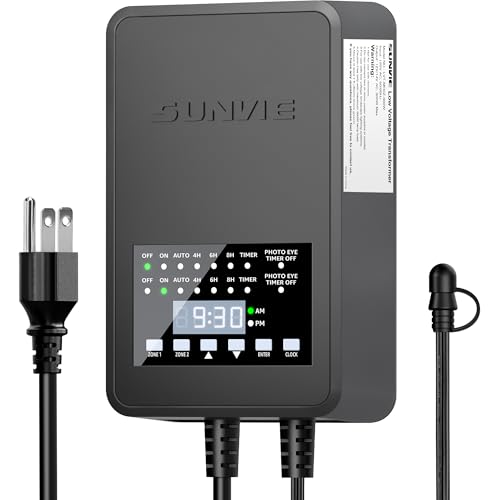
A low-voltage lighting transformer steps 120V house power down to 12 to 15V, and it is rated in watts. Many low-voltage lighting transformers are commonly reported to have multi-tap outputs for different voltage drops. If the total fixture load is too high, or if the transformer’s internal protection senses a fault, it may shut off or cycle on and off.
How to sort overload, short, and moisture from the first symptom
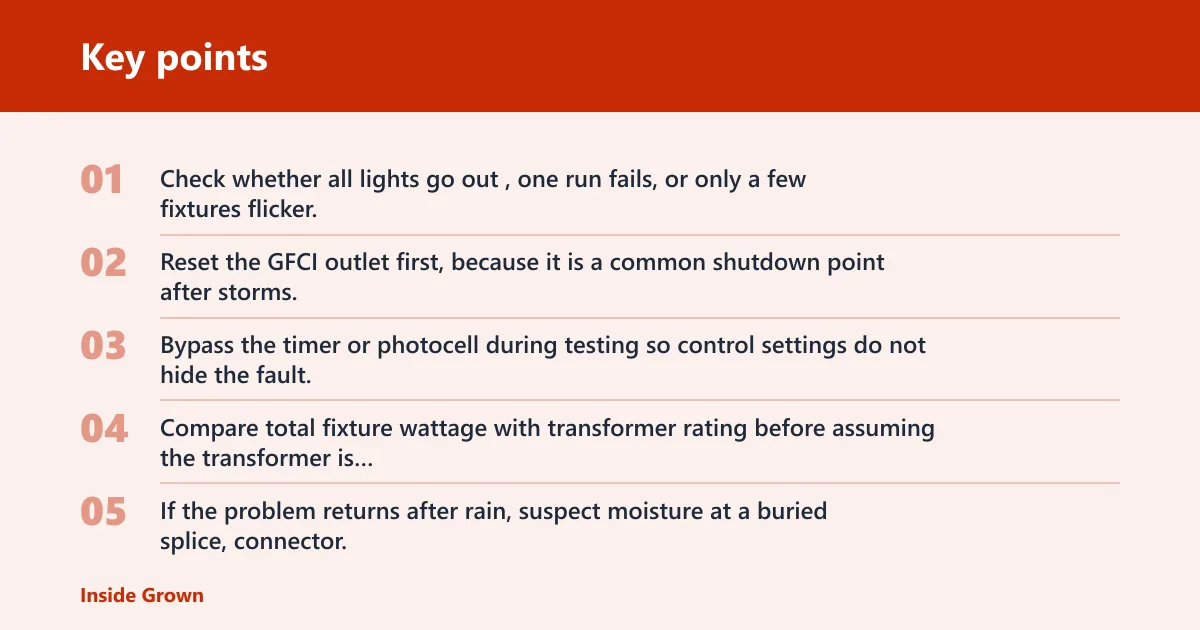
- Check whether all lights go out, one run fails, or only a few fixtures flicker.
- Reset the GFCI outlet first, because it is a common shutdown point after storms.
- Bypass the timer or photocell during testing so control settings do not hide the fault.
- Compare total fixture wattage with transformer rating before assuming the transformer is bad.
- If the problem returns after rain, suspect moisture at a buried splice, connector, or fixture housing.
Say your system has ten LED fixtures at 3 watts each on a 150-watt transformer. That load is only 30 watts, so overload is unlikely. If the lights still trip only after rain, the next test should move toward a wet splice, corroded connector, or fixture socket.
Transformers and GFCI outlets: what to check first
Start at the power source. A GFCI outlet can trip and shut down the transformer, especially after wet weather, and a transformer can also trip on internal protection if its load is too high. If the unit has a timer or photocell, bypass it first so you are testing the transformer and wiring, not the control device.
Reset the GFCI before anything else
Many outdoor lighting systems are fed from a GFCI outlet. If that outlet has tripped, the transformer may look dead even when it is fine. Reset the GFCI, then check whether the transformer powers up. If it trips again immediately, that points to a downstream fault or moisture issue, not a simple timer problem.
Check the transformer label and tap settings
Troubleshooting often begins by checking the transformer’s model label, ratings, and terminal arrangement. Confirm the watt rating, then look at any multi-tap output settings. A unit set to the wrong tap can create low voltage at the far end of the run, which may look like a fixture failure when the real issue is voltage drop.
Bypass the timer or photocell during testing
A timer or photocell can lose its settings after a power interruption, drift out of sync, or fail. During troubleshooting, switch the system to constant on if the transformer allows it, or bypass the control device briefly. That removes one variable and helps separate control trouble from a short or overload.
Low-voltage lighting diagnostic matrix
This matrix separates the main symptom patterns into likely causes and the exact next test. Use it before swapping bulbs, transformers, or connectors. The point is to move from symptom to test in one step, not to guess at the bad part.
| Symptom pattern | Likely cause | Exact next test |
|---|---|---|
| All lights go out | GFCI trip, transformer internal protection, failed timer or photocell, no input power | Reset the GFCI, then bypass the timer or photocell and check transformer input and output |
| Trips after rain | Moisture in a buried splice, waterproof connector, fixture housing, or transformer enclosure | Unplug or disconnect suspect branches, dry the wettest section, then restore one run at a time |
| One run fails | Open cable, shorted wire, damaged buried splice, bad connector | Disconnect that run at the transformer and test it separately for continuity and visible damage |
| Blinking or on-off cycling | Transformer overload protection, intermittent short, moisture-related fault | Measure total wattage, then disconnect half the load and see whether cycling stops |
| Only far-end fixtures dim | Voltage drop from long wire runs, wire gauge too small, load imbalance | Check the tap setting, then compare the far-end voltage with the transformer output under load |
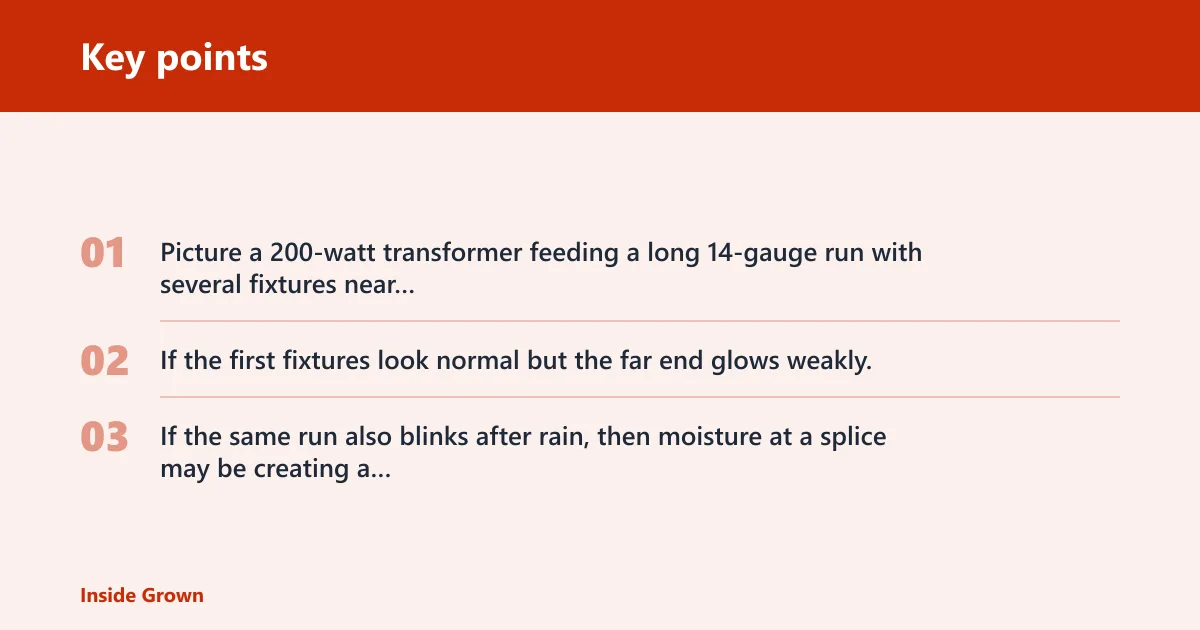
Picture a 200-watt transformer feeding a long 14-gauge run with several fixtures near the end. If the first fixtures look normal but the far end glows weakly, voltage drop is the first suspect. If the same run also blinks after rain, then moisture at a splice may be creating a separate fault.
Can too many lights overload the transformer?
Yes. Too many fixtures can overload a transformer, and overload protection may shut the unit off or make the lights blink repeatedly. The fix is not always a bigger box, but the right sized one for the actual wattage on the circuit. Compare the sum of fixture wattage with the transformer rating before changing parts.
How to total fixture wattage
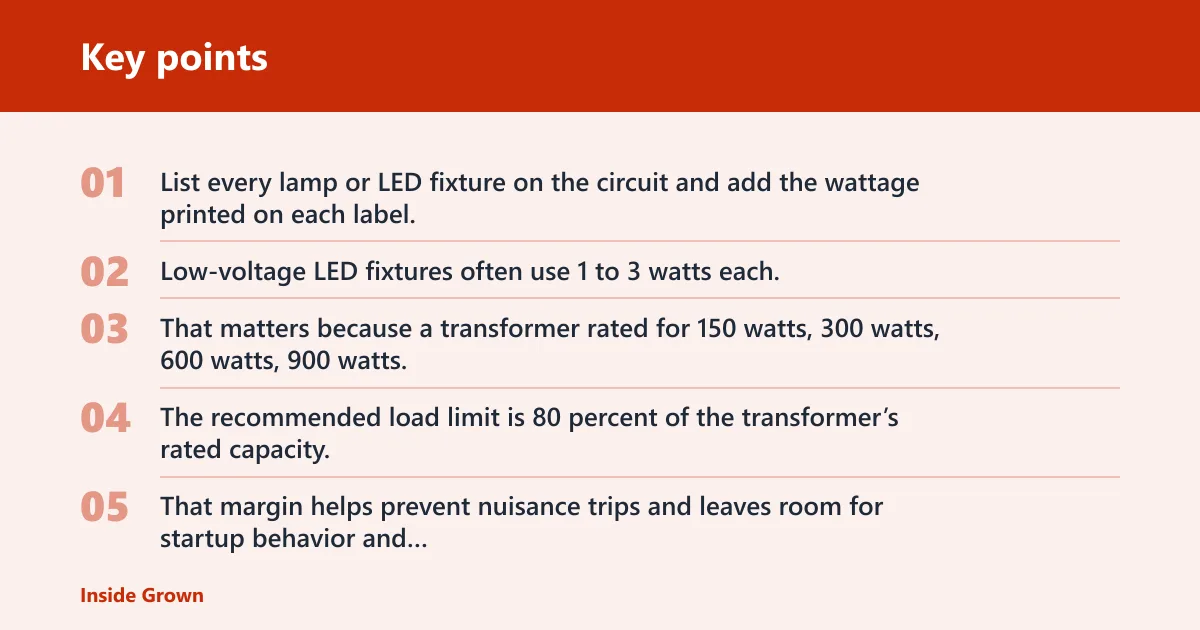
List every lamp or LED fixture on the circuit and add the wattage printed on each label. Low-voltage LED fixtures often use 1 to 3 watts each, so a big-looking system may still be light on total load. That matters because a transformer rated for 150 watts, 300 watts, 600 watts, 900 watts, or 1200 watts should not be treated as if all of that capacity is usable.
Why the 80 percent rule matters
The recommended load limit is 80 percent of the transformer’s rated capacity. That margin helps prevent nuisance trips and leaves room for startup behavior and real-world wiring losses. A 300-watt load needs a transformer above 375 watts, so installers round up to 600 watts rather than squeezing the circuit onto the smallest acceptable unit.
Load-check worksheet
| Worksheet item | Value | Pass or flag |
|---|---|---|
| Transformer rating | ________ watts | Use the nameplate rating |
| 80% capacity limit | Transformer rating × 0.8 = ________ watts | Flag if load is above this number |
| Total fixture wattage | ________ watts | Compare against the 80% limit |
| Result | Load is below / at / above limit | Above limit means overload risk |
If the load is over about 80 percent of rating, do not assume a bad transformer. First reduce the load, split the circuit, or move to a larger unit. A transformer that is already near capacity can behave like a failing part even when it is only doing overload protection.
Is the short in the wire or fixture?
A short can come from buried wire, a bad waterproof connector, or a fixture problem. The clue is where the fault shows up. If one run fails while others stay on, the wire or splice is more likely. If one fixture flickers or dies by itself, the socket and lamp contacts deserve attention first.
Signs of buried cable damage
Wire is commonly buried 6 to 12 inches deep, and low-voltage fixtures are often connected with 12- or 14-gauge wire. Cuts, crushed insulation, and corrosion in the buried cable can create shorts. Long cable runs can also need 10-gauge wire to manage voltage drop, especially when the load is spread far from the transformer.
Signs of a bad waterproof connector
A waterproof connector at a buried splice should keep moisture out. If it fails, water can enter, corrode the conductors, and create intermittent power or blinking after rain. A bad connector can absolutely cause the transformer to trip if the moisture creates a low-resistance fault on the circuit.
Fixture socket and lamp contact checks
Fixture sockets and lamp contacts can corrode or oxidize. That often shows up as one fixture failing, flickering, or working only when touched or moved. Remove the lamp, inspect the socket, and look for heat damage, green corrosion, bent contacts, or moisture inside the housing before blaming the transformer.
Why do lights trip after rain?
Rain-triggered trips usually point to moisture at a connector, splice, fixture, or the transformer housing itself. Water may not fail the system right away; it often creates a fault only when the circuit is energized. A system can seem fine in dry weather and then trip again after the next storm.
Moisture entry at splices and connectors
Moisture in buried connectors can cause blinking after rain. A waterproof connector that has loosened, cracked, or been installed poorly can admit water and begin corroding the wire ends. The result may be intermittent power, a GFCI trip, or transformer cycling that returns after the splice dries out.
Corrosion that appears only under load
A corroded splice may pass a quick visual check and still fail once the lights draw current. That is why rain-related faults can be hard to catch in minutes. The next test is to disconnect the wettest section, dry it, and restore power to one branch at a time so you can identify which part trips the system.
How to isolate a wet section safely
- Turn off power before touching buried splices, fixtures, or transformer terminals.
- Reset the GFCI only after you have separated the branches.
- Reconnect one run at a time and watch for a trip.
- Leave any connector that shows water, corrosion, or heat damage out of service.
A common first-timer mistake is replacing a fixture before checking the wet splice upstream. Suppose one branch trips every time it rains, while the other branch works normally. That pattern points to a localized moisture fault, not a whole-system failure.
Frequently asked questions
Why do my outdoor lights keep tripping the transformer?
Most repeated trips come from overload, a short in the low-voltage run, or moisture in a connector, fixture, or transformer housing. Start with the GFCI, then bypass the timer or photocell, and compare the total fixture wattage to the transformer rating before replacing parts.
How do I know if a light short is in the wire or fixture?
If one whole run fails, the buried cable, splice, or connector is the first place to check. If only one fixture flickers or dies, inspect the socket, lamp contacts, and housing first. Disconnecting the run and testing each branch separately usually separates those faults quickly.
How do I test a lighting transformer for failure?
Check whether the GFCI is tripped, then bypass the timer or photocell and verify the transformer’s input and output. If it still shuts down with a light load, the unit may have internal protection or a fault. Compare the load against the nameplate before deciding the transformer has failed.
How much load should a lighting transformer handle?
Keep the connected load under about 80 percent of the transformer’s rated capacity. That margin helps avoid nuisance trips and reduces stress on the unit. If the circuit is near or above that level, a larger transformer or a split load is the safer fix.
Why do my lights flicker or blink on and off?
Blinking can come from overload protection, moisture in a buried connector, or an intermittent short. It can also come from a bad socket or corroded lamp contact at one fixture. If the whole system blinks, check load and transformer protection first; if one branch blinks, focus on that run.