How to Reuse Old Potting Soil Without Harming Plants
Reuse old potting soil only if it has no disease, pests, or salt buildup, then refresh it with about 25% to 50% new mix. Skip reuse for high-risk crops. Bad mix can spread root disease, stunt seedlings, and waste a full container season. This guide explains how to inspect old potting soil, decide whether it is usable, and recondition it without hurting plants.
Quick answer


Yes, but only after a quick check for disease, pests, and salt buildup. Potting soil is usually a peat-based or coco coir-based soilless mix with perlite, vermiculite, compost, bark, or fertilizer, and it often breaks down after one season in containers. Reuse is safest for established plants in clean, still-draining mix, not for seed-starting or disease-prone plants.
Container-grown plants pull nutrients out faster than in-ground beds, and repeated fertilizing raises salt buildup risk. That means reused mix can work for tomatoes, herbs, and annual flowers if the soil still feels open and odor-free, but it is a poor choice for seedlings, cuttings, succulents, and houseplants that hate wet feet. Extension guidance also warns that soilborne pathogens can carry over in reused media, and that seedling mixes need extra cleanliness because young roots are especially vulnerable to damping-off and root disease. University of Minnesota Extension and Clemson Extension both emphasize disease-control limits in reused or heat-treated media.
Diagnosis
Before you decide to reuse old potting soil, sort the problem into one of four buckets: disease carryover, salt buildup, compaction, or simple nutrient depletion. That diagnosis matters because the fix is different for each one. University extension recommendations on container media note that a mix can look usable yet still hold salts, disease organisms, or a collapsed structure that makes roots struggle even after fertilizing. University of Minnesota Extension
Decision table
| Soil condition | Likely problem | Safest action | Plant types appropriate for reuse |
|---|---|---|---|
| Disease history | Root rot pathogens, damping-off, or fungal contamination | Discard; do not reuse for any crop that shares the same container family | None; use fresh mix only |
| White crust on rim or surface | Salt buildup or fertilizer residue | Flush if mild, then replace part of the mix and reduce fertilizer rate | Established herbs, tomatoes, annual flowers |
| Dense, muddy, or hard-packed texture | Particle breakdown and compaction | Fluff, sieve out debris, and blend in coarse material | Established container plants only |
| Visible gnats, larvae, or crawling pests | Pest presence in the media | Pasteurize only if infestation is light; discard if heavy or repeated | Low-risk ornamentals after treatment |
| Clean but depleted mix | Nutrient loss after a growing season | Refresh with 25% to 50% new mix plus amendments | Tomatoes, herbs, annual flowers, established foliage plants |
Reconditioning steps
Recondition old potting soil by removing debris, opening up air space, and replacing some of the nutrients and structure it lost in containers. A common rule is to mix in 25% to 50% fresh material, with the higher end often used for smaller pots, heavier feeding crops, or soil that has compacted noticeably.
What you’ll need
- A bucket, tarp, or wheelbarrow for sorting the old mix
- Gloves and a hand fork or trowel
- A sifter or your gloved hands for removing roots and clumps
- Fresh potting mix for partial replacement
- Fresh compost or worm castings for biological activity
- Perlite or coco coir to restore aeration and water retention
- A trash bag for diseased or pest-heavy material
- Sift out roots, stems, and dead leaves.
- Break apart clods with your hands or a trowel.
- Check the texture; if it feels dense, add about 1 part perlite for every 3 parts reused soil, or use coco coir when the goal is more water retention, then recheck drainage.
- Blend in 1 part fresh compost or worm castings for every 4 parts old mix when the soil is clean but tired.
- Add a balanced slow-release fertilizer at the label rate, or refill nutrients with a measured liquid feeding after potting.
- Use the refreshed mix only after it drains freely through the pot holes.
Pasteurization
Pasteurization can help when disease risk is low to moderate and the goal is to reduce pathogens, fungus gnats, and weed seeds. It is not a fix for exhausted structure, and it is not appropriate for soil that is already sour, slimy, or badly infested. Heat treatment is best used as a targeted cleanup step for media that is otherwise worth saving. Clemson Extension and several university greenhouse programs describe pasteurization, not true sterilization, as the safer target because overcooking the mix can damage texture while still failing to solve deeper media problems. Clemson Extension
Use pasteurization only when the mix is clean enough to reuse except for a limited pest or disease concern. If the potting soil has a history of root rot, repeated damping-off, a strong sour smell, or heavy insect pressure, the better call is disposal. Heat does not restore structure, and it does not make diseased or heavily infested media “good as new.”
Target pasteurization temperatures are usually about 140°F to 160°F for roughly 30 minutes, with the lower end preferred for less damage to the medium. Many extension sources recommend keeping the center of the mix in that range long enough to suppress most problem organisms, but not exceeding it for long periods because overheating can bake particles together and reduce pore space. Clemson Extension University of Minnesota Extension
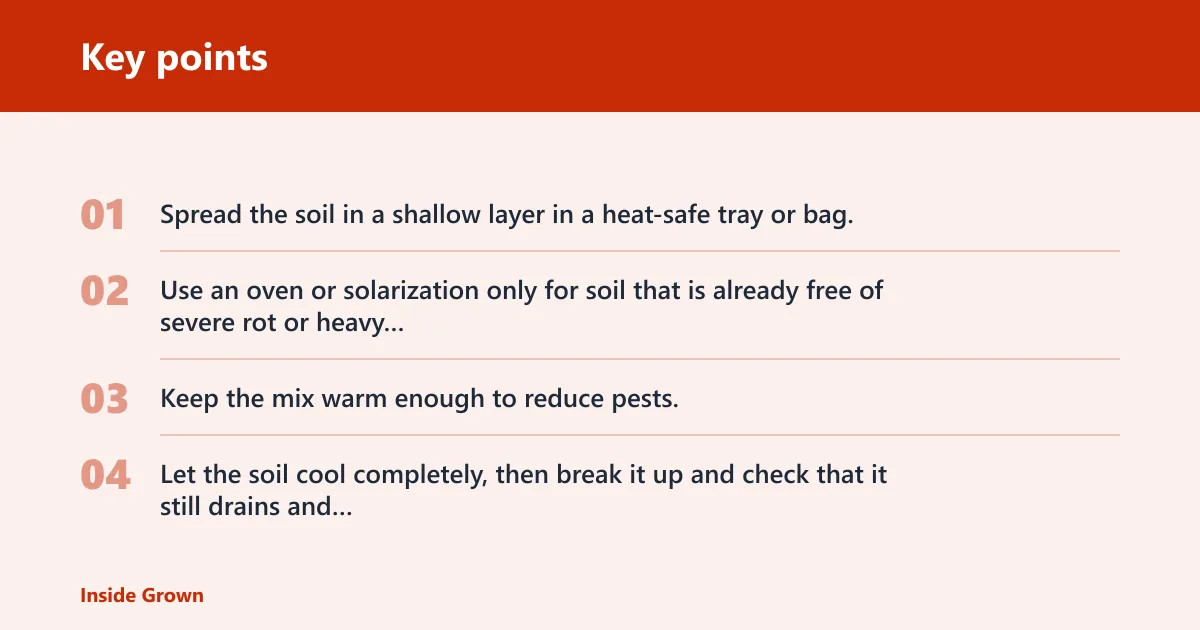
- Spread the soil in a shallow layer in a heat-safe tray or bag.
- Use an oven or solarization only for soil that is already free of severe rot or heavy infestation.
- Keep the mix warm enough to reduce pests, but avoid overheating that bakes the particles together.
- Let the soil cool completely, then break it up and check that it still drains and crumbles.
Because heat can reduce beneficial life as well as pests, pasteurized soil should be recharged with compost or worm castings before planting. If the mix still smells sour or feels paste-like after cooling, discard it instead of trying to save it.
When to discard
Discard old potting soil when it held diseased plants, when pests keep coming back, or when the texture and smell point to decay rather than simple depletion. Soil-borne disease is a clear stop sign, because root rot pathogens and damping-off organisms can survive in debris and infect the next crop.
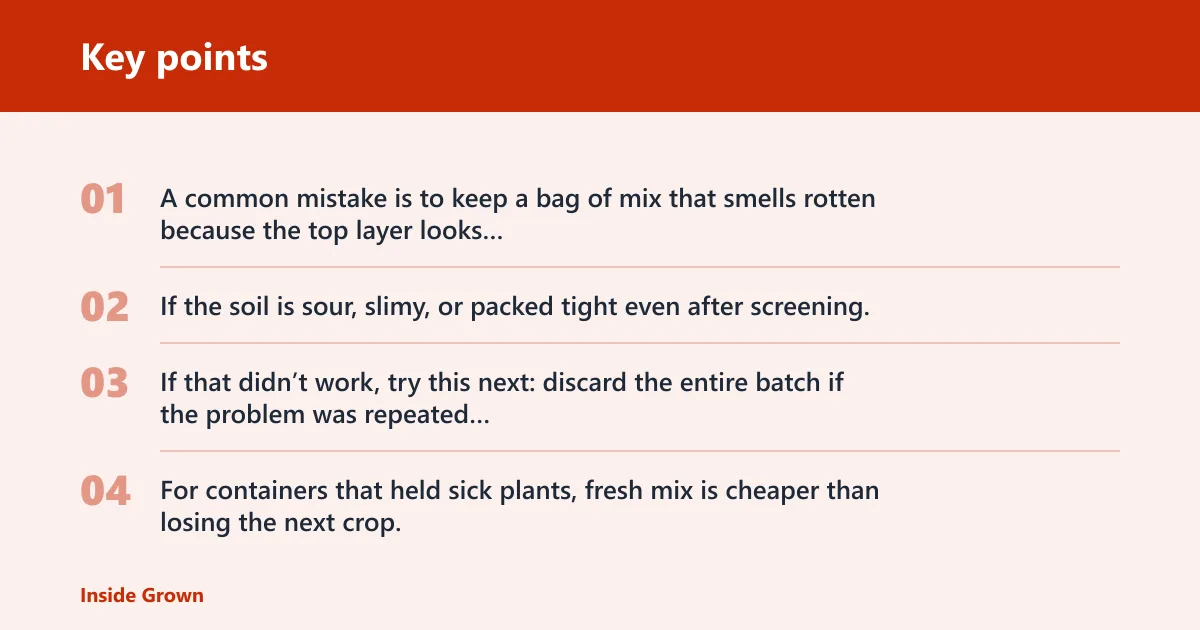
A common mistake is to keep a bag of mix that smells rotten because the top layer looks normal. If the soil is sour, slimy, or packed tight even after screening, replacement is safer than another round of repairs.
If that didn’t work, try this next: discard the entire batch if the problem was repeated fungus gnats, a strong rotten odor, or a plant death that looked like root rot. For containers that held sick plants, fresh mix is cheaper than losing the next crop.
Plant-by-plant reuse guidance
The safest reuse choice depends on how forgiving the crop is. Seedlings and cuttings need the cleanest, loosest media because they are the most sensitive to damping-off, salt residue, and waterlogged pockets. Larger, established container plants can tolerate more recycled mix if drainage stays strong. Seed-starting guidance from university horticulture programs consistently favors fresh, fine-textured media for young plants. University of Minnesota Extension
| Plant type | Reuse risk | Recommended refresh ratio | Best practice |
|---|---|---|---|
| Seedlings | High | 0% to 25% reused soil | Use mostly fresh mix; skip reused soil if disease or salts were present |
| Cuttings | High | 0% to 25% reused soil | Use fresh, airy media with excellent drainage |
| Succulents | Moderate to high | 25% to 40% reused soil | Only reuse if the mix is loose and fast-draining; add extra mineral material if needed |
| Houseplants | Moderate | 25% to 50% reused soil | Best for established foliage plants in clean, odor-free media |
| Herbs | Moderate | 25% to 50% reused soil | Works well if the mix is screened and nutrients are refreshed |
| Tomatoes | Moderate | 40% to 50% reused soil | Refresh heavily because tomatoes are high feeders and sensitive to poor drainage |
| Annual flowers | Low to moderate | 25% to 50% reused soil | Suitable for healthy, screened mix with added fertilizer |
FAQ
Can old potting soil be reused next year?
Yes, if it is clean, drains well, and did not hold diseased plants. Reusing old potting soil often works best after screening out roots and replacing about 25% to 50% of the mix with fresh material. For seed trays and cuttings, start with new mix instead.
How do you know if old potting soil is still safe to use?
Safe mix smells earthy, crumbles instead of packing, and shows no white crust, mold, or pest activity. If it has a sour smell, a greasy feel, or plant failure linked to rot, discard it. The best test is drainage: water should move through, not sit on top.
How do you replenish old potting soil?
Replace lost nutrients and structure with about 1 part fresh mix for every 1 to 1.5 parts old mix, then add compost or worm castings at roughly 10% to 25% of the blend. For weak drainage, fold in perlite or coco coir before potting.
Can you reuse potting soil in containers?
Yes, and containers are where reuse matters most because nutrient depletion and salt buildup happen faster than in garden beds. Use the freshest reused mix for established tomatoes, herbs, and annual flowers. Keep seed-starting mix, cuttings, and rot-prone houseplants on a clean batch.
How do you recondition old potting soil?
Start by removing roots and debris, then judge whether the main issue is depletion, salt, or compaction. Refresh with 25% to 50% new mix, add compost or worm castings for biological activity, and use perlite or coco coir when the goal is better aeration or water retention.
What should I do with old potting soil?
Screen it, sort it, and decide whether it belongs in the reuse pile or the trash. Clean, tired soil can go into larger containers for established plants. Soil from diseased pots, sour-smelling mix, or heavy pest pressure should be discarded, not recycled.
Is pasteurization the same as sterilization?
No. Pasteurization reduces many pests and pathogens, but it does not create a completely sterile medium. More importantly, it does not rebuild structure, remove salts, or fix soil that has already broken down. If the mix is diseased, sour, or badly compacted, replace it instead of heating it.
What temperature should potting soil reach during pasteurization?
Use a controlled range of about 140°F to 160°F for roughly 30 minutes, with many growers aiming near 160°F at the center of the mix. Higher temperatures increase the risk of baking the media and reducing pore space, which hurts roots even if pests are reduced.
Can I reuse soil that had fungus gnats?
Yes, if the infestation was mild and the mix is otherwise clean, airy, and odor-free. If gnats were persistent or the soil stayed wet and slimy, discard the batch. Gnats are often a sign of a broader moisture or breakdown problem rather than a standalone issue.