How to Fix Soggy Soil in Low Spots and Stop Repeat Puddles
Fix soggy soil in a low spot by first finding the cause: a shallow depression needs fill and regrading, compacted soil needs aeration, and water that keeps arriving from elsewhere needs drainage. If you guess wrong, the wet patch comes back, roots rot, and any fill you add can sink or wash out. This guide shows how to tell those cases apart and pick the right fix before you move a shovel of soil.
Check the wet spot first
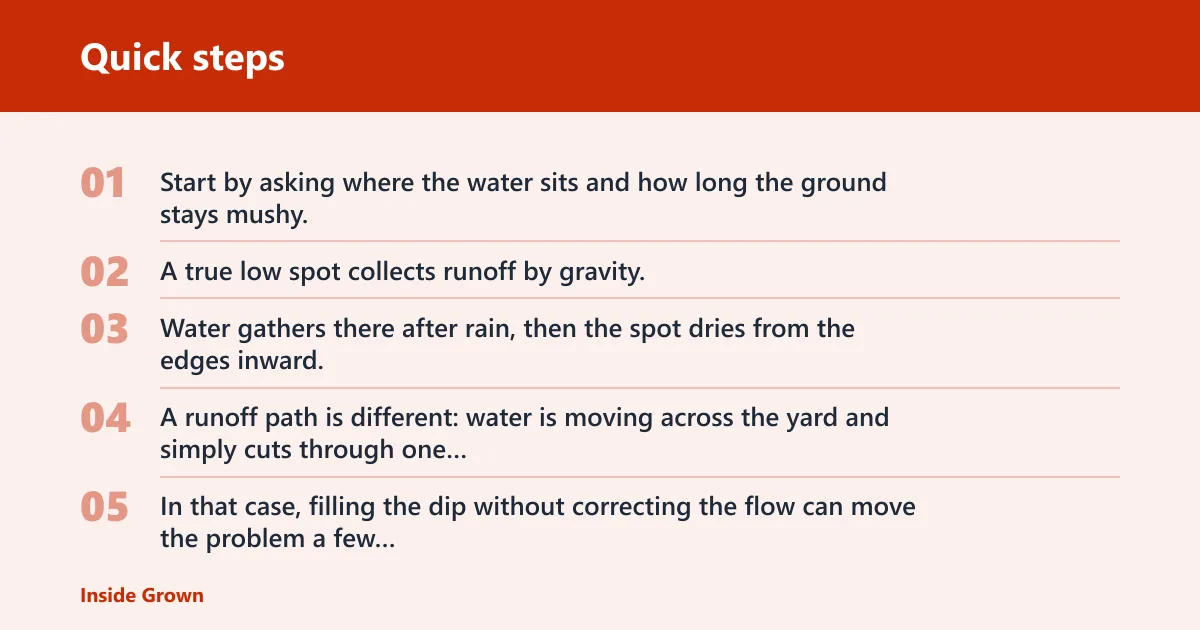


Start by asking where the water sits and how long the ground stays mushy. A true low spot collects runoff by gravity, while a broader drainage problem leaves the surface wet in several places or keeps the soil damp below the top layer. The fix changes with that distinction.
True depression versus runoff path
A true depression is a dip in the grade. Water gathers there after rain, then the spot dries from the edges inward. A runoff path is different: water is moving across the yard and simply cuts through one area on its way downhill. In that case, filling the dip without correcting the flow can move the problem a few feet away.
Surface wetness versus deep saturation
If the top inch or two is soft but the soil below is firming up, the issue is often surface grading or compacted turf. If the area stays wet below the surface, or the ground feels mushy underfoot for days, the cause is more likely slow drainage, clay soil, seepage, or a perched water table. That is when surface fill alone usually fails.
Lawn, bed, or foundation-adjacent area
The location matters. In a lawn, you can often correct a shallow dip, loosen compacted soil, or redirect roof runoff. In a bed, the repair may include compost and a new grade around shrubs or perennials. Near a foundation, do not guess. Water that sits beside a wall needs a more careful drainage plan.
What is making the soil stay wet?

The repair should match the cause. Clay soil holds moisture longer than sandy soil, compacted soil blocks air and water movement, and roof runoff or hillside flow can overwhelm a flat area. If water keeps returning from below the surface, or from a higher part of the site, the problem is bigger than a shallow dip.
Clay soil and slow drainage
Clay has small pore spaces, so it drains slowly and can stay waterlogged after normal rain. That does not mean every clay area needs a drain. Often, the first step is adding compost and fixing the grade so water can move off the surface instead of sitting on top.
Soil compaction and blocked pore space
Compacted soil is a common cause of lawn drainage problems. Heavy foot traffic, equipment, or repeated wetting can press soil particles together, which cuts down the pore space roots need. Core aeration helps when the soil is moist but not soggy, because the plugs it removes give water and air a path downward.
Downspouts, grading, and uphill runoff
Downspouts are a common source of excess water near low spots. If roof runoff empties beside the problem area, the spot can stay wet no matter how much soil you add. The same goes for uphill runoff. A low area that receives flow from above usually needs water redirected before any filling or topdressing.
Groundwater seepage or perched water
If the wet area stays damp long after rain ends, and the moisture seems to come from below rather than from the surface, seepage or a perched water layer may be involved. That is not a normal fill-and-level problem. It may call for a drain line, a swale, or professional help if the area is near the house.
Low spot decision table
This table matches the wet area to the repair that fits best. Use it as a quick filter before you dig, add soil, or install drainage. The wrong fix can bury the symptom and leave the cause untouched.
| Site condition | Recommended action | What not to do | Why this fits |
|---|---|---|---|
| Puddle clears after rain, and the area is a shallow dip in turf | Fill in thin lifts, then regrade so water sheds away from the low point | Do not topdress once and stop, or bury the dip under a thick layer | A surface depression needs a corrected slope, not just more soil on top |
| Soil feels tight, grass struggles, and the surface is not a true dip | Core aerate when the soil is moist, then top-dress lightly with compost | Do not aerate saturated ground, and do not use sand as the main fix | Compaction blocks pore space; loosening the soil restores movement of air and water |
| Water comes from roof runoff or uphill flow into a low area | Redirect downspouts, then use regrading or a swale to move water away | Do not fix the dip first while leaving the runoff source in place | The water source will keep feeding the spot unless you change its path |
| Soil stays wet below the surface, even when the top looks better | Use a French drain or other subsurface drainage, after checking the grade | Do not rely on fill alone, and do not assume a shallow repair will solve it | Saturation below grade usually points to slow drainage that needs an outlet |
| Wet area sits next to a foundation or wall | Call a professional before digging, and inspect downspout discharge first | Do not trench blindly or build a mound against the structure | Water near a foundation can cause bigger problems than a soggy lawn spot |
Can you fill the low spot?
Yes, if the issue is a shallow depression and the surrounding grade already drains well. Fill is generally best when water is pooling because the surface has dipped, rather than because the soil is saturated from below or being fed by runoff. Use it to restore shape, not to hide a drainage fault.
When fill works
Fill is the right move for a small yard dip, a settled patch in a lawn, or a bed edge that dropped below the surrounding grade. It is generally used in layers, with each layer compacted lightly before the next is added. That reduces later settling and keeps the repair from sinking.
What fill material to use
Use a fill that matches the site. For lawns, a screened topsoil mix is usually safer than chunky fill because grass roots need a fine, even surface. In beds, topsoil mixed with compost is often better because compost improves soil structure in heavy soil and helps drainage without creating a dense cap.
Do not use a sand-heavy mix as a universal fix for clay. Sand alone can leave heavy soil with a poor texture and poor drainage behavior. Compost is the safer amendment when the goal is better structure, especially in clay-based soil that holds water too long.
How to avoid settlement after filling
Work in thin lifts and let the area settle before final smoothing. If you dump all the soil at once, the top can look level while the sublayer later sinks. A common first-timer mistake is to feather the last inch and stop there; the spot may look repaired, then sink again after the next few storms.
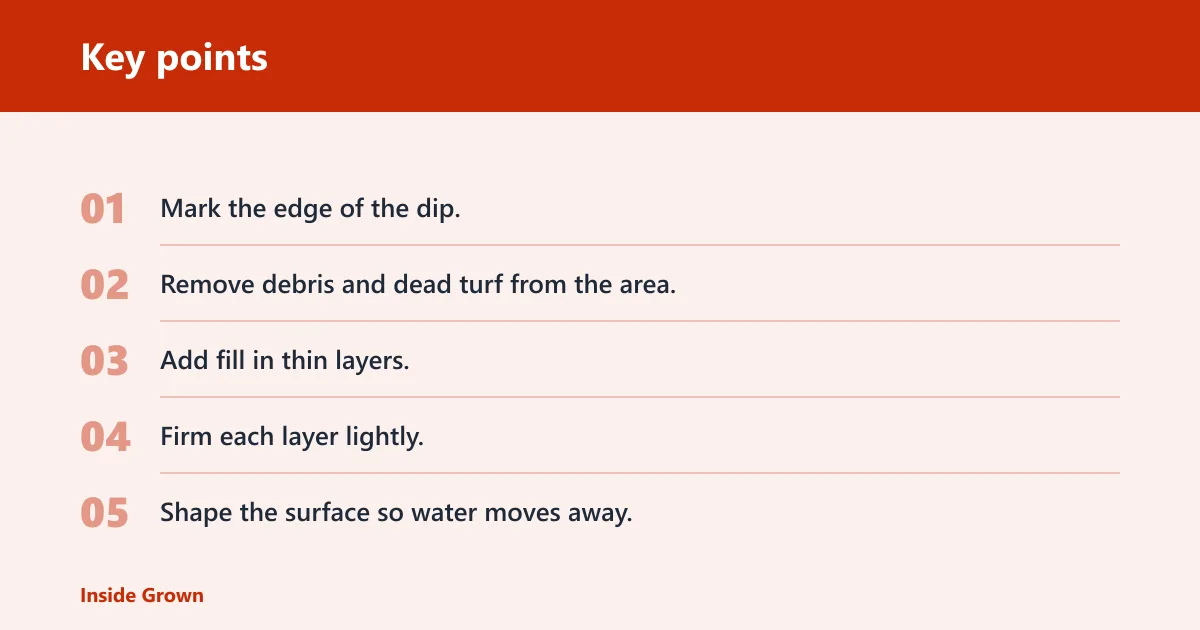
- Mark the edge of the dip.
- Remove debris and dead turf from the area.
- Add fill in thin layers.
- Firm each layer lightly.
- Shape the surface so water moves away.
- Water lightly only if the soil is workable and not saturated.
When fill alone will fail
Fill alone fails when the surrounding slope still points water at the area, when runoff from a roof or hillside keeps entering the spot, or when the soil stays saturated below the surface. In those cases, the new soil becomes a temporary lid over the same problem. The puddle returns, and the repair settles unevenly.
For example, a front lawn might have a roughly 6-foot-wide dip that holds water near the walkway after storms. If the surrounding yard drains well and the soil below is not constantly wet, filling and regrading can work. If the same dip sits below a downspout, the downspout must be redirected first.
Should you regrade instead?
Regrading is the better fix when the problem is a slope issue rather than a hole. A gentle grade away from the wet area lets water move off the surface instead of gathering in one place. If the surrounding contours are wrong, topdressing alone will not hold the change.
Gentle slope away from the problem area
The goal is not a steep hill. It is a smooth, shallow slope that moves water away from the low area and toward a safe discharge point. Regrading can be small and local, but it has to be continuous. Any flat pocket left behind can become the next puddle.
When a shallow regrade beats topdressing
If the low spot spans a broader section of lawn or bed, a shallow regrade beats a simple fill patch. That is especially true when the surface is collecting runoff from the yard above it. Regrading changes the path of the water, while topdressing only changes the height at one point.
How to pair regrade work with downspout changes
Do not fix the grade and leave a downspout dumping nearby. Extend the downspout to a discharge point that sends water away from the repair area. Then finish the regrade so the surface supports the new flow path. That pairing is often what keeps a repaired low spot from returning.
How do you improve the soil itself?
If the issue is compaction or heavy clay, you need to change the soil structure, not just the surface shape. Core aeration and compost are the main tools here. Use them when the soil is firm but still workable. If it is saturated, wait until it drains enough to avoid smearing and further compaction.
Core aeration for compacted turf
Core aerators pull plugs from the lawn and open channels for air and water. That helps when turf is thin, the ground feels tight, and puddling happens in areas that are not true depressions. Aeration is a good first repair on lawns with compacted soil, but it is not the fix for standing water fed by another source.
Compost as a top-dressing or amendment
Compost improves soil structure in heavy soils, especially clay. It can be used as a light top-dressing over turf or blended into a bed during repair. The goal is to help particles aggregate, which improves drainage and root movement over time. Use it as support, not as a thick blanket that smothers the surface.
Why sand alone is a poor fix for heavy clay
Sand-heavy repairs can backfire in clay. Heavy clay already holds moisture longer than sandy soil, and adding sand without enough organic matter can create a dense mix that still drains poorly. If the area is clay-based, compost is the safer first amendment for structure.
Suppose a backyard bed stays muddy along one edge, but the rest drains normally. If that edge sits in clay and the surface is flat, adding compost and correcting the grade may solve it. Sand alone would change the texture, but it would not fix the slope or the way the water enters the bed.
When drainage needs a channel
Some wet spots need a path for water to leave the area. That is when a French drain, a swale, or downspout changes become part of the fix. These are not first-line answers for every low spot. They make sense when water keeps arriving or stays saturated below the surface.
French drain basics
A French drain uses perforated pipe and gravel to move water away from a wet area below the surface. It fits places where the soil stays saturated beneath the top layer or where a shallow surface fix will not solve the problem. It should follow a correct grade plan, not replace one.
Swales for surface runoff
A swale is a shallow drainage channel that captures and redirects runoff. It is useful where surface water needs a clear path across the yard. For larger contour work, equipment may use a swale bucket, which is designed as an attachment for heavy equipment. It is wide and shallow rather than deep-sided, and the flat top doubles as a level gauge. The shape is ideal for forming drainage paths and landscaping contours.
Downspout extensions and discharge points
Downspout extensions are often the simplest drainage correction. If roof water is aimed at the wet area, send it farther away before you do anything else. A changed discharge point can reduce the load on a repaired low spot and lower the chance that soil work will fail after the next rain.
When to stop and call a professional
Stop and get help if the wet area is beside a foundation, if seepage appears to come from the ground itself, or if the drainage issue spreads across a large part of the yard. Groundwater and subsurface flow can require more than a homeowner fix. Water that does not drain properly can kill grass and invite pests, so serious cases should not be left to guesswork.
Frequently asked questions
How to fix a soggy backyard
A soggy backyard usually needs more than one correction. Start by redirecting downspouts, checking for runoff from higher ground, and finding the wettest areas. Then decide whether the fix is regrading, aeration, compost, or a French drain. If water is coming from below the surface, call a professional.
What to use to loosen soil
Use a core aerator for compacted lawn soil when the ground is moist but not saturated. For beds, loosen soil carefully and work in organic matter such as compost to improve structure. Avoid trying to loosen saturated soil, because that can smear the surface and make compaction worse.
How to improve poor soil
Improve poor soil by fixing the drainage path first, then adding organic matter to improve structure. Compost is the best general amendment for heavy soils, especially clay. If the area is compacted turf, core aeration helps restore pore space. If the area is steep or flat in the wrong way, regrade it first.
How to fix sandy soil
Sandy soil drains faster than clay, so the problem is often not waterlogging but poor moisture retention or settlement. If a sandy area still forms a low spot, correct the grade and add organic matter to improve structure. Do not rely on sand alone as a repair material, because it will not solve the shape issue.