
How Scientists Group Plants by Shared Traits
Scientists group plants by inherited traits first, then by DNA evidence when available, because shared ancestry matters more than similar appearance alone. Ignore that rule, and unrelated plants can land in the same group while real relationships stay hidden. This guide shows how visible traits, function, and genetics work together in plant classification.
What plant classification
Plant classification sorts plants by shared traits and ancestry so related species stay together at each taxonomic rank. In botany, those ranks run from domain to species, and broader groups include more species. The result is a nested system that lets scientists compare plants at different levels of relatedness.
Taxonomy is the hierarchical grouping system used for that job. It orders organisms by shared traits and common ancestry, and plant taxonomy focuses on the relation between plant species and genera. A plant can fit into several ranks at once, from family down to species, because each rank captures a different amount of detail.
Taxonomic ranks in botany
- Domain – the broadest rank.
- Kingdom – a major division within domain.
- Phylum/division – used in botany for large plant groups.
- Class – a narrower grouping.
- Order – groups related families.
- Family – groups related genera.
- Genus – groups closely related species.
- Species – the most specific common rank.
Scientists do not sort plants by one visible feature alone. They compare shared traits, then ask whether those traits point to common ancestry or whether they arose for similar reasons in different lineages.
Scientists often start with observable plant traits such as growth form, leaf arrangement, flower structure, stem anatomy, and ecological behavior like dormancy or dispersal. Then they compare those traits across multiple plants and check whether the pattern matches ancestry. Shared traits can be physical traits, behaviors, or DNA sequence differences.
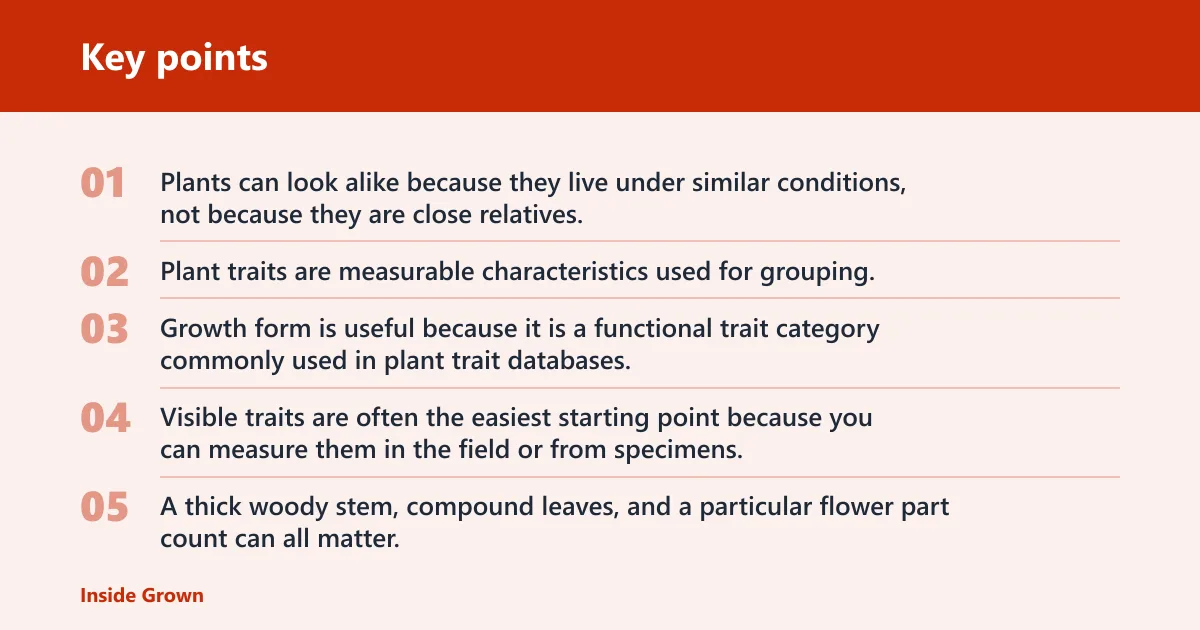
Use visible traits to build a first pass, but do not stop there if the pattern is weak or the trait could have evolved more than once. Plants can look alike because they live under similar conditions, not because they are close relatives.
Observable traits first
Plant traits are measurable characteristics used for grouping. They can be anatomical, such as vessel arrangement or leaf form, or ecological and functional, such as whether a plant is a tree, shrub, or herb. Growth form is useful because it is a functional trait category commonly used in plant trait databases.
Visible traits are often the easiest starting point because you can measure them in the field or from specimens. A thick woody stem, compound leaves, and a particular flower part count can all matter. But a single trait rarely carries the whole classification.
When similar traits mislead
Similarity can mislead when unrelated plants face similar pressures. Two species may both grow as low, spiny shrubs in dry places, yet that shape may reflect adaptation rather than close relationship. That is why appearance alone is not enough.
Suppose two plants both have fleshy leaves and a compact form. If one stores water because it is a desert plant and the other does so for salt tolerance near a coast, the shared look may be functional, not inherited from a recent shared ancestor. Classification should not treat that as proof of close relatedness.
Why ancestry matters more than appearance
Shared ancestry is the basis of classification because inherited traits carry a record of descent. When a trait is inherited from a shared branch point, it can help place plants in the same clade. When a trait evolved independently, it can pull unrelated plants together by mistake.
That is why classification changes when new evidence appears. A visible trait may still be useful, but DNA sequencing can reveal that a trait was lost, gained, or repeated in separate lineages.
What is a phylogenetic tree?
A phylogenetic tree is a visual model of evolutionary relationships. In plants, it uses branches and leaves to show where lineages split and which organisms are being described. Branches mark when evolutionary changes occur, and the pattern of splits helps scientists infer common ancestry.
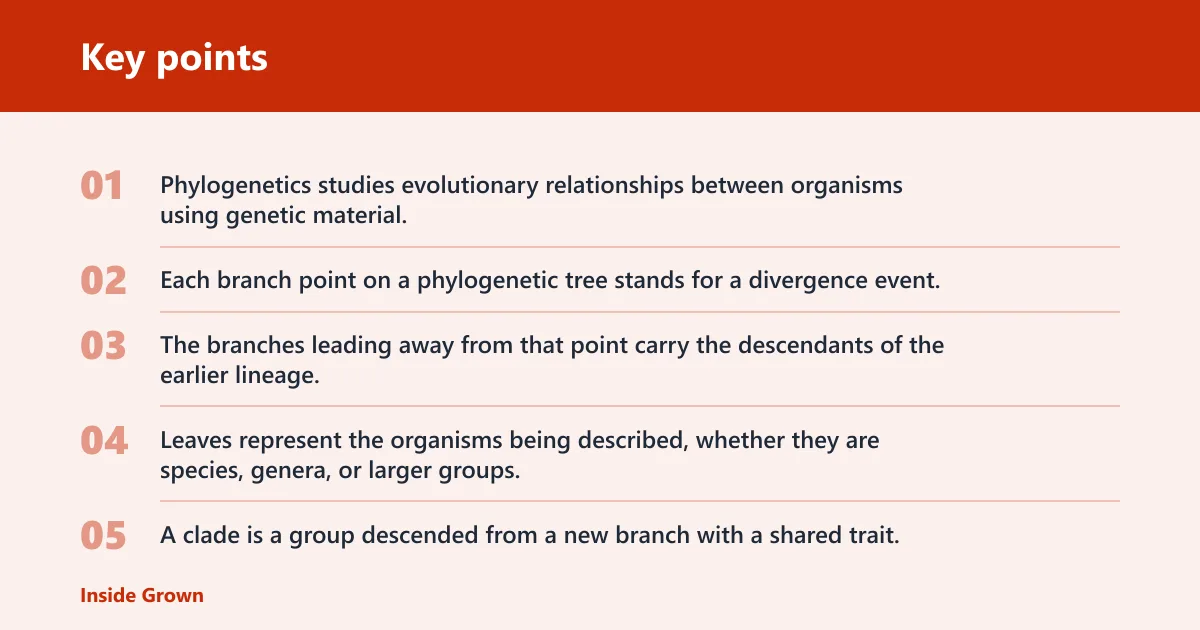
Phylogenetics studies evolutionary relationships between organisms using genetic material. In plant work, that often means comparing DNA sequences alongside visible traits so the tree reflects both what can be seen and what the genome suggests.
Branches, leaves, and common ancestry
Each branch point on a phylogenetic tree stands for a divergence event. The branches leading away from that point carry the descendants of the earlier lineage. Leaves represent the organisms being described, whether they are species, genera, or larger groups.
A clade is a group descended from a new branch with a shared trait. Members of a clade share a common ancestor, and they often share derived traits that appeared after that branch point. In other words, a clade includes an ancestor and all of its descendants.
What a clade means
Clades matter because they reflect history rather than convenience. If two plants sit in the same clade, they belong to the same branch of the tree and are more closely related than plants from different branches. That makes clades especially useful in evolutionary classification.
Picture a tree where all flowering plants are on one branch and ferns on another. The branch split is more informative than a single shared leaf shape, because the tree tracks descent across many traits at once.
Which plant traits matter most?

The most useful traits are the ones that are measurable, repeatable, and tied to inheritance. Structural traits such as leaf arrangement, floral parts, and stem anatomy often help first. Functional traits such as growth form, dormancy, and dispersal can add context, especially when visible structure is limited.
Scientists do not rank every trait equally. A trait matters most when it is consistent within a lineage and less likely to appear independently in unrelated plants. That is why growth form can help, but it rarely settles a relationship on its own.
Structural traits
Structural traits describe plant form and anatomy. Examples include whether stems are woody or herbaceous, whether leaves are opposite or alternate, and whether flowers have fused or separate parts. These traits can be measured directly and compared across specimens.
Structural traits often help separate major groups, especially when many features are available at once. Still, some structures evolve more than once under similar environmental pressure, so they need a second check.
Functional traits
Functional traits describe how a plant works in its environment. Dormancy, dispersal mode, growth rate, and whether a plant is a tree, shrub, or herb all fit here. These traits can be useful because they reflect ecological strategy, not only shape.
A plant may have wind-dispersed seeds, for example, but that does not automatically place it near every other wind-dispersed species. Dispersal is a useful clue, not a final answer.
Growth form
Growth form is one of the most practical plant traits because it is easy to observe and often recorded in trait databases. Tree, shrub, and herb are functional categories, but they do not map cleanly onto a single family or order. Different lineages can arrive at similar growth forms independently.
| Trait type | Example | Reliability for classification | Common mistake |
|---|---|---|---|
| Structural | Woody stem | Moderate; useful with other traits | Assuming all woody plants are close relatives |
| Structural | Leaf arrangement | Moderate to high when paired with flower traits | Using one leaf pattern as a final ID |
| Structural | Flower part count | High in many flowering-plant groups | Ignoring variation within a species |
| Structural | Vessel anatomy | Moderate; strong in some lineages | Treating anatomy as identical across all plants |
| Functional | Tree, shrub, herb growth form | Low to moderate on its own | Equating similar size with close ancestry |
| Functional | Dormancy strategy | Low to moderate | Using seasonal behavior as a family marker |
| Functional | Seed or fruit dispersal | Low on its own; helpful as support | Assuming wind or animal dispersal means relatedness |
| Molecular | DNA sequence difference | High for checking ancestry | Ignoring visible traits entirely |
Why DNA sequencing changes plant classification
DNA sequencing helps scientists tell organisms apart when visible traits are limited, misleading, or shaped by convergence. It is especially important for hard-to-see organisms and for plants whose traits were lost or evolved more than once. DNA can confirm a grouping or show that a trait-based grouping needs revision.
Scientists increasingly use DNA sequences to tell organisms apart. They also use chromosome counting and flow cytometry in plant research, especially when hybridization, polyploidization, or apomixis complicate the picture. Those methods help explain why some plants are hard to sort by appearance alone.
When visible traits are limited
Some plants have few obvious features at the stage being studied, or the key parts are tiny and easy to miss. In those cases, DNA can give a clearer signal than shape alone. That matters when the goal is to place a plant in the correct genus or family.
Plants also vary across life stages. Seedlings, sterile specimens, and vegetative shoots may look similar across unrelated groups, so DNA can provide a check before a name is assigned.
When traits evolved more than once
Convergent evolution can produce the same trait in different branches of the tree. A thorny stem, a succulent body, or a compact shrub form may appear in separate lineages because the same environment favored the same solution. That shared appearance does not guarantee shared ancestry.
DNA helps sort out those cases by testing whether the similar trait sits on the same branch or on different branches. If it appears in separate parts of the tree, the visible trait is functional but not proof of close relation.
How DNA confirms or revises groupings
Scientists compare DNA data with trait data and phylogenetic trees. If both point to the same branch, the grouping is stronger. If they conflict, the classification may change so the groups better match ancestry.
-
List the visible traits.
Record features such as leaf arrangement, flower parts, growth form, and stem anatomy. Use more than one trait, because single traits can mislead when they reflect adaptation instead of ancestry.
-
Compare likely relatives.
Check which plants share several traits at once, not just one. The goal is to find a pattern that could reflect common descent rather than a single shared function.
-
Test the pattern with DNA.
Use DNA sequencing when the visible data are thin, conflicting, or suspiciously similar across different groups. This is the strongest check for whether the trait pattern matches a real clade.
-
Revise the grouping.
If the DNA evidence disagrees with the visible-trait grouping, move the plant to the branch supported by ancestry. Classification should follow the best evidence, not the easiest appearance cue.
Frequently asked questions
What traits do all plants share?
All plants share inherited traits that place them in the plant lineage, but the details vary by group. For classification, the more useful point is that plants are sorted by shared traits and ancestry together. A single visible feature is never enough to capture all plants.
How do scientists group plants by shared traits?
Scientists compare measurable plant traits such as growth form, anatomy, and reproductive structures, then ask whether those traits point to common ancestry. They use a phylogenetic tree to test the pattern. If traits cluster in a way that matches DNA evidence, the grouping is stronger.
Which trait describes plants?
Many traits can describe plants, but growth form is one of the clearest starting points because it is easy to observe and widely used in trait databases. Tree, shrub, and herb are useful functional categories. Even so, growth form alone does not identify a family or genus.
What is the difference between a plant trait and a plant family?
A plant trait is a characteristic, such as leaf shape, dormancy, or growth form. A plant family is a taxonomic rank that groups related genera. Traits help scientists build families, but a trait is a feature and a family is a classification group.
Why do scientists use DNA as well as visible traits to group plants?
DNA adds evidence when visible traits are unclear, missing, or the result of convergent evolution. It can confirm that shared traits came from common ancestry, or it can show that similar-looking plants belong on different branches. That is how classification stays tied to evolutionary relationships.
How many taxonomic ranks are used to classify plants?
The standard list has eight ranks: domain, kingdom, phylum/division, class, order, family, genus, and species. Botanists use these names to place plants from the broadest group down to the most specific one. Broader ranks contain more species and less detail.