How Plants Respond to Stress in Simple Terms
Plants can respond to drought, heat, cold, low or high light, salt, pests, and disease by shifting hormones, closing stomata, slowing growth, and changing leaves, stems, or roots within hours to days. Miss those early signals, and plants lose water, stall growth, and recover more slowly. This guide explains which signals plants detect first, what changes inside them, and why visible symptoms come next.
What plant stress means
Plant stress is a response to a change that makes normal function harder. The trigger can be water shortage, heat, cold, too much or too little light, salt, pests, or disease. The plant does not “feel” stress the way people do. It detects a problem and shifts its internal chemistry to protect itself.
That sequence matters. A trigger starts the response. Signals move through the plant. Internal changes follow. Visible symptoms usually appear after internal changes begin. By the time leaves wilt or yellow, the plant may already have closed stomata, changed hormone levels, and slowed photosynthesis.
Short-term stress versus long-term stress
Short-term stress is brief. A hot afternoon or a dry day can cause temporary changes that reverse if conditions improve. Long-term stress lasts longer and keeps the plant in defense mode. That is when growth slows, leaves age faster, and damage can become permanent.
Acute stress often produces a quick protective response. Chronic stress can drain energy reserves and keep repair systems busy. The same trigger can do both, depending on duration and intensity.
How do plants react at first?
At first, plants react by sensing a problem and sending internal signals that change water movement, gas exchange, and growth. Stomata often close early because they help regulate water loss and carbon dioxide intake. Abscisic acid, or ABA, is one of the hormones commonly linked to helping plants conserve water.
That early response can look helpful, because it reduces water loss. It also has a cost. When stomata close, carbon dioxide entry is limited, so photosynthesis can drop. The plant is trading growth for survival.
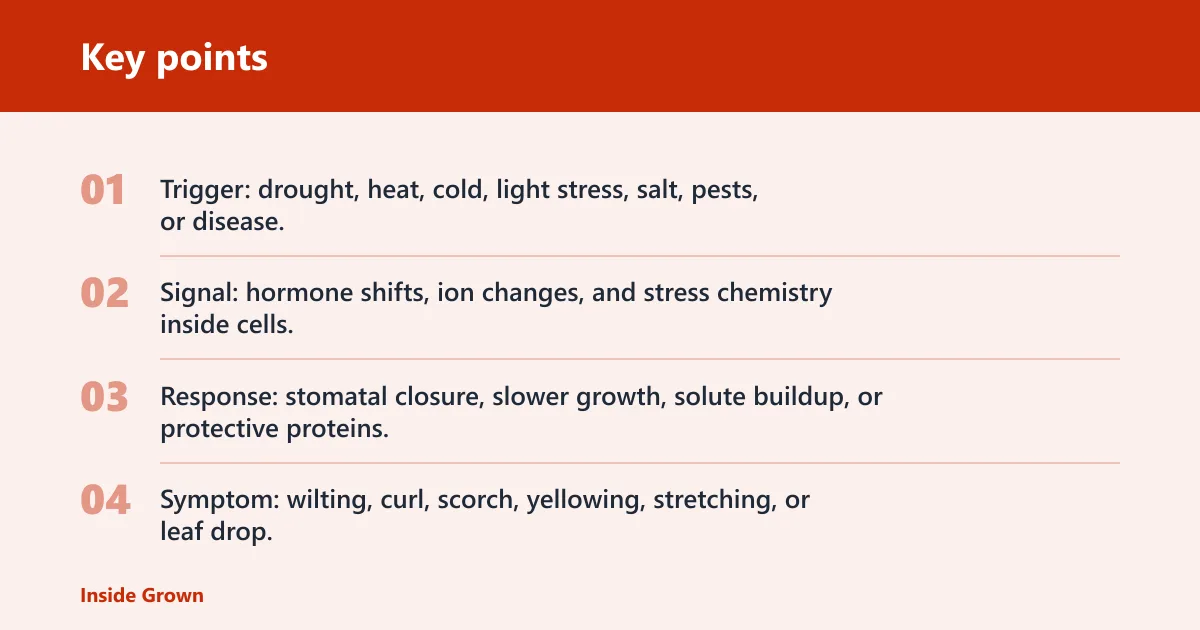
Trigger, signal, response, symptom
Think of plant stress as a chain. The trigger is the outside pressure. The signal is the internal message. The response is what the plant changes inside. The symptom is what you can see above ground. Those are related, but they are not the same thing.
- Trigger: drought, heat, cold, light stress, salt, pests, or disease.
- Signal: hormone shifts, ion changes, and stress chemistry inside cells.
- Response: stomatal closure, slower growth, solute buildup, or protective proteins.
- Symptom: wilting, curl, scorch, yellowing, stretching, or leaf drop.
Why stomata often change first
Stomata are tiny pores, usually on leaf surfaces, that balance water loss and gas exchange. When water becomes scarce or heat pushes evaporation higher, the plant can close those pores to conserve water. That reduces water loss fast, but it also limits carbon dioxide entry.
A common first-timer mistake is to read wilting as the only sign that matters. The stomata may have already been closing for hours. By the time a leaf softens or droops, the plant has often been defending itself for a while.
How abscisic acid helps the plant save water
ABA rises during water stress and helps drive stomatal closure. In simple terms, it tells the plant to spend less water. That reduces further loss through the leaf surface and helps the plant keep tissues hydrated for a little longer.
ABA does not fix the root problem. It buys time. If the stress continues, the plant still has to cope with lower gas exchange, reduced photosynthesis, and slower growth.
What changes inside the plant?
Inside the plant, stress changes water balance, cell chemistry, and energy use. Some responses protect cells. Others are side effects of strain. The visible symptom often appears only after these hidden changes have been building for a while.
Loss of turgor pressure
Turgor pressure is the internal water pressure that keeps cells firm. When water supply drops or leaves lose water too quickly, cells can lose turgor and tissues go limp. That is why drought-stressed plants wilt.
Plants can partly counter this with osmotic adjustment. They accumulate dissolved solutes, which helps cells hold onto water and maintain turgor under stress. This is a useful adjustment, but it has limits.
Reactive oxygen species and antioxidant defense
Stress can increase reactive oxygen species, or ROS. These are oxygen-containing molecules that can damage membranes, proteins, and pigments if they build up too much. Plants respond by turning on antioxidant defenses that help keep ROS under control.
ROS are not always pure harm. They also act as signals. The problem is balance. Too little control, and cells are damaged. Too much control too late, and stress injury spreads.
Reduced photosynthesis and slowed growth
When stomata close, carbon dioxide entry drops and photosynthesis slows. Heat, cold, and light stress can also interfere with chlorophyll function and enzyme activity. The plant produces less sugar, so growth slows or stops.
That slowdown is protective in the short term. It limits demand while the plant handles the stress. Over time, though, reduced photosynthesis means less energy for roots, shoots, flowers, and new leaves.
Drought stress response table
This table separates what happens inside the plant from what you can see and what recovery looks like after the stress eases.
| Stress type | Internal response | Visible symptoms | What recovery looks like |
|---|---|---|---|
| Drought | Loss of turgor pressure; ABA rises; stomata close; photosynthesis slows; osmotic adjustment may help cells hold water | Wilting, slower growth, leaf edge crisping in severe cases, possible early leaf drop | Leaves may firm up if water returns soon; growth often resumes slowly; badly dried tissue may not fully recover |
| Heat | Transpiration increases; membranes and enzymes can be damaged; cells activate protective proteins and other defenses; ROS may rise | Leaf curl, scorch, sun-exposed bleaching, droop during peak heat | Temporary droop can reverse after temperatures fall; scorched tissue stays damaged |
| Cold | Metabolism slows; ice can damage cells during frost; membranes become less stable; growth shifts into a lower gear | Delayed growth, darkened or water-soaked tissue after frost, limp or injured leaves | Light chill may pass with little lasting damage; frost injury often leaves permanent dead spots |
| Light stress | Too much light triggers photoprotection; chlorophyll changes and ROS control increase; too little light reduces energy capture | Sunburn or pale patches in high light; stretching and weak growth in low light | Plants can acclimate to a better light level over time; burned tissue does not recover |
How do plants respond to heat or cold?
Heat and cold stress both disturb normal cell function, but they do it in different ways. Heat pushes water loss higher and can damage membranes and enzymes. Cold slows metabolism, and frost can injure cells when ice forms and disrupts tissues. Both can delay growth.
Some damage shows up after the stress ends. A leaf may look fine during a cold night, then darken or collapse the next day. Heat injury can also appear later, once the plant’s repair systems fall behind.
Heat stress
Heat raises transpiration, so leaves lose water faster. If loss outruns uptake, the plant closes stomata to protect itself. That helps water balance, but it also reduces carbon dioxide intake and photosynthesis. In strong heat, enzymes and membranes can be damaged, which makes recovery harder.
Common visible signs are leaf curl, scorch, and drooping during the hottest part of the day. A plant may look better in the evening if the damage is mild. If tissue has been scorched, that part will not turn green again.
Cold stress
Cold slows metabolism and can delay growth for days or longer. Frost adds another layer of injury. Ice can damage cells and break membranes, which leaves tissue water-soaked, dark, or papery after thawing.
Some plants adjust gradually to cooler conditions. That acclimation can improve tolerance. A sudden cold snap gives less time for adjustment, so injury is more likely.
Why leaves wilt, curl, or yellow
Leaves wilt when cells lose turgor and cannot stay firm. They curl when the plant is trying to reduce exposed surface area or when heat and light stress alter leaf balance. Yellowing often follows reduced chlorophyll, lower photosynthesis, aging, or damage from stress that lasts too long.
Stretching is a different clue. In low light, plants may grow tall and thin as they search for more light. That is a sign of poor light capture, not water loss.
Picture a 20-centimeter houseplant on a bright windowsill in late afternoon. If the soil is still moist but the top leaves curl and show pale, dry-looking patches, light stress is a stronger suspect than drought. The issue is the light load, not just the root zone.
Suppose a tomato seedling stays in a cool room overnight after a warm day. The leaves may look normal at dusk, then droop and darken by morning if frost injury occurred. The visible symptom arrives after the stress event, not always during it.
Yellowing, stretching, and leaf drop
Yellowing can mean chlorophyll is breaking down or photosynthesis is falling behind demand. Leaf drop is often a later response. The plant sheds tissue it can no longer support, especially under chronic stress.
In low light, stretching can go with thin stems and larger spaces between leaves. In drought or heat, yellowing and drop may follow once the plant starts rationing energy and water.
Can plants recover after stress?
Plants can recover after stress is removed, but recovery is not automatic or complete. If the issue was brief and the tissues stayed intact, stomata can reopen, turgor can return, and growth can restart. If cells were killed, that damage stays.
Acclimation helps when stress repeats at moderate levels. The plant can harden over time by adjusting membrane stability, solute balance, and protective chemistry. That is tolerance buildup. It is not the same as repair after injury.
What recovery looks like when stress stops
Recovery usually shows up first as better leaf firmness and steadier growth. New leaves are a better sign than old ones. Old tissue may stay scarred, yellow, or dry even after the plant resumes normal function.
Early detection matters because the earlier the trigger is removed, the more of the response can reverse. Once tissue turns brown, collapses, or dies, that part is gone.
When damage becomes permanent
Damage becomes harder to reverse when membranes break, cells die, or roots lose too much function. Repeated stress also raises the chance of long-term decline. A plant may survive and still lose vigor, flowering, or leaf area.
That is why the same symptom can mean different things. Slight wilt in midday heat may disappear by evening. The same wilt after days of dry soil can point to injury that needs more time to recover.
Frequently asked questions
What is stress in plants?
Stress in plants is the response to a condition that makes normal growth or water balance harder. Common triggers include drought, heat, cold, light stress, salt, pests, and disease. The plant reacts through signals, internal changes, and visible symptoms that may appear later.
What is plant stress?
Plant stress is the set of changes a plant makes when it detects an environmental problem. Inside the plant, hormones shift, stomata may close, photosynthesis can slow, and defense chemistry turns on. Outside, you may later see wilt, curl, yellowing, or slower growth.
What happens when plants are stressed
When plants are stressed, they often conserve water, reduce gas exchange, and slow growth to protect tissues. Abscisic acid can help close stomata, while osmotic adjustment and antioxidant defenses support cell survival. If stress lasts too long, visible damage and growth loss become more likely.
How do plants respond to drought stress in simple terms?
Under drought stress, plants try to save water first. They lose turgor, stomata close, photosynthesis drops, and growth slows. Leaves may wilt because cells no longer stay firm. If water returns soon and tissue is still alive, the plant can recover at least partly.
How do plants react to too much heat or cold?
Too much heat increases water loss and can damage membranes and enzymes, so leaves may curl or scorch. Cold slows metabolism, and frost can damage cells if ice forms. Both stresses can delay growth, and some injury appears only after temperatures return to normal.
Can plants recover after stress is removed?
Yes, sometimes. If the stress was brief and tissues were not badly damaged, stomata can reopen, turgor can return, and new growth can resume. Recovery is limited when cells die, roots are injured, or stress repeats often enough to cause lasting harm.