How Many Herb Cuttings Should You Root in One Pot?
Root 1 to 3 herb cuttings in a 3- to 4-inch pot or jar; a common rule of thumb is 1 cutting for woody herbs like rosemary and 3 to 5 for soft-stemmed herbs like mint, basil, or oregano if each stem has room. Too many cuttings crowd roots, slow rooting, and raise rot risk. This guide gives a pot-size rule, herb-by-herb counts, and the point when you should split them.
Spacing rule
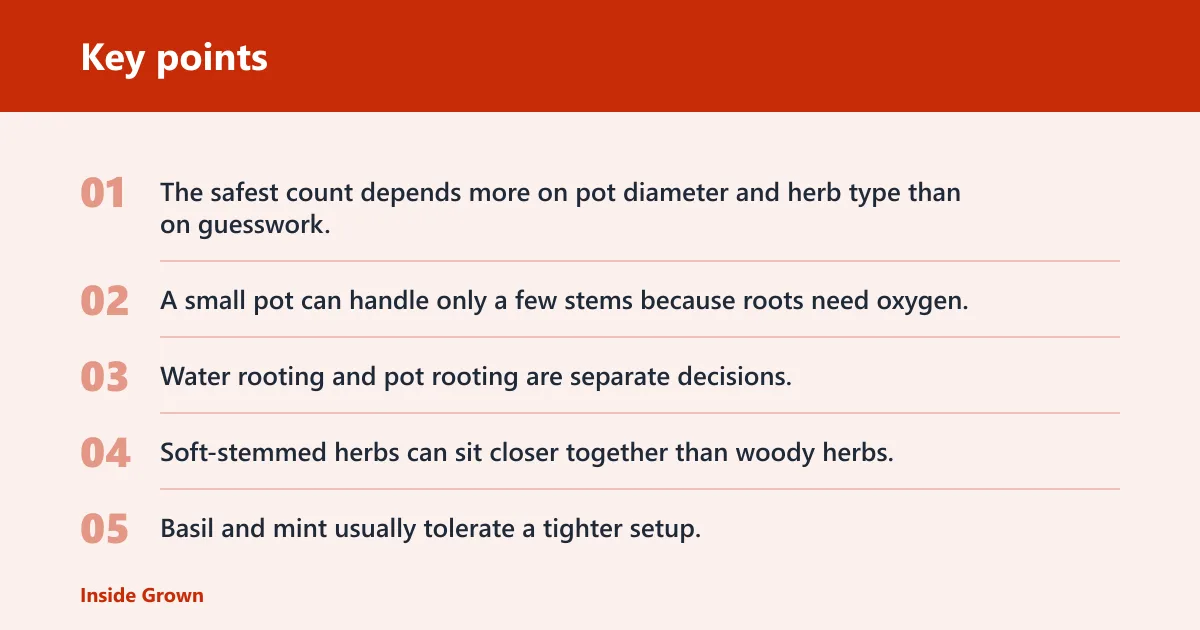


The safest count depends more on pot diameter and herb type than on guesswork. A small pot can handle only a few stems because roots need oxygen, the base of the cutting needs airflow, and crowded stems shade each other. Water rooting and pot rooting are separate decisions, so the right number in a jar is not always the right number in soil.
Soft-stemmed herbs can sit closer together than woody herbs. Basil and mint usually tolerate a tighter setup, while rosemary roots more slowly and is easier to lose if several cuttings share one small container.
What changes for basil, mint, and rosemary
Basil roots easily in water and often shows roots in about two weeks. Mint also roots quickly and usually tolerates shared containers better than woody herbs. Rosemary is slower and usually does better in soil, where the stem is less likely to sit in stagnant water while roots form.
What you need
- Healthy parent stems with active growth
- Clean snips or scissors
- 3-, 4-, 5-, 6-, or 8-inch pots or jars
- Pots with drainage holes
- Fresh water for water propagation
- Well-draining potting mix
- Perlite for a lighter mix
- Optional rooting hormone
- Bright indirect light
- A label for tracking herb type and start date
Healthy parent stems and clean snips
Take cuttings from healthy stems that are actively growing, so the plant has enough energy to make roots. A common rule is to choose cuttings at least 6 to 10 inches long with at least one node. Remove the lower leaves before rooting so submerged or buried foliage does not rot.
Jars, pots, and drainage holes
Use a jar for water rooting and a pot with drainage holes for soil rooting. Drainage holes matter because standing water at the bottom of a container raises rot risk. In a shared pot, airflow around the stems matters too, because crowded cuttings dry slowly at the base.
Well-draining mix, perlite, and optional rooting hormone
A well-draining mix with extra perlite helps soil stay moist without staying soggy. A common starting blend is about 2 parts potting mix to 1 part perlite. Rooting hormone is optional; a powder or gel can speed rooting on tougher stems, but it is not required for basil or mint.
Herb cutting count table
This table gives a safe maximum, not a target. If stems are thick, leaves are large, or air movement is poor, choose the lower number. If the pot has no drainage holes, do not share it at all.
| Pot diameter | Basil | Mint | Rosemary | Mixed herbs |
|---|---|---|---|---|
| 3 inches | 1 to 2 | 1 to 2 | 1 | 1 |
| 4 inches | 2 to 3 | 2 to 3 | 1 | 1 to 2 |
| 5 inches | 3 to 4 | 3 to 4 | 1 to 2 | 2 |
| 6 inches | 4 to 5 | 4 to 5 | 2 | 2 to 3 |
| 8 inches | 6 to 8 | 6 to 8 | 3 | 4 to 6 |
For a healthy supermarket bunch, several cuttings is a safe ceiling. That matches the point where airflow, stem spacing, and rooting room start to matter more than convenience. One cutting is the better choice for rosemary in smaller pots, especially if the stem is woody.
How many cuttings fit in one pot?
Use the pot diameter as the first filter, then narrow by herb type. In a 3- or 4-inch container, about one to three cuttings is a practical limit for most herbs. In a 5- or 6-inch pot, soft-stemmed herbs can share more space, but woody herbs still need more breathing room. In an 8-inch planter, you can group more, as long as each stem is upright and not touching too many neighbors.
3-inch and 4-inch pots
These pots are best for one rosemary cutting or a small pair of basil or mint stems. If the stem count is higher, the lower leaves press together and the base stays damp too long. That is where rot starts.
5-inch and 6-inch pots
These sizes fit a small cluster of basil or mint cuttings. Keep the stems separated enough that water can move through the mix and air can reach the crown. For rosemary, limit the count to one or two because slower rooting means a longer time in a fragile state.
8-inch pots and wider shared planters
An 8-inch pot can hold a small group of soft-stemmed cuttings, but only if the mix is airy and the drainage holes are clear. Mixed herbs are easiest to overcrowd, so keep rosemary separate from basil or mint whenever possible. A wider planter does not cancel the need for spacing.
How do you root multiple cuttings?
Root multiple cuttings by matching the method to the herb. Basil and mint can root in water or soil, while rosemary is usually safer in soil. In either method, keep only the lower nodes submerged or buried, because nodes are the root initiation points and the leaves above them drive new growth.
Water propagation steps for jars and windowsills
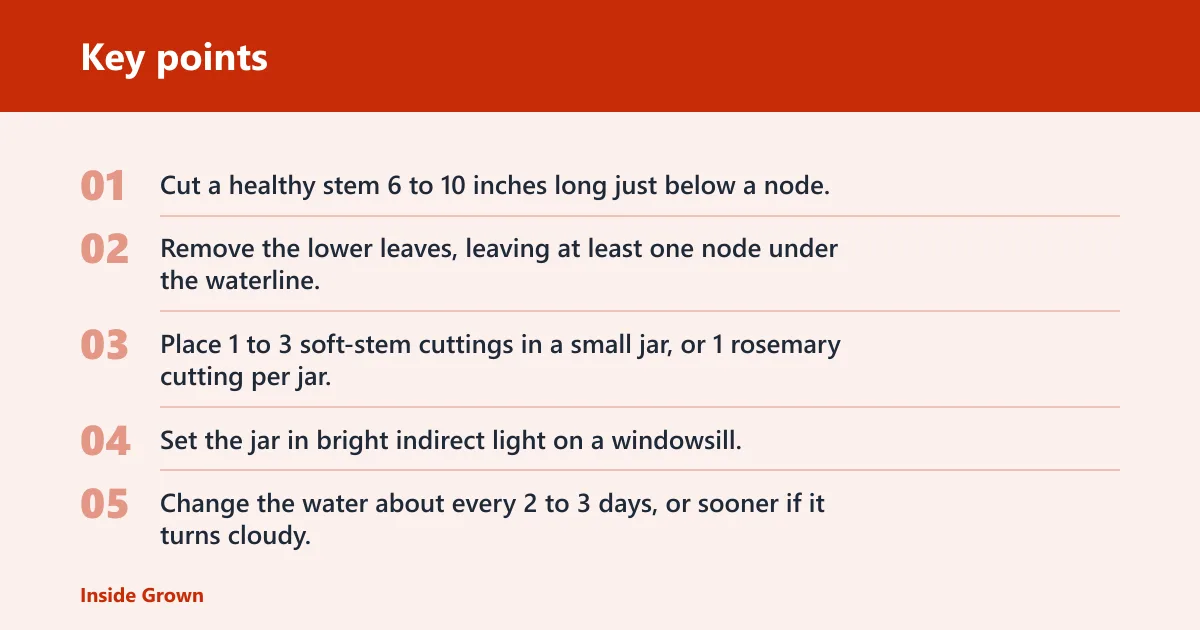
- Cut a healthy stem 6 to 10 inches long just below a node.
- Remove the lower leaves, leaving at least one node under the waterline.
- Place 1 to 3 soft-stem cuttings in a small jar, or 1 rosemary cutting per jar.
- Set the jar in bright indirect light on a windowsill.
- Change the water about every 2 to 3 days, or sooner if it turns cloudy.
Basil usually roots in about two weeks, and basil and mint often root quickly. Rosemary takes longer, and sometimes longer if the room is cool. Water should stay fresh because stagnant water limits oxygen at the stem base.
Soil propagation steps for direct-to-pot rooting
- Fill the pot with a moist, well-draining mix.
- Make a hole with a pencil or dibber for each cutting.
- Strip leaves from the lower section and keep at least one node under the mix.
- Insert each cutting so stems do not touch at the base.
- Press the mix gently and water once to settle it.
Keep the mix evenly moist, not wet. Direct-to-pot rooting is a good choice for rosemary, and it also works for basil and mint when you want to avoid moving fragile roots from water to soil.
Why basil and mint root faster than rosemary
Basil and mint are soft-stemmed, so they form roots faster and tolerate water propagation better. Rosemary has a woody stem, so it takes longer to initiate roots and is more sensitive to excess moisture. A cooler windowsill slows all three, but rosemary usually shows the difference first.
When should you split or repot?
Pot up rooted cuttings when roots are about 1 cm long and the cutting can resist a gentle tug. If several stems share one pot, split them sooner when they begin crowding each other. A cutting that has roots but no room to expand will stall, yellow, or rot.
Root length signals
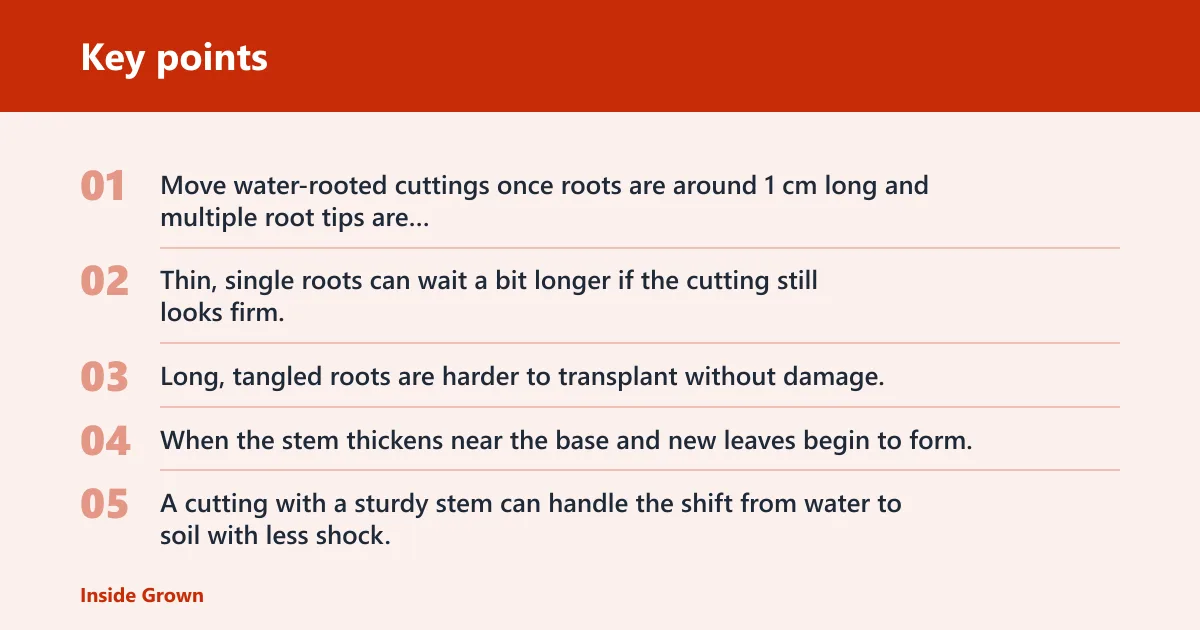
Move water-rooted cuttings once roots are around 1 cm long and multiple root tips are visible. Thin, single roots can wait a bit longer if the cutting still looks firm, but a dense root cluster is better. Long, tangled roots are harder to transplant without damage.
Stem thickness and new growth cues
When the stem thickens near the base and new leaves begin to form, the cutting is ready for more space. That is a better cue than leaf count alone. A cutting with a sturdy stem can handle the shift from water to soil with less shock.
Crowding symptoms, rot, and stalled growth
Split cuttings if leaves overlap too tightly, stems lean hard away from the center, or the water stays cloudy soon after a change. These are signs that the container is holding too many cuttings. Crowding also slows airflow, which lets rot move faster.
Say a 4-inch jar holds four basil cuttings on a warm windowsill. If two stems lean into each other and the water clouds by the next day, move the weakest cutting to a second jar and keep the remaining three spaced apart. One change at a time is easier to judge.
Suppose a 6-inch pot contains three rosemary cuttings in a heavy mix. If the stems stay dark at the base and new growth stalls after a week, repot one cutting into a lighter mix with perlite and keep the other two separate. Rosemary usually improves when each stem gets more air.
Common mistakes
Overcrowding is the biggest mistake. Too many cuttings in one container trap moisture, slow rooting, and make rot more likely. A second mistake is treating water rooting and final pot spacing as the same decision. A jar can hold a few cuttings for rooting, but the finished plant still needs room.
Another problem is stale water or a heavy mix. Cloudy water should be changed right away, and soil should drain freely after watering. If the mix stays wet for days, add perlite or move the cutting to a better-draining pot. Late transplanting is also common; by then, roots may already be tangled.
A common first-timer mistake is putting five basil cuttings into a 3-inch pot because they look small on day one. A week later, the stems press together, leaves yellow at the base, and the mix stays damp too long. The safer move is to start with two and pot up early.
Prevention is simple: keep each cutting’s lower node clear, use drainage holes, and separate crowded stems before the roots knit together. That single habit prevents most rot problems.
Frequently asked questions
How many herb cuttings can I root in one pot?
Use the pot diameter first, then the herb type. A 3- to 4-inch pot usually fits 1 to 3 cuttings, a 5- to 6-inch pot fits 2 to 5 soft-stemmed cuttings, and an 8-inch pot can hold more, but only if the stems are not packed tightly at the base.
How close together should herb cuttings be planted in a container?
Leave enough space that the lower leaves do not touch after planting. As a practical rule, keep stems about 1 to 2 inches apart in small pots and farther apart in larger ones. If the cuttings bend together or shade each other, the spacing is too tight.
Can I root multiple herb cuttings in the same jar of water?
Yes, if the jar is wide enough for each stem to stand apart and the water stays fresh. Soft-stemmed herbs can share a jar more easily than rosemary. Change the water every 2 to 3 days, and move to individual pots once roots are about 1 cm long.
How many cuttings can come from one supermarket herb bunch?
A healthy supermarket bunch can yield several cuttings safely. Use stems that are firm, green, and at least 6 to 10 inches long. If the bunch is short or woody at the base, stop sooner rather than forcing weak stems to root.
Which herbs root best in water versus soil?
Basil and mint root especially well in water, which makes them good choices for a bright windowsill jar. Rosemary usually does better in soil because it is woody and slower to root. If the room is cool or dim, soil propagation is often steadier for rosemary.
How long does it take herb cuttings to root?
Basil and mint root quickly, and basil cuttings in water commonly show roots in a short time. Rosemary usually takes longer. Cooler temperatures, low light, and crowded containers can slow all three.
When should I pot up rooted herb cuttings?
Pot up once roots are about 1 cm long and the cutting has begun to hold itself upright. Move water-rooted stems into a light potting mix, then water lightly and keep them in bright indirect light for a few days. Waiting too long can make roots tangled and brittle.
Why do herb cuttings rot in water?
Rot usually starts when water stays stagnant, leaves sit below the surface, or too many cuttings crowd one jar. Fresh water and lower-leaf removal prevent most problems. If the water clouds quickly or the stem base turns soft, replace the water and reduce the number of cuttings.
Do basil, mint, and rosemary need different rooting methods?
Yes. Basil and mint can root in either water or soil, with water working especially well for soft stems. Rosemary usually does better in a well-draining soil mix and with fewer cuttings per container. The method should match the stem type, not just the pot size.