How Botanical Gardens Store and Protect Plant Records
Botanical gardens often protect plant records with three main layers: living collections, seed backups, and documentation backups. If one layer fails, the other two can still trace or replace a plant. Lose those records, and plants can be misnamed, duplicated, or impossible to recover after disease, storms, or staff turnover. This guide explains how each layer is stored, backed up, and restored, and why each fails in a different way.
Plant record stack table
Garden records work best as a stack, not a single file. The accession record links a plant to its history, the living collection record shows where it is now, and backup material plus documentation can help preserve identity if the plant is damaged or removed.
| Record type | What it stores | Where it lives | Who updates it | What happens if that layer is lost |
|---|---|---|---|---|
| Accession record | Unique accession number, plant identity, source, date received, and collection history | Collection database and backup files | Curator, collections manager, or records staff | Plants may still exist, but the chain of custody breaks and later tracking becomes uncertain |
| Living collection record | Bed, house, plot, or tree location; family, genus, species; source; health; losses | Living collection database and GIS/map layer | Horticulture staff and records staff | The plant can remain in the garden, but staff may not find it quickly or may misread its current status |
| Herbarium voucher | Pressed reference specimen that supports identification | Herbarium cabinet and specimen database | Taxonomy staff or herbarium staff | Names become harder to verify over time, especially after reidentification or label drift |
| Seed bank lot | Propagation material, collection date, storage conditions, and viability data | Seed bank storage and lot records | Seed bank staff | The living plant may be gone, but the genetic backup can still support regeneration if the lot remains viable |
| Cultural-use record | Traditional names, uses, source community notes, and handling guidance | Collection database with restricted or shared notes | Curators with community partners | Plant identity may remain, but local knowledge and context can be lost or flattened |
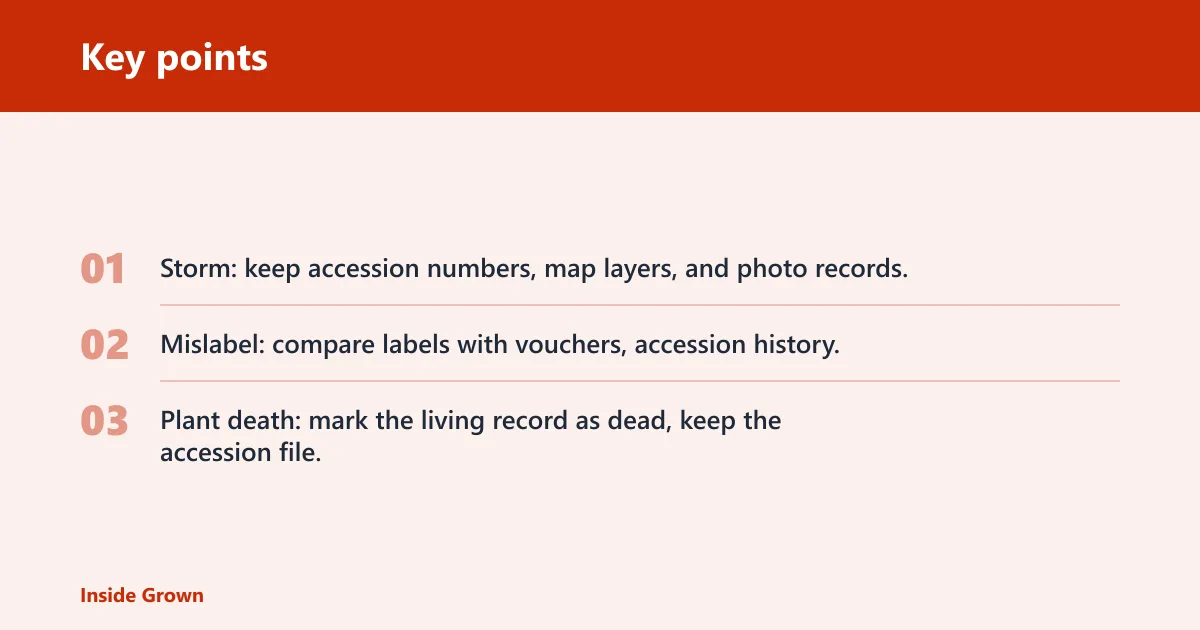
- Storm: keep accession numbers, map layers, and photo records; use them to locate surviving plants and confirm losses.
- Mislabel: compare labels with vouchers, accession history, and source data before changing names in the database.
- Plant death: mark the living record as dead, keep the accession file, and check whether seed, voucher, or propagation material exists.
How do botanical gardens store plant records?
Botanical gardens store plant records in linked systems: accession numbers, labels, databases, maps, vouchers, and backup storage. Botanical gardens keep the same plant identity across those systems, while each record type tracks a different job. One file identifies the plant, another places it in the garden, and another confirms what it is if the label later becomes doubtful.
Accession numbers and label data
An accession number is typically the unique identifier for a plant record. It links the plant’s identity to collection history, source, and movement across the garden. Labels usually carry that number plus the accepted name, which keeps the plant tied to the record even when it is moved or divided.
Labels matter because they are the fastest field check. A bed label can be read in seconds. A database can be searched later. Together, they reduce confusion when several plants share the same genus or when seedlings, cuttings, and divisions have to stay connected to one original record.
Database fields staff update
The living collection database usually records family, genus, species, source, location in the garden, and current status. Staff add plant health notes, pruning history, losses, and replacement events. Those updates matter because the record must reflect what is actually on the ground, not only what was planted years ago.
Say a tree is moved during path work. The accession number should stay the same, but the map point, bed code, and status field should change. If those fields are not updated together, a staff member may search the old site and think the plant is missing.
Where records live
Records usually live in more than one place: a database, a GIS layer, printed labels, and archival files such as vouchers or seed lot sheets. That spread is the point. If renovation wipes out one map set, the accession file and voucher still preserve identity, source, and reference material.
A common first-timer mistake is to treat the plant tag as the full record, even though the garden also needs accession logs, location maps, and backup files to protect the specimen’s history. It is only one piece. The record stack is what protects the plant history when weather, labor shifts, or naming changes make the field label unreliable.
What goes into a plant record?
A useful plant record keeps identity, source, location, and status together. At minimum, staff need accession data, taxonomy, provenance, and current condition. For conservation and native collections, they also need notes on where the material came from and whether it can be replaced.
Identity fields
Identity fields usually include the accession number, accepted name, family, genus, species, and any cultivar or local form name. Those fields let staff sort, search, and compare plants across beds, greenhouses, and seed storage. They also support later corrections when taxonomy changes.
Provenance and source data
Provenance data records where plant material came from. That can mean a wild site, a donor garden, a nursery, or a partner collection. For native and conservation collections, provenance can be the most important field because it affects whether a plant can be used for restoration, breeding, or reintroduction.
Provenance also changes how staff manage replacements. A plant of uncertain origin may still be valuable for display. It is less useful for a conservation program than a plant with a documented wild source and collection date.
Health, status, and location fields
Health and status fields tell staff whether a plant is thriving, stressed, propagating, dead, or removed. Location fields tell them where it sits now, down to bed level or tree level when needed. That matters during storm cleanup, replanting, and seasonal moves.
GIS supports this work by plotting specimen locations on a map layer. Staff can trace an accession to a bed, greenhouse bench, or tree pit instead of hunting through paper notes. If a renovation shifts paths or bed edges, the map layer helps recover the plant list and its placements.
Why do gardens use maps and GIS?
Gardens use maps and GIS to turn plant records into locations staff can act on. A map layer links accession records to exact sites, which helps with bed-level and tree-level tracking, inventory checks, and recovery after storms, construction, or a changed garden layout.
Bed-level and tree-level tracking
Bed-level tracking works well for mixed borders, native plots, and accessioned collections arranged by family or habitat. Tree-level tracking matters when one tree has its own history, source, or risk profile. Both levels help staff confirm whether a plant is present, mislabeled, or newly lost.
Picture a garden that renovates a shade border and removes all old stakes. The accession record still says the plant exists, but the GIS layer shows the last known bed. Staff can then check nearby holding areas, temporary pots, and replanting zones instead of starting over.
Recovery after storms or renovations
After storms, map data helps staff find uprooted or buried plants and separate survivors from losses. After renovations, it helps match old collection lists to new layouts. Without the map layer, a garden may still own the records but lose the practical path back to each living specimen.
Do botanical gardens use seed banks to protect records and plants?
Yes. Seed banks protect propagation material and back up living collections, especially for rare or threatened plants. They do not replace a living plant or a full record file, but they can preserve the option to regenerate a species or restore a lost accession later.
What seed banks preserve
A seed bank typically preserves seed lots, collection dates, storage conditions, and related identifiers. That backup matters when a living plant dies, is stolen, or is wiped out by weather. It preserves genetic material, not the full living history of the plant in the garden.
That distinction matters. A seed lot can preserve the chance to grow the plant again. It cannot preserve everything a living collection record holds, such as its exact bed location last season, its pruning history, or every label change over time.
Seed viability tracking
Seed viability tracking records when seed was collected, how it has been stored, and when it should be tested, regenerated, or replaced. Those dates guide whether the lot still supports conservation work or needs fresh material. Without viability data, a seed bank can hold old seed that no longer germinates well.
When regeneration is needed
Regeneration is needed when viability drops, storage time runs long, or conservation plans call for a fresh lot. In that case, staff use the accession file, provenance data, and any voucher material to confirm what should be grown next and where replacement material can come from.
How are rare plants tracked in botanical gardens?
Rare plants are tracked with tighter links between accession records, location data, provenance, and backup material. Staff need to know not only where the plant sits, but also where it came from, whether it has a voucher, and whether seed exists as a backup.
Why provenance matters most
For rare plants, provenance often determines value. A rare species from a documented wild source can support conservation work in ways a garden-center plant cannot. The record should capture donor name, collection site, and any restrictions on sharing, planting, or regeneration.
Why vouchers matter for accuracy over time
A herbarium voucher is a preserved reference specimen. It verifies plant identification and supports record accuracy over time. If a plant is later found to have been misnamed, the voucher and accession history give staff the evidence needed to correct the database without guessing.
When names change, the plant does not have to be relabeled blindly. Staff can compare the voucher, source notes, and current features. That keeps the record honest and helps prevent a single mistake from spreading across labels, maps, and seed lot files.
How do botanical gardens recover after loss?
Recovery starts by separating what was lost from what still exists in the record stack. A plant can be gone from the ground while its accession, voucher, seed lot, and map data survive. That surviving paper trail is what lets staff rebuild the collection correctly.
Storm damage
After a storm, staff usually check the map layer first, then reconcile the living collection database with field conditions. The record should show whether a plant was uprooted, snapped, moved, or buried. If seed or voucher material exists, the accession file stays useful even when the plant itself does not.
Mislabels and taxonomic updates
Mislabels are resolved by comparing label text, accession history, provenance, and voucher specimens. Taxonomic updates work the same way. A new accepted name should replace the old one in the database, while the old name stays attached as historical information so earlier records still make sense.
Plant death and replacement
When a plant dies, staff mark the living record as dead, keep the accession history, and look for backups. If seed exists, the plant may be regrown. If only a voucher exists, the garden still keeps proof of identity. If neither exists, the record may remain, but the collection loses a key layer of evidence.
Suppose a rare shrub dies after a dry summer in a 3-by-4-meter bed. The accession number and voucher still tell staff what it was, but without viable seed or living backup, replacement depends on new material from the same source or a documented substitute.
- Check the field location and update the GIS layer.
- Compare labels with the accession record and voucher.
- Confirm whether seed lots or propagation material exist.
- Mark the living record as lost, dead, moved, or renamed.
- Reissue labels and map points only after the record is reconciled.
Cultural and native plant records
Native and ethnobotanical collections need more than taxonomic data. They also need provenance, community context, and cultural-use notes. Those fields protect the plant’s meaning as well as its identity, especially when a collection includes traditional names, harvest uses, or preferred handling methods.
Provenance for native collections
For native plant collections, provenance tells staff whether a plant came from a wild site, a donor, or a cultivated source. That detail affects conservation value and future use. It also helps prevent mixing material from different populations that should stay separate.
Cultural-use notes
Cultural-use notes can record traditional names, uses, seasons of harvest, and community guidance. Those notes are not decoration. They help staff keep plants in ways that respect the knowledge attached to them and keep interpretive labels from flattening local history into a one-line display tag.
Maui Nui Botanical Gardens gives a concrete example of how these layers meet in one place. It has a dedicated conservation area called the MNBG Seed Bank, is dedicated to protecting Maui Nui’s native plants and cultural heritage, uses partnerships to extend its conservation work, and provides interpretation of its plant collection. It also hires local cultural practitioners to teach traditional Hawaiian arts and uses xeriscaping as a water conservation technique.
That mix shows why records have to carry more than names. A collection can support public interpretation, conservation, and community knowledge at the same time only if its accession files, seed records, and cultural notes stay tied together.
Frequently asked questions
What information is kept in a botanical garden plant record?
A good record keeps the accession number, accepted name, family, genus, species, source, date received, current location, health status, and loss history. For conservation or native plants, it should also include provenance, storage notes, and any related voucher or seed lot information.
What happens to plant records if a botanical garden loses plants?
The living plant may be lost, but the record should remain. Staff mark the status, keep the accession history, and check for seed, voucher, or propagation backups. If those layers exist, the garden can rebuild the collection with better evidence and less confusion.
How do botanical gardens preserve cultural plant knowledge?
They add cultural-use notes, traditional names, and community source information to the plant record, then keep those notes linked to accession data and collection care. That approach protects the plant’s context, not only its label, and it helps interpretation stay accurate and respectful.
Why do botanical gardens label plants so carefully?
Labels are the field tool that connects a plant to its accession record, source, and map point. Careful labeling reduces misidentification, helps staff recover plants after moves or storms, and keeps visitors from learning the wrong name from a damaged or outdated tag.