How Botanical Gardens Educate Visitors About Conservation
Botanical gardens teach visitors about conservation through labeled collections, interpretive signs, guided tours, and hands-on programs that explain plant loss, habitat protection, and seed saving. Without clear interpretation, a garden becomes a pleasant walk instead of a lesson in why plant species and ecosystems need protection. This guide covers the signs, collections, tours, and programs that turn a visit into conservation education.
What visitors learn in a botanic garden
Visitors learn that plant conservation is concrete. It shows up in names on labels, rare species in collection beds, seed storage, restoration projects, and programs that explain how plants support pollinators, habitats, and climate regulation. BGCI says botanic gardens hold documented living plant collections and support scientific research, conservation, display, and education.
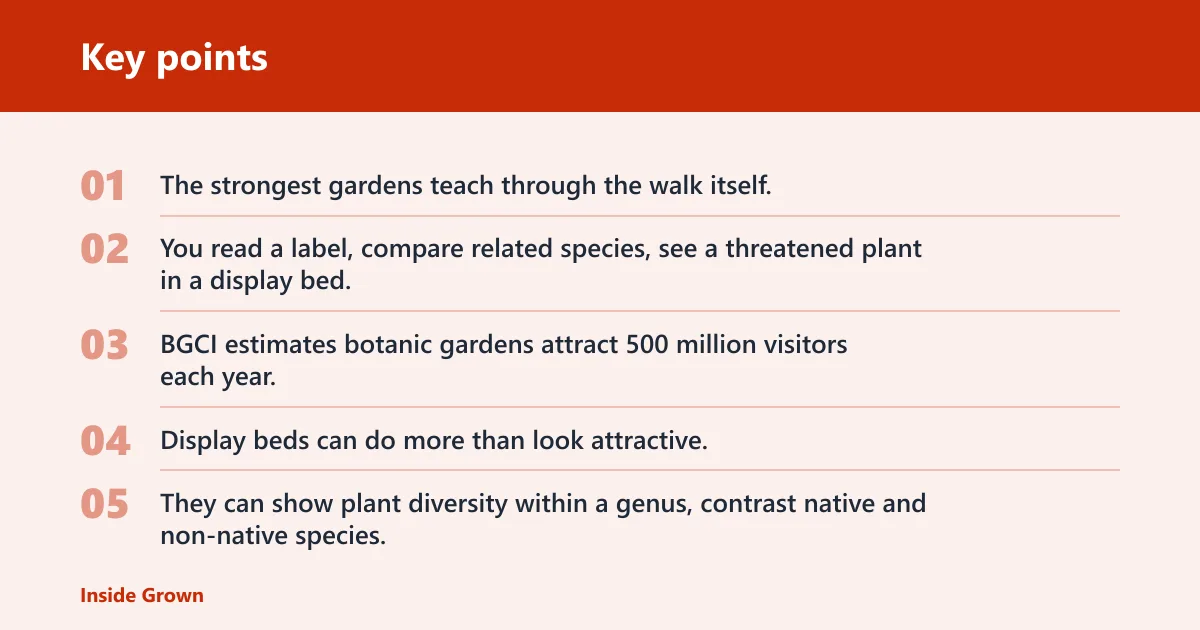
The strongest gardens teach through the walk itself. You read a label, compare related species, see a threatened plant in a display bed, then hear how staff propagate it or store backup seed. BGCI estimates botanic gardens attract 500 million visitors each year, so this on-site teaching reaches a very large public.
Conservation ideas behind the displays
Display beds can do more than look attractive. They can show plant diversity within a genus, contrast native and non-native species, or explain why some plants are rare in the wild. That turns a visual stop into a lesson about habitat loss, collection pressure, and careful identification.
Suppose a visitor stops at a bed of alpine plants with a sign explaining that some species are limited to small mountain ranges. The immediate lesson is geographic vulnerability. The next is practical: if a species exists in only a narrow habitat band, its protection depends on both in-situ habitat care and ex-situ collections.
Why gardens teach through plants, not lectures
Plants do the talking first. Labels, mapped collections, and themed beds let visitors absorb conservation ideas without needing prior training. That matters for casual tourists, students, and parents with limited time. A sign can sometimes carry more in about 30 seconds than a formal talk can in about 10 minutes.
Botanic Gardens of Sydney says conservation and discoveries are central to its work, and it links conservation with advanced science and research. That combination is useful for visitors because it connects the visible garden to the work behind it: taxonomy, genetics, propagation, and habitat recovery.
What different visitors can take away
Children usually notice color, size, and names. Adults often notice the conservation message behind the names. Plant enthusiasts may look for provenance, family relationships, or threatened-status notes. Good interpretation gives each group something usable without flattening the science.
The same source says education helps botanic gardens communicate the importance of conserving plants. That communication works best when it uses several entry points at once: a quick label for the casual visitor, a deeper sign for the curious one, and a program for the visitor who wants a fuller explanation.
Botanic garden collections and conservation
Living collections are not just display stock. They can protect rare species, support scientific work, and help with restoration and rehabilitation of degraded habitats. BGCI links living collections and seed banks to safeguarding species, which is why modern gardens often keep both visible collections and backup material.
Living collections and rare plants
Living collections let visitors see species that may be uncommon in the wild. They also let gardens compare forms, growth habits, and flowering patterns in a controlled setting. That supports display and education, and it supports identification and conservation work for threatened plants.
Botanic Gardens of Sydney says it protects critically endangered plant species and habitats. On a visitor path, that usually appears as a sign pointing out why a plant is rare, where it comes from, and what protection or recovery work is tied to it.
Seed banks and backup protection
Seed banks are part of the conservation story because they safeguard species alongside living collections. If a species is lost in one place, stored seed can support future propagation and restoration. The visitor may not see the storage vault itself, but the garden can explain its role in plain language.
A common first-timer mistake is assuming every conservation plant must be in a display bed. A seed bank is quieter than a border full of flowers, but it can matter just as much. Gardens that explain this difference help visitors see why conservation work often happens out of sight.
Propagation, restoration, and habitat recovery
The same source says gardens support restoration and rehabilitation of degraded habitats. That means a collection can be more than a display of rare plants; it can be a source of material for recovery projects. Visitors may see propagation houses, nursery labels, or signs that mention reintroduction.
This is where conservation becomes concrete. A plant is not only admired for its look. It may also be multiplied, monitored, and sent into restoration work that rebuilds habitat structure and food sources for other species.
Why are plant labels so detailed?

Plant labels are detailed because visitors need help moving from common names to scientific names, and from casual recognition to actual identification. Labels teach classification, show relationships between species, and signal which plants matter for conservation, research, or collection work.
Common names versus scientific names
Common names are useful, but they can vary by region or describe several different plants at once. Scientific names give visitors a stable way to identify a plant and connect it to taxonomy. That matters in botanic gardens because precise naming is part of the educational mission.
The same source notes that research includes taxonomy and genetics. A plant label is often the visitor-facing version of that work. It shows that the name is not decorative. It is part of how the garden documents, studies, and protects the plant.
How labels teach taxonomy and identification
Detailed labels often include family, genus, species, origin, and sometimes conservation status. Each field teaches a different lesson. Family tells you which plants are related. Genus and species show classification. Origin can point to habitat needs and range limits.
When labels are consistent across a collection, visitors can compare plants directly. That makes taxonomy easier to learn on the path than in a classroom. It also helps explain why two plants that look similar may have very different conservation needs.
What label details signal conservation value
Look for words such as threatened, endangered, rare, endemic, native range, or propagation notes. A label that mentions seed source or restoration use is especially informative. It tells you the plant is part of a conservation program, not only a display bed.
Labels can also point to scientific research. If a bed contains several species from the same genus, the garden may be teaching how botanists compare traits or study resilience. That is where a walk becomes a lesson in plant classification and conservation choices.
Conservation visit checklist

Use this checklist to spot conservation teaching in a garden, whether you have 10 minutes or a full hour. The same site can offer very different experiences depending on how much time you have and how deeply you read the labels and program signs.
| Feature | Where it appears | What it teaches | One question to ask on the visit |
|---|---|---|---|
| Scientific name labels | At individual plants or bed edges | How common names connect to taxonomy and identification | What does the scientific name tell me that the common name does not? |
| Origin notes | Plant tags and bed signs | Native range, habitat, and why place matters for conservation | Where does this plant grow in the wild? |
| Threat-status language | Collection labels and interpretive panels | Which species are rare, threatened, or under protection | Is this species rare in cultivation, in the wild, or both? |
| Restoration signage | Near nursery areas or specialty collections | How plants are raised for habitat recovery | Is this material used for restoration or reintroduction? |
| Seed-bank references | Interpretive panels and program displays | How backup storage supports species survival | How does the garden store seed for future use? |
| Propagation areas | Glasshouses, nurseries, behind-the-scenes program signs | How gardens multiply plants for conservation work | Which plants here are being propagated for conservation? |
| Family or genus grouping | Themed beds and taxonomic collections | How related plants are classified and compared | Why are these species displayed together? |
| Pollinator beds | Meadows, native plant beds, insect gardens | How plant diversity supports pollination and food webs | Which plants here support bees, butterflies, or birds? |
| Biodiversity exhibits | Visitor centers and outdoor interpretation | Why diverse plant collections matter for ecosystems | What is this exhibit saying about biodiversity loss? |
| Guided tour stops | Scheduled routes and docent-led walks | How staff translate research into plain language | What conservation story is this guide trying to explain? |
| Youth activity stations | Family days, school programs, discovery carts | How gardens teach through sorting, observing, and comparing | What can a child learn here in five minutes? |
| Seminar or talk boards | Event listings and education hubs | How gardens explain current research and conservation priorities | Which conservation project is the garden working on now? |
10-minute and 60-minute reading plans
If you only have about 10 minutes, focus on the labels nearest the entrance, one conservation bed, and one interpretive panel. That is usually enough to see whether the garden explains scientific names, threatened plants, and restoration work. You do not need a full tour to spot the conservation message.
If you have about 60 minutes, a practical plan is to add a guided walk, a nursery area, and a pollinator or biodiversity exhibit. The longer visit usually reveals how the garden links display with science, and how it adjusts the message for casual visitors, students, and plant enthusiasts.
How do tours and classes teach conservation?
Guided tours, classes, seminars, and youth programs turn plant labels into a fuller story. They let staff explain habitat loss, propagation, taxonomy, and conservation priorities in plain language. The same source says education helps gardens communicate the importance of conserving plants, and these programs are how that happens on the ground.
Guided tours for casual visitors
Guided tours help visitors notice what they might otherwise miss. A guide can point out why one collection matters, how a label was chosen, or why a plant is displayed with its relatives. That is especially useful for tourists who have limited time and no background in botany.
Do botanical gardens offer guided tours about conservation? Yes, many do. The format may be a daily garden walk, a themed tour, or a seasonal program focused on threatened plants, native habitats, or pollinators. The key is that the guide connects the plant display to the conservation message.
Youth programs and school groups
University of Washington Botanic Gardens appears to offer adult education, youth programs, and school field trips. That mix matters because children and teens need different entry points from adults. Hands-on observation, comparison activities, and simple identification tasks help younger visitors absorb the same core ideas.
For school groups, a garden can connect plant structure to habitat needs and biodiversity in a way that classroom diagrams cannot. For families, it can turn a short visit into a shared learning experience that is easy to remember.
Seminars, talks, and hands-on learning
Talks and seminars go deeper into plant science. They can cover taxonomy, genetics, seed storage, or restoration planning without simplifying away the conservation work. Hands-on programs often show how seeds are cleaned, how cuttings are propagated, or how plants are matched to habitat conditions.
UW Botanic Gardens says visitors can learn about plants through collections and profiles. That is a reminder that education is not limited to scheduled events. It also happens through self-guided reading, curated beds, and plant records that make the collection legible.
How do gardens connect plants and biodiversity?
Botanic gardens connect plants and biodiversity by showing that plant diversity supports ecosystem services such as pollination and climate regulation. BGCI is commonly cited as saying plants provide services like pollination and climate regulation. That message helps visitors see conservation as more than saving individual species.
Pollinators and ecosystem services
Pollinator beds are often the clearest example of biodiversity in action. Different flower shapes, bloom times, and nectar sources support different insects. Visitors can see that a diverse planting scheme is part of a functioning habitat, not just a colorful display.
Labels and exhibits may explain which plants feed bees, butterflies, or other pollinators. That links a garden visit to everyday ecology. It also shows why losing plant diversity can affect food webs beyond the garden fence.
Climate regulation and habitat links
Plants influence shade, soil stability, water movement, and carbon storage. Gardens often explain these links through themed exhibits or native plant beds. The visitor takeaway is simple: plant conservation matters because plant communities help regulate the systems people and wildlife rely on.
Rare and threatened plants are often a visible conservation focus in modern botanic gardens, but biodiversity exhibits usually widen the lens. They show that conserving a species also means conserving the habitat relationships around it.
Why plant diversity matters in collections
Collections with many species from one region, one habitat, or one family let visitors compare biodiversity directly. That helps people see how a collection can be both educational and scientific. It also shows why gardens invest in documented living collections instead of random displays.
When a garden labels those plants carefully, visitors can trace related species, compare traits, and understand why some plants need special protection. That is the conservation lesson in its clearest form.
Frequently asked questions
How do botanical gardens teach visitors about conservation?
They teach conservation through labeled plants, interpretive signs, guided tours, and programs that explain habitat loss, threatened species, seed saving, and restoration work. The lesson is strongest when visitors can see the conservation story in the collection itself, not only in a brochure or lecture.
What conservation programs do botanical gardens show the public?
Public programs often include guided tours, school field trips, youth activities, seminars, and hands-on demonstrations. Many gardens also use exhibit panels to explain propagation, seed banking, rare plant protection, and restoration projects, so the visitor sees both the science and the public message.
Why do botanical gardens label plants so carefully?
Labels help visitors connect common names to scientific names, which supports identification and classification. They may also include origin, family, or conservation notes. That detail helps the public see how botanists sort plants, compare related species, and track rare or threatened material.
Do botanical gardens have education programs about plant conservation?
Yes. The same source says education helps botanic gardens communicate the importance of conserving plants, and many gardens offer classes, seminars, tours, and youth programs. These programs translate research into plain language and give visitors a clearer view of why plant conservation matters.
Can you learn about biodiversity at a botanical garden visit?
Yes. A garden visit can show biodiversity through pollinator beds, native plant collections, family groupings, and exhibits on ecosystem services. Visitors can see how different plants support insects, habitats, and climate-related functions, which makes biodiversity easier to understand than an abstract definition.
How do botanical gardens help protect endangered plants?
They protect endangered plants through living collections, seed banks, propagation, and restoration work. Some gardens also focus on habitat recovery and reintroduction. Visitors may see this in display beds, nursery areas, or signs that explain how a plant is being conserved for future use.