Winter Houseplant Care for Tropical Plants vs Succulents
Treat winter care as two tracks: keep tropical houseplants evenly moist, brighter, and warmer, while letting succulents dry fully between waterings and sit cooler and brighter. If you cannot separate them, water for the thirstiest plant only after checking each pot. Ignore that split and you get root rot, leaf drop, shriveled growth, and a mixed collection that declines fast. This guide shows how to sort tropicals and succulents by light, moisture, and temperature so you can water each group correctly in winter.
| Decision factor | Winter Houseplant Care for Tropical Plants | Succulents | Winner |
|---|---|---|---|
| Light | Bright indirect light near a south- or west-facing window, or under grow lights if winter sun is weak | Brightest window available, with at least 6 hours of direct sun a day when possible | Succulents |
| Watering trigger | Water when the top layer dries but the root zone is not bone-dry | Water only after the pot dries much more fully; many need about once-a-month watering in winter | Winter Houseplant Care for Tropical Plants |
| Humidity | Often prefers closer to 50% humidity | Usually does not need extra humidity and can suffer if air stays damp around the foliage | Winter Houseplant Care for Tropical Plants |
| Temperature range | Best around 65°F to 75°F by day and 55°F to 65°F at night | Tolerates cooler winter conditions better, but still needs protection from freezing blasts and cold glass | Succulents |
| Red-flag symptoms | Yellowing, drooping, brown tips, or leaf drop near vents, cold glass, or very dry air | Soft, translucent, or collapsing tissue, stretched growth, or shriveling that does not improve after a proper soak | Tie |
Winter care differences at a glance
Tropical houseplants and succulents do not share one winter schedule. Tropicals usually need steadier moisture, more humidity, and warmer air, while succulents need brighter light, drier soil, and much less water. In a mixed room, the safest approach is to sort by the thirstiest pot and the brightest spot, then adjust each plant individually.
Tropicals such as orchids, African violets, and alocasias often keep growing slowly through winter, or they may only partially slow down. Succulents can coast through cooler conditions with far less watering, but they still need protection from freezing cold blasts and cold window glass. That difference matters more than any generic “water less” rule.
Say your pothos sits beside a jade plant on the same shelf. The pothos may still want evenly moist soil and brighter indirect light, while the jade needs a much longer dry-down and the sunniest window you have. Treating both like “houseplants” leads to one of them failing first.
How winter changes indoor plant growth
Winter brings a lower sun angle, so windows get less direct light for fewer hours. Heated rooms also pull moisture out of the air. Growth, photosynthesis, and root activity slow, so many plants use less water and take up fewer nutrients. Some plants go partially dormant; others keep growing, especially under good light.
That slowdown is why one universal calendar does not work. If a plant is actively growing under a grow light, it may need more water than the same plant on a dim sill. If it is sitting in a cold corner, it may need less water and more protection from temperature swings.
How much water do each need in winter?
Both groups usually need less water in winter because growth slows down, but they do not dry out on the same schedule. Tropical houseplants often want slightly moist media rather than bone-dry soil, while succulents need a much more complete dry-down before you water again. The best trigger is the soil, not the calendar.
Watering triggers for tropical houseplants
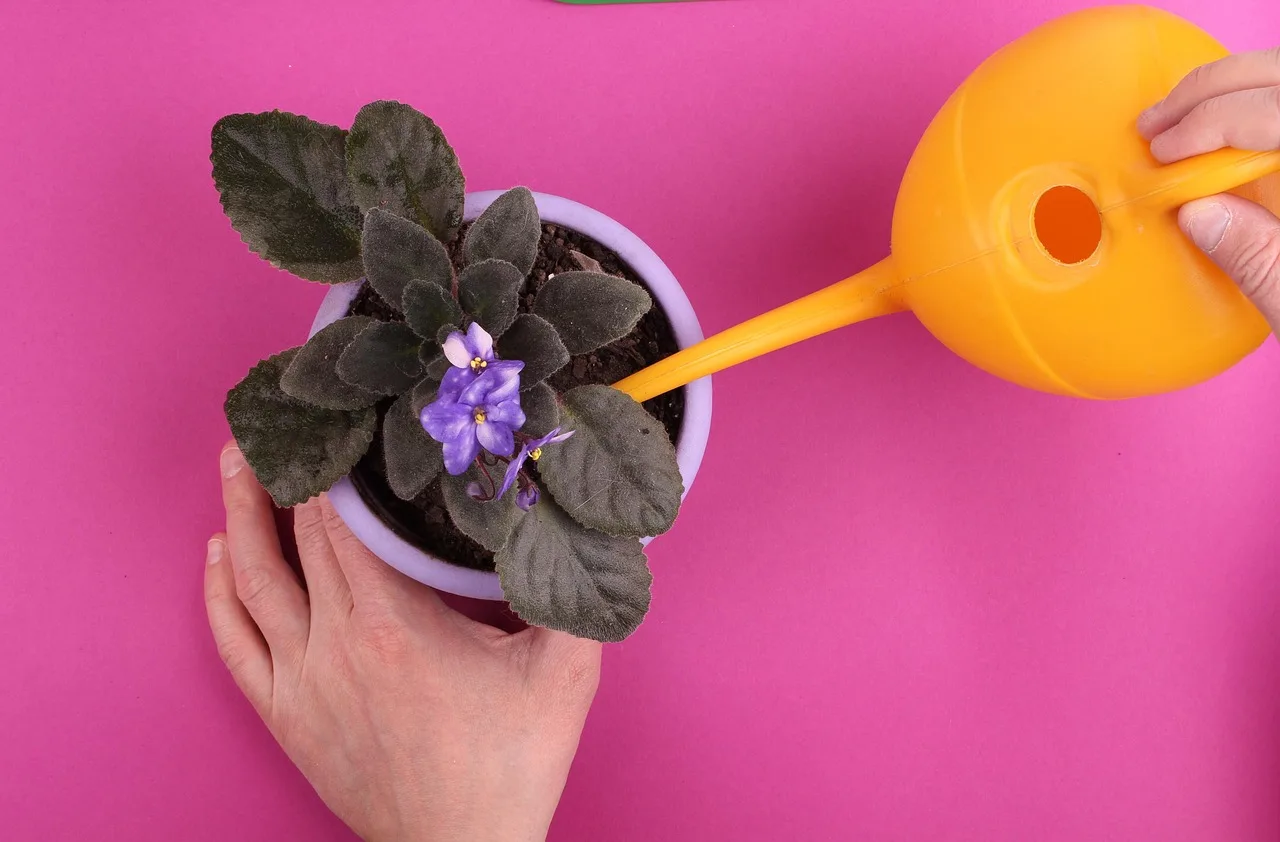
Check the potting mix with a finger or moisture meter before every watering. For most tropicals, water when the top layer feels dry but the root zone still has a little moisture left; many houseplants do better with longer gaps between waterings in winter. Use room-temperature water to avoid shocking roots.
Do not let tropicals sit in constantly wet mix just because winter growth is slower. That is a common root-rot setup, especially near cold windows where evaporation is slower. If leaves yellow, droop, or turn crispy at the tips while the soil stays damp, the issue is usually water timing, temperature, or both.
Watering triggers for succulents
Succulents should dry much more fully between waterings. In winter, many only need water about once a month, and some need even less if light is weak or temperatures are cool. Give a full soak only when the mix is dry well below the surface.
A common mistake is assuming a single midwinter soak suits both a palm and a jade plant. That pattern keeps roots too damp for too long, and succulents respond with soft tissue, shrinking, or collapse. If a succulent is under grow lights and still pushing new growth, it may need more frequent watering than one on a dim sill, but the soil should still dry thoroughly first.
How to check soil moisture before watering
- Test the root zone. Insert a finger into the mix or use a moisture meter near the center of the pot, not just at the surface. Surface dryness alone can hide wet soil below.
- Compare the plant type. If it is a tropical plant, water when the top layer is dry but the lower mix still holds a little moisture. If it is a succulent, wait for a much deeper dry-down before watering.
- Water slowly. Use room-temperature water and stop once the root ball is evenly moistened. Empty saucers so roots do not sit in runoff.
Do tropical plants and succulents need the same light?
No. Tropical houseplants usually want bright indirect light in winter, while succulents need the strongest window you have and often do best with at least 6 hours of direct sun a day. Winter sun is weaker and lower, so placement matters more than it does in summer. Rotate plants if they lean toward the window.
Best winter window placement
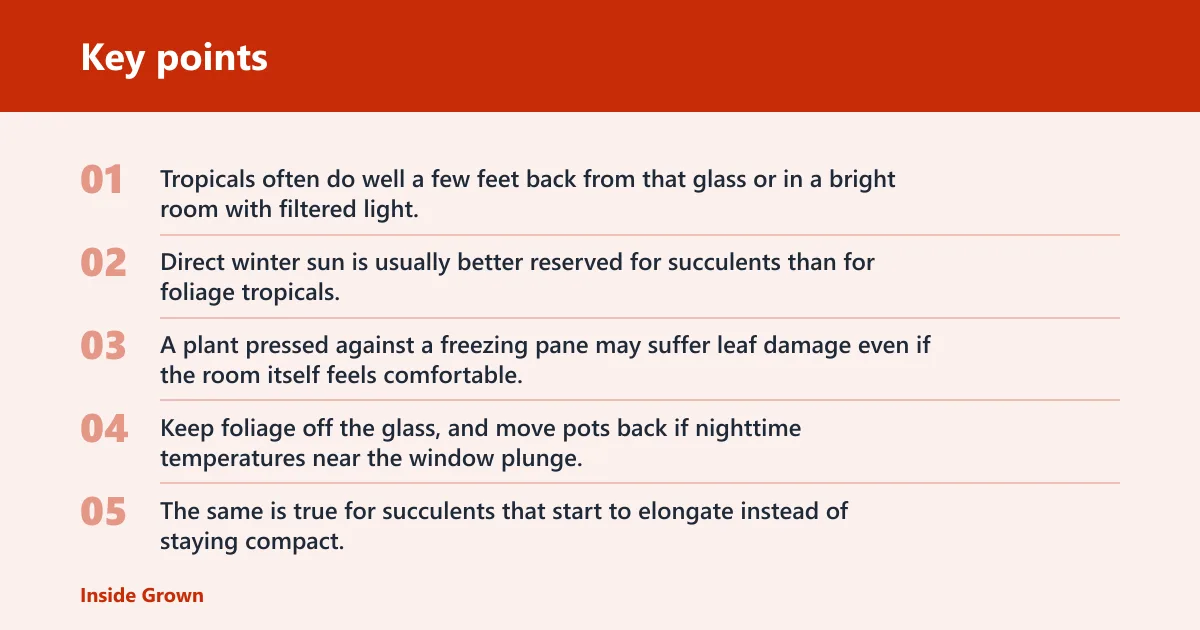
South-facing and west-facing windows are often the strongest natural-light spots for winter, especially for succulents and cacti. Tropicals often do well a few feet back from that glass or in a bright room with filtered light. Direct winter sun is usually better reserved for succulents than for foliage tropicals.
Cold glass can also be a problem. A plant pressed against a freezing pane may suffer leaf damage even if the room itself feels comfortable. Keep foliage off the glass, and move pots back if nighttime temperatures near the window plunge.
When to add grow lights
If a tropical plant keeps stretching, leaning, or dropping leaves in winter, it probably needs more light than the room provides. Grow lights can replace weak natural light. The same is true for succulents that start to elongate instead of staying compact.
Grow lights are especially useful in mixed rooms where one window is good enough for succulents but too harsh for tropicals. A light on one shelf can let you keep both plant types in the same room without forcing the dimmer plants into stress.
Why rotation matters in low winter sun
Plants lean toward their brightest source because winter light hits the room from a lower angle. Rotate pots regularly so one side does not stay underlit. This matters most for succulents, which can stretch quickly if one face gets too little sun.
Humidity and air movement: what changes by plant type
Indoor winter humidity can fall to 10% to 20%, while many houseplants prefer closer to 50%. That gap is wide enough to matter. Tropical houseplants usually need extra humidity support in winter; succulents usually do not, and very damp air around them can be counterproductive if watering is already frequent.
When tropicals need extra humidity
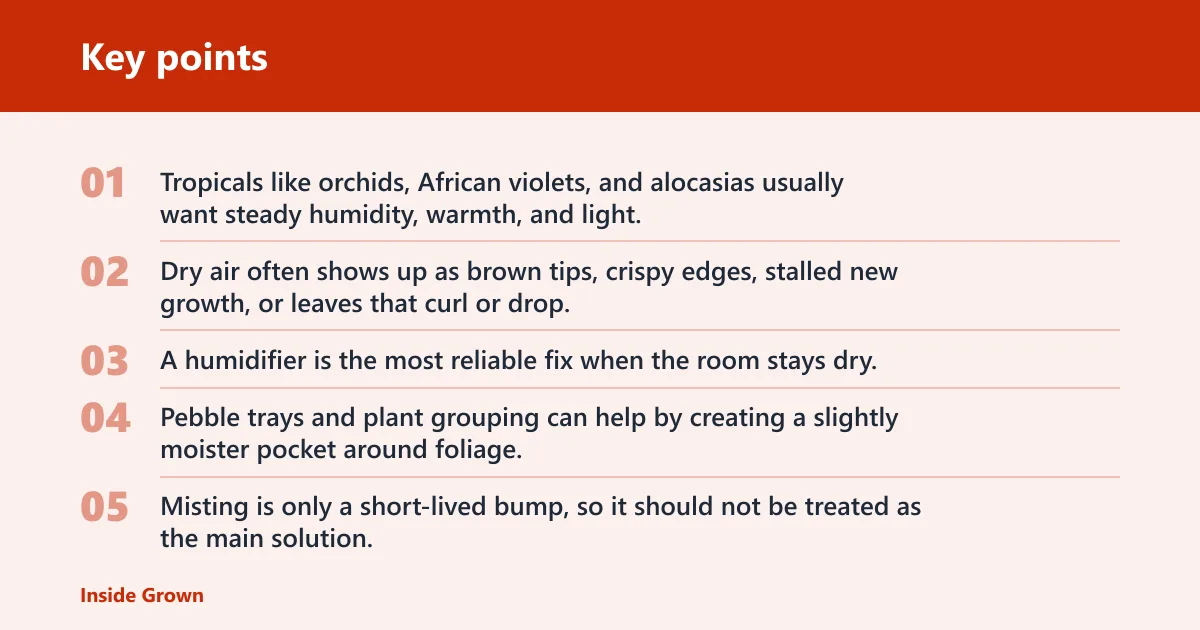
Tropicals like orchids, African violets, and alocasias usually want steady humidity, warmth, and light. Dry air often shows up as brown tips, crispy edges, stalled new growth, or leaves that curl or drop. A humidifier is the most reliable fix when the room stays dry.
Pebble trays and plant grouping can help by creating a slightly moister pocket around foliage. Misting is only a short-lived bump, so it should not be treated as the main solution. It can be a stopgap, not a climate plan.
Why succulents usually do not need it
Succulents are built for drier air and do not need the same humidity target as tropicals. Extra humidity does not replace light, and it does not make up for watering too often. For succulents, air movement and dry soil matter more than a humidifier.
If you keep tropicals and succulents in one room, aim humidity tools at the tropical side of the space and keep succulents out of the moistest microclimate. That split helps you avoid the common mistake of creating a room that is comfortable for one group and too damp for the other.
What humidifiers, pebble trays, and grouping can and cannot do
Humidifiers can raise room humidity in a meaningful way, especially in heated homes. Pebble trays and grouped plants create a small local effect, which can help near the plants but usually will not lift an entire dry room to 50%. Misting only moistens the surface briefly, then the effect fades.
For a mixed collection, think in zones. Put tropicals together near the humidifier and farther from vents, and keep succulents in the brightest, drier part of the room. That is the cleanest way to avoid watering mistakes.
What temperatures are safe indoors?
Many tropical houseplants are commonly reported to be comfortable at about 65°F to 75°F by day and 55°F to 65°F at night. Succulents can handle cooler winter conditions better than tropicals, but they still need protection from freezing blasts, cold windows, doorway drafts, radiators, and vents. Sudden hot or cold air can damage leaves or kill a plant.
Warm range for tropical houseplants
Keep tropicals away from drafty doors, heating vents, and cold glass. These plants are more sensitive to sudden swings than succulents are, and even brief blasts of cold air can cause leaf damage. If the room is comfortable for people but exposed to drafts, that does not mean it is stable for plants.
Some plants, like pothos and certain succulents, tolerate cooler winter conditions better than others. That does not erase the risk of a cold snap at the window or a radiator blasting dry heat from below. Stability matters as much as the number on the thermostat.
Cooler tolerance for succulents
Succulents usually manage cooler indoor temperatures better than tropicals, but they are not freezer-proof. Keep them away from cold window panes and from air leaks at doors. Cool is fine; freezing blasts are not.
Suppose a succulent sits on a windowsill that gets cold at night but still has bright light during the day. That can work if the glass is not freezing and the soil stays dry enough. If leaves turn translucent or mushy, the problem is usually too much moisture combined with cold exposure.
Winter care comparison table
This table turns the split into a quick decision tool. Use it when you are deciding which group gets the humidifier, which shelf gets the brightest window, and which pots should wait longer before watering again.
| Factor | Winter Houseplant Care for Tropical Plants | Succulents | Winner |
|---|---|---|---|
| Light | Bright indirect light or filtered sun; under grow lights if the room is dim | Brightest window available, with at least 6 hours of direct sun a day when possible | Succulents |
| Watering trigger | Water when the top layer dries but the root zone is not bone-dry | Water only after the pot dries much more fully; many need about once-a-month watering in winter | Winter Houseplant Care for Tropical Plants |
| Humidity target | Often closer to 50% humidity | Low to moderate humidity is usually fine; extra moisture is usually unnecessary | Winter Houseplant Care for Tropical Plants |
| Temperature range | Best around 65°F to 75°F by day and 55°F to 65°F at night | Tolerates cooler indoor conditions better, but still needs protection from freezing blasts and cold glass | Succulents |
| Red-flag symptoms | Yellowing, drooping, brown tips, or leaf drop near vents, cold glass, or very dry air | Soft, translucent, or collapsing tissue, stretched growth, or shriveling that does not improve after a proper soak | Tie |
If/then checklist for mixed rooms: If the room is dry and warm, put tropicals closest to the humidifier and keep succulents farther away. If the brightest window is also cold at night, move succulents off the glass and keep tropicals even farther back. If one shelf gets strong sun, use it for succulents first.
Should you fertilize, repot, or leave plants alone?
Most houseplants do not need winter fertilizer, because growth slows and nutrient demand drops. Resume feeding when new growth starts again. Repotting is usually best saved for active growth unless a plant has a serious soil or root problem that cannot wait.
When to pause fertilizer
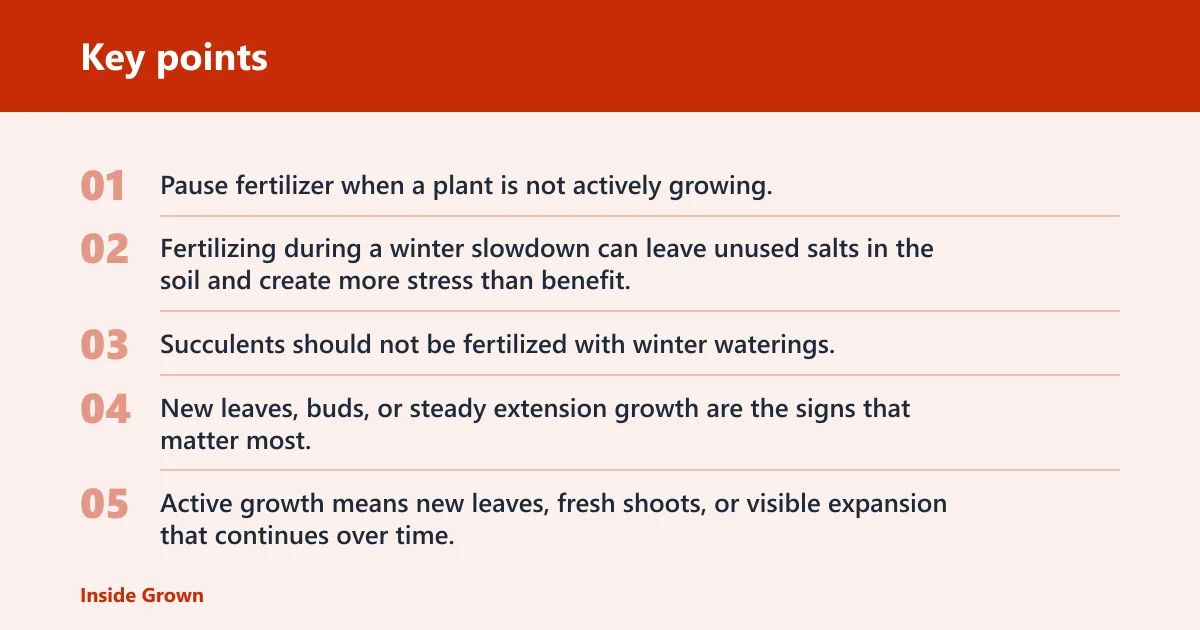
Pause fertilizer when a plant is not actively growing. That applies to most tropicals in low light and to succulents that have slowed down for the season. Fertilizing during a winter slowdown can leave unused salts in the soil and create more stress than benefit.
Succulents should not be fertilized with winter waterings. Tropical flowering plants can be exceptions, but only if they are clearly in active growth and still taking up water normally. New leaves, buds, or steady extension growth are the signs that matter most.
What counts as active winter growth
Active growth means new leaves, fresh shoots, or visible expansion that continues over time. A plant under grow lights may still be growing enough to need more water and a lighter hand with fertilizer. A plant that only looks “alive” is not necessarily active.
Do not assume that slower growth means dormancy by default. Yellowing, drooping, brown tips, or leaf drop can mean the plant is too cold, too wet, too dry, or too dark. Those are stress signals, not a normal winter label.
Signs that a plant needs more than a routine adjustment
If a plant keeps declining after you correct water, light, and temperature, the issue may be root damage, pests, or a mix of problems. Check for spider mites and mealybugs, especially on plants kept in dry indoor air. If roots smell sour or stems feel soft, the plant needs a bigger intervention than a simple schedule change.
Choose winter Houseplant Care for Tropical plants if…
Choose Winter Houseplant Care for Tropical Plants if your room is warm, bright, and humid enough to support moisture-loving plants, or if your collection includes orchids, African violets, alocasias, pothos, and other plants that need steadier winter moisture. This track also fits any plant that stays actively growing under a grow light.
Choose Succulents if…
Choose Succulents if your brightest space is a south- or west-facing window, your room runs on the dry side, and you want a winter routine built around full dry-downs and sparse watering. This track is the better fit for plants that tolerate cooler conditions and need far less water in winter.
If both types share one room, separate them by window, humidity, and watering rhythm. Put tropicals where the air is warmer and a bit moister, and keep succulents in the brightest, driest spot you have. That is the cleanest way to keep a mixed collection alive through winter.


Frequently asked questions
Do tropical houseplants and succulents need the same winter care?
No. Tropical houseplants usually want steadier moisture, more humidity, and warmer air, while succulents need brighter light, drier soil, and much less water. A shared room can work, but only if you separate the care by pot and not by one universal schedule.
How often should I water tropical houseplants in winter?
Water tropical houseplants when the top layer dries but the root zone is not fully dry. The exact timing depends on light, temperature, pot size, and plant type. If the plant is under a grow light and still growing, it may need water more often than one in a dim room.
How often should I water succulents in winter?
Many succulents need only once-a-month watering in winter, and some need even less. The real trigger is full or near-full dry-down, not a fixed calendar day. If the plant is cool, dim, and barely growing, stretch the interval further.
Should I use a humidifier for tropical plants in winter?
Yes, if the room is dry and the plants show stress from low humidity. Indoor winter humidity can drop to 10% to 20%, while many houseplants prefer closer to 50%. A humidifier is more effective than misting, which only gives a short-lived boost.
Can succulents stay near a cold window in winter?
They can stay near a cool window if the glass does not get freezing cold and the pot stays dry enough. Succulents tolerate cooler winter conditions better than tropicals, but they still need protection from cold drafts and freezing blasts near doors or windows.
How do I tell if my plant is dormant or just struggling?
Look at the pattern. Dormancy or slowdown means less growth, lower water use, and a pause in feeding. Yellowing, drooping, crispy edges, soft stems, or leaf drop usually point to a care mismatch, pests, or temperature stress rather than normal winter rest.