Do Houseplants Need Grow Lights in Winter?
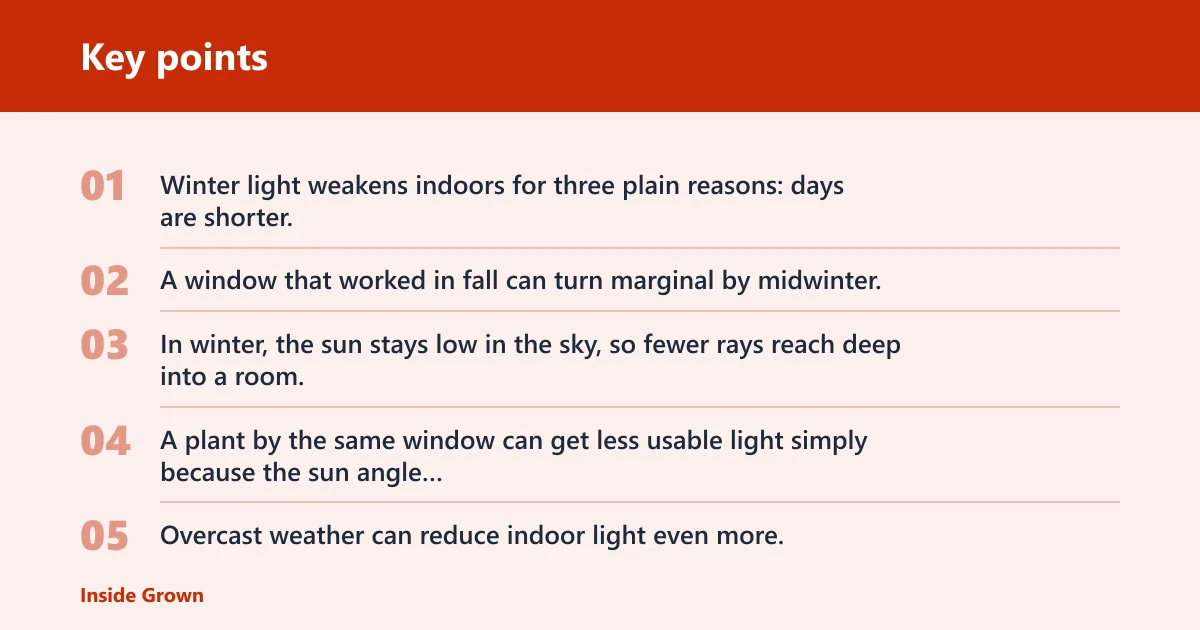
Winter light weakens indoors for three plain reasons: days are shorter, the sun stays lower, and clouds block more usable light. A window that worked in fall can turn marginal by midwinter, especially for plants that need bright indirect light or more. Room orientation matters first.
This guide is part of our Winter Houseplant Care: Light, Water, Humidity and Cold Drafts series.
Winter light changes indoors


Shorter days and lower sun angle
In winter, the sun stays low in the sky, so fewer rays reach deep into a room. That matters even on bright days. A plant by the same window can get less usable light simply because the sun angle changed, not because the plant did.
Cloud cover makes a window weaker
Overcast weather can reduce indoor light even more. A room can look bright and still be poor for plants if clouds hang around for days. Check the window direction and the plant’s response, not only how the room feels to you.
One window can shift from enough to not enough
A south-facing window in winter often stays the strongest option, while a north-facing window is usually the weakest. East and west windows sit in the middle. If a plant was fine in another season, the winter sun path can drop it below the level it needs.
Do houseplants need grow lights in winter?
Not always. Low-light houseplants can usually handle dimmer winter conditions, while bright-light plants, succulents, and many tropicals are more likely to need help. If a bright window still leaves the plant stretched, pale, or stalled, a grow light is the cleanest fix, not more watering.
When a bright window is enough
A bright window can be enough for some plants in winter, especially when the plant sits close to the glass and the room faces south in the Northern Hemisphere. Watch the growth. If the plant stays compact and healthy, you may not need a lamp.
When winter light usually falls short
Winter light usually falls short when the plant sits in a weak window, is set far from the glass, or belongs to a high-light group. Some houseplants need supplemental light when winter daylight hours shorten. Plants in dead zones with no sunlight are also strong candidates for artificial light.
Winter light decision table
Use this table as a quick screen before you buy anything. Match the room and plant first. Then decide whether moving the plant, adding a grow light, or leaving the setup alone makes the most sense.
| Room/window type | Likely plant response | Recommended action |
|---|---|---|
| South-facing window, plant close to the glass | Often strong winter light for many plants; compact growth may continue | Keep setup; no grow light for low-light plants, yes for high-light plants that still slow down |
| North-facing window, plant close to the glass | Usually the lowest winter light; growth may stretch or stall | Yes, add a grow light for most medium- and high-light plants |
| Plant 3 feet from a window | Light drops fast with distance; leaves may lean toward the window | Move closer first; add a grow light if the plant still shows weak growth |
| Plant showing legginess and smaller new leaves | Classic low-light stress signal | Yes, use a grow light unless moving it to a much brighter spot fixes the problem |
| High-light plant in a cloudy climate | Bright daylight may still not be enough on many winter days | Yes, supplement with a grow light |
| Low-light plant near an east window | May stay healthy if growth remains steady | No grow light unless it starts stretching or fading |
| Succulent in a dim room | Likely to weaken, stretch, or lose compact shape | Yes, add a grow light and move it to the brightest spot available |
| Tropical plant in a west window | Often adequate for moderate-light tropicals; some may still need more in midwinter | Check growth first; use a grow light if leaves pale, size shrinks, or stems lean |
How do I know if my houseplant needs one?
Look for winter stress symptoms: leggy growth, smaller new leaves, leaning toward the window, and pale or weak growth. Those signs mean the plant is reaching for more light. If moving it closer to the window improves the look quickly, that may be enough. If not, add light.
Check the plant first
- Compare new growth with older growth.
- Look for longer gaps between leaves or stems.
- Check whether new leaves are smaller than normal.
- See if the plant tilts toward one side of the window.
- Note whether color looks washed out or weak.
Use a light meter or lux reading
A light meter or lux reading gives you an objective check when appearance alone is not enough. Two rooms that look equally bright can send very different light to the leaf surface. The reading helps you compare spots and decide whether window light is actually enough.
Move the plant before you buy
Should you move plants closer to the window in winter? Yes, if temperature allows. A small shift toward the glass can solve a mild light deficit without extra equipment. Avoid pressing leaves against cold glass, and watch for drafts near the frame.
Say your pothos sits three feet from a north window and has long, bare stems with smaller new leaves. Moving it to the sill may fix the issue. If the same plant still stretches after that move, a grow light becomes the better next step.
What kind of grow light should you use?
A full-spectrum LED grow light is the default choice for most houseplants in winter. LED grow lights are often used to support plant growth, and plain white 6500K options are commonly used in living spaces. They usually run cooler than older bulb types, which helps near foliage and windows.
Why full-spectrum LED is the default pick
Full-spectrum LED bulbs give plants usable light without forcing you to live with a harsh colored glow. The Sill notes that grow lights are typically warm and full-spectrum, while Houseplant 101 suggests full-spectrum LED bulbs for winter lighting. That makes them a practical first option for most rooms.
Where 6500K white LEDs fit
6500K white LEDs are a common fit when you want a fixture that blends into a room and still supports plant growth. They are often easier to live with than pink or purple lamps. The exact wattage and brightness still matter, but white LEDs are not a weak choice.
Why heat output matters near foliage and glass
Heat matters because a lamp placed too close can dry leaves or warm the air unevenly, while a lamp too near cold glass can create a poor setup. Cooler-running LEDs reduce that risk. The Sill notes that a bulb with lumens greater than 500 may be bright enough for some situations, but plant type still decides the final answer.
How long and how close should it be?
A common schedule is 12 to 16 hours a day on a timer, which keeps the light cycle steady. Placement often falls about 8 to 18 inches above the foliage, though fixture output and plant type can change the exact distance. Stronger fixtures can usually sit farther away.
How many hours a day to run it
How many hours a day should houseplants be under grow lights? For many setups, 12 to 16 hours is a practical range. Glowrium recommends 10 to 12 hours a day, while Homes & Gardens suggests 12 to 16 hours. Timers help keep the schedule consistent, which is useful in winter.
How far above the plant
How far should the light sit above foliage? Homes & Gardens recommends positioning grow lights 12 to 18 inches above plants. In practice, many indoor setups end up somewhere in the broader 8 to 18 inch range. A stronger fixture can sit farther away; a weaker one needs to be closer.
Common setup mistakes
- Placing the lamp so close that leaves warm up or curl.
- Assuming every winter symptom means low light.
- Running the light inconsistently from day to day.
- Using a lamp on a semi-dormant plant that already needs less growth.
- Leaving a plant far from the window and expecting the lamp to do all the work.
Picture a rubber plant in a west window that has started making smaller leaves. A white LED fixture 12 inches above the canopy, on a timer, can correct the light deficit without moving the plant across the room. If the leaves start to bleach or curl, the light is too intense or too close.
Frequently asked questions
Is a bright window enough for houseplants in winter?
Sometimes. A bright window may still be sufficient for some plants in winter, especially near a south-facing window in the Northern Hemisphere. But room orientation, cloud cover, and plant type still matter, so a bright room is not automatic proof that the plant has enough light.
Should I move my plants closer to the window in winter?
Yes, if the plant can tolerate the temperature and draft conditions near the glass. Moving closer is often the cheapest first step, and it may remove the need for a lamp. Keep leaves off cold panes and watch whether growth improves within a few weeks.
Can houseplants get too much light from grow lights?
Yes. Too much light can bleach leaves, dry foliage, or leave the plant looking stressed. That risk goes up when the fixture is too close, left on too long, or matched to a plant that prefers lower light. Start with a sensible distance and use a timer.
Which houseplants benefit most from winter grow lights?
Bright-light plants, succulents, and many tropicals benefit most because their winter light demand is higher. Low-light plants usually need less help unless the room is very dim. A plant in a north window or far from glass is more likely to benefit than one in a south window.
What kind of grow light should I use for houseplants?
A full-spectrum LED grow light is the easiest default choice. White 6500K LEDs are widely used, fit living spaces well, and usually run cooler than older bulb types. Choose a fixture that matches the plant’s light demand, then adjust height and hours based on growth.