How to Keep a Live Christmas Tree Alive Indoors
Keep a live Christmas tree indoors for about 7 to 10 days by recutting the trunk, setting it in a stand that holds roughly 1 quart per inch of trunk diameter, and checking the water every day; if the reservoir runs dry, needle loss can speed up quickly. Skip watering, and the tree dries out, drops needles, and turns into a fire risk. This guide gives you an indoor care plan, a realistic time limit, watering benchmarks, and a rescue checklist for a tree already starting to dry out.
Assessing tree freshness at the lot


Freshness check first
Start with a tree that still has pliable needles and firm attachment. A fresh tree should not shed needles when tapped, and the outer branches should hold together when you give them a light shake or gentle pull.
If needles fall easily before the tree comes home, indoor care will not reverse that. Freshness at the lot matters because needle retention depends on how recently the tree was cut and how much moisture it still has in the trunk.
What a healthy shake test looks like
Stand near the base and tap the trunk lightly. A healthy tree may shed a few loose needles, but it should not drop a visible spray.
Then lift and release one outer branch. The branch should flex and spring back rather than crumble in your hand. A tree that already sheds heavily is a poor pick for a long indoor stay.
When to leave the tree at the lot
Leave the tree behind if the branches are brittle, the needles snap instead of bend, or the tree showers needles with the slightest touch. Those signs mean the tree is already too dry to hold up well indoors.
Cut the trunk and water immediately
Fresh-cut trees should have a fresh cut made at the base before they go into the stand, and they should be watered right after that cut. Remove about 1/2 inch to 1 inch from the base, cut straight across, and place the tree in water as soon as you can so the trunk can start drawing moisture again.
How much to cut off the base
Trim about 1/2 inch to 1 inch from the bottom of the trunk. Another common recommendation is to cut about an inch from the bottom.
The goal is not to shorten the tree for appearance. The goal is to expose fresh wood that can take up water after the original cut has started to dry.
Why the cut must be straight across
Cut the trunk straight across rather than at an angle. A straight cut gives the trunk a flat base that sits properly in the stand reservoir and helps the tree stand upright.
It also makes the bottom easier to seat in water without the trunk tipping or resting above the reservoir opening.
How fast the tree needs water
Some live trees can go 6-8 hours after a fresh cut before watering, but sooner is better. Make the cut just before you place the tree in the stand, and do not let the base sit dry for long.
Once the cut dries, the tree can lose its ability to take up water efficiently. If the trunk sits dry for too long, recutting may be needed before the tree can drink well again.
Tree stand reservoir and water needs
A reservoir-type stand is the right setup for a fresh-cut tree. Pick a stand that fits the trunk diameter and can hold enough water for the tree’s daily demand, which is about 1 quart per inch of trunk diameter.
Match the stand to trunk diameter
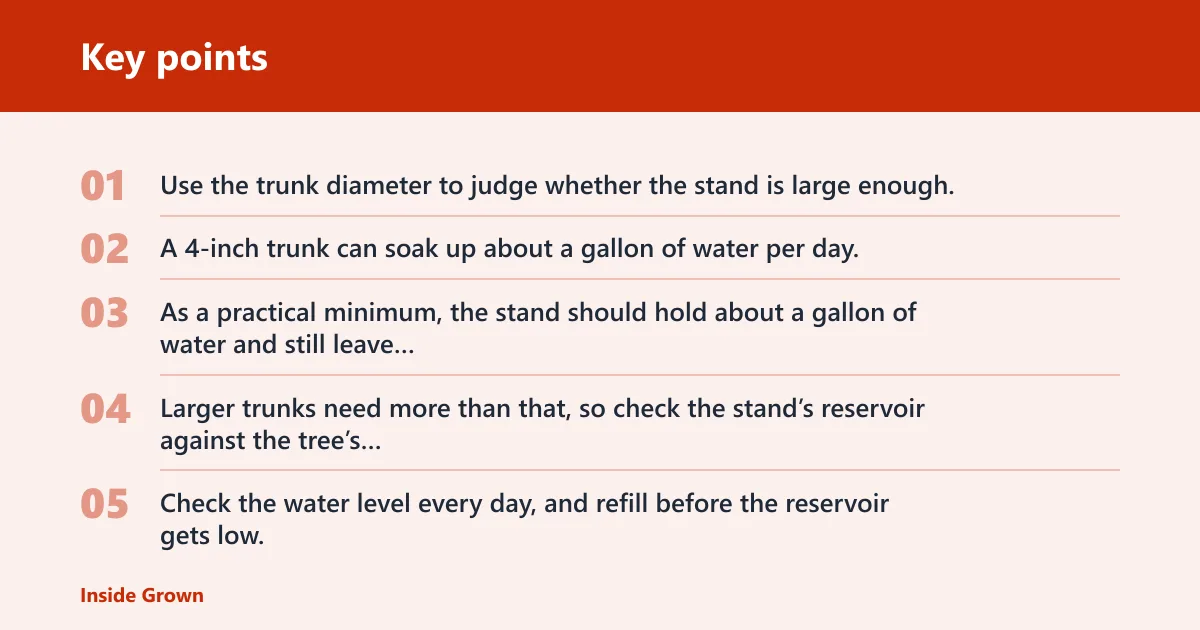
Use the trunk diameter to judge whether the stand is large enough. A 4-inch trunk can soak up about a gallon of water per day, so a small reservoir will be too shallow for a large tree.
As a practical minimum, the stand should hold about a gallon of water and still leave room for daily refilling. Larger trunks need more than that, so check the stand’s reservoir against the tree’s size before you buy it.
Daily refill rule
Check the water level every day, and refill before the reservoir gets low. A tree can take in a surprising amount of water during the first days indoors, especially if the room is warm or dry.
Do not assume a stand that was full yesterday is still enough today. If the water line drops below the cut end of the trunk, the tree can start sealing off and drinking less.
How to read water demand by size
Use trunk diameter as your guide. The larger the trunk, the more water the tree needs, and the faster you should expect the stand to empty.
| Trunk diameter | Expected daily water use | Maximum safe indoor days | Warning signs: recoverable or replace |
|---|---|---|---|
| 2 inches | About 2 quarts per day | About 7 to 10 days in a cool room | Recoverable: needles still pliable, branches bend, water demand stays steady. Replace: heavy needle shower, brittle tips, trunk stays dry after refilling. |
| 4 inches | About 1 gallon per day | About 7 to 10 days if water stays full and room heat is low | Recoverable: trunk still drinks within a day, needles hold on when tapped. Replace: water use drops sharply, branches crisp up, needles fall in clumps. |
| 6 inches | About 1.5 gallons per day | Short indoor window unless the room stays cool and the reservoir is large | Recoverable: reservoir empties predictably and the tree still feels fresh. Replace: the stand cannot keep up, the trunk dries at the base, or the tree sheds needles after one dry day. |
A simple rule follows from the table: the stand should match the tree’s thirst, not the other way around. If the reservoir cannot cover a full day’s demand, the tree is too large for that stand.
How long can you keep a live Christmas tree indoors?
For a fresh-cut tree in a cool room, a common working target is about 7 to 10 days indoors. A well-watered tree purchased after Thanksgiving should last through the 12 days of Christmas, but that depends on freshness, room heat, and daily water checks. (Gatech)

Fresh-cut tree time limit by conditions
The indoor window shortens when the room is warm, the stand is small, or the trunk was already drying before it came inside. A cooler room and a reservoir that stays full can stretch the time.
Think in conditions, not a single deadline. A fresh tree in a cool room may hold up better than a larger tree in a hot family room with a low-water stand.
When a potted tree needs to go back outside
Potted or live-rooted Christmas trees are a different case from cut trees. They should ideally be brought indoors as late as possible, with the weekend before Christmas suggested, and then moved back outside soon after the holiday period ends.
Those trees are alive at the roots, so warmth indoors wakes them up. The longer they stay inside, the more likely they are to suffer stress when they go back out.
Warning signs that shorten the indoor window
Shorten the stay if needles become brittle, the water use drops, or the room feels dry and warm. Sudden needle drop is a warning that the tree is losing moisture faster than the stand can replace it.
Say your 7-foot tree has a 4-inch trunk and the stand keeps going dry overnight. That tree is telling you the reservoir is too small or the room is too hot for a long indoor stay.
Keep it away from heat and dry air
Place the tree away from fireplaces, space heaters, heat vents, stoves, and direct sun. Heat dries the tree faster and shortens the time it can stay fresh indoors.
Bad placement in the home
Do not park the tree beside a fireplace opening or right under a supply vent. Hot air moves across the branches and pulls moisture out of the needles and trunk.
Direct sun can do the same thing near a bright window. Even a few hours of repeated heat exposure can cut into the tree’s indoor window.
Forced-air heat and direct sun
If the home uses forced-air heat, the air around the tree may dry faster than expected. A humidifier can slow drying, especially in homes where winter air feels very dry.
Indoor winter humidity should be around 40 percent for better freshness. That target is not a guarantee, but it helps the tree hold moisture longer.
Lighting and fire-safety basics
Use LED holiday lights on live trees because they run cooler than traditional bulbs. Make sure the lights are in good working order before hanging them, and replace damaged strings instead of patching around broken sockets or frayed wire.
For homes with pets or kids, keep cords out of walkways, keep decorations out of reach where possible, and avoid overloading outlets. Follow the product manual for the lights and any timers you use.
Live tree survival checklist
This checklist is for a fresh-cut tree that is already indoors. It separates recoverable trees from trees that are drying too far to save, and it gives you a quick check against trunk size, water use, and room conditions.
- Confirm the trunk was recut straight across before setup.
- Fill the stand reservoir immediately after setting the tree in place.
- Check the water level every day.
- Keep the tree away from fireplaces, stoves, space heaters, heat vents, and direct sun.
- Use LED holiday lights in good working order.
- Watch for pliable needles that stay attached when tapped.
- Treat a dry reservoir as an urgent problem, not a minor one.
Recoverable: the trunk still drinks water, the needles stay flexible, and the tree only sheds a few loose needles when handled. Replace now: the tree drops needles heavily, branches feel crisp, or the base has stayed dry long enough that water uptake has clearly stalled.
A common first-timer mistake is to top off the stand only when the tree looks dry. By then, the reservoir may already have gone low enough for the trunk to stop drawing water well.
Do tree preservatives help?
Tree preservatives do not replace plain water, and they are not a cure for a drying tree. Use them, if at all, as optional add-ons, not as a reason to skip daily water checks or proper placement.
What additives can and cannot do
Additives cannot revive a tree that has already dried past the point of good water uptake. Georgia Tech warns against using Miracle-Gro in the tree stand, so do not assume fertilizer-style products will help a live indoor tree.
Water is the baseline. If the tree is already thirsty, an additive does not solve the main problem.
Why plain water is the baseline
The tree’s first need is simple: keep the cut end hydrated. Fresh water keeps the trunk open to uptake, while additives add extra steps without fixing a dry stand or a hot room.
That is why a clean reservoir and daily refill habit matter more than any mix.
When to skip the mix entirely
Skip preservatives if you are already fighting low water, warm indoor air, or a tree that is losing needles quickly. In those cases, plain water and cooler placement are the better move.
If the tree is a potted or live-rooted type, do not treat it like a cut tree with a stand reservoir. Its indoor window is shorter, and its root system needs a different plan.
Frequently asked questions
How often should I water a live Christmas tree indoors?
Check the reservoir every day and refill it before it gets low. A tree can use about 1 quart per inch of trunk diameter, and a 4-inch trunk can soak up about a gallon of water per day. If the stand is dry, the tree can start shedding needles fast.
How big should a Christmas tree stand reservoir be?
Choose a reservoir-type stand that fits the trunk and can keep up with the tree’s daily demand. As a practical minimum, aim for about a gallon of water in the reservoir, and remember that larger trunks may need much more than that across a day.
Should I cut the trunk before putting the tree in water?
Yes. Make a fresh cut of about 1/2 inch to 1 inch from the base, and cut it straight across before placing the tree in the stand. That fresh cut restores water uptake, which is why the tree should not sit dry for long after cutting.
Where should I place a live Christmas tree in the house?
Set it away from fireplaces, space vents, stoves, space heaters, and direct sun. Those heat sources dry the tree faster and speed needle drop. A cooler spot with less forced-air exposure helps the tree stay fresh longer and makes daily watering more effective.
How long can a live Christmas tree go without water after cutting?
Some live trees can go 6-8 hours after a fresh cut before watering, but that is a limit, not a target. Water it right after the cut if possible. The longer the base sits dry, the more likely the tree is to lose water uptake and drop needles.
Do Christmas tree preservatives actually help?
Not much, and they should not replace water. Plain water is the baseline, and Georgia Tech warns against using Miracle-Gro in the stand. If the tree is already drying out, additives will not undo heat stress or a reservoir that has gone empty.