How Many Hours of Grow Light Do Houseplants Need?
Many houseplants are commonly given about 12 to 16 hours of grow light daily. Low-light plants often do well at 10 to 12 hours, while high-light plants may need 14 to 16 hours, depending on light strength and distance. Too little light slows growth and causes leaf drop, while too much can bleach leaves, dry soil too fast, and waste electricity. This guide gives you a simple hour-by-hour framework based on plant type, room brightness, and grow-light output.
Quick answer by light level
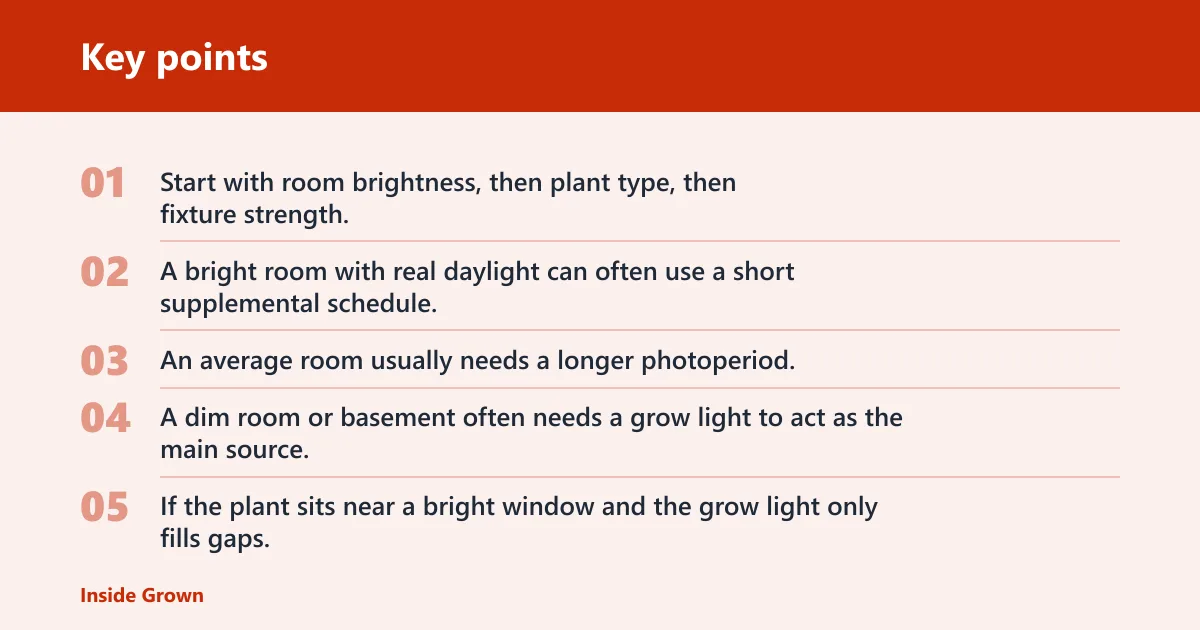


Start with room brightness, then plant type, then fixture strength. A bright room with real daylight can often use a short supplemental schedule. An average room usually needs a longer photoperiod. A dim room or basement often needs a grow light to act as the main source, with a much longer daily run time and a dark period at night.
Bright room
If the plant sits near a bright window and the grow light only fills gaps, about 4 to 6 extra hours may be enough. That is a supplemental setup, not a full replacement for daylight. Keep the fixture close enough to matter, but not so close that leaves warm up or pale.
Average room
In a room with filtered daylight or a window that does not reach the plant all day, about 8 to 12 hours is a common starting point. This range fits many foliage houseplants when the grow light adds to daylight rather than replacing it. A timer helps keep the schedule steady.
Dim room or basement
In a dim room, basement, or windowless space, 12 to 16 hours is more realistic because the light has to do most of the work. Weak fixtures may still fail here if the output is too low. If the plant stretches toward the lamp, the schedule is not the only problem.
Houseplant light schedule table
This table gives a practical starting point for different indoor light situations. Use it as a schedule, not a guarantee. Light output, distance, and plant type still decide whether the setup is enough.
| Indoor light scenario | Recommended daily hours | Distance and notes | Warning signs |
|---|---|---|---|
| Bright room | 4 to 6 hours | Use as supplemental light near a bright window; keep the fixture close enough to add usable light, but not close enough to heat leaves. | Leaves bleaching, soil drying faster than expected, or curled edges suggest too much light or too much heat. |
| Average room | 8 to 12 hours | Good for many foliage plants; the lamp usually needs to sit above the canopy at a distance that still gives strong light at the leaves. | Leggy stems, smaller new leaves, or leaning growth mean the schedule or intensity is too weak. |
| Dim room | 12 to 16 hours | Often works better as the main light source; use a stronger fixture and keep the canopy close enough for usable intensity. | Long internodes, pale leaves, and slow growth point to not enough light at the plant. |
| Basement or windowless room | 14 to 16 hours | Primary lighting is usually needed; low-output DIY setups often fail here unless the fixture is strong and placed well. | Persistent stretching, drooping new growth, or a plant that turns toward any tiny light source shows the setup is inadequate. |
How do you match hours to plant type?
Different houseplants need different light levels, so the same hour count will not fit every plant. Foliage plants usually need less light than flowering houseplants, while seedlings need strong light quickly after emergence. The right schedule depends on whether the light supplements daylight or replaces it.
Foliage plants and lower-light species
Pothos, philodendron types, and other lower-light foliage plants often do well with shorter schedules in bright rooms and moderate schedules in average rooms. Start lower rather than higher, then watch for leggy growth. If the plant reaches for the lamp, add hours or move the fixture closer.
Flowering houseplants and higher-light species
Flowering houseplants usually need more usable light than low-light foliage plants. They often need the upper end of the daily range, especially in rooms without strong daylight. Hours alone do not solve the problem if the lamp is weak, so light intensity matters as much as the photoperiod.
Seedlings after emergence
Seedlings do not need light to germinate, but they do need adequate light after they break through the soil. Without enough light, seedlings can become weak and leggy. A simple timer with a steady daily schedule usually works well once the seedlings are up and growing.
What changes the answer besides hours?
Hours are only part of the decision. The amount of light reaching the leaves, the distance from the canopy, the brightness of the room, and the LED spectrum all change how useful that schedule is. A long schedule with weak light can still fail, while a shorter schedule with strong light can be enough.
Light intensity at the canopy
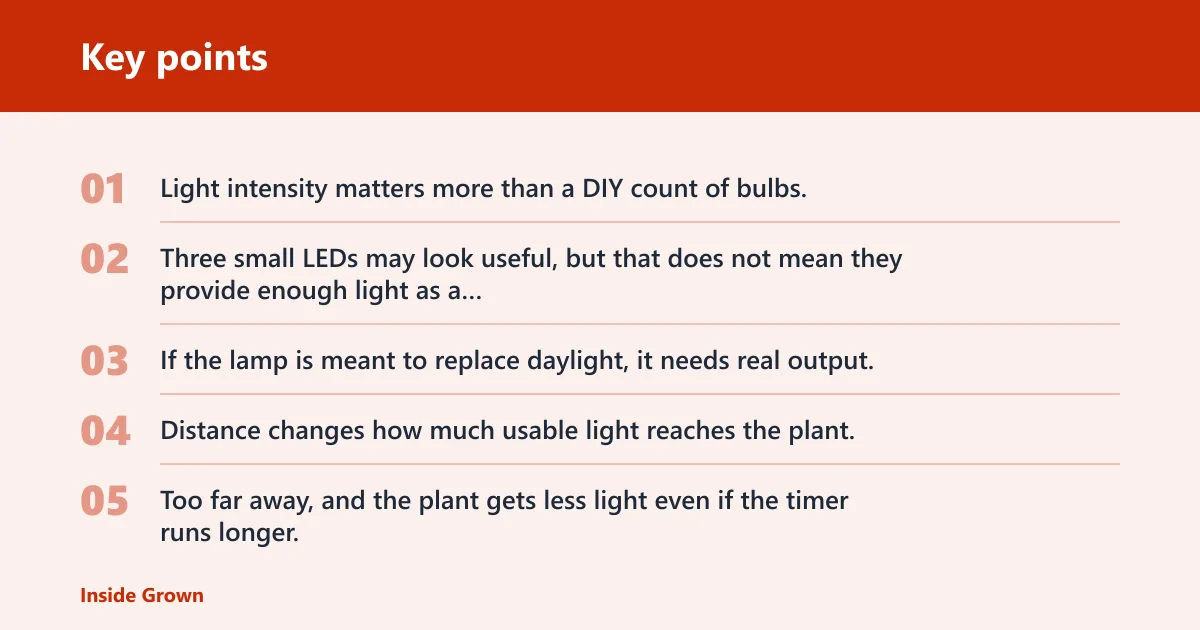
Light intensity matters more than a DIY count of bulbs. Three small LEDs may look useful, but that does not mean they provide enough light as a primary source. If the lamp is meant to replace daylight, it needs real output, not just a higher bulb count.
Distance from the leaves
Distance changes how much usable light reaches the plant. Too far away, and the plant gets less light even if the timer runs longer. Too close, and leaves may stress, bleach, or dry out faster. Keep the fixture positioned for the plant, not for convenience alone.
Room brightness and daylight spill
A bright room gives the plant some daylight before the grow light even turns on. That means the fixture can play a supporting role. In a dim room, there is little daylight to work with, so the grow light has to do much more. That is why the same hour count can work in one room and fail in another.
LED spectrum and output
LED grow lights often use red and blue spectrum discussions, but white LEDs may be a better general choice than red-only lighting. Spectrum matters, but power and output determine whether the light is useful. A weak red-only bulb can still underperform if it does not deliver enough light at the leaves.
When should a grow light replace daylight?
Use grow lights as supplemental light in bright rooms and as primary light in dim rooms. If the plant already gets strong daylight, the lamp can fill in after sunset or during short winter days. If the room stays dark, the grow light has to carry the schedule on its own.
Supplemental use in bright rooms
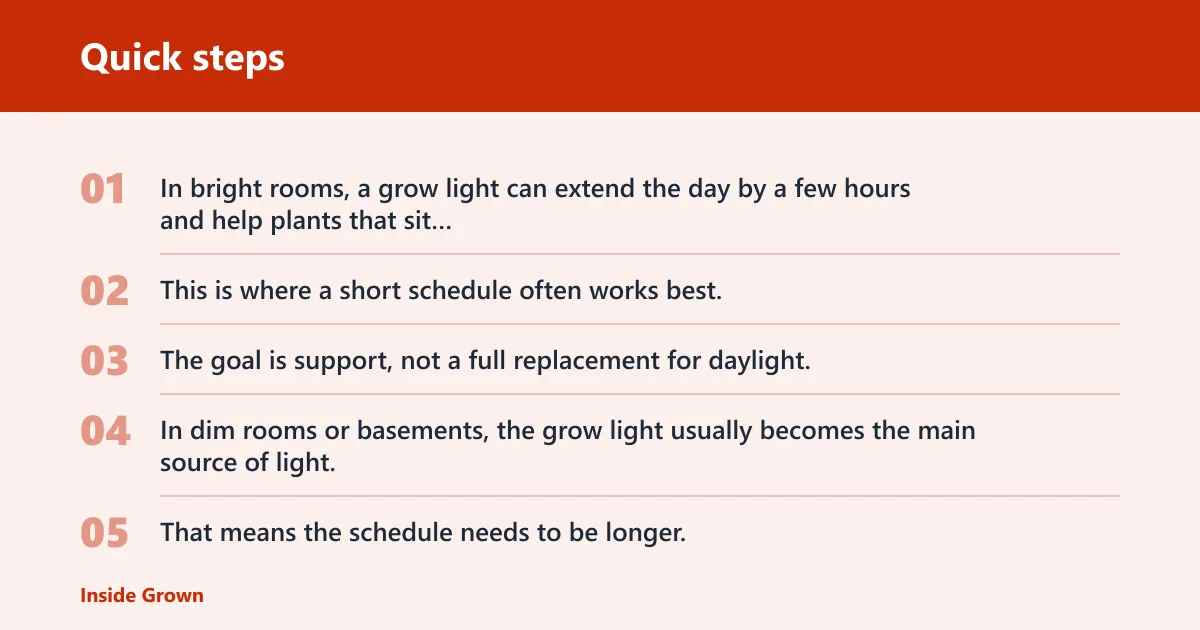
In bright rooms, a grow light can extend the day by a few hours and help plants that sit away from the window. This is where a short schedule often works best. The goal is support, not a full replacement for daylight.
Primary use in dim rooms
In dim rooms or basements, the grow light usually becomes the main source of light. That means the schedule needs to be longer, and the fixture needs enough output to matter at the canopy. If the plant still stretches, the setup is too weak or too far away.
Signs that the light is not strong enough
Leggy growth is one of the clearest signs of insufficient light. Other clues include pale color, slow new growth, leaves leaning toward the lamp, and long gaps between nodes. If those signs show up, check intensity and distance before adding more hours.
Say your pothos sits three feet from a north-facing window in a living room that feels dim by afternoon. A 10-hour grow-light schedule may be a better starting point than 4 hours because the lamp is supplementing weak daylight, not replacing strong sun. If the stems still stretch, move the fixture closer before extending the photoperiod.
A basil seedling tray under a small LED panel in a windowless laundry room may need about 14 to 16 hours of light. The seeds did not need light to germinate, but once they emerge they need adequate light fast, or they become weak and leggy. In that case, 14 to 16 hours with a strong fixture is more realistic than a short schedule.
LED grow lights, timers, and setup basics
A simple setup is enough for many homes. A timer keeps the schedule consistent, while a suitable LED fixture gives the plant the light it actually needs. Complexity is less important than matching output, distance, and daily hours to the room.
Why white LEDs are often the safer default
White LEDs are often a better general choice than red-only setups because they provide broader light that is easier to use for mixed houseplants. Red and blue light matter, but a balanced white fixture is often more practical for foliage plants, seedlings, and general indoor use.
Why a timer is usually enough
A timer can set additional hours of light and keep the photoperiod steady without much effort. That consistency matters because plants respond to repeated daily exposure, not a random on-and-off pattern. For many setups, a basic timer is enough automation.
Why low-power DIY lights can fall short
Low-power DIY lights may look helpful, but they may not be enough as a primary grow light. One commenter notes that three LEDs are not enough as a primary grow light, and another says the LEDs look like 1 watt each. That kind of setup may work only as a very weak supplement.
Common mistakes that waste light
The most common problems are easy to avoid: leaving lights on too long, placing the fixture too far from the plant, and ignoring the plant’s response. More hours do not fix a weak fixture, and stronger light does not help if the plant is already stressed by heat or poor placement.
Leaving lights on too long
Do grow lights need to stay on all day? No. Houseplants need a dark period too. Keeping the light on constantly can waste electricity and interfere with a normal light-dark cycle. A timer makes it easier to stop at the right hour.
Putting the fixture too far from the plant
If the lamp is too far away, the plant may look as if it is getting light while still receiving too little usable intensity. That leads to stretching and slow growth. Before you add hours, check whether the fixture should be moved closer to the canopy.
Ignoring leggy growth and other warning signs
Leggy stems are a message, not a mystery. They usually mean the plant needs more usable light, whether that means more hours, stronger output, less distance, or a move to a brighter room. Bleached leaves, dry soil, or heat stress point the other way.
Frequently asked questions
How many hours of grow light do houseplants need?
Most houseplants need 12 to 16 hours of grow light daily, but the best number depends on room brightness, plant type, and fixture strength. Low-light foliage plants may do fine with 8 to 12 hours in a brighter room, while dim rooms often need 12 to 16 hours.
How much grow light do indoor plants need?
Indoor plants need enough light at the leaves to support steady growth, not just a lamp that is switched on for a long time. Use shorter schedules in bright rooms and longer schedules in dim rooms. If the plant becomes leggy, the light is too weak or too far away.
How many hours of grow light do plants need?
There is no single number for all plants. Seedlings after emergence often need a strong daily schedule, foliage plants usually need less than flowering plants, and low-light rooms need more hours than bright rooms. Start with the table, then adjust based on growth and leaf color.
How long should grow lights be on for indoor plants?
For many indoor plants, a practical starting point is 8 to 12 hours in average rooms and 12 to 16 hours in dim rooms. Bright rooms can use fewer supplemental hours. Always leave a dark period, and use a timer so the schedule stays steady.
Do seedlings need light right away?
Seedlings do not need light to germinate, but they need adequate light as soon as they emerge. Without enough light after sprouting, they can become weak and leggy. A bright, consistent photoperiod helps seedlings stay compact and grow stronger stems.
Can a simple timer be enough for houseplant grow lights?
Yes. For many houseplant setups, a simple timer is enough to keep the photoperiod consistent. It does not fix weak light output, but it does remove guesswork. Set the hours you want, then judge the plant’s response over the next few weeks.