Why Are My Houseplant Leaves Turning Brown in Winter?
Brown houseplant leaves in winter usually point to one of three causes: dry air or salt buildup that crisps the tips, overwatering that leaves tissue soft and brown, or cold damage from drafts or glass. Miss the pattern, and you can keep worsening root stress, leaf drop, and dieback. This guide helps you diagnose the browning by symptom first, then adjust water, light, and humidity in the right order.
Brown leaves are a symptom, not a diagnosis


Brown leaves are a symptom, not a diagnosis. Start with where the damage shows up, how it feels, and whether the soil is wet or dry, because those details point to very different fixes. A brown tip on a dracaena needs a different response than soft brown patches on leaves sitting in soggy mix.
Dry damage versus soft damage
Dry, crispy brown tissue usually points to underwatering, low humidity, salt buildup, or sun scorch. Soft, mushy, or water-soaked browning more often points to overwatering and root stress. Keep that split in mind before you change care, because the wrong correction can make the problem worse.
Older leaves versus new growth
If only the oldest lower leaves are browning and new growth looks sound, the plant may be shedding aging foliage normally. If the newest leaves are also damaged, the cause is active and still affecting the plant. That difference matters more in winter, when slower growth can hide a problem until the damage spreads.
Brown leaf triage table
Use this table to sort the pattern before you water, move, or feed the plant. Start with the symptom location and texture, then match it to the soil and room conditions nearby.
| Symptom location | Texture | Soil condition | Room condition | Most likely cause | What to test | Confirmatory check | What to change first |
|---|---|---|---|---|---|---|---|
| Leaf tips and margins | Dry, crisp, brittle | Dry several inches down | Warm, dry indoor air; plant may sit near a heater or in a low-humidity room | Low humidity or underwatering; salt buildup can also contribute | Finger test in the pot; check room humidity with a hygrometer | Brown tissue is crisp rather than soft, and the pot dries quickly between waterings | Water thoroughly if the mix is dry; raise humidity with a humidifier or plant grouping |
| Lower leaves or whole leaf sections | Yellowing before browning, then limp or soft | Wet or soggy and stays that way | Cool room, poor drainage, saucer holding water | Overwatering and reduced root oxygen | Check drainage holes and whether water remains in the saucer | Pot feels heavy for days, and roots may smell sour or look brown instead of white | Empty standing water and let the mix dry before the next watering |
| One side of the plant | Brown, yellow, or bleached on the exposed side | Can be either wet or dry | Near a drafty window, exterior door, vent, or air-conditioning stream | Cold draft or hot, dry airflow from the room system | See whether the damage faces the same direction as the window or vent | Only the exposed side is injured, while protected leaves stay healthier | Move the plant away from the exposure source |
| Leaves closest to bright glass | Bleached, browned, or crispy patches | Usually normal or slightly dry | Bright winter sun through glass | Sun scorch near the window | Note whether the plant gets direct sun during the short winter day | Damage appears on the glass-facing side and is worst after bright, cold days | Pull it back from the glass or filter the light |
| Older lower leaves first | Gradual browning, then drop | May be normal or slightly off | Plant otherwise looks stable | Natural aging or low light | Check whether new growth remains healthy | Only older foliage is affected and new leaves stay smaller but intact | Remove only fully brown leaves and review light levels |
| Leaf tips on sensitive species | Brown, crispy tips with a sometimes yellow edge | Can be evenly moist or slightly dry | Tap water with hard or treated chemistry | Tap-water mineral load, chlorine, or fluoride sensitivity | Check whether the plant is a known sensitive type; compare with filtered or rainwater use | Other care is correct, but tips keep browning after repeated tap watering | Switch to filtered, distilled, or rainwater for a few waterings |
| New growth or older leaves after feeding | Leaf-edge burn, tip burn, or patchy browning | White crust on soil, pot rim, or drainage holes; mix may be dry | Recent fertilizer use in low-light winter conditions | Fertilizer excess or salt buildup | Check whether feeding happened recently and whether crust is visible at the soil surface | Symptoms follow feeding, and watering does not improve them quickly | Pause feeding and flush the pot if the mix is not staying waterlogged |
| Entire plant with pale growth and brown margins | Slow decline, weak color, browned tips or edges | Often light on nutrients, but not necessarily dry | Cool, low-light winter window | Nutrient deficiency slowed by winter uptake | Review fertilizing history and whether the plant has been unfed for months | New growth is smaller, paler, and slower rather than scorched | Resume light feeding only after growth restarts in stronger light |
Is low humidity causing the brown tips?
Yes, low indoor humidity is a common winter cause of crisp brown tips, especially on tropical houseplants. University extension guidance commonly places comfortable indoor humidity for people around 30% to 50%, but many tropical houseplants still show tip burn, edge crisping, or faster moisture loss when indoor air is persistently dry. If the tips are dry and the rest of the leaf is still fairly firm, dry air is a strong suspect (University of Minnesota Extension; North Carolina State Extension).
Why winter air dries indoor plants
Heating systems lower indoor humidity, and that dry air pulls moisture from leaf edges and tips first. That is why spider plant, dracaena, and peace lily are often reported to show tip burn before broader decline. Some species are also sensitive to tap-water minerals, so the same brown tip can have more than one contributor. For more detail, see how low humidity affects houseplants in winter and tap water issues in indoor plants.
How to confirm it with a hygrometer
A hygrometer is the best basic check. If the room reads very dry and the plant has crisp tips without soggy soil, humidity belongs on the list. If dryness is the main issue, a water-filled tray with stones beneath the pot may help, and grouping plants together can make the air around them less harsh.
Picture a peace lily on a windowsill above a radiator. If the tips brown first while the soil dries fast and the room feels dry, the likely issue is a mix of low humidity and underwatering, not disease.
Could drafts or heater air be the problem?
Yes. Drafty windows, doors, vents, and air-conditioning can stress houseplants, and cold drafts can make indoor tropical plants yellow, especially near windows or air-conditioner vents. University and botanical guidance note that sudden cold exposure and chilling injury can cause localized browning, water-soaked patches, or collapse on leaves and stems, especially where foliage touches cold glass or sits in a draft corridor (University of Florida IFAS Extension; Missouri Botanical Garden). If the damage is strongest on one side, that is a major clue that room exposure is the issue rather than the potting mix.
One-sided browning as a clue
If a plant turns brown on the side facing a window or vent, nearby windows or vents may be affecting only that side. Houseplants do not like sudden temperature changes, so a cold leak near a door or a hot, dry blast from a register can leave a very uneven pattern. That pattern is more useful than the color alone.
What to move first
Move the plant away from the draft source before changing fertilizer, repotting, or pruning heavily. Then watch the newest leaves. Existing brown tissue will not turn green again, but new growth should come in cleaner if the stress source is removed.
Say your 8-inch spider plant sits 6 inches from a winter window. Only the window-facing leaves brown and bleach while the far side stays greener. Moving the pot a few feet back is a better first step than watering more.
Check watering before anything else
Use soil moisture as the first check before changing care. Overwatering keeps soil wet too long, reduces root oxygen, and can lead to yellowing plus brown damage. University extension sources consistently describe oxygen stress as a root-level problem: when the pore spaces in the mix stay filled with water, roots cannot respire normally and decline follows (University of Wisconsin-Madison Extension; Penn State Extension). Underwatering leaves soil dry several inches down and often causes crispy margins, tips, drooping, or leaf drop. The texture of the soil tells you which direction to go.
Signs of overwatering
The soil test for overwatering is whether it feels wet or soggy and stays that way. The plant may look dull, yellow, or limp, and brown tissue often appears alongside yellowing rather than alone. Check drainage holes, and empty any water sitting in the saucer so the roots are not standing in it.
Signs of underwatering
A common fix for underwatering is to let the top couple inches of soil dry before watering again, but that only applies when the mix is already dry and the plant is not one of the more moisture-loving types. If the pot is bone dry several inches down, water thoroughly, then let excess drain away.
A common first-timer mistake is to see brown tips and water more often without checking the pot. If the mix is already wet, that move can push the roots toward rot instead of recovery.
What winter light changes can do
Winter light is weaker and shorter, so insufficient light can contribute to yellowing and decline. Brown crispy or bleached leaves can also signal too much sun if the plant sits against bright winter glass. Light problems often show up in combination with watering mistakes, which is why the soil check comes first.
Low light and slower growth
When light drops, the plant uses water more slowly. If you keep the summer watering pattern, the mix may stay wet longer than the roots can handle. That is one reason winter decline can look like a watering issue even when the real change started with light.
Window scorch near bright glass
If leaves closest to a sunny window brown, bleach, or crisp while the rest of the plant looks fine, too much sun may be the cause. A plant that tolerated a summer window can still scorch in winter if the angle changes or the glass delivers brighter direct light for longer periods.
Grow lights may help in dark homes, especially when a plant is dropping lower leaves from weak light and no other stress pattern fits. Use them as a response to low light, not as a fix for wet soil or draft damage. For a deeper winter-light approach, see how to manage winter light for houseplants.
Is it a nutrient deficiency or fertilizer excess in winter?
Winter browning can come from either too little nutrition or too much fertilizer, and the symptom pattern matters. A true deficiency usually shows gradual, overall weakness: smaller leaves, slower growth, paler color, and then browning on older leaves or edges as the plant runs short on mobile nutrients. Fertilizer excess or salt buildup tends to show sharper tip burn, edge scorch, crusty residue on the soil, and worsening symptoms after feeding rather than after long neglect. In winter, many houseplants need less fertilizer because growth slows, so regular feeding can backfire.
How deficiency looks
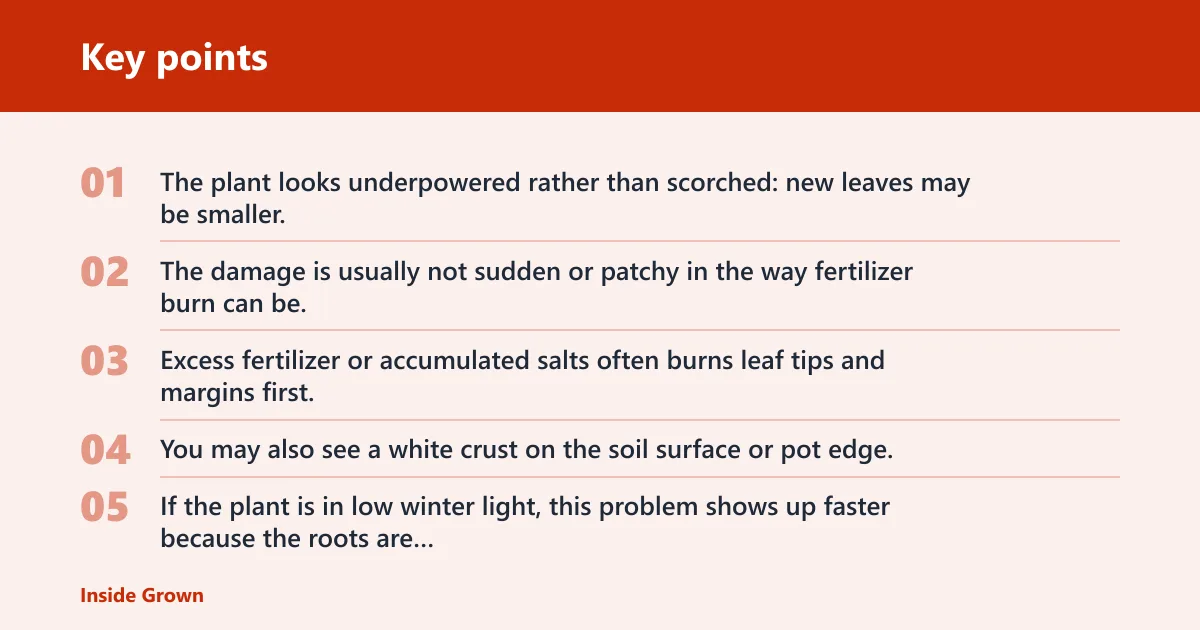
Deficiency usually develops slowly. The plant looks underpowered rather than scorched: new leaves may be smaller, older leaves may pale first, and browning often follows a long period of low light or missed feeding. The damage is usually not sudden or patchy in the way fertilizer burn can be.
How fertilizer excess or salt buildup looks
Excess fertilizer or accumulated salts often burns leaf tips and margins first. You may also see a white crust on the soil surface or pot edge, especially after repeated feeding. If the plant is in low winter light, this problem shows up faster because the roots are taking up less water and the mix is staying wetter or saltier longer.
When feeding should pause
Pause feeding when the plant is dormant or barely growing, when soil stays wet for long periods, or when leaf tips are already burning. Resume only when new growth restarts and the plant is clearly active again. If the plant shows salt buildup, stop fertilizer and flush the pot with plain water only if drainage is good and the mix is not already waterlogged.
How to tell salt buildup from true deficiency
Salt buildup usually causes burnt tips or edges first, and the symptoms may worsen soon after feeding. True deficiency tends to affect overall vigor more than leaf tips alone. If the plant has crust on the pot rim, recent fertilizer use, and crisp tip burn, excess is more likely than deficiency. If it has pale, slow, small new growth after months without feeding, deficiency becomes more plausible.
If you want a related step-by-step, see how to fix overwatered houseplants and why houseplant leaves get crispy tips.
Brown leaves FAQ
What should I check first when houseplant leaves turn brown?
Check the soil first, because wet versus dry points you toward opposite fixes. Then look at where the browning starts, whether the tissue is crisp or soft, and whether the damage is on one side, on older leaves, or near the window. That sequence prevents random changes.
Can tap water cause brown tips on houseplants?
Yes. Some houseplants develop brown tips from excessive calcium or magnesium, and chlorine or fluoride can also bother sensitive species. Dracaena, spider plant, and peace lily are common examples, and botanical and extension sources commonly note these species as sensitive to fluoride or dissolved salts in irrigation water (Missouri Botanical Garden; Clemson Extension; University of Florida IFAS Extension). If the soil and room conditions do not fit another cause, filtered, distilled, or rainwater may help.
How do I tell if brown leaves are from overwatering or underwatering?
Overwatering usually means wet or soggy soil that stays that way, often with yellowing and soft decline. Underwatering usually means dry soil several inches down, with crispy tips or margins, drooping, and leaf drop. The texture matters: soggy points one way, brittle points the other.
Should I water houseplants less in winter?
Often yes, but only because winter light and growth slow down, not because every plant needs a fixed schedule change. Check the soil instead of watering on autopilot. If the top couple inches are dry, water; if the mix is still wet, wait and let the roots recover.
Why are only the older leaves turning brown?
If only older lower leaves are browning and the new growth stays healthy, natural aging is a likely explanation. That pattern is different from active stress, which usually spreads to newer growth or shows up in a stronger pattern such as crispy tips, wet-soil damage, or one-sided browning.
Why do houseplant leaves turn brown?
In winter, the main reasons are dry air, overwatering, underwatering, cold drafts, weak light, sun scorch, and tap-water sensitivity. Brown leaves are the result, not the diagnosis. Start with soil moisture, then look at the shape and location of the damage before changing anything else.
Why house plants leaves turn brown
House plants turn brown for different reasons depending on the pattern. Crispy tips suggest dry air or salt buildup, soft browning suggests wet roots, and one-sided damage points to drafts or glass. If only older leaves are affected and new growth looks normal, the plant may simply be aging foliage.