Signs Your Houseplant Needs More Light in Winter
Your houseplant likely needs more winter light if it leans toward the window, makes smaller pale leaves, and the soil stays wet far longer than usual. Ignore that pattern and you often get leggy growth, leaf drop, and root rot from repeated overwatering. This guide shows how to tell low light from cold stress and overwatering, then fix each symptom pattern.
Why winter light changes matter
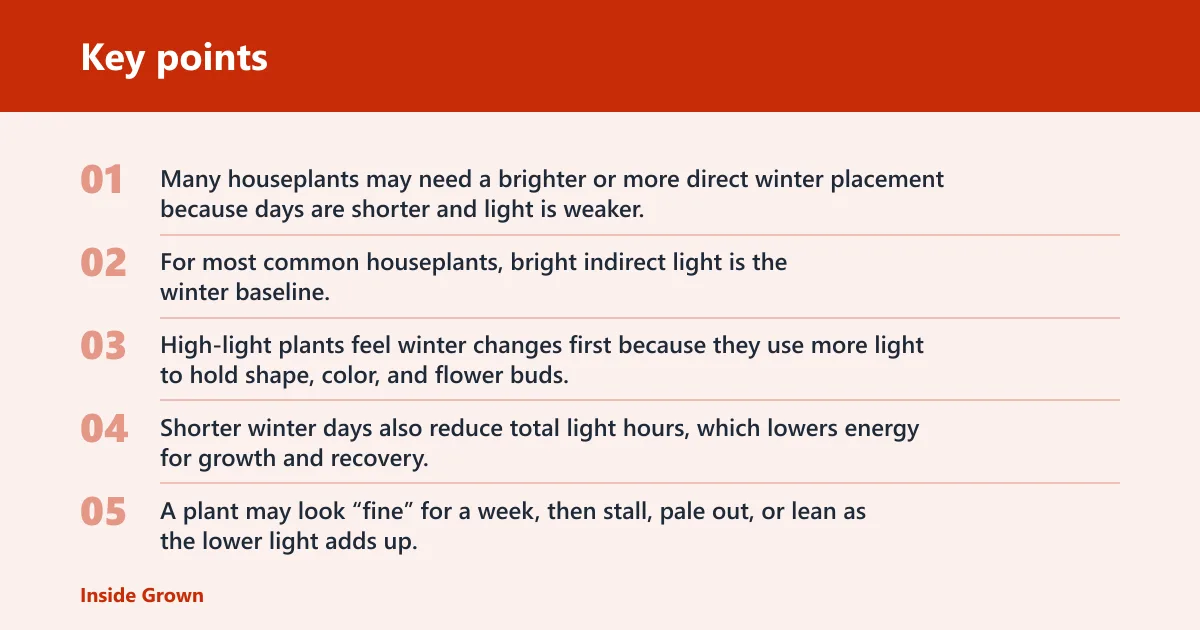


Many houseplants may need a brighter or more direct winter placement because days are shorter and light is weaker. The same spot that works in summer can turn poor once the sun sits lower, the day length drops, and nearby trees, eaves, or curtains cut usable light further.
For most common houseplants, bright indirect light is the winter baseline. That usually means a bright room with steady daylight, often near a south- or west-facing window, but with the plant set close to the glass and kept out of direct leaf-to-glass contact.
Which plants feel the drop first?
High-light plants feel winter changes first because they use more light to hold shape, color, and flower buds. Succulents, flowering plants, and sun-lovers often show the problem before medium-light tropicals do, especially in north- or east-facing rooms.
Shorter winter days also reduce total light hours, which lowers energy for growth and recovery. A plant may look “fine” for a week, then stall, pale out, or lean as the lower light adds up.
What low light looks like
Low light usually shows up as a pattern, not a single symptom. The clearest signs are stretching toward the window, thinner new growth, and slower recovery after watering. The plant is trying to reach better light, but it cannot build normal, compact growth where it sits.
Leaf stretching and leaning
Stretching, or etiolation, is often a reliable sign of low light. Stems lengthen between leaves, the plant leans toward the brightest side, and fresh growth can look spaced out instead of full.
That leaning matters because it often means the plant is not getting enough light from above or from the room side. If the pot stays in the same spot, the bend gets stronger over time.
Smaller, thinner new growth
Low light often leads to new leaves that are smaller, thinner, or paler than older growth. This is especially common on vines, tropical foliage plants, and anything that has moved from a brighter summer spot to a dimmer winter corner.
Those changes can be reversed if you catch them early. New growth may improve within a few weeks after a better placement, while older stretched stems usually stay stretched.
Slower recovery after watering
In low light, a plant uses water more slowly. If the pot stays wet long after a normal watering, that is often a sign the plant is not actively growing enough to drink it up.
That slowdown is one reason winter overwatering is common. The issue starts with low light, then gets worse when the same watering rhythm continues into shorter, dimmer days.
Could it be something else?
Yes. Winter plant decline is often a mix of light, temperature, and watering, and the fix depends on which symptom pattern you see first. Brown spots near a cold pane are not the same as stretched stems, and soggy soil is not the same as a light problem.
Cold window glass damage
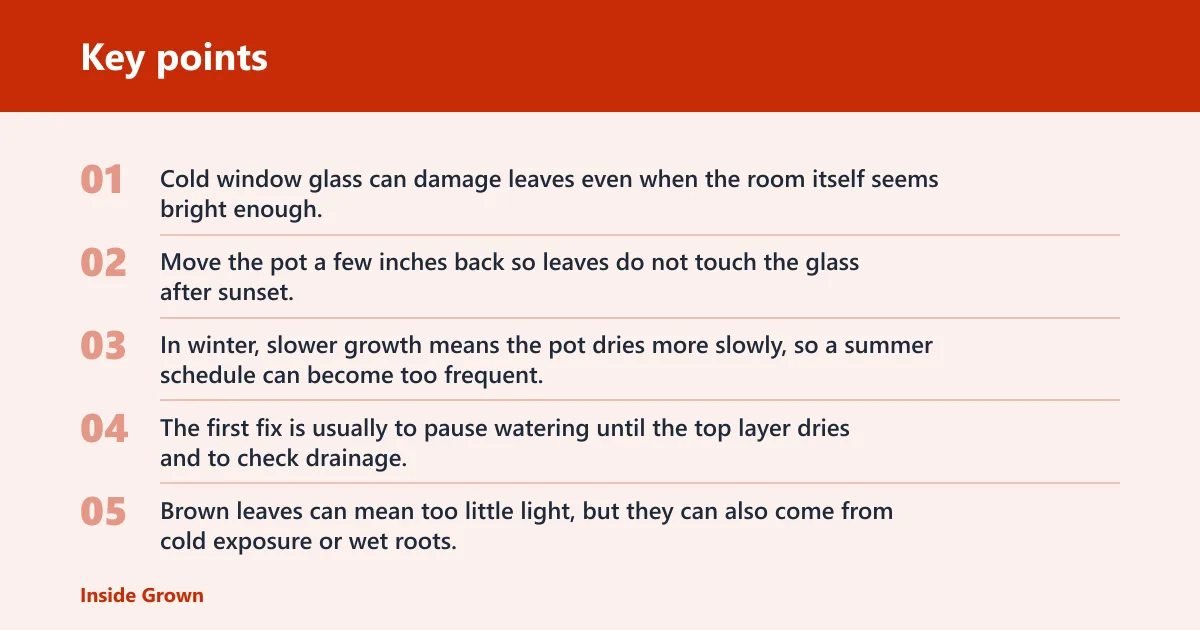
Cold window glass can damage leaves even when the room itself seems bright enough. Sensitive foliage may show dark, water-soaked, crisp, or bleached patches on the side that touched the glass, especially at night when the pane is coldest.
If the damaged side faces the window and the rest of the plant looks normal, cold contact is a stronger clue than low light. Move the pot a few inches back so leaves do not touch the glass after sunset.
Overwatering in winter
Overwatering often looks like limp leaves, yellowing, persistent wet soil, and a plant that seems to decline even though the room is bright. In winter, slower growth means the pot dries more slowly, so a summer schedule can become too frequent.
If the soil is still damp several days after watering, light may be part of the problem, but watering is also part of it. The first fix is usually to pause watering until the top layer dries and to check drainage.
When brown leaves are not a light problem
Brown leaves can mean too little light, but they can also come from cold exposure or wet roots. A leaf that browns after touching cold glass points to temperature stress. A leaf that yellows, softens, and drops after long wet periods points more toward overwatering.
Look at the whole plant, not just the color. Location, soil moisture, and which side shows damage matter more than the fact that the leaf is brown.
Winter light diagnosis checklist
This checklist helps you separate low light from cold-glass damage and overwatering. Use the symptom pattern, the window exposure, and the first fix together instead of treating every winter problem as the same issue.
| Symptom | Likely cause | First fix to try |
|---|---|---|
| Plant leans toward the window, stems stretch, new leaves are smaller | Low light | Move it closer to the brightest safe window and rotate the pot after watering |
| Leaves touching the glass show dark or crispy patches on the window side | Cold glass | Pull the plant back so no foliage touches the pane at night |
| Soil stays wet for a long time, lower leaves yellow, roots may smell off | Overwatering | Let the mix dry farther between waterings and check drainage holes |
| Plant looks dull, but leaves and stems stay compact | Dusty leaves or dirty window reducing usable light | Clean the leaves and window before changing placement |
| New growth is pale and thin, older growth is normal | Low light | Increase exposure or add a grow light if the window is already the brightest option |
Check the growth pattern. Look for leaning, stretching, or smaller new leaves first. Those are the strongest clues that the plant needs more light, especially if the change started after the season shifted.
Inspect the glass and leaves. Check whether any foliage touches a cold pane at night. If the damage is only on the side near the window, cold contact may be part of the problem even when the room is bright.
Feel the soil before watering. If the mix stays damp much longer than it did in warmer months, reduce watering and check drainage. Slow drying often points to reduced winter growth, which can make overwatering worse.
Clean the light path. Wipe dusty leaves and dirty windows with a soft damp cloth. Dust blocks usable light, and this low-cost fix can help before you move the plant or add a lamp.
Rotate the pot periodically. Turn the plant after watering so one side does not keep reaching for the window. This helps even out growth and reduces one-sided leaning.
Say your pothos sits two feet from a north window and starts making longer stems with smaller leaves in January. That pattern points to low light first, not cold damage. Moving it closer to the brightest part of the room may solve it without adding a lamp.
Suppose a peace lily sits near a bright east window, but the leaves nearest the glass turn brown where they touch the pane. That is more consistent with cold-window damage than with low light, so the better fix is to move it back a few inches rather than increase watering.
Where should you move it?
Window direction matters more in winter than a vague “near a window” rule. South- and west-facing windows usually give the strongest winter exposure, while north- and east-facing windows often need closer placement or supplemental light for high-light plants.
North and east windows
North windows usually give the least winter light, and east windows offer gentler morning sun that fades fast. For many medium-light tropicals, a spot very close to the glass may be enough. For sun-lovers, these windows often need a grow light.
If the room is dim, placing the plant on the brightest sill or right beside the glass can help, as long as leaves do not touch the cold pane.
South and west windows
South- and west-facing windows usually provide the best natural winter light. They are the first places to try for plants that need more brightness, especially if the room is otherwise dim.
Keep the plant close to the glass, but not touching it. That gives the strongest available winter exposure while limiting cold damage at night.
Placement for sun-loving plants
Sun-loving plants, many succulents, and flowering plants are the most likely to need the brightest window in winter. If they are still stretching in a south- or west-facing window, the room probably needs supplemental light.
For those plants, bright indirect light alone may not be enough once winter days shorten. A brighter window plus a grow light is often the better fit than moving the plant to a slightly less cold but dimmer spot.
Move closer or add grow light?
Use a window move first if the plant is only slightly stretched and the room already has decent daylight. Use a grow light when the brightest window still leaves the plant leaning, pale, or stalled. That decision keeps you from overcorrecting with too much shade or too much water.
Signs a window move is enough
If the plant is in a north or east room but still gets a clear shaft of daylight, moving it within the room may be enough. A few feet closer to the glass can matter when winter light is weak but not absent.
This is most useful for medium-light houseplants that are only slightly leggy and still making new leaves.
When a grow light makes more sense
If the plant already sits in the brightest safe window and still stretches, a grow light is the next step. That is common for high-light plants, flowering plants, and succulents in dark rooms or shaded apartments.
Grow lights also help when the room has no south or west exposure, or when trees, overhangs, or heavy curtains cut the day short.
What to look for in a clip-on full-spectrum light
Choose a clip-on format if you need the light close to the plant and easy to reposition. Full-spectrum output is useful because it gives a more balanced light source than a narrow, color-tinted bulb, and timer support helps keep the schedule consistent.
Run the light on a regular daily cycle and place it close enough to matter, but not so close that leaves heat up or bleach. The goal is steady supplemental light, not a hot spotlight.
Start with the brightest window. Move the plant to a south- or west-facing window if available. If those are not available, use the brightest east window and keep the plant as close to the glass as cold safety allows.
Watch the new growth. Give the plant a few weeks to respond. If new leaves stay smaller and thinner, or the stem keeps reaching, the placement is still too dim for that plant.
Add supplemental light. Use a clip-on full-spectrum grow light with a timer when the window move does not stop stretching. This is the clearest fix when winter daylight is plainly too weak for the plant’s type.
Pot rotation helps too, but it is a support step, not a substitute for enough light. Rotate after watering, then keep an eye on whether the plant still leans in one direction. If it does, the issue is likely exposure, not just position.
Frequently asked questions
How do I know if my houseplant needs more light in winter?
Look for a pattern of stretching, leaning, smaller new leaves, and slower recovery after watering. If the plant also sits farther from a south- or west-facing window, the odds rise that winter light is the issue. Dusty leaves and dirty glass can make the problem look worse.
Why is my plant suddenly stretching toward the window in winter?
That is a classic low-light response called etiolation. Winter brings shorter days and weaker light, so the plant reaches toward the brightest source and makes longer stems with smaller leaves. If the stretching starts after a move to a dimmer room, placement is the first thing to change.
Do houseplants need grow lights in winter?
Not all of them. Many common houseplants do fine with bright indirect light near a good window, but high-light plants, succulents, and flowering plants often need supplemental light when winter sun is weak. A grow light makes sense when the best window still leaves the plant stretched or pale.
How far can houseplants be from a winter window?
There is no single distance that fits every plant, but winter light drops off fast as you move away from the glass. Medium-light plants may handle a few feet from a bright window, while high-light plants usually do better close to the pane, with no leaf contact. North rooms need the shortest distance.
Can winter brown leaves mean too little light?
Sometimes, but not always. Brown leaves can also come from cold glass contact or watering problems. If browning appears only where leaves touch a cold window, suspect temperature damage. If leaves yellow and the soil stays wet, overwatering is the better match.
Which houseplants need the most winter light?
Succulents, many flowering plants, and other sun-loving houseplants need the strongest winter exposure. They do best in bright indirect light or in a south- or west-facing window close to the glass. If they still stretch there, add a full-spectrum grow light rather than moving them to a dimmer spot.